10 Words Describing Work Ethic for Job Applications
Explore 10 words describing work ethic, with résumé, cover letter, interview, and ATS-friendly phrasing examples for stronger applications.
Words such as diligent, proactive, and adaptable can strengthen a job application, but only when they accurately describe how you work. On their own, they're labels. A recruiter learns more from the action behind the label, such as how you checked a complex report, handled changing priorities, or followed through on a difficult project.
Use the adjective as a concise summary, then prove it in the format where it appears. On a résumé, connect it to a specific bullet and a concrete accomplishment. In a cover letter, add a short example that explains why the trait matters to the employer. In an interview, use a STAR-style response that shows the situation, task, action, and result. ATS-friendly wording should mirror relevant language from the target job description, but it shouldn't rely on keyword stuffing or exaggeration.
That distinction matters because work ethic is treated as a measurable workplace construct, connected with behaviors such as conscientiousness, integrity, reliability, and initiative, rather than as an empty personality claim. Employability-skills research indexed by ERIC supports treating work ethic as something that can be assessed through observable behavior.
GetTheCall can import a LinkedIn profile or résumé, analyze a job listing, and help align your truthful experience with role-specific keywords. The tool can support the editing process, but your evidence still has to come from work you did.
Table of Contents
- 1. Diligent
- 2. Persistent
- 3. Meticulous
- 4. Proactive
- 5. Adaptable
- 6. Strategic
- 7. Thorough
- 8. Resourceful
- 9. Dedicated
- 10. Authentic
- 10-Point Comparison of Work Ethic Traits
- Choose the Word Your Evidence Can Support
1. Diligent
Diligent signals steady care, especially when accuracy matters. It suits research, documentation, compliance, finance, operations, and administration, where a small omission can create a larger problem. Collins defines diligent as “persevering and careful in work; industrious,” placing it near conscientious, painstaking, persistent, and assiduous. The comparison is useful: persistent emphasizes continuing through obstacles, while diligent emphasizes the quality and consistency of the work.
Use the word as a label, then attach evidence to it. Instead of “I'm diligent and hardworking,” write: “Reviewed client documentation for completeness, resolved missing information, and maintained accurate records across recurring submissions.” The actions show the trait more clearly than the adjective, while giving an ATS and a recruiter relevant terms to recognize.
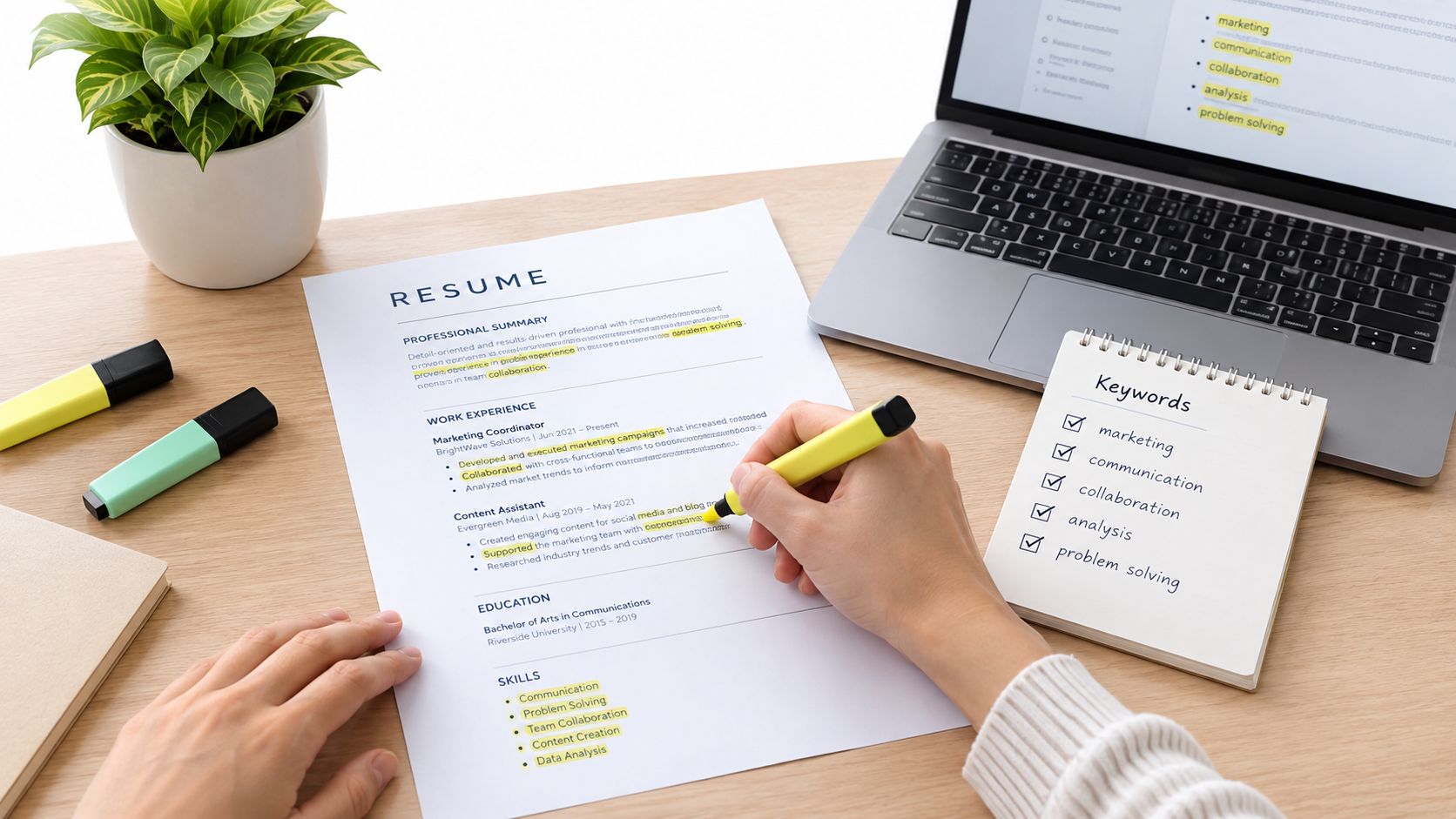
A diligent application also begins with the target listing. Mark its required skills, responsibilities, and terminology, then revise your résumé so those ideas appear naturally where your experience supports them. Career switchers can use this process to connect transferable work to a new field without stretching the truth. This guide to tailoring a résumé to a job description offers a structured checklist for reviewing each bullet, keyword, and accomplishment.
Practical rule: Let careful review, follow-through, and accurate documentation prove diligent.
In a cover letter, connect that evidence to the employer's need. In an interview, describe the checking process, the issue you found, and what happened afterward. Those details turn a positive impression into something an employer can evaluate.
2. Persistent
Persistent suggests that you continue working toward a goal when progress is slow or obstacles appear. It fits job applications, sales, research, customer support, project delivery, and other contexts where follow-up and sustained effort matter. The word is stronger when you explain what you kept doing and what changed because of that effort.
On a résumé, persistence can appear through a bullet about resolving a recurring issue, completing a long-running initiative, or maintaining a process through changing conditions. For example: “Followed recurring customer issues through investigation, escalation, and resolution, documenting patterns for the support team.” That sentence demonstrates persistence without claiming it directly.
In a cover letter, you can connect the trait to the employer's needs: “I'm comfortable staying with complex problems until the cause is clear and the next action is documented.” In an interview, choose a story where an initial approach didn't work. Explain how you gathered feedback, adjusted your method, and continued responsibly rather than repeating the same action.
Persistence also applies to the job search itself. A generic résumé makes repeated applications harder to improve because you don't know which message fits which role. Tailoring each submission, tracking feedback, and refining your evidence creates a more useful learning loop.
Show endurance without sounding stubborn
Persistence isn't the same as refusing to change. A persistent employee keeps the objective in view while adapting the route. Use verbs such as followed through, resolved, revisited, refined, or continued only when they describe your actual behavior.
- On a résumé: Pair persistence with a problem, process, or deliverable.
- In a cover letter: Explain why the goal mattered and how you stayed engaged.
- In an interview: Include the adjustment you made after receiving new information.
A strong example makes persistence visible through a sequence of actions, not through a stack of positive adjectives.

3. Meticulous
Meticulous signals precision, consistency, and high standards. It suits financial analysis, quality assurance, editing, engineering, laboratory work, and data management, where accuracy must be demonstrated. The word is narrower than diligent. Diligence describes steady care and effort; meticulousness focuses on checking each relevant detail.
Turn the adjective into evidence through verbs such as auditing, reconciling, validating, testing, proofreading, and documenting. “Meticulously managed reports” leaves the work unclear. “Validated report inputs, reconciled discrepancies, and documented corrections before distribution” shows what you inspected and how you handled errors.
Your application materials should demonstrate the same care. Check dates, job titles, formatting, grammar, and keyword placement against the target description. Use relevant terms naturally, rather than copying every skill from the posting. A clean, single-column résumé with standard section labels is generally easier for ATS software to parse than a design using tables, text boxes, graphics, or multiple columns. This résumé tailoring guide explains how role-specific wording and careful editing support each other.
Meticulous doesn't mean slow
Accuracy matters, but employers also need timely work. In an interview, show how you prioritize high-risk details, follow a review process, and meet deadlines. For a cover letter, connect meticulousness to a responsibility where errors would create rework, confusion, or risk.
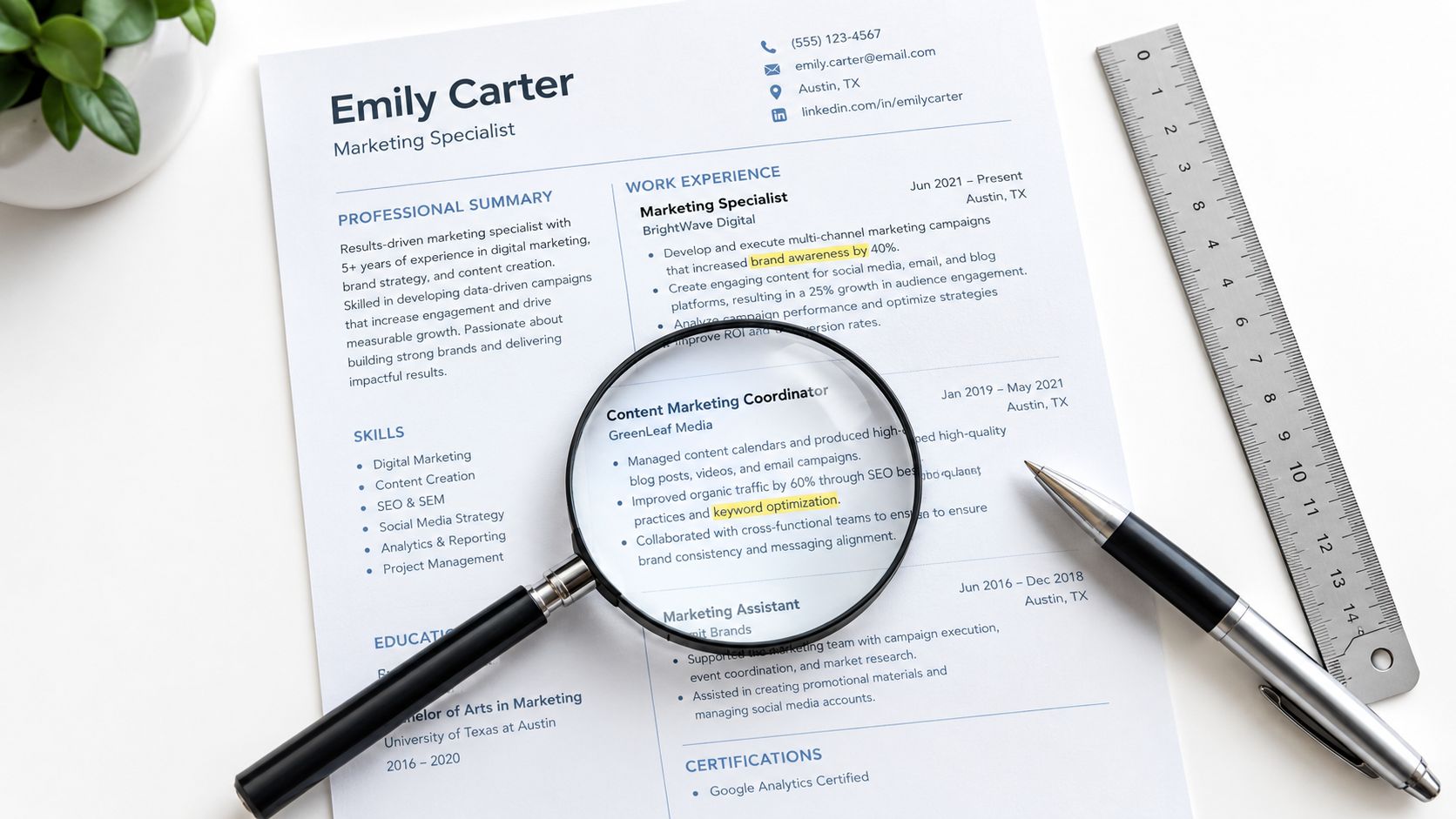
Use this short editing checklist:
- Dates and titles: Confirm that your career history is accurate.
- Evidence: Make sure each accomplishment reflects your direct contribution.
- Keywords: Use relevant terms from the job description in a natural context.
- Consistency: Keep punctuation, spacing, tense, and formatting uniform.
- Parsing: Review the final file as selectable text, not as an image.
4. Proactive
Proactive suggests initiative, anticipation, and action without waiting for instructions. It works best for sales, account management, operations, leadership, customer success, and roles where people are expected to spot needs before they become urgent. The word can sound empty if you don't name the issue you noticed or the action you took.
Compare these two statements:
- “Proactive team member who takes initiative.”
- “Reviewed recurring customer questions, created a shared response guide, and proposed updates to the onboarding workflow.”
The second statement supplies the evidence. It shows observation, ownership, and action. If you have an outcome, include the result. If you don't have a defensible measurement, describe the practical change without inventing a figure.
Proactivity can also shape your application strategy. Research the employer, study the listing, and identify which capabilities the role emphasizes before you rewrite your résumé. A job-specific ATS résumé checker from GetTheCall can help you review parsing and keyword issues, but it shouldn't replace your judgment about whether the experience is relevant.
Proactive wording answers a simple question: what did you notice, and what did you do before someone had to direct you?
In an interview, describe the trigger for your action. Perhaps you saw a repeated handoff problem, anticipated a customer need, or recognized that a process would fail under heavier demand. Then explain how you secured agreement, tested the idea, and measured or observed the result.
Avoid presenting proactivity as constant independence. Strong initiative includes communication, judgment, and respect for priorities. An employee who starts unapproved work may be active, but not necessarily effective.
5. Adaptable
Adaptable creates an impression of flexibility when circumstances, tools, priorities, or information change. It fits career changers, returning professionals, consultants, project teams, customer-facing roles, and jobs that require learning unfamiliar systems. The word is especially useful when you can show how you adjusted without losing quality or accountability.
A career changer might have experience coordinating schedules, analyzing customer needs, or improving internal processes, even if the previous job used different industry language. On the résumé, translate those activities into the target role's terminology only when the connection is truthful. In a cover letter, explain the bridge directly: “My experience coordinating cross-functional work has prepared me to manage product requirements and stakeholder communication.”
Adapt the emphasis, not the facts
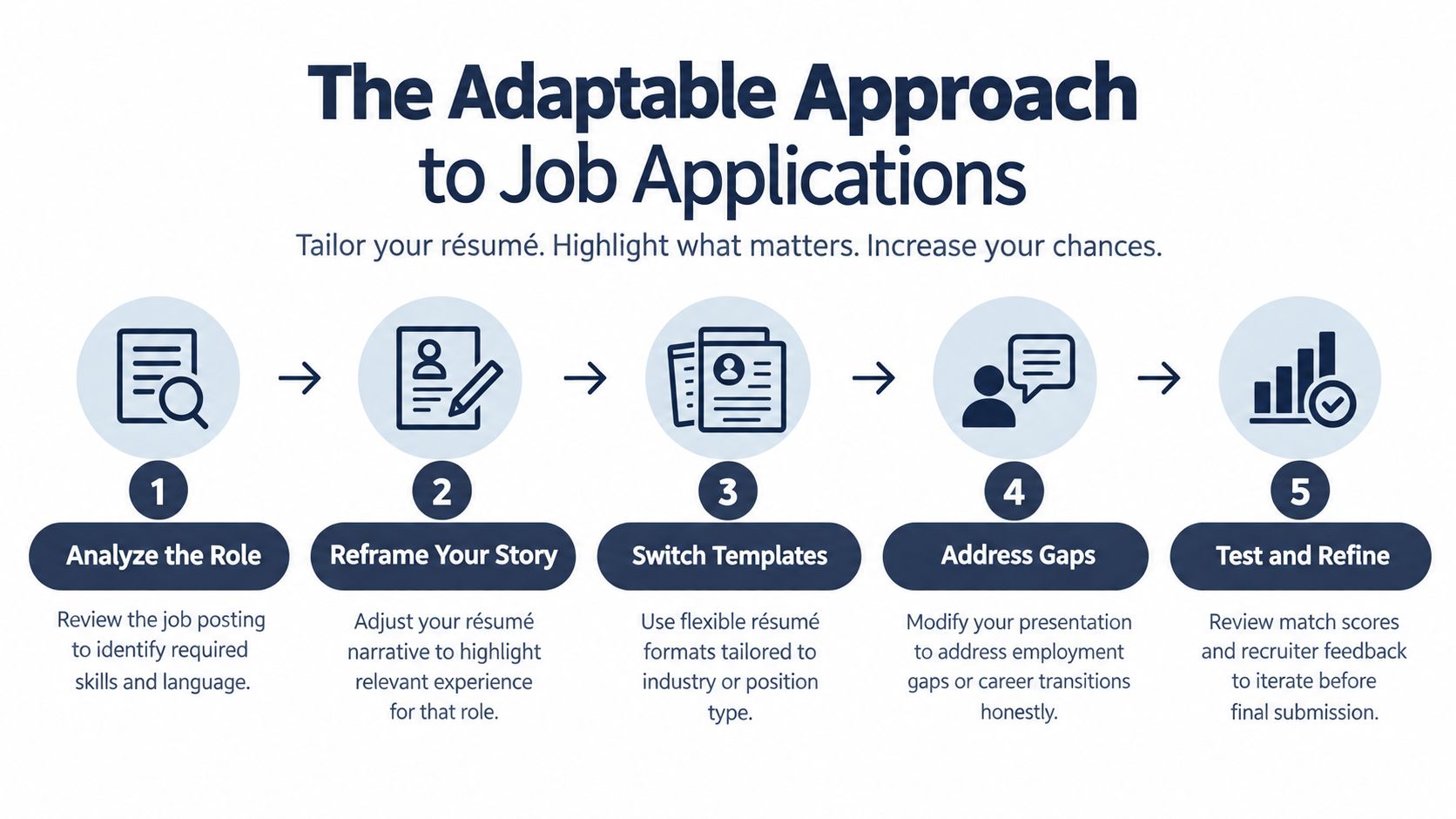
One résumé version might emphasize process improvement for an operations role. Another might emphasize stakeholder communication for a project management role. That isn't inconsistency. It's a clearer presentation of the same background for different audiences.
- Create narrative options: Keep a master record of accomplishments, skills, tools, and projects.
- Reframe responsibly: Change the emphasis, but don't change what happened.
- Learn from feedback: If recruiters repeatedly misunderstand your experience, revise the explanation.
- Show learning: Mention relevant training, projects, or new systems you have used.
- Prepare for change: In interviews, describe a time you revised your approach after priorities shifted.
Adaptability differs from being unfocused. A flexible professional still understands the objective and makes deliberate choices about what to change. The strongest evidence includes the original situation, the adjustment, and how you protected the work's quality or purpose.
6. Strategic
Strategic suggests deliberate planning tied to a larger objective. It's often useful for managers, business professionals, analysts, marketers, engineers, and candidates targeting roles that involve prioritization or long-term thinking. The word loses force when it appears without a goal, decision, or trade-off.
Instead of “Strategic professional with strong business judgment,” write about the work: “Prioritized process improvements around customer impact, coordinated stakeholders, and sequenced implementation around operational constraints.” That version gives the recruiter a behavior to evaluate.
Strategic job seekers also make deliberate choices about applications. They don't send the same document everywhere. They identify the role's central requirements, select the most relevant accomplishments, and decide which evidence deserves space. A match score can help organize that review, but it isn't a substitute for reading the job description or checking the truth of every bullet.
Use strategic in a cover letter when you can connect your experience to the employer's stated direction. In an interview, explain how you chose between competing priorities. What information did you consider? Who needed to be involved? What did you postpone, reject, or sequence differently?
Turn planning into ATS-friendly evidence
ATS software generally parses a résumé, matches extracted information against job-specific terms, and ranks applications for review. An explanation of ATS résumé formatting describes why the wording and structure need to support both machine extraction and human reading.
Use standard headings, place relevant skills in context, and lead with the action you took. Then connect the action to the business or team objective. That progression is more useful than repeating strategic in a summary, skills list, and cover letter.
7. Thorough
Thorough communicates completeness. It tells an employer that you don't stop at the most visible part of an assignment. You review requirements, check dependencies, address gaps, and finish the details that make the work usable.
The term differs slightly from meticulous. Meticulous work focuses on precision and fine detail. Thorough work focuses on coverage and completion. A thorough project coordinator may ensure every stakeholder, dependency, document, and follow-up is accounted for, while a meticulous analyst may focus on validating each figure.
A strong résumé bullet might read: “Coordinated project documentation, tracked open decisions, and confirmed handoffs across participating teams.” It doesn't need to say thorough. The actions demonstrate it. If the job description emphasizes requirements gathering, documentation, quality control, or end-to-end ownership, use the employer's relevant wording where it accurately describes your work.
A complete application addresses the role's real requirements. It doesn't merely repeat the title or the most obvious skill.
Before submitting, compare your résumé with the posting. Include relevant education, certifications, tools, responsibilities, and transferable skills, but don't create qualifications you don't have. This guide to creating an ATS-friendly résumé covers practical formatting choices that make information easier for parsing systems to extract.
A cover letter can provide context for a legitimate gap, career change, or unusual experience pattern. It shouldn't compensate for missing evidence by making broad claims. In an interview, thoroughness appears in how you prepare, answer the full question, and explain what happened after the initial task was complete.
8. Resourceful
Resourceful creates an impression of practical problem-solving under constraints. It fits operations, customer service, project work, technical support, entrepreneurship, and early-career applications where candidates may need to work with limited direction or tools.
Resourcefulness isn't the same as improvising recklessly. It means finding a workable path with the information, people, and systems available. A résumé bullet might say, “Located existing documentation, consulted subject-matter experts, and built a repeatable process for handling an unfamiliar request.” That demonstrates initiative and judgment without claiming a dramatic result.
Students and career switchers can use this term particularly well when they need to show how they learned. A class project, volunteer activity, freelance assignment, or community role may provide evidence if you explain the problem, your contribution, and the outcome truthfully. The experience doesn't have to come from a traditional full-time job.
Make limited resources part of the story
In a cover letter, explain how you handled a constraint. Maybe you found a low-cost way to organize information, learned a tool independently, or connected with someone who could clarify an unfamiliar process. In an interview, describe what you tried first, where you looked for information, and how you decided whether the solution was reliable.
Use free learning materials, employer documentation, professional communities, and feedback from mentors to improve your application. A tool such as GetTheCall can organize résumé and job-listing information, but the strongest resource remains your own record of projects, responsibilities, and results.
Resourceful candidates don't hide gaps. They explain how they addressed them and what they learned.
9. Dedicated
Dedicated suggests committed, focused effort over time. It's appropriate for roles where sustained attention, service, quality, or mission matters. The word can work in a summary or cover letter, but it needs an object. Dedicated to what, and how did that commitment appear in your work?
“Dedicated professional” is too broad. “Dedicated customer support specialist who maintained careful follow-up on unresolved requests and documented recurring issues for team review” is more meaningful because it connects commitment with behavior. Adjust the details to your real experience.
Dedication differs from persistence. Persistence emphasizes continuing through obstacles. Dedication emphasizes the importance you attach to a goal, responsibility, team, or standard. A dedicated employee may consistently invest effort in a role even when there isn't a visible crisis. A persistent employee may keep pursuing a difficult objective after setbacks.
Keep dedication sustainable
In an interview, don't suggest that dedication means working without limits or ignoring competing priorities. Explain how you protect quality, communicate risks, and maintain reliable follow-through. Employers need commitment, but they also need sound judgment.
Your cover letter can show dedication by linking your experience to the organization's work. Avoid generic praise about the company. Identify a specific responsibility or mission described in the listing, then explain how your background prepares you to contribute.
On a résumé, use verbs such as supported, maintained, developed, served, improved, or completed where they're accurate. The adjective should summarize a pattern that appears across your experience. If it appears only once and has no supporting example, remove it and give the space to evidence instead.
10. Authentic
Authentic creates an impression of honesty, consistency, and self-awareness. It's one of the most important words in this list because every other work-ethic term becomes risky when it isn't true. Authentic job applications reflect your real responsibilities, contribution level, skills, and communication style.
Use precise ownership verbs. Led means you directed the work. Collaborated means you worked with others. Supported means your contribution helped the work without claiming complete ownership. Those distinctions build credibility and make interview follow-up easier.
An authentic career switcher doesn't pretend to have industry experience they lack. They identify transferable skills, relevant projects, training, and evidence of learning. A mid-career professional should use actual results rather than estimated or assumed metrics. If you don't know the exact number, describe the outcome qualitatively rather than inventing precision.
Keep every version consistent
Your résumé, cover letter, LinkedIn profile, and interview answers should describe the same professional history. The emphasis can change for a different role, but the facts shouldn't.
- Use natural language: Choose wording you can explain comfortably in conversation.
- Check ownership: Make sure every verb reflects your actual contribution.
- Use real measurements: Include a figure only when you can verify it.
- Address gaps directly: Explain context without disguising it.
- Prepare examples: Have a short story ready for the traits you feature.
Authenticity doesn't mean sharing every weakness or writing casually. It means presenting relevant truth clearly, without inflated claims or borrowed language that doesn't sound like you.
10-Point Comparison of Work Ethic Traits
| Work Ethic | 🔄 Implementation Complexity | ⚡ Resource Requirements | 📊 Expected Outcomes | 💡 Ideal use cases | ⭐ Key advantages |
|---|---|---|---|---|---|
| Diligent | Moderate, careful, methodical tailoring per role | Moderate time + ATS tools for systematic optimization | Higher ATS match and increased callbacks | Mid-career applicants and roles requiring close keyword fit | Improved credibility and ATS scores |
| Persistent | Low–moderate, repeatable process at scale | High time (volume) unless streamlined by tools | Greater interview volume and faster learning curve | Recent grads, competitive markets, high-volume searches | Volume-driven opportunity discovery |
| Meticulous | High, precise editing, formatting, and verification | Significant time and proofreading tools/peers | Fewer parsing errors; stronger first impressions | Finance, engineering, compliance, roles valuing accuracy | Error-free, professional presentation |
| Proactive | Moderate, research-focused and anticipatory | Time for company/role research and prep tools | Faster, higher-quality tailoring; better alignment | Fast-moving startups, roles where initiative matters | Anticipates needs; gains competitive edge |
| Adaptable | Moderate, frequent reframing per target role | Templates and multiple résumé versions | Improved relevance across diverse roles | Career changers, multi-role applicants | Flexible framing for different audiences |
| Strategic | High, planning, targeting, and prioritization | Time for goal-setting, target lists, data tracking | Higher conversion and long-term role fit | Senior hires, career pivots, ROI-focused searches | Prioritizes high-fit opportunities |
| Thorough | High, exhaustive coverage of requirements | Considerable time to document and cross-check | Fewer rejections for missing quals; complete picture | Regulated roles, detailed job specs, entry-level thoroughness | Minimizes screening gaps and follow-ups |
| Resourceful | Low–moderate, creative use of available tools | Low budget; leverages free tools and communities | Good optimization with limited spend; efficient progress | Students, budget-conscious job seekers | Cost-effective, practical problem solving |
| Dedicated | Moderate, sustained, disciplined effort over time | Ongoing time commitment and task scheduling | Cumulative improvement and higher long-term success | Long searches, targeted senior roles, entrepreneurs | Persistence yields quality and momentum |
| Authentic | Low, honest, consistent presentation | Self-assessment and careful editing | Better cultural fit and trust; sustainable matches | Roles valuing culture fit and integrity | Builds trust and long-term job satisfaction |
Choose the Word Your Evidence Can Support
The best words describing work ethic aren't the most impressive-sounding words. They're the terms your experience can defend. Choosing two or three accurate traits usually creates a clearer application than filling a résumé summary with every positive adjective available.
Start with the target role. A compliance position may call for diligent, meticulous, and thorough evidence. A customer success role may benefit from persistent, proactive, and resourceful examples. A leadership position may need strategic, adaptable, and dedicated behavior. These aren't fixed categories, but they help you select language that matches the work rather than your preferred self-image.
Then mirror the job description's relevant terms naturally. ATS software extracts information such as work history, education, certifications, and skills, then compares that information with the employer's requirements. Indeed's explanation of automated résumé screening describes why a missing keyword or formatting problem can prevent a résumé from reaching a human reviewer.
Use this workflow for each application:
- Choose the strongest trait: Select the word that best describes your actual behavior in the target role.
- Find supporting evidence: Identify a project, responsibility, problem, or accomplishment that demonstrates it.
- Match the language: Use relevant terms from the posting when they accurately describe your experience.
- Write for the format: Turn the evidence into a concise résumé bullet, a connected cover-letter example, and a STAR-style interview story.
- Review the document: Confirm that the file is easy to parse, factually accurate, and free from unsupported claims.
A résumé should also use conventional section labels such as Work Experience, Education, Skills, and Summary. Independent ATS formatting guidance recommends a simple single-column structure without tables, multiple columns, text boxes, graphics, or unusual encoding. Ohio Northern University's ATS résumé guide also notes that a clean DOCX file commonly parses reliably, while a PDF should contain selectable text rather than a scanned image.
GetTheCall's free ATS résumé checker or job-specific match guidance can provide a structured final review. It can help identify parsing concerns, compare your wording with a target listing, and organize edits, but no tool should add experience, skills, or results you don't have. The final responsibility is yours: make sure every word reflects work you can explain with confidence.
Choose the word your evidence supports, attach it to a real action, and let the example do most of the convincing.
GetTheCall can import your LinkedIn profile or existing résumé, analyze a target job listing, align truthful experience with relevant keywords, and provide a live ATS Role Match score. Visit GetTheCall to tailor your next application with clearer evidence and a job-specific résumé.