Willingness to Learn on a Resume: Examples That Prove It
Learn what willingness to learn means to hiring managers, then use real resume phrases, sample bullets and interview answers to prove it.
If willingness to learn matters so much, why do so many resumes try to prove it with an adjective instead of an example? A hiring manager can't tell what you'll do with an unfamiliar task from a line that says you're eager, adaptable, or motivated.
You need evidence of what you learned, how you learned it, and what you did differently afterward. That evidence doesn't have to come from an expensive course. A reporting fix, a volunteer project, or a skill refreshed around caregiving responsibilities can make a convincing case when you describe the work clearly.
Table of Contents
- Why Hiring Managers Value Willingness to Learn
- Weak Phrases and Stronger Evidence to Use
- How to Document Learning as a Loop
- Showing Motivation When Learning Access Is Limited
- Sample Resume and LinkedIn Bullets by Career Stage
- Interview Answers That Show Willingness to Learn
- Check Your Evidence Before You Apply
Why Hiring Managers Value Willingness to Learn
Willingness to learn is a steady drive to build skills and tackle challenges that feel difficult. It shows up as a pattern of behavior, not a temporary burst of enthusiasm. On a resume, the useful question isn't whether you enjoy learning. It's what you do when your current knowledge isn't enough.
Employers need to judge how you'll handle new tools, changing responsibilities, and unfamiliar problems. Relevant experience matters, but so does your ability to develop beyond it. A candidate who can explain a successful learning experience gives the interviewer something concrete to examine.
What hiring managers can actually assess
Look for evidence in these forms:
- A skill acquired on the job: You learned spreadsheet formulas to reconcile records rather than continuing with manual checks.
- A tool learned for a purpose: You used Salesforce reporting to answer an operational question.
- Growing responsibility: You moved from following a process to maintaining it or teaching colleagues.
- A before-and-after result: Your new capability helped improve accuracy, turnaround, service, or consistency.
Learning can happen through structured study, but the practical application matters just as much.

According to Eurostat's adult learning survey, 46.6% of adults aged 25–64 in the European Union participated in formal or non-formal education or training in the preceding 12 months in 2022, while 25.9% wanted to participate, or participate more, but had unmet learning needs. Participation doesn't capture everyone's motivation, because time, cost, access, and employer support affect what people can undertake.
A missing course shouldn't automatically count against a candidate. Equally, a certificate shouldn't replace an explanation of what the candidate can now do.
Practical rule: Give the hiring manager an action to investigate, not a personality claim to accept.
Eager to learn is easy to write and difficult to distinguish from anyone else's claim. A specific learning moment gives the reader a reason to pause.
Start by listing a learning experience from the last two years. Record the skill, the method you used, and the result. Don't polish the wording yet. First establish what happened and what you can support.
Weak Phrases and Stronger Evidence to Use
Eager to learn names an attitude without showing any work. A stronger line names the skill, explains the learning activity, and connects it to something useful. You're not looking for a more impressive synonym. You're replacing a claim with evidence.
Workplace researchers describe learning goal orientation as a desire to develop competence and master challenging situations; a meta-analysis published in the Journal of Organizational Behavior found that learning was positively associated with task performance. That association isn't a guarantee of individual performance, but it supports focusing on learning behavior rather than enthusiasm alone.
Weak resume phrases and stronger evidence versions
The following lines are illustrative templates, not candidate achievements. All sample numbers and timeframes must be replaced with figures you can verify from your own work.
| Weak phrase | Why it falls short | Stronger evidence line | Evidence elements |
|---|---|---|---|
| Eager to learn | States a mood without proof | Completed SQL training and automated the monthly sales report, cutting preparation time by 30% | Skill, method, result |
| Quick learner | Claims speed with no case | Learned Figma in two weeks to redesign the onboarding screens used by new customers each month | Tool, timeframe, scale |
| Self-motivated | Describes personality, not action | Built a Python script in evenings over three months to clean inventory data and remove weekly manual checks | Project, duration, effect |
| Open to feedback | Generic and unverifiable | Revised the onboarding deck after two rounds of manager feedback, cutting repeat customer questions on the same topic by 20% | Feedback source, change, outcome |
| Happy to take on new challenges | Vague until tied to a task | Took over quarterly invoice reconciliation, learned the accounting software's pivot tables in one week, and cut close time from five days to three | Challenge, learning step, result |
Read across each row to see what changed. The stronger version gives the interviewer a tool, task, process, or outcome to ask about. It also makes the limits visible: redesigning onboarding screens doesn't automatically establish that someone can lead an entire product design function.
Keep the substance, not every detail
You don't need to squeeze a course title, timeframe, project scope, and metric into every bullet. Keep the details that establish relevance and credibility. A deadline matters when speed was part of the challenge; a learning method matters when it explains how you developed an unfamiliar capability.
Choose examples against the actual vacancy. A Python project may be useful for an analyst role, while a feedback-led improvement to customer instructions may be stronger for customer success. Use a job-description tailoring approach to prioritize relevant evidence rather than copying every skill mentioned in the advertisement.
Don't manufacture a percentage to make a line look complete. A clear operational outcome, such as replacing a manual check or enabling a colleague to complete a task independently, can be enough.
The strongest line is one you can defend in an interview. You should be able to describe the learning step, explain your contribution, and identify how you established the result.
How to Document Learning as a Loop
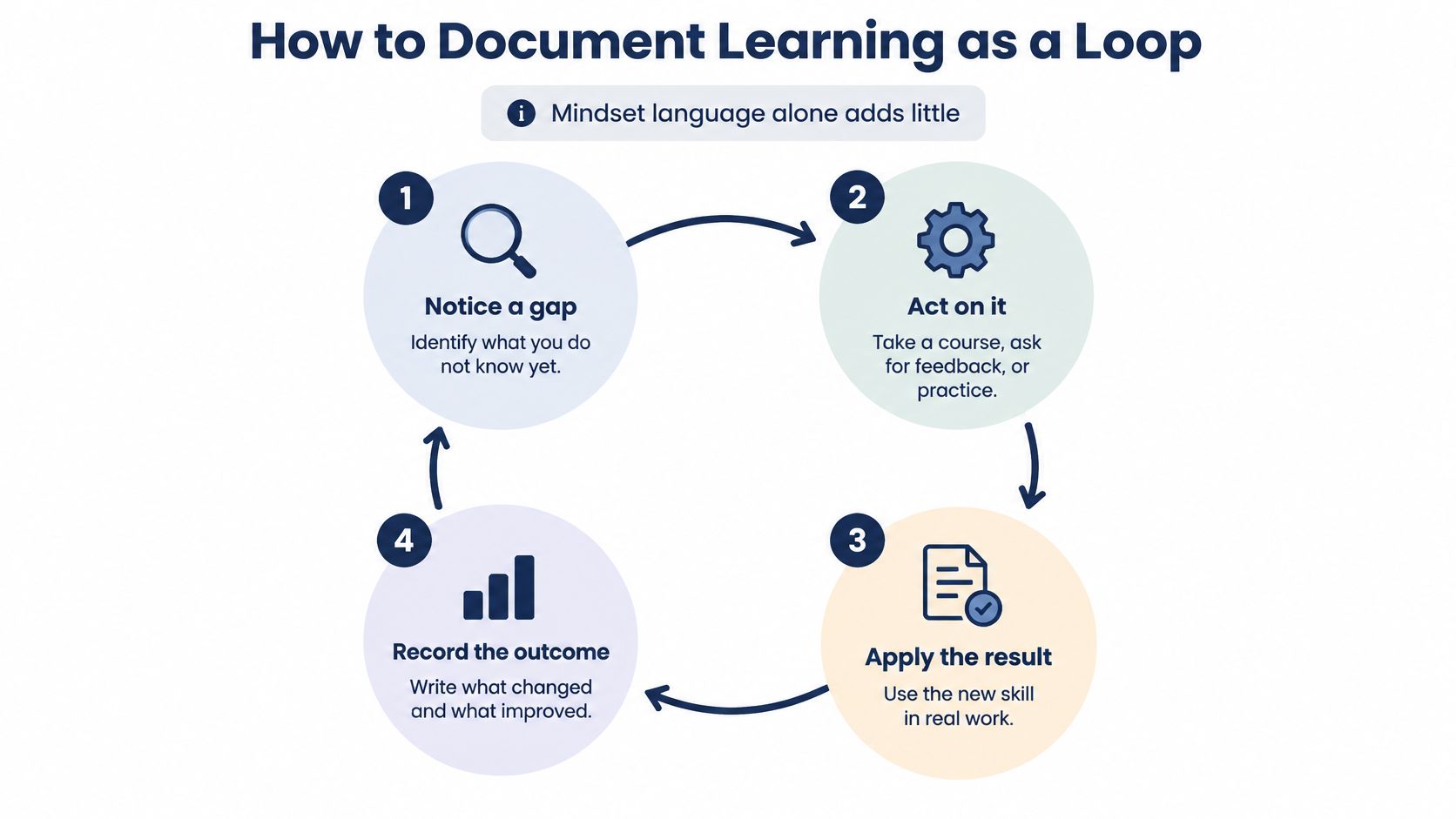
A convincing learning story follows a repeatable process: notice a gap, act on it, apply the result, and record the outcome. This prevents a course list from standing in for capability. It also helps you identify which experiences are ready for your resume and which still need practical application.
Keep a working document with the task, learning resource, practice output, and result. Save supporting material where appropriate, but don't copy confidential customer information or internal reports into a personal portfolio.
Use this visual as a reminder of the sequence.
Turn an experience into a defensible resume line
Name the gap. Check the job listing for a skill, tool, or task you can't yet demonstrate, then describe the specific capability missing. Common slip: treating a broad requirement such as data analysis as a manageable learning target instead of narrowing it to something like joining tables in SQL.
Choose an accessible learning method. Use official documentation, a free course, peer review, or internal shadowing that addresses the gap. Common slip: choosing a prestigious course that doesn't teach the task you need.
Practice on a small real task. Try cleaning a volunteer contact list, testing a spreadsheet formula, or drafting an improved customer help page. Common slip: following a tutorial exactly and presenting the guided exercise as independent work.
Apply the skill to useful work. Record the scope, such as the reports, accounts, users, or workflow affected, and clarify your own contribution. Common slip: listing a tool as a working proficiency after using it only briefly.
Establish what changed. Compare the same task before and after, using records where available or a concrete operational difference where measurement isn't possible. Common slip: attributing a team-wide improvement entirely to your own learning.
Write the resume line. Combine the relevant skill, learning action, and outcome, then remove details that don't help the target employer assess you. Common slip: giving the course more space than the work it enabled.
You don't need a dramatic success for every loop. Discovering that an approach didn't work, testing an alternative, and documenting the improvement can demonstrate sound judgment. What matters is whether you can separate the attempt from the eventual result.
Can you explain the gap, your action, and the outcome in under a minute without relying on the phrase quick learner?
If you can't, clarify the experience before adding stronger language.
Showing Motivation When Learning Access Is Limited
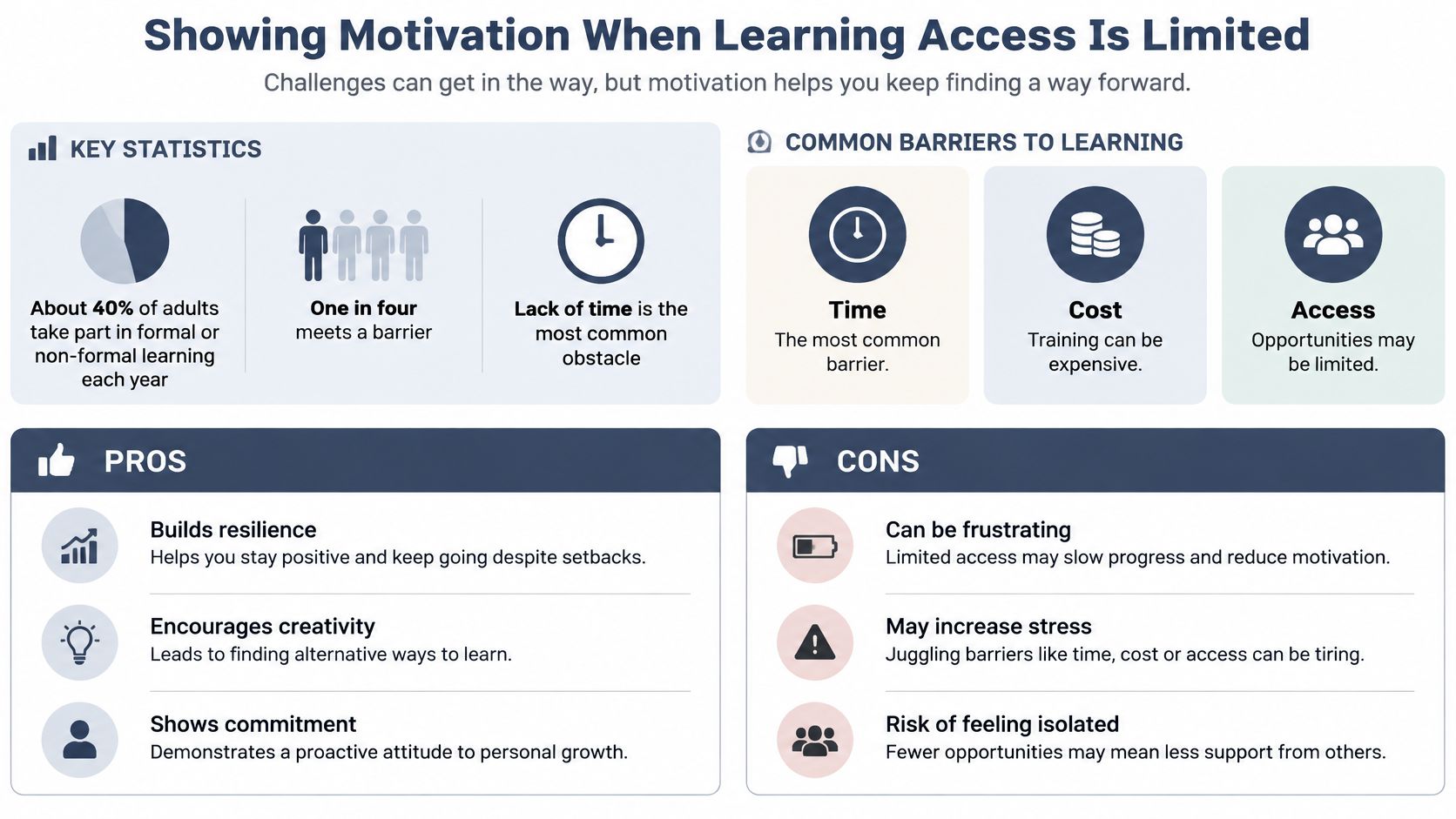
The OECD's report on barriers to adult learning finds that about 40% of adults participate in formal or non-formal learning each year, one in four encounters a barrier, and lack of time is the most common obstacle. Cost and suitable opportunities also affect access, particularly for people with low incomes or unstable employment.
Learning motivation is the drive to develop. Learning access is whether time, money, and suitable opportunities make that possible. Candidates shouldn't have to pretend those are the same thing.
These barriers deserve attention when choosing what evidence to present.
Costly versus low-cost proof of learning
| Proof type | Costly version | Low-cost version | Why it counts |
|---|---|---|---|
| Course evidence | Paid bootcamp certificate | Free online course finished and applied to a team spreadsheet | Shows method and application equally |
| Practice | Paid software license | Public portfolio project built with free tools | Visible, checkable work |
| Peer learning | Paid workshop | Study group with a shared output such as a template | Shows collaboration and a concrete output |
| On-the-job learning | Formal employer training | Self-study that improved a process at the current job, documented with a number | Shows application at work |
| Transferable learning | Paid role in target field | Skill built through caregiving or volunteering, described in work terms | Shows learning in a new context |
These alternatives can carry comparable weight as evidence of learning, though they don't replace mandatory qualifications or regulated credentials. A free project also needs enough substance to demonstrate the relevant skill.
State constraints briefly, then emphasize action. For example, a candidate might explain that they're completing a free SQL course around evening shifts and applying the lessons to a team attendance report. That establishes the gap, resource, plan, and application without apologizing.
For another perspective on developing your approach to learning, watch the following video.
You don't need to disclose private financial or family circumstances. Present the work you can discuss. A documented application gives an interviewer more to assess than the price of the training behind it.
Sample Resume and LinkedIn Bullets by Career Stage
Your career stage affects where the evidence belongs, not whether you can show it. A graduate may need a Projects section; an experienced professional can usually place the example under the role where the learning occurred.
The samples below are adaptable models, not claims to copy unchanged. Bracketed details require your own records. Keep only the tools, tasks, and outcomes that accurately describe your experience.
Recent graduate
- Survey analysis: Learned Excel Power Query through a class project to clean and analyze [verified response count] campus-club survey responses, informing the committee's event-format decision.
- Applied feedback: Revised a campus-club survey after tutor feedback and documented coding rules so project teammates could analyze responses consistently.
Placement: Put these under Projects, identifying the academic or student-organization context. Don't imply the work was paid employment. Include the response count only if you can establish it from the project file.
Mid-career professional
- System adoption: Learned the new purchasing platform through vendor guidance and internal testing, then rebuilt approval instructions to reduce returned requests.
- Process improvement: Applied Power BI training to replace manual report consolidation, saving [verified preparation time] per reporting cycle.
Placement: Use Experience under the relevant employer. Lead with the operational improvement when the target role values process ownership, and keep the training detail as supporting context.
Career switcher
- Independent development: Studied HTML and CSS through documentation and applied the skills to a volunteer organization's website, replacing outdated event pages with a maintainable template.
- Analytical practice: Used SQL self-study to analyze a community group's anonymized attendance records and presented findings that informed its scheduling decisions.
Placement: Choose Projects for independent work or Experience for a clearly labeled volunteer role. Don't describe a practice dataset as a client assignment. Explain the project's purpose so the reader understands why the work mattered.
Return-to-work candidate
- Skills refresh: Refreshed Excel lookup and validation skills through a short course, then used them to maintain a volunteer rota and identify scheduling conflicts.
- Workplace re-entry: Learned the employer's booking system through supervised practice and created a reference guide for recurring appointment changes.
Placement: Applied outcomes belong in Experience or Projects. List an actual earned credential under Certifications, and reserve Skills for capabilities you can demonstrate now.
For LinkedIn, use the About section to connect your development to your target role in a short learning story. Use Featured to link to a suitable project, with confidential information removed.
When converting your LinkedIn profile into a resume, shorten that narrative into role-specific evidence. Keep the context honest: completed work, work in progress, and planned learning are different things.
Interview Answers That Show Willingness to Learn
Prepare for questions such as Tell me about a time you learned something new quickly and What do you do when you lack a skill the job needs? Both ask for more than confidence. The interviewer needs to understand how you approach unfamiliar work and when you seek support.
Use this sequence: situation, skill gap, learning action, application, result, next step. Spend less time describing the background than explaining what you did.
A customer operations example
Here's a hypothetical answer to adapt only where the details match your experience:
Our customer operations team was repeatedly checking tickets manually because we couldn't easily identify overdue follow-ups. I knew the CRM's basic functions but hadn't used its reporting features. I worked through the help documentation, asked our administrator to review my filters, and tested a report against existing tickets. I then built a reusable template that helped the team identify outstanding actions and cut duplicate follow-up work. I now teach the template to new hires. Next, I'd validate whether the report still captures the right exceptions as our workflow changes.
The answer establishes a business problem before describing the learning. It also includes a review step, which matters when an incorrect report could cause colleagues to miss customer issues.
- Situation and gap: Manual ticket checks, with limited reporting knowledge.
- Learning and application: Documentation, administrator feedback, testing, and a reusable template.
- Result and next step: Less duplicate work, colleague training, and continued validation.
If you have a verified count or time comparison, prepare it for a follow-up question. If you don't, explain the observable change without inventing precision.
An answer without formal training
A candidate without course access could use a different kind of example:
I haven't had access to formal analytics training, so I used the spreadsheet documentation to learn data validation and lookup functions. I practiced on a volunteer rota, checked the results manually, and used the revised file to flag scheduling conflicts. I'd still need support with more advanced analysis, but I can explain and demonstrate the functions I used.
Don't open with quick learner and stop there. Don't describe a failed attempt without explaining what you changed afterward, either.
Rehearse aloud rather than memorizing polished prose. You should sound comfortable discussing the decisions, limitations, and evidence behind the answer, including what you couldn't yet do independently.
Check Your Evidence Before You Apply
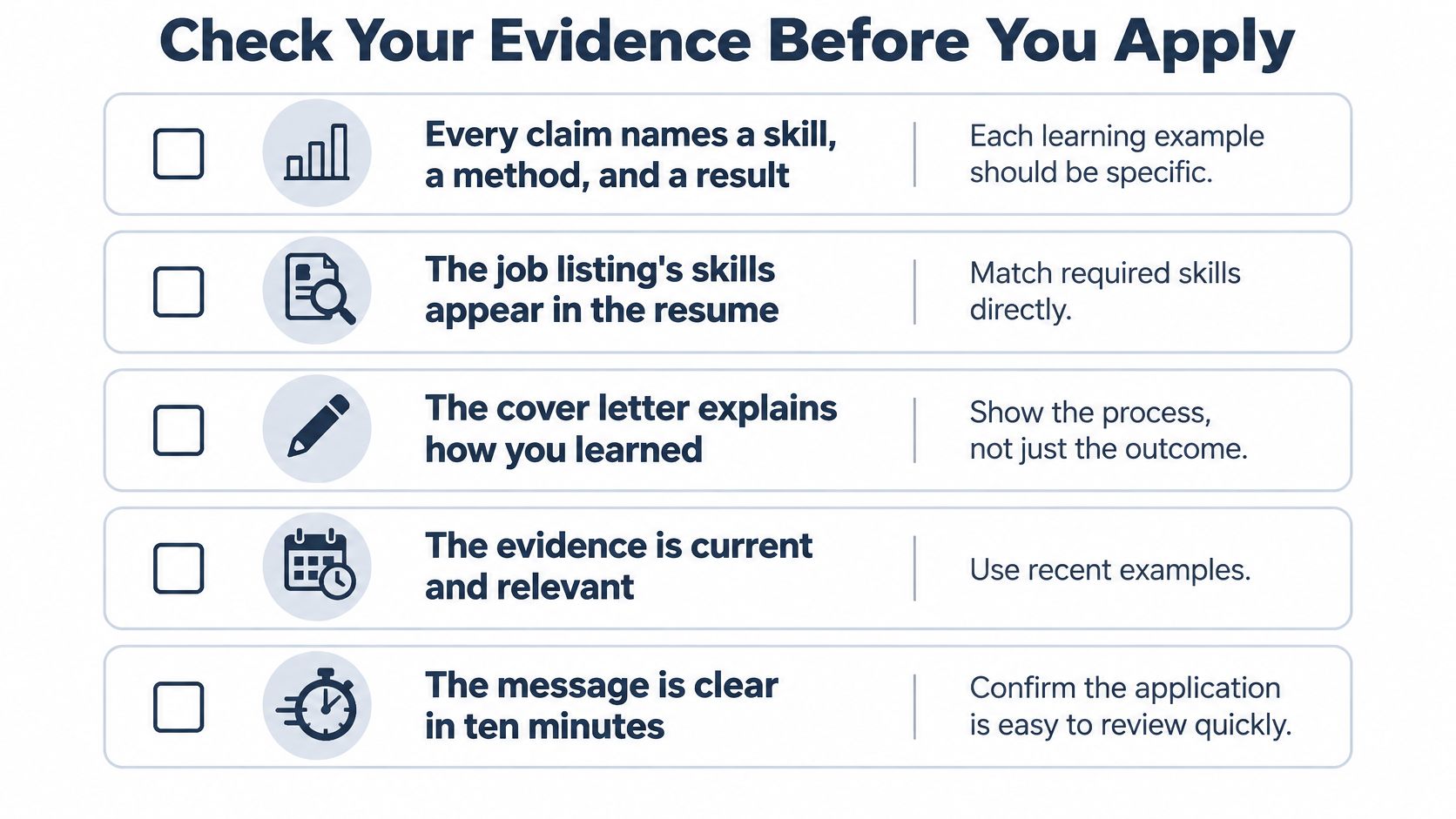
Run a ten-minute check before submitting:
- Complete the claim: Every learning example names a skill, method, and result.
- Verify the match: Job-listing skills appear only where real experience supports them.
- Prioritize the evidence: Put your strongest relevant learning line near the top of the appropriate role.
- Align your records: Check that LinkedIn dates, titles, and skills match your resume.
- Prepare the explanation: Have an interview story ready for each learning claim.
Use the checklist as a final review, not a reason to add more unsupported detail.
A 2026 study of prompt-injection risks in resume-screening systems identified skills injection as the most prevalent attack strategy in its analysis. That isn't a reason to add keywords indiscriminately. Match genuine requirements accurately, and expect to explain your claims during human review.
For help reviewing the fit, use our ATS resume checker. Add your LinkedIn profile URL or upload an existing resume; a job listing is optional. When you provide a listing, our AI reads its required skills and keywords and recommends evidence-based revisions using only your real experience. Review each suggestion against what you can substantiate.
GetTheCall helps you turn real experience into a job-specific resume, including learning examples that deserve more than a generic adjective. Visit GetTheCall, import your profile or resume, and add a target listing if you have one to review how clearly your evidence matches the role.