8 Travel Nurse Resumes for Every Career Stage
Explore 8 travel nurse resumes for specialties, experience levels, credentials, and career transitions, with ATS keywords and tailoring tips.

The best travel nurse resume isn't one resume. A new graduate, an ICU specialist, a career switcher, and a nurse returning after a break need different evidence near the top of the page. The useful details also change by assignment. A critical care recruiter may look for ventilator management and CRRT, while an emergency department manager may prioritize ESI triage, throughput, and trauma credentials.
That matters because travel nursing has moved from a relatively small occupation into a much larger, highly mobile workforce. The 2024 HRSA nurse workforce snapshot reported that travel nurses represented over 5% of the nursing workforce, compared with 1% in the 2018 survey. Your resume must therefore do more than list employers. It needs to translate verified experience into the language of one target assignment.
The eight examples below examine positioning, ATS keywords, licenses, certifications, proof, trade-offs, and practical tailoring. Use the closest example as your starting point, then change the document for the role you want.
Table of Contents
- 1. Entry-Level Travel Nurse Resume
- 2. ICU Travel Nurse Resume
- 3. Emergency Department Travel Nurse Resume
- 4. Med-Surg and Telemetry Travel Nurse Resume
- 5. Specialty Travel Nurse Resume
- 6. Mid-Career and Experienced Travel Nurse Resume
- 7. Career Switcher and New-to-Travel Nurse Resume
- 8. Return-to-Work and Career Gap Travel Nurse Resume
- 8 Travel Nurse Resume Types Compared
- Turn the Right Example Into Your Version
1. Entry-Level Travel Nurse Resume
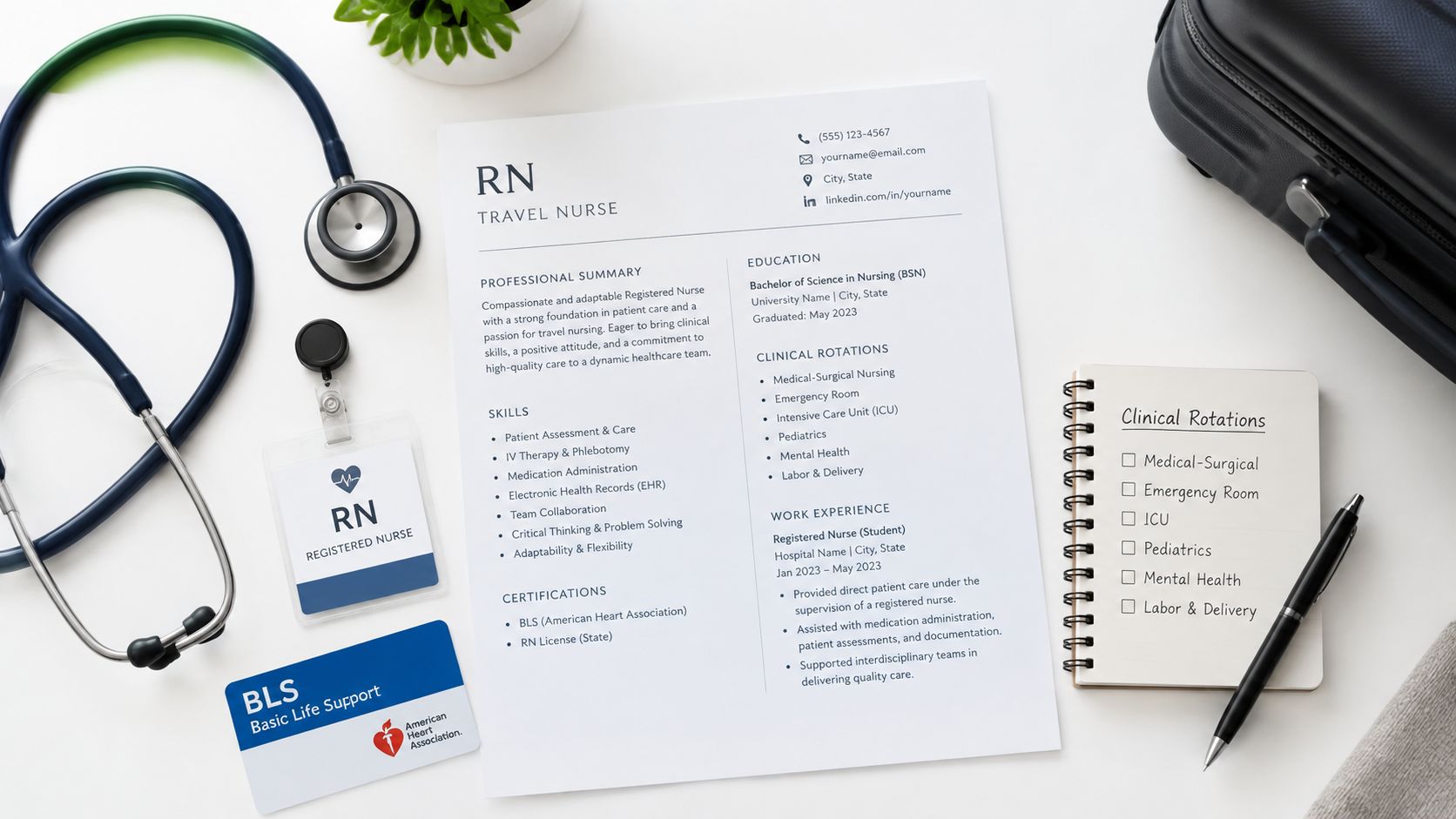
A new nurse has a different persuasion problem than an experienced traveler. You may not have a long assignment history, but you can still show clinical readiness, adaptability, and a clear foundation for safe practice. Put your RN license, BLS, ACLS when required, acute-care education, and relevant clinical exposure close to the top.
A strong opening might identify your nursing degree, new-graduate residency, acute-care rotations, and experience with several unit types. A residency nurse who rotated through medical-surgical, telemetry, and emergency settings can present those rotations as specialty exposure, not as disconnected school experience. An ADN graduate who recently completed a BSN can emphasize acute-care clinical hours, preceptorship, and readiness to learn a new facility's workflow.
Practical rule: Never turn a clinical rotation into an inflated employment claim. Label it accurately, then explain what you practiced and under what supervision.
What to emphasize
- Clinical adaptability: Name the units, patient populations, procedures, and handoff responsibilities you've encountered.
- Certifications: List BLS and ACLS with the issuing organization and expiration dates. Add specialty credentials only when you hold them or the posting requires them.
- Assignment readiness: Use truthful language such as “prepared for rapid onboarding,” supported by residency, preceptorship, float, or acute-care experience.
- Core skills: Include medication administration, assessment, patient education, infection prevention, escalation, documentation, and teamwork.
Avoid copying a senior traveler's format if it forces your education and clinical preparation onto a distant second page. Instead, use a clean structure with a concise summary, licenses and certifications, clinical experience, education, and skills. GetTheCall's ATS-friendly resume guide can help you preserve readable section labels and parsing-friendly formatting while you tailor the content.
2. ICU Travel Nurse Resume
An ICU resume should make acuity visible before a recruiter has to hunt for it. Lead with ICU specialty, critical-care certification, active licenses, EMR systems, and high-acuity competencies. The reader should quickly understand whether you've worked in MICU, SICU, NICU, PICU, or a burn setting.
Your bullets should name the clinical work you perform. Examples include ventilator management, hemodynamic monitoring, vasoactive infusions, CRRT, post-operative care, neurological assessment, and rapid response. If a posting names “CRRT,” “balloon pump,” or “prone positioning,” use that exact term only when your experience supports it. “Critical care experience” is too broad when the facility is screening for a specific device or protocol.
A CCRN-certified MICU nurse might write about managing ventilated patients with vasopressor support and participating in multidisciplinary rounds. A PICU nurse should put PALS, pediatric population experience, and complex congenital or post-operative care where they're easy to find. Patient-to-nurse ratio, unit type, facility environment, and EMR add context that a job title cannot provide.
Turn ICU experience into evidence
- Acuity: State the patient mix and typical ratio you personally handled.
- Technical skills: Name equipment, therapies, and protocols you've used directly.
- Independence: Describe how you adapted to unfamiliar layouts, equipment, documentation systems, or orientation processes.
- Leadership: Include charge coverage, mentoring, precepting, rounds, or protocol work when those duties are real.
Don't claim a procedure because it appears in the job description. Tailoring should mirror the employer's vocabulary, not replace your employment history. GetTheCall's guide to tailoring a resume is useful when you need to compare your real ICU experience with the requirements of a particular contract.

3. Emergency Department Travel Nurse Resume
Emergency nursing requires a resume that communicates range and speed. An ED manager wants to see more than “provided care in a fast-paced environment.” Show how you assess, prioritize, communicate, and move patients through unpredictable conditions.
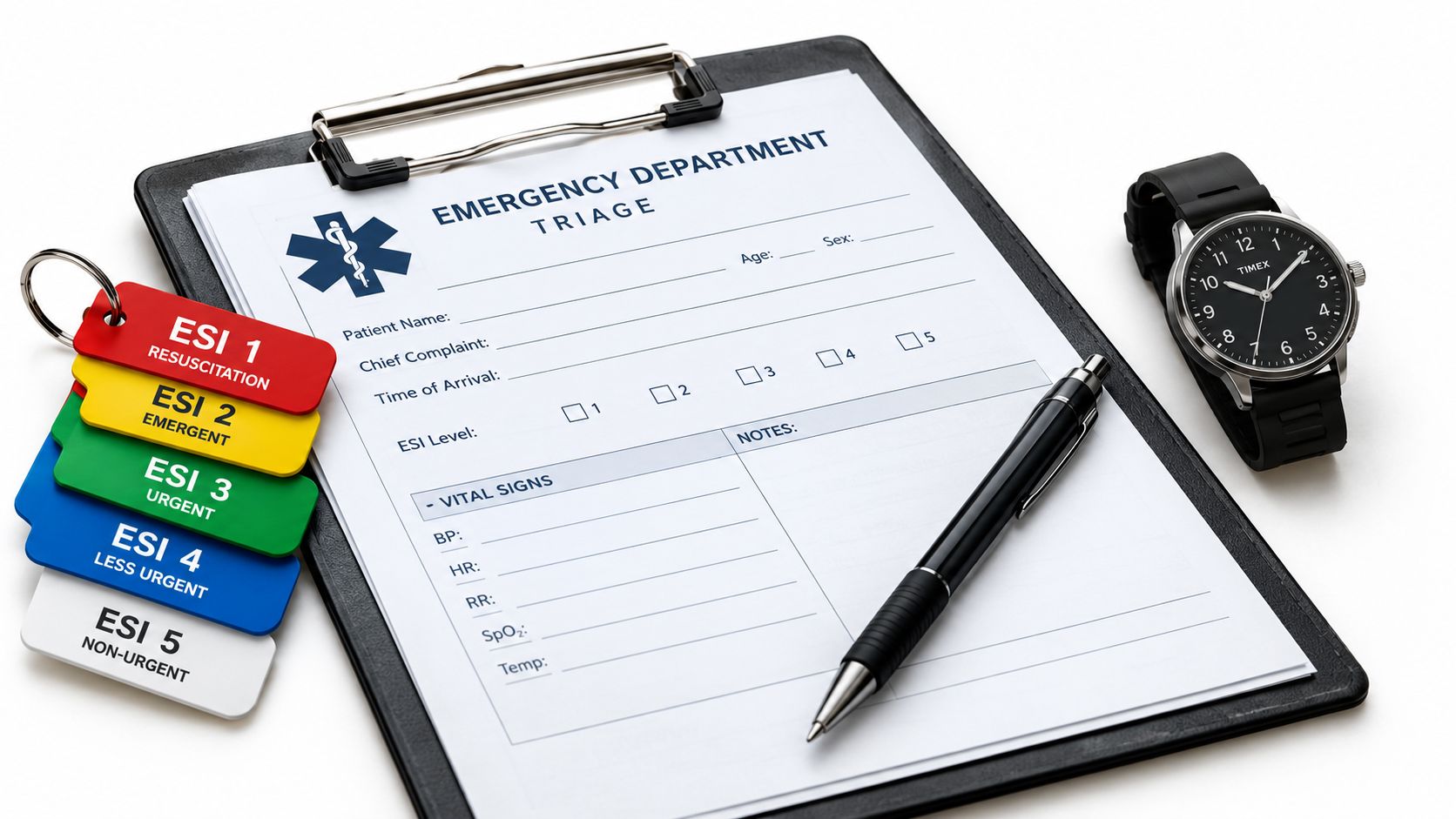
An experienced ED nurse could describe ESI triage, trauma response, STAT laboratory coordination, psychiatric emergencies, pediatric care, fast-track protocols, and diagnostic uncertainty. If your normal workload includes a stated patient volume, include it only when it's accurate and explain the setting. The example “32 to 36 patients per shift” is useful only for the nurse whose records and experience support that range.
Make the workflow recognizable
Name the triage system, EHR, handoff method, treatment zones, and patient populations you know. A trauma-center nurse should feature TNCC, code response, critical transfers, and stabilization experience. A nurse with pediatric exposure should surface PALS or ENPC when current and relevant. CEN, ACLS, TNCC, ENPC, and PALS shouldn't be buried under general skills if the posting searches for them.
Use bullets that connect action to clinical context:
- Triage: Identify ESI experience and the kinds of presentations you assessed.
- Throughput: Describe fast-track, discharge, transfer, or bed-coordination work you performed.
- Acuity: Show exposure to trauma, resuscitation, pediatric, behavioral-health, or high-risk presentations.
- Adaptability: Explain how you function across changing assignments and diverse patient populations.
A rural ED and an urban trauma department may ask for different evidence, even when both use the title “ED RN.” Tailor the summary and first assignment bullets to the target environment, while keeping the rest of your history complete and truthful.
4. Med-Surg and Telemetry Travel Nurse Resume
Med-surg and telemetry resumes succeed through specificity, not exaggerated specialization. These nurses often need to demonstrate dependable fundamentals across diagnoses, floor layouts, shifts, and documentation systems. Start with the target unit, then show patient load, acuity, cardiac monitoring, care coordination, discharge planning, and education.
A med-surg nurse might describe a typical five- or six-patient assignment, post-operative care, pain-management protocols, wound care, escalation, and discharge teaching. A telemetry nurse should name cardiac monitoring, EKG interpretation, dysrhythmia recognition, and rapid-response participation if those are part of the role. If the posting focuses on orthopedic, vascular, or oncology patients, bring that experience forward rather than leaving the reader to infer it.
Assignment details carry weight
For each facility placement, include the facility name, city and state, unit type, bed count, patient-to-nurse ratio, EMR, and exact dates when available. This operational detail helps a recruiter understand what “med-surg experience” meant in that particular setting. It also separates an assignment-based career narrative from a generic staff-nurse description.
Name systems such as Epic, Cerner, or Meditech if you've used them. “EHR proficient” doesn't tell a staffing team whether you've worked in the platform named in the contract. You can also mention that you've learned different workflows, but don't suggest familiarity with a system you haven't used.
Include availability and shift flexibility only if they're accurate. A short statement about rotating shifts, weekends, or assignment duration can remove uncertainty, but it shouldn't replace clinical proof. Travel facilities need nurses who can contribute safely, not candidates who appear generally available.
5. Specialty Travel Nurse Resume
Labor and delivery, perioperative nursing, oncology, dialysis, and other focused specialties need a narrow, credential-forward resume. The first third of the page should tell the reader exactly which population, procedures, and setting you know. Generic phrases such as “excellent clinical skills” take space away from evidence that differentiates you.
An L&D nurse might lead with RNC-OB, NRP, high-risk obstetrics, VBAC support, fetal monitoring, and delivery-room teamwork. A perioperative nurse could emphasize CNOR, RNFA experience, surgical instrumentation, service lines, and room turnover. An oncology nurse should identify the patient population and treatment-support experience that belongs in the role, such as bone marrow transplant supportive care.
Quantify specialty work only when you can verify it. A nurse who has managed a documented number of deliveries, procedures, or patient encounters can include that figure with context. A nurse who can't verify a number should use a precise qualitative description instead of guessing.
Tailor to the facility's niche
Academic medical centers, community hospitals, cancer institutes, high-risk obstetric centers, and trauma surgery programs may use different screening language. Extract the facility's actual requirements and reflect those terms in your summary, certifications, and most relevant bullets.
- Credentials first: Show current specialty certifications and renewal dates.
- Subspecialty exposure: Name VBAC management, robotic surgery, complex oncology support, or other experience you have.
- Setting fit: Explain whether you've worked in academic, community, high-volume, or resource-limited environments.
- Scope clarity: Separate direct clinical practice from observation, coursework, or cross-training.
A specialty resume can be longer than a generic one if every line helps establish fit. The trade-off is focus. Remove unrelated duties before you remove the clinical detail that proves you can enter the target specialty safely.
6. Mid-Career and Experienced Travel Nurse Resume
Experienced nurses shouldn't hide leadership behind a long list of bedside duties. If you've served as charge nurse, preceptor, committee member, educator, or quality-improvement contributor, place that evidence near the top. Facilities often need travelers who can make sound decisions independently and help a team function during transition.
A strong summary can connect specialty depth with leadership scope. Instead of writing “experienced ICU nurse,” describe the unit type, clinical judgment, charge responsibilities, and mentoring work that are relevant to the assignment. A med-surg nurse pursuing advancement might feature a BSN, evidence-based practice work, quality committees, and student preceptorship.
Use metrics only when they're yours
Patient safety measures, training volume, project outcomes, and documented feedback can make senior experience persuasive. But a result belongs on the resume only when you know what happened, what you did, and how the organization measured it. Don't borrow an impressive percentage from a sample resume or convert a team result into a personal achievement.
A senior resume should answer one question quickly: what can this nurse take responsibility for beyond a routine assignment?
Look for role-level terms in each posting, including charge nurse, preceptor, senior nurse, educator, quality improvement, and clinical leadership. Then place the most relevant term in a bullet that demonstrates the work. “Leadership” by itself is weak. “Precepted new nurses during orientation and supported charge coverage” is clearer, provided it's true.
Keep professional memberships, advanced certifications, and continuing education visible, but don't let them crowd out recent clinical work. Experienced travelers still need assignment-level detail, including facility, unit, dates, EMR, and patient context. Leadership strengthens the resume. It doesn't replace the evidence that you can practice in the target setting.
7. Career Switcher and New-to-Travel Nurse Resume
A permanent hospital nurse moving into travel nursing usually has enough clinical experience. The challenge is translation. Staff-resume language often emphasizes loyalty to one institution, while a travel resume must show independence, adaptability, rapid onboarding, and comfort with unfamiliar systems.
Start with the specialty you want to travel in, not with an apology that you haven't traveled before. A four-year med-surg nurse can foreground patient assignment size, discharge planning, Epic or Cerner experience, float-pool shifts, relief work, mentoring, and cross-unit exposure. An ICU nurse can feature CCRN, unfamiliar-equipment experience, protocol adaptation, and the ability to stabilize care while learning a new unit.
Reframe without overstating
- Float experience: Explain the units and populations you covered.
- System flexibility: Name every EMR you've used and describe genuine workflow changes you handled.
- Autonomy: Show independent assessment, escalation, prioritization, and handoff.
- Motivation: State why you're moving into travel nursing, such as geographic flexibility, specialty exploration, or professional growth.
A concise career statement can reassure a recruiter: “Seeking travel assignments to expand clinical experience and professional networks while maintaining clinical excellence in diverse healthcare settings.” Adjust that language to your real motivation. Don't claim rapid onboarding unless your background supports it through float work, temporary assignments, relief shifts, or comparable transitions.
You can turn a LinkedIn profile into a starting document with this LinkedIn-to-resume workflow, then edit every line for accuracy and assignment relevance. LinkedIn may capture broad employment history, but it won't automatically supply the unit, ratio, EMR, dates, and contract context a travel recruiter needs.
Here's a short video element you can place after the experience section when you want to explain the transition visually:
8. Return-to-Work and Career Gap Travel Nurse Resume
A career gap doesn't erase clinical experience, but it does create a question about readiness. Answer it directly and briefly. The resume should show what you've done to return safely, including renewed credentials, recent clinical work, refresher education, orientation, or per diem practice.
A nurse who paused for family responsibilities might write: “Career break for family responsibilities. Completed current certification renewal and returned to clinical practice through local per diem work.” Keep the explanation factual and short. The rest of the page should focus on specialty background, recent preparation, active licensure, and the type of assignment that matches your present readiness.
Put currency before history
Move recent evidence above older achievements. If you completed a critical-care refresher, renewed CCRN, worked per diem in an ED, or reviewed current protocols, list those details near the summary. Volunteer work, community health involvement, and other relevant engagement can help show continued connection to patient care, but don't present informal exposure as paid clinical employment.
- Credentials: Verify every license and certification status before applying.
- Recent practice: Identify the setting, duties, and supervision accurately.
- Re-entry goal: State that you're returning with renewed commitment to patient care and professional growth.
- Assignment choice: Consider an orientation-focused, part-time, or lower-acuity placement before pursuing a high-acuity contract.
Travel nursing may offer a structured way to rebuild confidence, but the contract still has to match your current skills. Don't hide a long break, and don't let it dominate the document. A calm explanation plus credible re-entry preparation gives recruiters something concrete to evaluate.
8 Travel Nurse Resume Types Compared
| Template | 🔄 Implementation Complexity | ⚡ Resource Requirements | 📊 Expected Outcomes | ⭐ Ideal Use Cases | 💡 Key Advantages |
|---|---|---|---|---|---|
| Entry-Level Travel Nurse Resume (0–2 Years Experience) | Low, compact, ATS-friendly structure | Moderate, certifications, clinical rotation details, school reputation | Good visibility for junior travel roles; fewer measurable outcomes | New grads, recent residency completers, early-career travelers | Emphasizes certifications/education; highlights adaptability and fast onboarding |
| ICU Travel Nurse Resume (Critical Care Specialization) | High, specialty terminology, quantified acuity, advanced procedures | High, CCRN/PCCN, documented ventilator/CRRT/ECMO experience, metrics | Strong ATS alignment; higher match rate for ICU contracts and premium pay | Experienced critical care RNs (3+ yrs) seeking ICU travel roles | Leads with credentials and acuity metrics; differentiates for premium contracts |
| Emergency Department Travel Nurse Resume (ED Specialization) | Moderate–High, triage metrics, high-volume examples, trauma language | Moderate, TNCC/CEN/PALS, patient-volume stats, triage examples | High relevance for ED postings; demonstrates independence under pressure | ED nurses in trauma/fast-track/high-volume settings | Highlights throughput, triage skillset, and autonomy for unpredictable environments |
| Med-Surg/Telemetry Travel Nurse Resume (Intermediate Experience) | Moderate, broad organized sections; EMR and outcome focus | Moderate, telemetry competency, EMR names, patient-safety metrics | Broad match across many travel roles; competitive volume-based positioning | 2–5 yr med-surg or telemetry nurses seeking flexible contracts | High demand role; versatile, less credential-heavy, appeals to many facilities |
| Specialty Travel Nurse Resume (L&D, OR, Oncology) | High, niche language, procedure counts, specialty outcomes | High, specialty certs (NRP, CNOR, OCN), procedure volume, subspecialty training | High-quality matches in niche markets; fewer openings but premium pay | Deep-specialty nurses seeking L&D, OR, oncology travel assignments | Demonstrates depth of practice, specialty credentials, and differentiated value |
| Mid-Career/Experienced Travel Nurse Resume (5+ Years) | Moderate–High, leadership, quality metrics, outcome-driven bullets | Moderate, leadership examples, QI outcomes, advanced certifications/degrees | Positions for senior/charge/preceptor roles and premium contracts | Seasoned RNs seeking leadership-track or high-autonomy travel assignments | Emphasizes mentorship, measurable outcomes, and unit-stabilizing experience |
| Career Switcher / New-to-Travel Nurse Resume (Hospital → Travel) | Moderate, reframes hospital experience into travel language | Moderate, cross-unit exposure, EHR diversity, travel-intent statement | Improves recruiter confidence; may face preference for veteran travelers | Hospital-based RNs transitioning to travel for first-time assignments | Bridges permanent-hospital metrics to travel needs; highlights adaptability |
| Return-to-Work / Career Gap Travel Nurse Resume (Re-entry) | Moderate, concise gap framing plus recent training evidence | Moderate, refresher courses, cert renewals, per diem/volunteer work | Facilitates re-entry with orientation-friendly assignments; possible lower initial offers | RNs returning after career breaks seeking gradual re-entry via travel | Builds trust via transparency; highlights recent preparation and readiness |
Turn the Right Example Into Your Version
Choose the example closest to the assignment you want, then customize it in a deliberate order. If you're a career switcher applying to ICU, start with the ICU structure and add the transition evidence from the career-switcher example. If you're returning to work in labor and delivery, use the specialty format, then place recent re-entry preparation above older employment history. Your resume should reflect the target role, not every possible role you might consider.
First, verify the facts. Check your RN license, compact status when applicable, certification names, issuing organizations, and expiration dates. The HRSA workforce snapshot shows why travel nursing now requires a concise but verifiable employment narrative. A mobile workforce needs a document that makes agency-based staffing, facility assignments, and dates easy to understand.
Next, extract the target posting's language. ATS tools commonly match resume terms against job-posting terms, especially in qualifications, skills, and experience sections, as explained in this guide to ATS resume keywords. Look for the exact specialty, unit, certifications, EMR, procedures, license wording, patient population, and shift expectations. Add a term only when your real experience supports it.
Then revise the evidence, not just the keywords. A job description may ask for ventilator management, but your bullet should explain the patient context and your responsibility. An ED posting may emphasize throughput, but your resume should identify the workflow you handled. The keyword-matching workflow described by ResumeFast can help you compare the full posting with your resume and flag missing terms, including variations. Treat those flags as prompts for review, not permission to invent experience.
Formatting comes last, but it still matters. Use standardized section labels, readable body text, plain backgrounds, and a black-and-white layout. Guidance on nurse resume formatting and ATS readability cautions against graphics, decorative headers and footers, special fonts, and colored backgrounds that can interfere with parsing. For assignment history, include facility, city and state, unit, bed count when available, patient-to-nurse ratio, EMR, and exact dates.
GetTheCall can import a LinkedIn profile or existing résumé, parse a target job listing, suggest job-specific rewrites based on your actual experience, show a live ATS Role Match score, and export an ATS-ready PDF through GetTheCall. Use that workflow as a final review, then proofread the exported file yourself. The strongest travel nurse resume is focused, truthful, easy to parse, and deliberately aligned to one role.
Visit GetTheCall to import your current résumé or LinkedIn profile, compare it with a travel nursing job listing, and identify missing specialty, credential, EMR, or license terms. Use the live match feedback to tailor one accurate version for the assignment you want, then export a clean PDF ready for submission.