8 Software Engineer Cover Letter Examples
Explore 8 software engineer cover letter examples for junior, senior, career-switching, and specialized roles, with ATS and customization tips.
The Best Cover Letter Is Not the Longest One
The most popular advice about software engineer cover letters is also the least useful: write a generic paragraph about your passion for technology, then repeat your résumé in polished prose. Hiring teams don't need another declaration that you've “always loved coding.” They need a concise reason to believe your experience fits this role, on this team, at this company.
A strong letter connects two or three verified pieces of evidence to the target job. That might be a shipped project, a production incident you helped resolve, a migration you supported, or a technical decision that improved an outcome. A 2023 ResumeGo field experiment involving 7,287 applications found that personalized cover letters produced a 53% higher callback rate than applications without a cover letter. The useful lesson isn't "always write more." It's that specificity can matter.
The eight software engineer cover letter examples below adapt the same principle to different situations, including early-career applications, specialization changes, career gaps, startup and enterprise roles, and leadership transitions. ATS alignment should support truthful customization, not keyword stuffing. GetTheCall can help parse a job listing and align résumé evidence with its requirements before you draft, so the letter reflects the role instead of becoming a generic technical biography.
Table of Contents
- 1. Early-Career Software Engineer Cover Letter
- 2. Mid-Level Software Engineer Cover Letter
- 3. Senior or Staff Software Engineer Cover Letter
- 4. Software Engineer Transitioning to a New Tech Stack or Domain
- 5. Software Engineer Returning to Work After a Career Gap
- 6. Specialized Software Engineer Cover Letter
- 7. Software Engineer Applying to Startups vs. Enterprise Roles
- 8. Software Engineer Pivoting into Engineering Management or Leadership
- 8-Scenario Software Engineer Cover Letter Comparison
- Turn One Strong Letter Into Eight Better Applications
1. Early-Career Software Engineer Cover Letter
Early-career candidates don't need to disguise limited industry experience. They need to make academic, portfolio, internship, and collaborative work easy to evaluate. A junior full-stack application might connect a React and Node.js capstone to the employer's need for frontend development, API integration, debugging, and collaborative coding.
Practical rule: Replace “I don't have much experience” with a specific account of what you built, how you built it, and what you learned from the result.
A useful opening could be:
“I'm applying for the Junior Full-Stack Engineer role because my capstone project required the same combination of React, SQL, and Node.js described in your posting. I designed the user interface, built the API integration, and debugged deployment issues with two project partners. The repository and implementation notes are available in my portfolio.”
That paragraph works because it names the exact stack, shows collaboration, and gives the reader somewhere to verify the work. A bootcamp graduate could use the same structure for a deployed personal web application, while a career switcher might connect a data structures course and internship coding work to the role's requirements.
Use the posting's language naturally. ATS-oriented cover-letter guidance recommends reusing repeated skills, responsibilities, and outcomes, then pairing relevant keywords with concrete project evidence. Don't list every language you've encountered. Select the technologies that genuinely overlap with the job.
Your editing moves are straightforward:
- Name the repository: Link directly to GitHub or your portfolio, and identify the relevant project rather than offering a bare profile link.
- Show an outcome: Use a verified metric such as a measured load-time improvement, or describe the result qualitatively if you don't have reliable measurement.
- Sound confident, not defensive: Say what you built and what you can contribute. Don't apologize for being early in your career.

2. Mid-Level Software Engineer Cover Letter
At mid-level, a cover letter should move beyond “I know these tools.” The stronger case is, I used these tools to solve a production problem, and I understand the consequences of the decision. A backend engineer might discuss a service migration, a frontend specialist might describe a component library, and a full-stack engineer might connect delivery work with architecture decisions.
Start with the problem, not the technology:
“Your posting emphasizes service ownership, performance, and cross-functional collaboration. In my current role, I owned a reliability improvement for a heavily used backend component, working with product and operations to identify the most disruptive failure modes. I then introduced targeted caching, expanded monitoring, and documented the rollout process for the team.”
This example avoids an unsupported performance claim while still showing ownership. If you have a verified before-and-after result, include it. Intuit's software engineer cover-letter guidance emphasizes connecting a concrete engineering problem to a measurable result and then linking that result to the target company's stack or challenge.
Use a compact situation, action, result structure. The situation gives context, the action establishes your contribution, and the result explains why the work mattered. Don't turn the letter into a list of frameworks. Mention Kubernetes, Agile, SOLID principles, or another required term only when it belongs to a real example.
For a mid-level letter, prioritize:
- Production ownership: Explain the component, system, or feature you owned.
- Team contribution: Mention mentoring, code-review leadership, documentation, or cross-functional work when the posting values it.
- Company context: A startup may respond to evidence of scrappy delivery and ambiguity. An enterprise may care more about process, testing, governance, and maintainability.
- Technical credibility: Open-source contributions, technical writing, or conference talks can support the case, but only if they're relevant to the role.
The letter should complement your résumé, not repeat it. Give the reader the reasoning and trade-offs that a résumé bullet can't carry.
3. Senior or Staff Software Engineer Cover Letter
Senior and staff letters need a wider lens. A feature is evidence, but scope and impact are the true differentiators. Show how your decisions influenced architecture, engineering culture, delivery practices, or the effectiveness of other teams.
A senior engineer might write:
“I led the migration of a core service from a monolithic design to independently deployable components. The work required more than implementation. I coordinated the rollout plan, documented operational risks, and helped adjacent teams adopt the new interfaces without interrupting their delivery schedules.”
A staff-level version should go further:
“The migration also changed how teams made architectural decisions. I established an RFC process, facilitated trade-off reviews, and created implementation guidance that other teams used when planning similar changes.”
The second example demonstrates organizational scope rather than merely claiming leadership. For senior roles, mirror language such as technical strategy, architecture, mentorship culture, and cross-functional leadership when those terms accurately describe your experience. A role-specific ATS résumé checker can help identify gaps in the target language before you adapt the letter, but it can't replace judgment about which evidence is credible.
Write about decisions, not status
Avoid turning the letter into a résumé in paragraph form. Choose one substantial example and explain the trade-off. Why did you choose a modular migration instead of a rewrite? What risk did you accept? Who adopted the resulting pattern? Did the decision improve reliability, delivery confidence, or team autonomy?
If you have verified figures, use them. If you don't, describe the scope accurately through teams, systems, adoption, or decision ownership. Don't borrow impressive metrics from a generic senior engineer cover letter example.

4. Software Engineer Transitioning to a New Tech Stack or Domain
A technology transition works best when the letter separates proven engineering fundamentals from new-domain preparation. A Java backend engineer moving toward Go infrastructure, a web developer entering embedded systems, and an iOS engineer moving into backend work all need to answer the same question: why should the employer believe the transition is realistic?
Lead with overlap:
“My production experience is in Java backend services, where I've worked with API design, testing, observability, and performance troubleshooting. I'm now applying those fundamentals to Go through a personal command-line tool and infrastructure-focused coursework. The target role's focus on concurrency, container orchestration, and reliable service operation is the bridge between what I've done professionally and where I'm going next.”
That framing is more persuasive than saying “I'm passionate about learning Go.” It identifies transferable skills and backs up the transition with current work. GetTheCall's guide to tailoring a résumé to a job description is relevant here because comparing your existing evidence with the target posting helps reveal shared concepts such as API design, testing, concurrency, and performance tuning.
Be specific about learning. Name a completed course, a project you built, or an open-source contribution you can discuss in an interview. Acknowledge the gap plainly, but don't overstate it:
“While my production experience is in Java, I've been building in Go through a personal CLI project and contributing documentation fixes to a related open-source tool.”
The letter should also explain why the new domain appeals to you. A move into embedded systems might connect an interest in hardware constraints to existing debugging and testing experience. A move into platform engineering might connect service ownership to infrastructure automation.
Don't promise an unrealistic ramp-up. State what you already know, what you're actively learning, and which responsibilities you can handle immediately.
5. Software Engineer Returning to Work After a Career Gap
A career gap doesn't need a dramatic explanation. It needs a clear one. Name the reason briefly, then move quickly to evidence that shows your current technical readiness.
“I took time away from full-time engineering to focus on family responsibilities. During that period, I maintained a small software project, completed cloud-focused training, and contributed fixes to an open-source DevOps repository. I'm now ready to return to a production engineering role focused on reliable backend systems.”
That structure removes ambiguity without inviting the letter to become a personal essay. If the gap involved graduate study, health recovery, caregiving, or another circumstance, use the level of detail you're comfortable sharing. You don't owe a hiring team private medical information.
The most important editing move is to connect recent activity to the target posting. If the job asks for cloud deployment, describe the relevant project. If it emphasizes distributed systems, foreground coursework, research, or practical work in that area. Guidance on whether a cover letter is useful in modern technical hiring highlights a practical issue many examples miss: some engineering teams care more about demonstrated work, portfolios, and shipped products than about a polished letter.
Make the return concrete
A return-to-work letter can include:
- Current technical evidence: Recent projects, freelance work, coursework, certifications, or open-source contributions.
- Relevant continuity: Skills that remained active during the gap, such as testing, data modeling, scripting, or technical writing.
- A realistic target: Explain why this role fits your return rather than applying broadly with the same language.
- A direct tone: Don't describe yourself as “behind.” Describe the experience and the work you've done to prepare.
Keep the résumé gap visible and explain it consistently across your application materials. The letter should add context, not contradict the dates or scope shown on the résumé.
6. Specialized Software Engineer Cover Letter
Specialists need precision. A DevOps, data, security, or platform engineering letter should make it easy to see the relationship between the posting's tools and your actual experience. If the job names Kubernetes, Terraform, Spark, Airflow, AWS, or a certification, use those exact terms when they're accurate.
A platform engineer might open with the operational problem:
“Your platform role centers on infrastructure as code, CI/CD reliability, and Kubernetes operations. In my current work, I maintain deployment automation and help application teams move changes through controlled release paths. I'm especially interested in this position because it combines hands-on platform engineering with the enablement work required to make those systems usable by product teams.”
The letter becomes stronger when it explains business impact in plain English. “Implemented autoscaling” is incomplete. Explain what the policy enabled, such as handling demand changes with less manual intervention, improving release safety, or reducing operational friction. Use a verified metric if you have one. Never insert a percentage, cost saving, traffic figure, or incident reduction just because the example sounds more convincing.
For data engineering, connect the pipeline to data availability, query performance, or decision quality. For security engineering, explain the vulnerability-management process, threat model, or remediation workflow without exposing confidential details. For DevOps, describe how infrastructure changes affected deployment confidence and developer experience.
Use certifications carefully. Include the credential and its current status when relevant, but don't let it replace evidence of practical work. An open-source contribution, incident review, architecture document, or technical article can show how you apply specialized knowledge.
The ATS cover-letter examples for software engineers also point toward achievement-led writing. The useful pattern is simple: name the technical intervention, explain the problem it addressed, and state the verified outcome.
7. Software Engineer Applying to Startups vs. Enterprise Roles
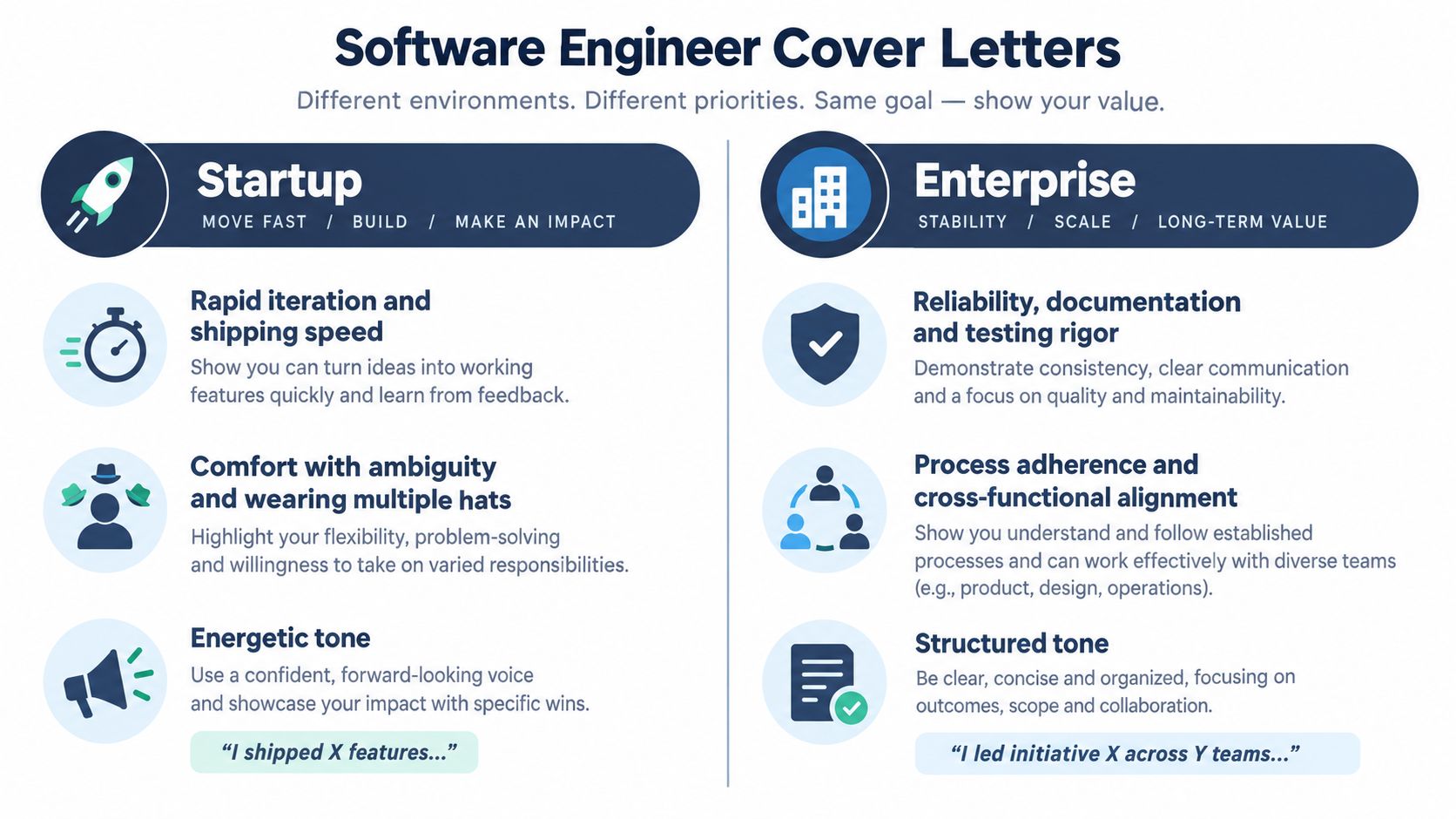
The same experience can require a different emphasis depending on company context. A startup may want evidence that you can work through ambiguity, make sensible trade-offs, and ship without a large support structure. An enterprise may want evidence of scalable design, testing discipline, documentation, governance, and collaboration across established teams.
For a startup, write:
“I joined a project with an unclear ownership boundary, clarified the first release with product and design, and shipped the smallest useful version while documenting the follow-up risks. That experience taught me to make progress without treating uncertainty as a reason to wait.”
For an enterprise, adapt the same experience:
“I worked with product, design, security, and operations to define the release criteria for a new service. I documented the architecture, established testing expectations, and created an ownership model that supported maintenance after launch.”
Neither version is automatically better. Each one answers a different hiring concern. Indeed's keyword guidance recommends comparing multiple postings for the same role and reflecting recurring wording naturally. Apply that approach here, but don't imitate slogans mechanically.
Change the evidence, not the truth
Startup language such as “move fast,” “iterate,” and “MVP” may justify emphasizing rapid problem-solving and broad ownership. Enterprise language such as “reliability,” “scale,” and “governance” may justify emphasizing process and long-term stewardship. Research the company and reference a real product, engineering challenge, or public direction that connects to your experience.
Avoid stereotypes. A startup letter doesn't need jokes about ping-pong tables or “failing fast.” An enterprise letter doesn't need vague claims about stakeholder alignment. Say who you worked with, what changed, and why the result mattered. A guide to ATS-friendly résumé structure can help keep the underlying application readable while you adjust the emphasis for each environment.
8. Software Engineer Pivoting into Engineering Management or Leadership
A move from individual contributor to technical leadership or engineering management requires a different definition of impact. The letter shouldn't suggest that coding no longer matters. It should show how you've begun multiplying the effectiveness of other people through mentoring, project ownership, communication, and judgment.
For a tech lead application, emphasize architecture and technical direction:
“I led a cross-team effort to modernize a legacy service, defined the technical roadmap, and supported engineers through the implementation. I also presented progress and trade-offs to senior stakeholders, which helped the team make decisions without losing sight of delivery constraints.”
For an engineering manager role, put more weight on people leadership:
“My strongest leadership work has involved mentoring engineers, setting clearer expectations, facilitating difficult technical conversations, and helping the team learn from incidents. I'm applying for management because I've found that improving how a team works can create more sustained impact than completing another feature alone.”
Those examples show evidence rather than relying on “natural leader.” If you haven't formally managed people, say so and identify the adjacent experience you do have. Mentorship programs, hiring participation, onboarding, performance feedback, incident post-mortems, and conflict resolution can all be relevant when described accurately.
A useful distinction is:
- Technical leadership: Architecture, technical strategy, design reviews, roadmap decisions, and engineering standards.
- People leadership: Coaching, hiring, feedback, team health, prioritization, and career development.
- Organizational leadership: Cross-team influence, stakeholder communication, operating rhythms, and business alignment.
Don't promise to remain "committed to technical work" without explaining what that means in practice. Say whether you intend to keep reviewing designs, contributing code, mentoring engineers, or staying close to operational decisions. Your motivation should sound considered, not like an escape from individual-contributor work.
8-Scenario Software Engineer Cover Letter Comparison
| Cover Letter Type | 🔄 Complexity | 💡 Resources & Prep | ⭐📊 Expected Outcomes | Ideal Use Cases | ⚡ Key Advantages |
|---|---|---|---|---|---|
| Early-Career Software Engineer Cover Letter | Low, concise template, simple tailoring 🔄 | Portfolio/GitHub, bootcamp certs, 1–3 projects 💡 | Improves ATS match and interview invites ⭐ 📊 | Junior roles, bootcamp grads, career switchers | Project-focused, adaptable, ATS-friendly ⚡ |
| Mid-Level Software Engineer (5–8 yrs) | Moderate, edit for metrics & leadership 🔄 | Production examples, quantified metrics, mentoring evidence 💡 | Demonstrates delivery and leadership; higher interview conversion ⭐ 📊 | Mid-career ICs seeking senior IC roles | Shows measurable impact and mentorship credibility ⚡ |
| Senior or Staff Software Engineer | High, strategic framing of influence & trade-offs 🔄 | Cross-team outcomes, strategic decisions, thought leadership 💡 | Positions for senior/architect roles; strong offers and scope ⭐ 📊 | 8+ years; staff/principal/technical leadership roles | Signals organizational influence and compensation leverage ⚡ |
| Transitioning to a New Tech Stack or Domain | Moderate, balance honesty with transferable skills 🔄 | Courses, side projects, overlapping technical keywords 💡 | Conveys adaptability; mitigates domain-gap concerns; targeted interviews ⭐ 📊 | Engineers switching languages/domains (e.g., Java→Go) | Emphasizes transferable fundamentals and active learning ⚡ |
| Returning to Work After Career Gap | Low–Moderate, concise gap explanation + proof 🔄 | Recent projects, certifications, open-source contributions 💡 | Reassures readiness; reduces bias and increases callbacks ⭐ 📊 | Professionals re-entering after parenting, health, education breaks | Frames gap positively; demonstrates current competence ⚡ |
| Specialized Cover Letter (DevOps/Data/Security/Platform) | Moderate–High, precise tool and cert naming required 🔄 | Role-specific certs, tool proficiency, domain metrics (e.g., downtime, cost) 💡 | High ATS match for niche roles; strong offers if credentials current ⭐ 📊 | Specialist roles requiring Kubernetes, Terraform, Spark, CISSP, etc. | Signals deep, verifiable expertise; commands premium compensation ⚡ |
| Applying to Startups vs. Enterprise Roles | Moderate, tone and focus must be adapted per audience 🔄 | Company research, tailored examples emphasizing stage-specific concerns 💡 | Better cultural fit and relevance; increased hire likelihood ⭐ 📊 | Applicants targeting both startup and enterprise environments | Aligns tone to org stage; improves perceived fit and relevance ⚡ |
| Pivoting into Engineering Management or Leadership | High, must balance tech credibility with people outcomes 🔄 | Mentorship examples, stakeholder outcomes, leadership training/case studies 💡 | Positions candidate for manager/lead roles; shows multiplier impact ⭐ 📊 | ICs moving to tech lead, engineering manager, or director roles | Demonstrates leadership while retaining technical credibility ⚡ |
Turn One Strong Letter Into Eight Better Applications
You don't need eight completely different personal stories. You need a reliable editing process that selects the clearest version of your real experience for each role.
Start by identifying the posting's priorities. Is the employer asking for frontend delivery, backend ownership, platform reliability, architecture, mentoring, or business-facing leadership? Then select one or two truthful proof points that demonstrate those priorities. A project with several dimensions can support different applications, but the emphasis should change. A service migration might demonstrate technical depth in one letter, cross-team influence in another, and leadership development in a third.
Next, mirror only the relevant language. Monster's targeted-resumé guidance cites an industry report stating that 99.7% of recruiters use ATS or similar filters, with skills identified as the most common filter. That supports careful role alignment, not keyword stuffing. Use the exact framework or responsibility name when it accurately describes your experience, and remove terms that aren't supported by your work.
Explain the result in plain English. “Improved observability” is less useful than explaining what became easier to detect, diagnose, or operate. If you have a verified metric, include it with context. If you don't, describe the outcome without inventing precision.
Keep the document readable. Career guidance on cover-letter length reports that 68% of employers prefer half a page or less, while 12% prefer a full page and 20% have no preference. The practical benchmark is a concise, focused letter, usually around 250 to 400 words, rather than a padded technical essay. The same source supports a one-page format.
Before sending, check:
- Role title: Does the letter name the correct position?
- Technical keywords: Are the relevant tools and responsibilities present in the same language as the posting?
- Measurable evidence: Did you include a verified result, or explain the outcome qualitatively?
- Company motivation: Is there a specific, credible reason this company and team interest you?
- Readable formatting: Can a person and an ATS extract the text easily?
- Résumé consistency: Do dates, titles, technologies, and project scope match across both documents?
GetTheCall can parse the target listing, tailor verified résumé content, provide a live ATS Role Match score, and export an ATS-ready PDF. Its cover-letter feature has been announced and is coming soon, so you can use the existing résumé workflow to establish the evidence and language before drafting the letter yourself.
Customization isn't inventing a new story. It's choosing the clearest version of the authentic one for the problem this team needs to solve.
GetTheCall helps you analyze a target job listing, align your verified experience with its required skills, and track a live ATS Role Match score before you apply. Visit GetTheCall to prepare a job-specific, ATS-ready application and make your software engineer cover letter easier to tailor.