Resume Past Tense or Present Tense: A Clear Rule Set
Resume past tense or present tense — learn the exact rules, real bullet examples, and common pitfalls that trip up job seekers applying through ATS.
The popular advice is simple: use present tense for your current job and past tense for every previous job. That rule is useful, but it's incomplete. Resume tense isn't a style choice designed to make bullets sound more energetic. It's a status signal. Present tense tells the reader that the work is still happening. Past tense tells them it's finished.
That distinction matters because hiring managers skim quickly. They need to understand whether you still own a responsibility, whether a project has shipped, and whether an accomplishment belongs to your current work or your earlier career. A tense mismatch makes them pause and guess.
The practical rule is straightforward: previous roles use past tense, ongoing responsibilities use present tense, and completed achievements use past tense. The current role is the main place where both can appear. Side projects, freelance work, sabbaticals, and career changes need the same status-based logic, not a one-size-fits-all shortcut. If your resume also needs a broader formatting review, compare your tense decisions with the principles in this ATS-friendly resume guide.
Table of Contents
- The Real Reason Tense Matters on a Resume
- The Core Rule and Why It Works
- How to Handle Your Current Role
- Tense for Tricky Situations Most Guides Skip
- Common Tense Mistakes and How to Fix Them
- A Quick Tense Audit Before You Hit Send
The Real Reason Tense Matters on a Resume
Tense helps a reader place your experience in time. That's its job. It doesn't need to make a bullet sound punchier, more impressive, or more “active.” A strong verb matters, but the verb's tense must first tell the truth about the work.
Consider the difference between these statements:
- Manage a cross-functional product team
- Managed a cross-functional product team
The first says the responsibility is live. The second says it belonged to a finished period. Neither is automatically stronger. The correct choice depends on whether you still do the work.
This status signal is especially important in a resume because each bullet carries more than one meaning. A recruiter may read “developed reporting dashboards” as evidence of a completed contribution. “Develop reporting dashboards” suggests an ongoing responsibility. If you use the wrong form, you blur the boundary between what you can do and what you're doing now.
Practical rule: Write the tense that answers one question clearly: is this action still happening?
Why consistency improves scanability
A previous job should normally use past tense throughout. That gives the reader a clean timeline and confirms that the role has ended. A current job can contain both tenses, but each bullet must communicate a distinct status. Present tense belongs to duties and responsibilities that remain active. Past tense belongs to completed launches, finished projects, awards, and results.
The problem isn't using both tenses across a resume. Most strong resumes do. The problem is switching without a reason, especially inside one bullet or one completed role. That inconsistency weakens clarity for both human reviewers and applicant tracking systems, which are built to parse structured information.
The rule saves editing time
You don't need to debate every verb as if you're choosing a personal brand voice. Ask whether the action is open or closed. Once you make that decision, the tense usually follows.
Previous positions get past tense. Current responsibilities get present tense. Finished accomplishments inside a current role get past tense. Side work uses the tense that reflects whether you still perform it. Learn that framework once, and you'll spend less time rewriting bullets later.
The Core Rule and Why It Works
Use past tense for work you no longer do and present tense for work you still perform. This is the rule that resolves most resume tense questions, and it matches the guidance in Indeed's resume tense overview, Monster's explanation of past and present tense, and Indeed's guidance on a current job.
In practical resume writing, present-tense verbs often use the base form or an -ing form, depending on the sentence structure. Past-tense verbs often end in -ed, but many of the strongest resume verbs are irregular. Memorize the forms you use most: led, built, ran, won, shipped, drove, cut, and grew.
Don't force every bullet into a single grammatical pattern. Force every bullet to communicate its status accurately.
See the conversion, not just the rule
| Before, mixed or wrong | After, correct tense |
|---|---|
| Manage vendor relationships and launched a new procurement process. | Manage vendor relationships and launch ongoing procurement improvements. |
| Led weekly reporting and improve forecast accuracy. | Led weekly reporting and improved forecast accuracy. |
| Develop onboarding materials and trained new hires. | Develop onboarding materials and train new hires. |
The first corrected example separates ongoing work from a continuing activity. If the procurement process was fully completed, write “Managed vendor relationships and launched a new procurement process.” The right answer depends on whether each action remains active.
The second example uses past tense for both completed actions. It belongs in a previous role or describes finished work. The third example uses present tense for responsibilities that still belong to the writer.
A quick editing method
Take one experience section and underline every action verb. Label each action ongoing or finished. Then convert ongoing work to present tense and finished work to past tense.
Present tense can feel stronger because it describes unfinished action. The reader experiences it as live capability. That feeling is useful, but it must never override accuracy. A completed project doesn't become ongoing just because present tense sounds more dynamic.
Indeed also explains the broader distinction between past and present tense on a resume. Use it as a mechanical editing rule, not as a reason to decorate your bullets with inconsistent verb forms.
How to Handle Your Current Role
Your current job is the one place where mixing past and present tense is not only acceptable, but often necessary. Your role is ongoing, so the position itself represents your current professional identity. Some responsibilities continue every week. Some projects have already ended. Your bullets should show that difference.
Use this decision method:
- Ask whether you still perform the responsibility. If yes, use present tense.
- Ask whether the project, launch, award, or result is complete. If yes, use past tense.
- Keep each bullet internally consistent. Don't begin in present tense and finish in past tense unless the sentence clearly separates the actions.
- Check the dates. An ongoing position can be marked as current, while completed achievements inside it remain historical.
For example, a product marketing manager might write:
- Own positioning, launch planning, and sales enablement for the company's product portfolio.
- Launched a customer research program that informed the latest messaging framework.
The first bullet describes an active responsibility. The second describes a finished project. Both belong under the same current role because their status differs.
Avoid the two extremes
A current role written entirely in past tense can make it appear that you no longer perform the work. That may confuse a reader about your present responsibilities. At the other extreme, writing every bullet in present tense can make completed achievements sound like routine duties.
Many resumes lose force when every bullet stays in present tense, reading like a job description. Finished outcomes deserve their own historical verbs: launched, improved, delivered, won, built, or reduced.
A current role should show both ownership and evidence. Present tense establishes what you do now. Past tense proves what you already completed.
Use the same logic when you bring information from LinkedIn into your resume. A profile may contain broad descriptions that need to be separated into current responsibilities and completed outcomes. The LinkedIn-to-resume workflow can help you organize that information, but you still need to verify the status of every bullet yourself.
Tense for Tricky Situations Most Guides Skip
“Past for old jobs, present for the current job” doesn't cover every career. The better question remains: does the responsibility or project still belong to you?
Side projects
Verdict: use present tense if the project is active.
A personal product, newsletter, open-source contribution, or portfolio site can remain ongoing even if it isn't paid work.
- Maintain a portfolio website featuring product design case studies and accessibility-focused experiments.
If you stopped updating it and the project is complete, use past tense:
- Built a portfolio site to demonstrate product design and accessibility skills.
Don't use present tense because the project still exists online. Activity, not visibility, determines the tense.
Freelance retainers
Verdict: use present tense while the client relationship or recurring responsibility continues.
A freelancer may have evergreen work that feels less clearly current than a traditional job. If you still advise the client, maintain the account, or deliver recurring work, present tense is appropriate.
- Advise a continuing client on content strategy, editorial planning, and search-focused updates.
For a closed engagement, switch to past tense:
- Advised a retail client on content strategy during a completed website relaunch.
The skill remains part of your professional identity, but the specific engagement can still be finished.
Sabbaticals and career breaks
Verdict: use past tense for completed work, present tense only for activities that are ongoing.
A sabbatical itself doesn't require forced present-tense language. You can describe completed study or volunteer work in past tense:
- Completed a structured professional development program during a planned career break.
If you're currently volunteering or studying, use present tense:
- Volunteer with a community organization, coordinating weekly communications and event updates.
Don't disguise a break as a current job. Clear dates and precise status create more trust than inflated wording.
Career switches
Verdict: tense follows completion, not relevance.
An old accomplishment may feel stale because you're changing industries, but that doesn't make it current. Keep the historical verb and improve the bullet's relevance through framing.
- Built reporting dashboards that translated complex operational data into decisions for senior stakeholders.
The transferable skill is visible without pretending the project is still underway. Your summary and skills section can connect that experience to the target field, while the experience section preserves its timeline.
Promotions within one employer
Verdict: divide the roles if the promotion changed your scope.
When you held two titles at the same company, list each position with its own dates and bullets. Use past tense for the earlier title if it ended, and present tense for ongoing responsibilities in the promoted role.
- Operations Coordinator: Coordinated supplier records and resolved order discrepancies.
- Operations Manager: Lead supplier performance reviews and oversee process improvements.
This structure tells the reader exactly when your responsibilities changed. It also prevents one long entry from hiding career progression.
Common Tense Mistakes and How to Fix Them
Recruiters notice inconsistency because it slows down the reading process. ATS tools also rely on recognizable text patterns, so vague or contradictory verbs don't help your resume communicate cleanly. The biggest mistake isn't using both tenses. It's using them without a status-based reason.
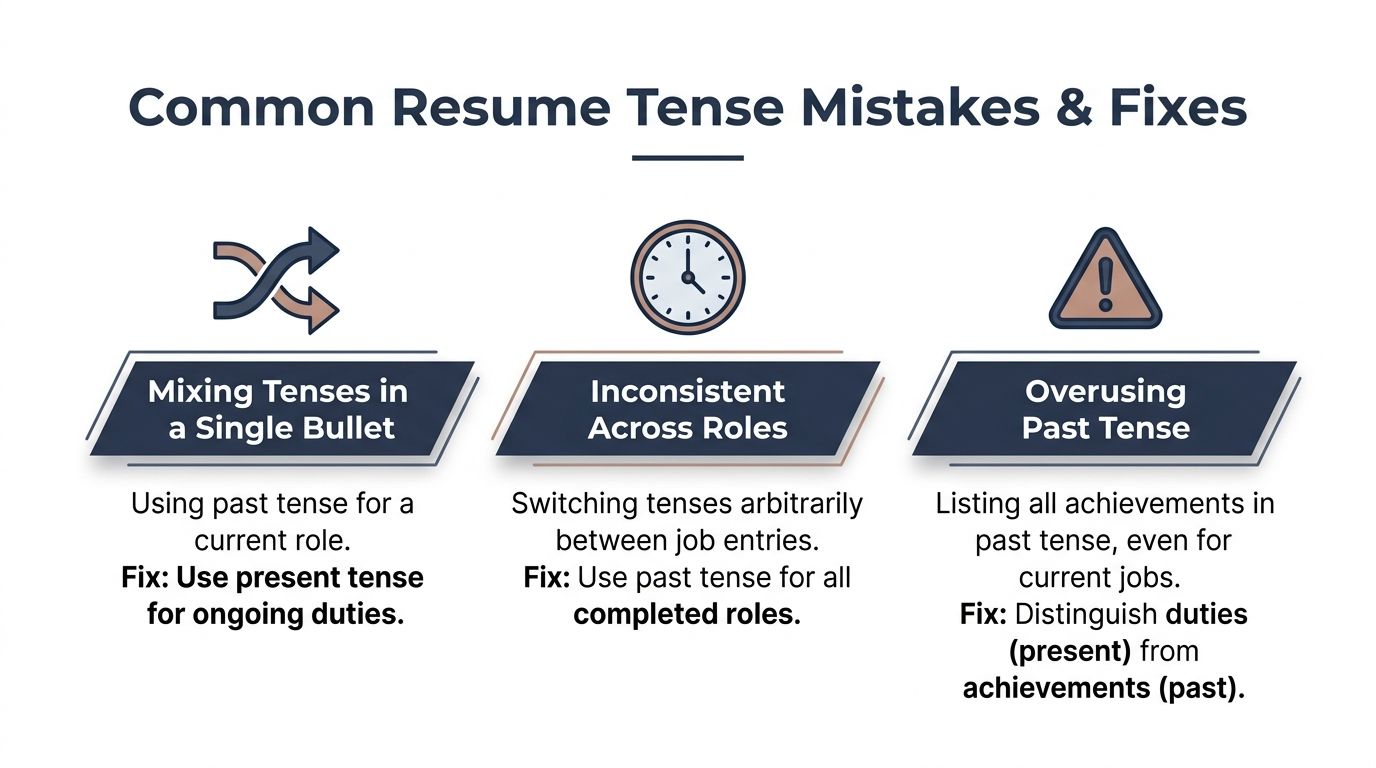
Mistake one, mixing tenses inside one bullet
Weak:
- Manage customer escalations and resolved recurring service issues.
Improved:
- Manage customer escalations and resolve recurring service issues.
Or, if the resolution is complete:
- Manage customer escalations and resolved a recurring service issue through a documented support workflow.
The reader should never have to infer why the verb changes.
Mistake two, writing a current role entirely in past tense
Weak:
- Managed the sales pipeline and created quarterly forecasts.
Improved:
- Manage the sales pipeline and create quarterly forecasts.
- Created a forecasting model that improved planning visibility.
The first bullet shows current ownership. The second preserves a completed achievement.
Mistake three, treating an active side project as finished
Weak:
- Built and maintained an active UX research portfolio.
Improved:
- Maintain an active UX research portfolio featuring usability studies and design recommendations.
If the portfolio is no longer active, the original past-tense wording is fine. Don't let the project label decide. Let the work status decide.
Mistake four, hiding the action behind vague phrases
Weak:
- Responsible for improving onboarding and helped with documentation.
Improved:
- Improve onboarding workflows and maintain employee documentation.
If the work ended:
- Improved onboarding workflows and created employee documentation.
“Responsible for” and “helped with” conceal ownership. Replace them with the clearest verb you can defend.
Watch the video below for another practical perspective on resume wording and tense.
Run a ten-minute fix pass
Open your resume and review each role from newest to oldest.
- Mark every verb: Label it ongoing or finished.
- Check each bullet: Remove tense switches that don't reflect a real status change.
- Rewrite vague phrases: Replace “responsible for” with a direct action.
- Review completed roles: Convert the entire entry to past tense.
- Read it aloud: Awkward shifts become obvious when you hear them.
Don't rewrite your whole resume because one bullet is wrong. Fix the lines that flip-flop, then scan the surrounding entry for the same problem.
A Quick Tense Audit Before You Hit Send
Treat the final review as a short audit, not another full rewrite. Tense is a small detail, but it signals whether you pay attention to accuracy and consistency.
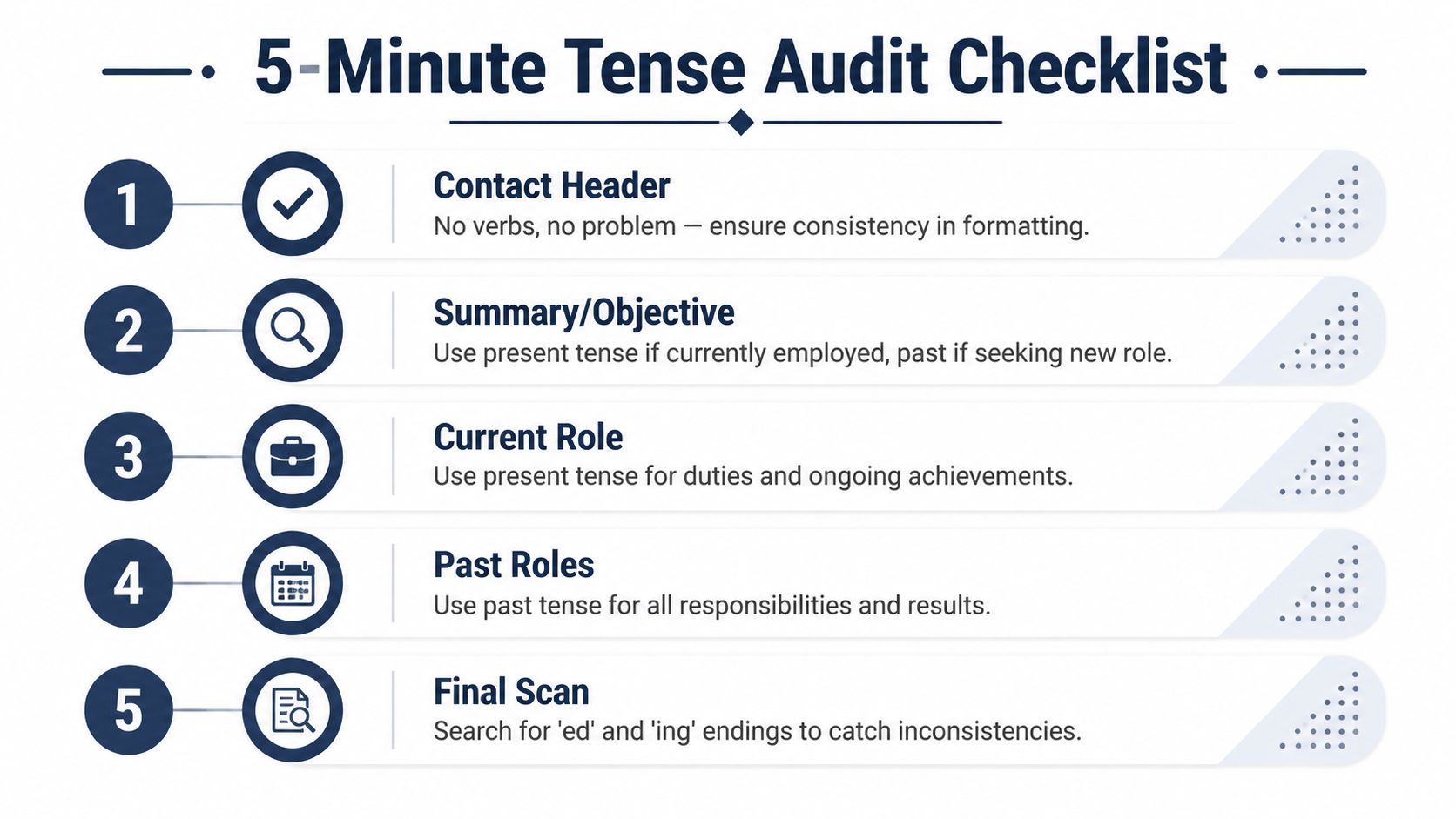
Use this checklist:
- Contact header: There should be no verbs to audit. Check formatting consistency instead.
- Summary: Use present tense for your current professional identity. Use past tense when you're citing completed proof points.
- Current role: Write ongoing duties in present tense. Use past tense for finished launches, awards, and results.
- Past roles: Use past tense for every responsibility and accomplishment.
- Education: Use past tense for completed degrees. Use present tense only when a degree or program is ongoing.
- Skills and certifications: Keep these in list form. They don't need full-sentence tense.
- Final scan: Search for common -ed and -ing endings, then investigate any unexpected switch rather than changing every verb automatically.
A free ATS resume checker can provide another formatting and parsing review, but no tool can decide whether a project is genuinely finished better than you can. Make the status decision first, then let the software help you catch inconsistencies.
The answer to “resume past tense or present tense” is not “pick one.” Use past tense for completed work, present tense for ongoing work, and both only when the status of each bullet supports the choice. Apply that rule before every application, especially when tailoring your resume to a different role.
If you want to move from tense cleanup to a job-specific, ATS-ready application, visit GetTheCall. It can import your LinkedIn profile or existing resume, analyze a target listing, align your verified experience with relevant keywords, and provide a live role-match score before you submit.