Resume of Finance Analyst: Build an ATS-Friendly One
Build an ATS-friendly resume of finance analyst that lands interviews. Get core competencies, quantifiable bullets, and keyword strategies that work.
You've built forecasts, reconciled actuals, automated reports, and presented numbers to decision-makers. Yet your applications disappear into silence. The frustrating part is that your experience may be solid while your resume of finance analyst experience fails to communicate it in the language hiring systems can process.
A strong finance analyst resume must do two jobs at once. It has to survive automated parsing and give a recruiter immediate evidence of analytical depth. That means naming the model type, tool, method, scope, and business outcome, not hiding behind phrases such as “supported reporting” or “strong analytical skills.”
Table of Contents
- Why Most Finance Analyst Resumes Never Reach a Human
- The Core Sections of a Finance Analyst Resume
- Keywords That Actually Rank Your Resume Higher
- Writing Bullets That Prove Analytical Depth
- Mapping Your Experience to the Job Description
- Choosing a Format That Parses Cleanly
- Your Pre-Submission Checklist
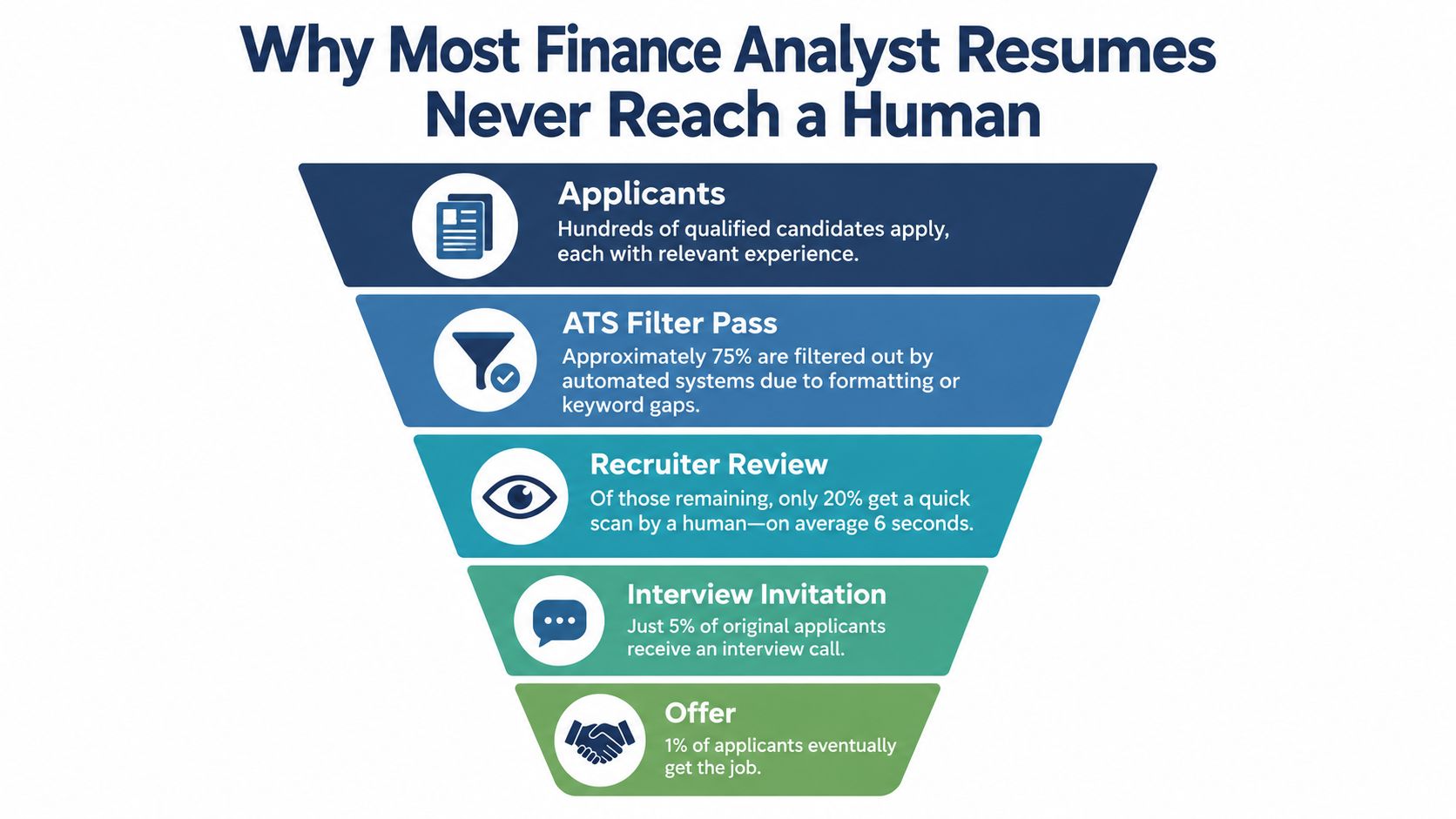
Why Most Finance Analyst Resumes Never Reach a Human
A senior analyst with years of Big Four experience can still lose to a less qualified applicant because the document is difficult for software to read. A two-column layout may place dates beside the wrong employer. A creative heading such as “What I Bring” may not map cleanly to a skills field. A chart showing “Excel proficiency” may disappear entirely during text extraction.
That risk is structural, not cosmetic. In 2025, 97.8% of Fortune 500 companies had a detectable applicant tracking system, according to research on ATS adoption and resume screening. For finance candidates, the first reviewer is often software that extracts contact details, titles, dates, skills, education, and experience before comparing the resulting text with the job description.
What the parser is actually doing
The system first breaks your file into structured fields. If formatting disrupts that process, your employer, job title, dates, or skills may be garbled before keyword matching begins. An explanation of ATS parsing behavior shows why complex layouts can fail without displaying an obvious error.
The next step is comparison with the posting. Modern scanners convert both documents into plain text, then assess terms by relevance and frequency. SkillSyncer's description of job-description matching reflects the practical reality: the employer's wording matters, especially when the posting repeatedly names a specific tool, model, or finance process.
That's why bullet quality comes after structural quality. A brilliant achievement won't help if the parser assigns it to the wrong role or drops it from the extracted text.
Recruiter rule: Make the resume boring to parse and interesting to read.
The Core Sections of a Finance Analyst Resume
Recruiters usually scan a finance resume in a predictable sequence: contact information, summary, skills, recent experience, then education. Build the page in that order so both the reader and the software encounter the information where they expect it.
Start with a clean identity block
Use one line for your name, city and state, phone, professional email, and LinkedIn URL. Leave out a full street address, headshot, and “References available upon request.”
Better:
Alex Morgan | Boston, MA | 555-555-5555 | alex.morgan@email.com | linkedin.com/in/alexmorgan
Avoid:
A graphic-heavy header with icons, a photo, and contact information split between a sidebar and footer.
Make the summary specific
Your summary should take about three lines. Identify your level, specialization, sectors, and strongest technical tools.
Better:
Senior financial analyst with corporate finance and FP&A experience supporting consumer businesses. Builds rolling forecasts, variance analysis, and three-statement models in Excel, SQL, and Power BI. Partners with operations and executive teams to turn financial data into planning decisions.
Avoid:
“Results-oriented finance professional with excellent communication skills seeking a challenging opportunity.”
The second version makes claims without evidence and wastes valuable keyword space.
Group skills without creating a keyword dump
Use a compact cluster of relevant tools and methods, grouped under clear labels such as Financial Modeling, Data and BI, Reporting, and Credentials. Include exact terms you use, including Excel, DCF, FP&A, forecasting, SQL, Power BI, Tableau, SAP, Oracle, or NetSuite when relevant.
Give experience the most room
List company, title, and dates clearly. Use three to five bullets for substantial roles, with the strongest and most relevant accomplishment first.
Better:
Senior Financial Analyst, FP&A | Company Name | 2022 to Present
Built a rolling forecast in Excel and Power BI, linking revenue assumptions to operating expenses and monthly variance commentary.
Avoid:
Finance Team | Various Duties | Present
Responsible for reports, budgets, and analysis.
Education belongs near the bottom for experienced candidates. Entry-level applicants can move it higher and add relevant coursework, projects, or credentials.
Keywords That Actually Rank Your Resume Higher
Most keyword advice misses the point. A finance resume doesn't rank because you pasted a long skills list into the bottom of the page. It performs better when the right terms appear naturally in the summary, skills section, and experience bullets, where they're connected to actual work.
Across 4,686 financial analyst job postings, the most frequent terms were financial analysis at 57.2%, Excel at 42.9%, analytical skills at 37.5%, communication skills at 36.8%, financial modeling at 36.4%, and budgeting at 32.8%, based on the financial analyst posting analysis. Those terms tell you what belongs in the document, but they don't tell you to repeat them mechanically.
Build four keyword families
| Category | High-Signal Keywords | Posting Frequency |
|---|---|---|
| Core analysis | Financial analysis, analytical skills, financial modeling | 57.2%, 37.5%, 36.4% |
| Tools | Excel | 42.9% |
| Communication and planning | Communication skills, budgeting | 36.8%, 32.8% |
| Role-specific terms | DCF, LBO, SQL, Power BI, Tableau, FP&A, variance analysis | Varies by posting |
The first six frequencies come from the verified posting-frequency analysis. The remaining terms should be treated as job-specific requirements, not universal claims about every posting.
Turn terms into evidence
A skills list might say “Excel, Power Query, forecasting.” A stronger bullet shows how those items worked together:
- Built a three-statement model in Excel and Power Query to support scenario analysis for a capital allocation decision.
- Automated rolling cash-flow forecasting with Excel Power Query, giving finance leaders a repeatable view of liquidity assumptions.
- Prepared FP&A variance analysis in Power BI, connecting monthly actuals with budget commentary for operating stakeholders.
The specific dollar amount or result belongs in the bullet only if you can verify it. Never add a number because a template suggests one.
Guidance on finance analyst ATS keywords recommends extracting the target posting, grouping repeated requirements into five to seven competency clusters, and mirroring exact tool and model names. That approach beats stuffing every possible term into a separate block because it proves you've used the language in context.
Writing Bullets That Prove Analytical Depth
“Responsible for financial analysis and reporting” tells a recruiter almost nothing. It doesn't identify the work product, the system, the financial method, or the decision the analysis supported.
Use this formula instead:
Action + Scope + Method + Tool + Outcome
The outcome can be a verified dollar amount, percentage, time reduction, accuracy change, volume, or decision supported. If you don't have a defensible metric, describe the business result qualitatively rather than inventing one.
Three useful rewrites
Weak:
Responsible for financial analysis and reporting.
Stronger:
Built monthly management reporting in Tableau, combining revenue, expense, and variance analysis for leadership review.
This version names the platform, reporting process, and analytical method. Add a measured outcome only when your records support it.
Weak:
Helped with financial modeling for potential investments.
Stronger:
Built DCF and comparable-company models in Excel to evaluate investment scenarios and prepare materials for senior review.
Now the reader knows the model types, tool, and purpose. If you worked on an LBO model, say LBO model. Don't hide a recognizable finance deliverable behind “valuation work.”
Weak:
Assisted with budgeting and forecasting.
Stronger:
Forecasted operating expenses by business unit in Excel, reconciled actuals to budget, and prepared variance commentary for planning discussions.
That bullet demonstrates ownership of a process without claiming an unsupported result.
Choose verbs that show finance work
Use built, modeled, automated, reconciled, forecasted, analyzed, evaluated, consolidated, presented, and partnered when they accurately describe your contribution. Avoid relying on “helped,” “assisted,” and “responsible for,” because those phrases describe proximity to work rather than the work itself.
Finance resume keyword guidance recommends pairing a tool, method, and outcome instead of making an unsupported capability claim. The principle is simple: name the artifact you created and the decision or process it improved.
Bullet test: If someone removed your job title, would the bullet still reveal that you work in finance?
Lead with the most important scope when it matters. “Owned the forecast for four business units” is clearer than burying that responsibility after a long introductory phrase. But don't manufacture dollar values or percentages. A precise qualitative description is stronger than a fake metric.
Mapping Your Experience to the Job Description
A hiring manager should see the match within seconds. Treat the job description as your guide for each application, then choose evidence that supports the target role.
Extract three groups from the posting:
- Required methods, such as forecasting, variance analysis, DCF, budgeting, or three-statement modeling.
- Required tools, such as Excel, SQL, Power BI, Tableau, SAP, Oracle, or Anaplan.
- Business context, such as FP&A, capital allocation, M&A, board reporting, or cross-functional partnership.
Audit your resume against those groups. Place each requirement inside a credible work example, not only in a keyword block. If forecasting dominates the posting, lead the relevant position with a forecasting bullet. If the role centers on M&A, prioritize transaction modeling and diligence over routine monthly reporting.
Use a simple T-shape test
The vertical part of the T measures depth. Can your resume prove the exact analysis the role requires, including the model type, tool, and business use? The horizontal part measures breadth. Does it also show communication, stakeholder management, reporting, systems, and commercial judgment?
A candidate moving from accounting into FP&A can frame a reconciliations-heavy role around forecasting inputs, budget-versus-actual analysis, and business partnering when those activities were part of the job. Someone moving from operations into finance can emphasize dashboarding, KPI tracking, cost analysis, and collaboration with finance teams without claiming to have built models independently.
Use this guide to tailoring a resume to a job description for a practical workflow, then review every claim yourself.
Keep alignment truthful. Do not insert “DCF,” “SQL,” or “FP&A” into unrelated bullets. Interviewers may test those terms. If you have not used a tool, leave it out or describe adjacent experience accurately. A precise transfer of real work beats keyword stuffing every time.
Choosing a Format That Parses Cleanly
The safest default is a single-column, reverse-chronological resume with literal headings such as Work Experience, Education, and Skills. That structure matches common ATS expectations and lets a hiring manager understand your career progression without hunting through design elements. ATS formatting guidance specifically warns that tables, text boxes, columns, graphics, headers, footers, and photos can interfere with parsing.
A hybrid format can help a career switcher or return-to-work candidate foreground transferable finance capabilities before the employment history. A functional format may suit a consulting-heavy background, but it can also make chronology less clear. Use either only when it solves a real positioning problem, not because a template looks more modern.
Remove quiet parsing hazards
Avoid putting dates in a right-aligned text box, hiding skills inside a table, or placing your phone number in a footer. Decorative skill bars don't communicate proficiency reliably, and icons create noise without giving the parser useful text.
Use a readable font, clear spacing, and consistent date formats. For length, one page is usually enough for an analyst with less than five years of experience, while a more experienced candidate may need two pages to show relevant depth. Don't shrink the type to preserve weak bullets.
File handling matters too. Follow the portal's instructions on PDF or Word format, and use a descriptive filename such as Alex_Morgan_Finance_Analyst.pdf. Before submitting, paste the entire document into a plain-text editor. If the reading order changes, the ATS may see the same problem.
For a practical reference, review this ATS-friendly resume guide before finalizing the layout.
Your Pre-Submission Checklist
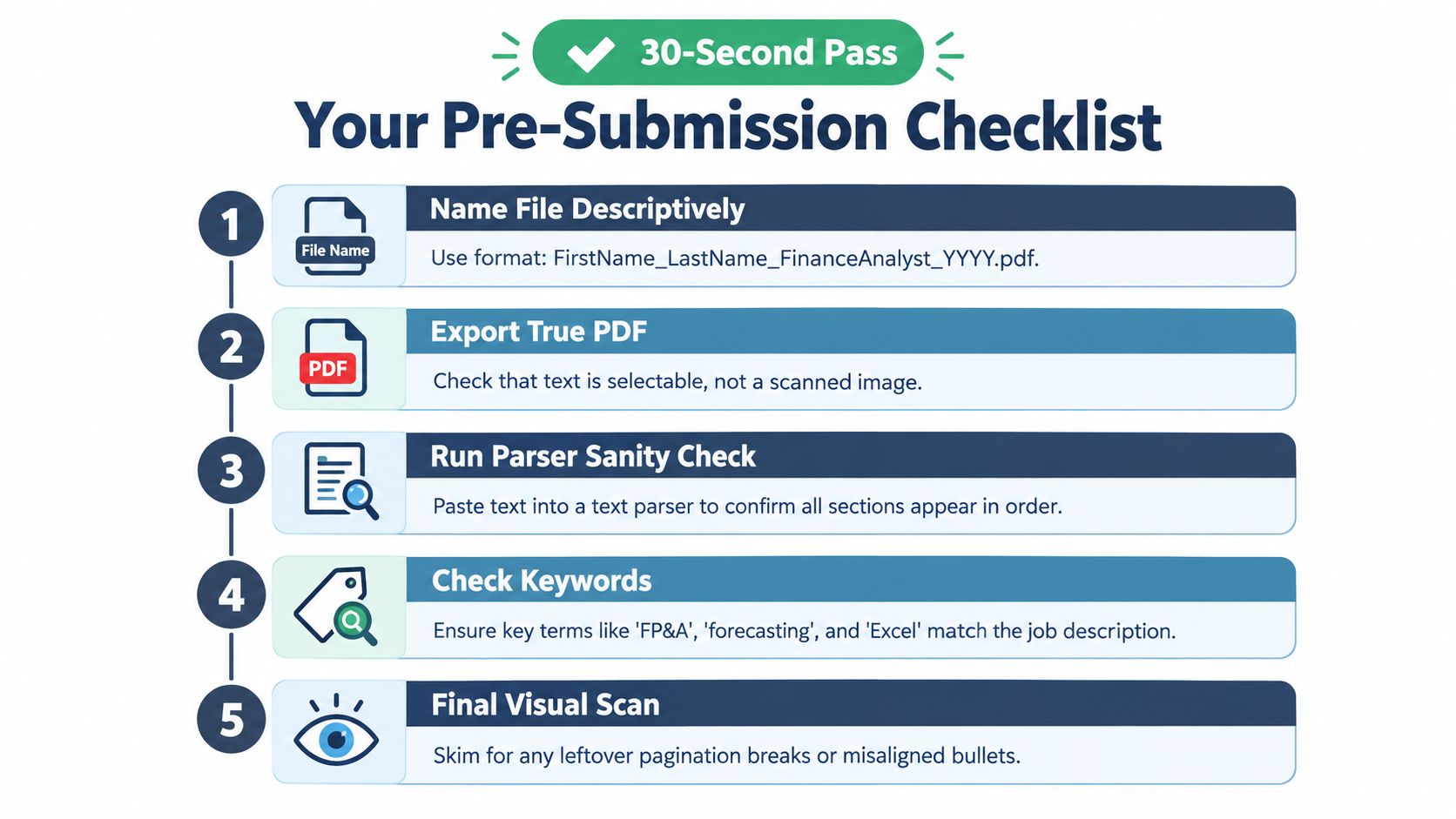
Run this pass before every application. It should be quick, but don't skip it.
- Name the file clearly. Use your name and target role, such as
FirstName_LastName_FinanceAnalyst_YYYY.pdf. - Export a true PDF. Confirm that the text is selectable. A scanned image may look perfect to you and still be unreadable to an ATS.
- Test the reading order. Copy the resume into a plain-text editor and check that headings, dates, employers, and bullets appear in the correct sequence.
- Check the opening third. Make sure the target job title and the three most important job-specific keywords appear early, supported by honest evidence.
- Inspect every bullet. Confirm that each metric is current and defensible, and that the strongest line names the action, model or tool, and outcome.
Use an ATS resume checker to catch missing terms and parsing issues, but treat its suggestions as a review aid, not permission to claim experience you don't have.
Read your strongest bullet aloud. If it doesn't tell a recruiter what you built, which tool or method you used, and what changed because of your work, rewrite it before you apply.
GetTheCall can import your LinkedIn profile or existing resume, analyze a target job listing, suggest job-specific revisions based on your actual experience, and export an ATS-ready PDF with a live role-match score. Visit GetTheCall to tailor your finance analyst resume before submitting your next application.