7 Resume for Real Estate Agent Examples That Get Interviews
Explore 7 resume for real estate agent examples with ATS-friendly phrasing, sample bullets, keywords, and actionable tailoring tips.

The most popular real estate resume advice is to lead with impressive sales numbers. That's useful for an established producer, but it's the wrong starting point for a newly licensed agent, leasing professional, or brokerage manager. Lead with the strongest evidence for the role you want, not the biggest number you can put on the page.
A strong resume for real estate agent hiring makes qualifications easy to verify and connects experience to the brokerage's priorities. For a residential sales position, that means personal production and client acquisition. For a leadership role, it means coaching, recruiting, and operational oversight. For a new agent, it means licensing, disciplined follow-up, and credible transferable experience.
Your document also needs language that applicant tracking systems and hiring managers can recognize. Use the listing's terminology where it accurately describes your work, then support it with a clear example.
Start with relevance: Choose the format that explains why you're ready for this specific job. Don't stretch your history to fit a more impressive-looking template.
The formats below show how to organize that evidence without exaggerating experience. Treat sample bullets as wording models, not accomplishments to copy. Replace bracketed fields with verified details, and remove any statement you can't substantiate.
Table of Contents
- 1. Production-Focused Sales Resume
- 2. New Agent Resume for Recently Licensed Professionals
- 3. Brokerage Leadership and Team Management Resume
- 4. Career Switcher Resume for Entering Real Estate
- 5. Commercial Real Estate Agent Resume
- 6. Property Management and Leasing Agent Resume
- 7. Digital-First Listing Specialist Resume
- 7 Real Estate Agent Resume Examples Compared
- Tailor the Resume, Keep the Proof Real
1. Production-Focused Sales Resume
Use this format when your personal residential sales results are your strongest qualification. Put a performance summary below your contact information and license details, followed by reverse-chronological experience, relevant tools, and education.
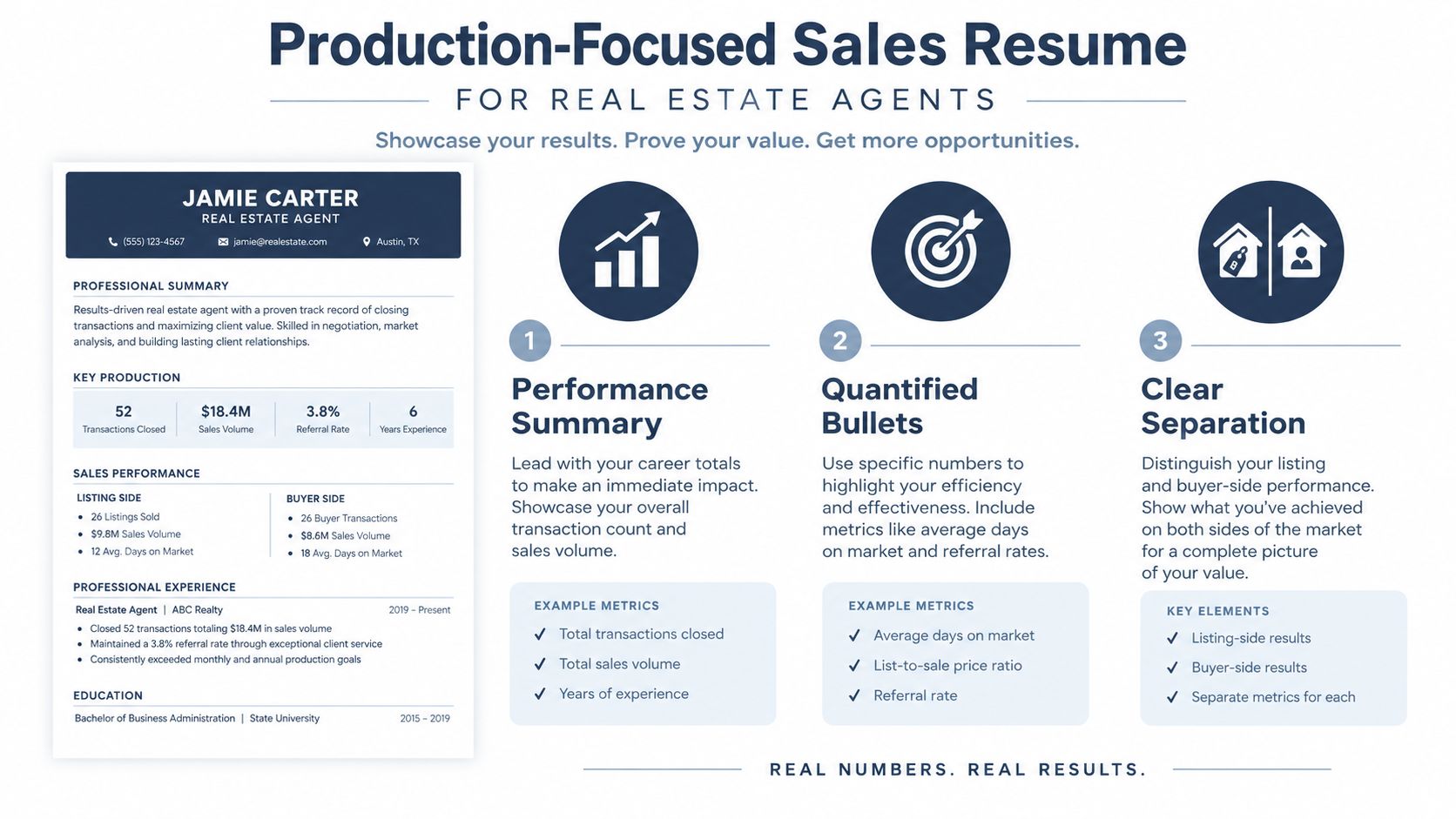
Brokerages need enough context to interpret your production. Identify the market, property type, reporting period, and whether you represented buyers, sellers, or both. Transaction sides and sales volume aren't interchangeable, so label each measure accurately.
The National Association of REALTORS® member profile reported that the typical member completed 10 transactions during 2024, with median sales volume of $2.5 million. Those are industry reference points, not figures to borrow for your own resume.
Build bullets around attributable results
Adapt these examples only when your records support them:
- Production: Closed [verified transaction count] residential transactions totaling [verified sales volume] across [market] during [period].
- Listing execution: Managed pricing recommendations, seller updates, and offer negotiations for [property specialization].
- Business development: Generated [verified share] of personal business through past-client outreach and referrals.
Use closing statements, brokerage reports, or MLS records to verify results. If you include a producer ranking, identify the awarding organization and period rather than writing an unsupported “top producer” claim.
Keep earned designations such as ABR, CRS, or GRI on a dedicated credentials line. Follow an ATS-friendly resume structure with standard headings and readable text.
For a listing-focused opening, emphasize pricing, listing presentations, and seller communication. For a buyer-team opening, prioritize buyer consultations, prospecting, and contract coordination. Keep the underlying production figures unchanged.
2. New Agent Resume for Recently Licensed Professionals
You don't need a closing history to demonstrate readiness. You need a visible license, relevant training, and evidence that you can communicate with clients, organize follow-ups, and learn brokerage processes.

Place your licensing section near the top, followed by a short summary, relevant experience, training, and software skills. The Bureau of Labor Statistics occupational overview states that every state requires real estate sales agents to be licensed. State your actual status clearly, and include your license number if the posting requests it.
A useful summary connects your background to agent responsibilities: “Recently licensed real estate agent bringing customer-service experience, structured follow-up habits, and knowledge of [local market].”
Show readiness without inventing production
A former retail employee can demonstrate client communication. A brokerage assistant can show transaction support, but shouldn't claim the team's closings as personal sales.
- Customer service: Resolved customer concerns, documented next steps, and maintained communication through resolution.
- Administrative support: Organized appointment schedules and maintained accurate customer records in [software].
- Brokerage exposure: Supported open-house preparation, recorded visitor inquiries, and routed follow-up requests to the supervising agent.
Add prelicensing education and completed broker training using the provider's actual course title. Don't turn classroom exercises into professional transaction experience.
Supported transactions are credible experience. They aren't personal production.
Tailor your skills to the listing's genuine requirements, such as client relations, lead generation, CRM, or appointment scheduling. If you haven't used the requested platform, list the system you know rather than substituting the employer's preferred name. Keep your growth plan brief and practical, such as completing brokerage onboarding and developing a documented prospecting routine.
3. Brokerage Leadership and Team Management Resume
A managing broker's resume shouldn't read like an individual agent's production report with a management title added. Show what you helped other agents accomplish and which operations you owned.

Open with your leadership scope: office responsibility, agent supervision, recruiting, onboarding, transaction review, or business planning. Keep your broker license and state visible. Separate personal sales from team or office production so the reader can evaluate each fairly.
Describe the management work behind the result
For a team leader who built onboarding processes, useful sample bullets include:
- Agent development: Created onboarding materials covering CRM setup, listing preparation, client communication, and transaction-file procedures.
- Coaching: Reviewed agent pipelines and used individual coaching sessions to address prospecting and follow-up gaps.
- Operational oversight: Coordinated file reviews, tracked unresolved documentation, and escalated compliance questions to the responsible broker.
Add verified retention, recruiting, or production results when you have records. Explain your contribution instead of implying that every office result came from your leadership.
Current transaction knowledge also belongs in this format. The Federal Reserve's analysis of broker compensation changes explains that compensation offers can no longer be communicated through MLS listings under the changed practices, and agents working with buyers must use written agreements before touring homes.
If you trained agents on buyer-representation agreements, compensation disclosures, or fee discussions, describe that work specifically. Don't claim legal expertise because you administered a process.
Match the opening's emphasis. A recruiting-heavy position needs evidence of sourcing and onboarding; an operations-heavy role needs file oversight, workflow management, and clear accountability. Keep leadership terms attached to actions, not isolated in a skills list.
4. Career Switcher Resume for Entering Real Estate
A hospitality manager and a teacher can both bring valuable experience to real estate. Neither should rename past work to make it sound like property sales. Translate the relevance, not the job title.

Use a combination format: a concise transition summary, relevant capabilities, then a clearly dated employment history. State your licensing status separately so the reader doesn't have to infer whether you're ready to practice.
Your summary should explain what you bring, not apologize for what you lack. For example: “Customer-service professional transitioning into real estate, bringing experience coordinating complex schedules, resolving concerns, and maintaining long-term client relationships.”
Connect past work to brokerage priorities
A hospitality professional can write:
- Coordination: Managed client requirements, vendor schedules, and last-minute changes while maintaining clear communication.
- Negotiation: Discussed service options and contract terms with clients and escalated exceptions for approval.
A former teacher can emphasize documented family communication, appointment organization, and explaining complex information. Those examples support communication and follow-through, but they don't establish real estate negotiation experience.
Keep the original context visible. Recruiters should understand both what you did and why it matters for the new role.
Use a repeatable process for tailoring your resume to a job description. Identify the brokerage's main responsibilities, find genuine parallels in your work history, and rewrite the relevant bullets using accurate language.
For a prospecting-focused opening, highlight outreach and appointment setting. For a client-service team, prioritize issue resolution and coordination. Don't hide previous employers or dates behind a skills-only document; let the hiring manager see a deliberate transition supported by real experience.
5. Commercial Real Estate Agent Resume
Commercial applicants need to show what they represented, what they analyzed, and how they contributed to the deal. A broad “real estate sales” summary leaves too much unanswered for a role centered on office leasing, industrial transactions, or investment property.

Lead with your property specialization and representation experience. Follow with a selected-transactions section or achievement-focused work history, then analytical tools, credentials, and education. Include an earned designation such as CCIM prominently, but don't present coursework toward a designation as the completed credential.
Make deal experience readable
Use bullets that distinguish execution from support:
- Tenant representation: Represented [client category] in [property type] lease negotiations covering [verified area], coordinating proposals and business-term comparisons.
- Market analysis: Analyzed submarket availability, comparable asking rents, and competing properties using [tools used].
- Transaction support: Prepared lease summaries and coordinated due-diligence materials for the lead broker's review.
If confidentiality restricts disclosure, anonymize the parties and describe the property category, transaction type, and permitted deal details. Don't disclose client-sensitive terms merely to make a bullet more impressive.
Tailor commercial vocabulary carefully. Use tenant representation, landlord representation, lease abstraction, underwriting, or financial modeling only where your responsibilities support the term. Naming CoStar is useful when you've used it; explain whether you researched comparables, evaluated availability, or prepared market reports.
For an investment-sales opening, prioritize analysis and acquisition support. For a leasing position, move prospect outreach, tours, proposals, and lease negotiations higher. Follow the employer's requested file format and inspect the exported document for missing characters, broken headings, and unreadable text before submitting it.
6. Property Management and Leasing Agent Resume
Start with the operating responsibility you can prove: the portfolio you supported, the residents you served, and the leasing or maintenance processes you managed. This format should establish reliability as clearly as sales ability.
A leasing candidate who handled inquiries and tours needs a different emphasis from a property manager responsible for vendors, renewals, and owner reporting. Use a role-specific summary, then experience organized around the responsibilities in the opening. Put software names in a visible skills section and connect the most relevant tools to actual work.
Use operational evidence, not broad claims
Consider a leasing professional who coordinated prospective-resident communication but didn't control pricing or approve applications. These bullets describe that scope:
- Leasing communication: Responded to rental inquiries, scheduled tours, and documented prospect requirements in [leasing platform].
- Renewal support: Tracked upcoming lease expirations and coordinated renewal outreach with the property manager.
- Maintenance coordination: Logged resident requests, arranged vendor access, and followed up on completion status.
Add occupancy, renewal, or response-time metrics only when you can verify the reporting period and your responsibility. Distinguish a portfolio-wide result from an improvement directly attributable to your work.
Scope matters: A strong support-role resume explains the process you owned instead of claiming responsibility for the entire property's performance.
When a listing mentions fair housing or landlord-tenant compliance, identify your relevant training and procedures. Don't claim full legal knowledge based on routine leasing duties.
For an operations-heavy position, foreground vendor coordination, documentation, and resident issue resolution. For a leasing-focused opening, emphasize inquiry handling, tours, application follow-up, and move-in coordination. Select the strongest bullets rather than listing every recurring task, and verify that software names remain readable in the final file.
7. Digital-First Listing Specialist Resume
A digital-first resume needs more than social media activity. Connect marketing work to qualified inquiries, appointments, listing consultations, or attributable transactions. Keep visual polish secondary to evidence.
This format suits an agent who manages listing campaigns, CRM follow-up, online lead generation, or property content. Lead with a marketing-and-sales summary, then campaign results, work history, tools, and licensing. If you include a portfolio, use your own accessible link and confirm that client permissions allow sharing.
Follow the lead beyond the click
The National Association of REALTORS® account of agent business sources reports that past clients and customers generated 28% of the typical agent's business. That makes relationship nurturing worth showing alongside paid acquisition and listing promotion.
For an agent who produces neighborhood content and manages follow-up, adapt bullets such as:
- Listing marketing: Coordinated property photography, listing copy, and campaign publication across [channels used].
- Lead nurturing: Organized incoming inquiries in [CRM], assigned follow-up tasks, and tracked progression to consultations.
- Campaign reporting: Compared inquiry quality and appointment outcomes across [campaign types] to guide future marketing decisions.
The accompanying video offers another resume resource.
Keep attribution honest. Website visits aren't qualified leads, and leads aren't closed transactions. State how you defined each outcome and whether another team member handled the sale.
Tailor keywords such as CRM, lead nurturing, listing marketing, email campaigns, and social media advertising to your actual responsibilities. Use an ATS resume checker to inspect parsing and keyword issues, but don't treat a match score as a guarantee of an interview.
7 Real Estate Agent Resume Examples Compared
| Resume Type | Ideal Use Case | 🔄 Complexity & Resources | 📊 Expected Outcome | ⭐ Key Advantage | 💡 Main Consideration |
|---|---|---|---|---|---|
| Production-Focused Sales | Established residential agents with verifiable sales history | Low–moderate; requires accurate transaction and volume data | Highlights production, sales volume, and performance consistency | ⚡ Strong, measurable proof for brokerage recruiters | Limited production or unverifiable figures can weaken the resume |
| New Agent | Recently licensed professionals with little or no transaction history | Moderate; emphasizes licensing, training, and transferable skills | Presents readiness, credibility, and potential for growth | Avoids relying on sales history the candidate does not have | Tie transferable skills clearly to real estate |
| Brokerage Leadership & Team Management | Managing brokers, team leaders, and office managers | High; needs credible team, retention, revenue, and operational metrics | Demonstrates leadership scope and business impact | ⭐ Positions candidates for senior, higher-responsibility roles | Requires genuine management experience and specific evidence |
| Career Switcher | Professionals moving into real estate from another field | Moderate; requires reframing past experience and explaining the transition | Connects prior achievements to real estate responsibilities | Makes transferable experience relevant and intentional | Avoid generic skills claims; explain the move clearly |
| Commercial Real Estate Agent | Agents focused on office, retail, industrial, or multifamily deals | High; requires deal data, market analysis, and industry terminology | Shows transaction expertise and analytical capability | 📊 Specific deal metrics distinguish the candidate | Protect confidential details and use accurate commercial language |
| Property Management & Leasing | Candidates seeking leasing, property management, or rental operations roles | Moderate; requires operational metrics, software, and compliance knowledge | Demonstrates reliability and operational performance | ⚡ Quantifiable occupancy, renewal, and service results | Prioritize achievements over long duty lists |
| Digital-First Listing Specialist | Agents focused on online marketing, listing promotion, and lead generation | Moderate; requires platform metrics, tool knowledge, and ATS-friendly formatting | Shows digital reach, lead generation, and marketing impact | 💡 Highlights technical skills and measurable online performance | Connect engagement metrics to qualified leads or business outcomes |
Tailor the Resume, Keep the Proof Real
Choose the format that matches the job, then adapt the emphasis without changing the facts. An established agent can lead with personal production; a new agent can lead with licensing and relevant customer experience. A manager should make leadership scope clear, while a specialist should show the transaction types, tools, and workflows that match the opening.
Start with a truthful result or responsibility, connect it to a relevant skill, and explain the context. A production figure needs a reporting period and clear attribution. A support accomplishment needs an accurate description of your role. If a number can't be verified, replace it with a precise qualitative statement rather than an estimate presented as fact.
Tailor the language, not the history
Read the brokerage listing for responsibilities, required credentials, and named tools. Move the most relevant evidence higher, then revise bullets so the connection is obvious. Don't add a platform, designation, or transaction specialty because it appears in the advertisement.
Use standard headings such as Summary, Experience, Licenses, Education, and Skills. Keep essential qualifications in ordinary text rather than relying on graphics. Follow the application's file instructions, inspect the final export, and confirm that you can select and copy its text in a sensible reading order.
Before submitting, compare the document with your supporting records:
- Attribution: Separate personal results from team, office, or portfolio outcomes.
- Consistency: Check titles, employment dates, license details, and reporting periods.
- Relevance: Remove unsupported adjectives and unrelated responsibilities.
- Readability: Confirm that credentials, software names, and achievements remain easy to find.
GetTheCall can support this workflow by importing an existing resume or LinkedIn profile, analyzing a target listing, and aligning wording with your actual experience. Its live ATS Role Match score provides feedback while you edit, and its layouts and PDF export help prepare the final document.
Keep human judgment in the process. Review every generated sentence, reject suggestions that overstate your background, and save a version for the specific brokerage. You don't need to look like every other candidate. You need to make your genuine qualifications clear enough for the right employer to evaluate.
Bring your current resume or LinkedIn profile and a target brokerage listing to GetTheCall. Use its job-specific tailoring, live role-match feedback, and PDF export to build a real estate resume that highlights your relevant experience without inventing credentials or results.