Resume for Promotion Within Same Company: Proven Strategies
Learn to craft a compelling resume for promotion within same company. Highlight achievements, align with internal goals, and stand out in 2026.

You've found an internal role that looks like the natural next step. Your manager knows your work, colleagues recognize your contribution, and you may already be doing parts of the job. Yet the application still asks for a resume, and the document you used for external opportunities doesn't quite fit. It describes your career history, but it doesn't make the promotion case.
A strong resume for promotion within the same company has to perform two jobs at once. It must use language that an internal Applicant Tracking System, or ATS, can recognize, while translating familiar projects and achievements for leaders who know the organization but may not know the full scope of your work. The most persuasive version shows not only what you've done, but why your results demonstrate readiness for the target role.
Table of Contents
- Why Internal Resumes Require a Different Strategy
- Mapping Your Growth to the Target Role
- Formatting for Upward Mobility and Scope
- Translating Internal Jargon into Business Impact
- Optimizing for the Internal ATS Screening
- Finalizing Your Internal Promotion Case
Why Internal Resumes Require a Different Strategy
Your manager has seen your work, a senior leader remembers your last project, and colleagues know your internal reputation. You apply for the next role anyway, then discover that your external resume does not explain the case clearly. It lists responsibilities, but it does not show how your scope has grown or why promoting you serves the business.
A resume for promotion within the same company has two audiences. The internal ATS needs recognizable job-title language, capabilities, and terms from the posting. The hiring manager needs a concise explanation of your progression, judgment, and results. Internal translation connects those needs by converting project names, team shorthand, and company jargon into business-impact language.
Familiarity can work against you. Reviewers may remember a title or visible deliverable while missing the process you changed, the stakeholders you aligned, or the risk you prevented. Your resume should document the parts of your contribution that casual familiarity leaves out.
LinkedIn's analysis reported that internal mobility, defined as employees changing job titles while staying with the same company, rose from 18.7% in 2021 to 24.4% in 2023, an increase of 5.7 percentage points, or about 30% relative growth (LinkedIn internal mobility analysis). As internal moves become a more visible career path, relevant tenure alone will not distinguish your application. The evidence must show progression and readiness.
The ATS and the human case
The ATS checks whether your resume aligns with the target posting. The hiring manager checks whether your recent work demonstrates the level required. Address both in every major entry.
Use the target title, relevant capabilities, systems, and role terminology where they accurately describe your experience. Then explain the business meaning of the work. “Supported the launch of Project Atlas” leaves an outsider guessing. “Coordinated Product, Operations, and Compliance to launch a revised customer onboarding workflow” identifies the teams, action, and operational result.
Practical rule: Treat your resume as a promotion packet, not a record of attendance.
Your insider knowledge matters because it lets you explain decisions, dependencies, and organizational context. Tenure by itself does not prove readiness. Show the decisions you influenced, the teams you coordinated, and the measurable or observable improvements you delivered. A reviewer outside your immediate group should understand how your current experience transfers to the target role.
A 2023 LinkedIn Talent Trends report found that internal mobility was trending upward across 16 of 19 global industries, even as hiring slowed in many organizations (LinkedIn Talent Trends coverage). Internal applications therefore need the tailoring expected of external applications, with greater emphasis on progression, organizational impact, and clear translation of internal work.
Mapping Your Growth to the Target Role
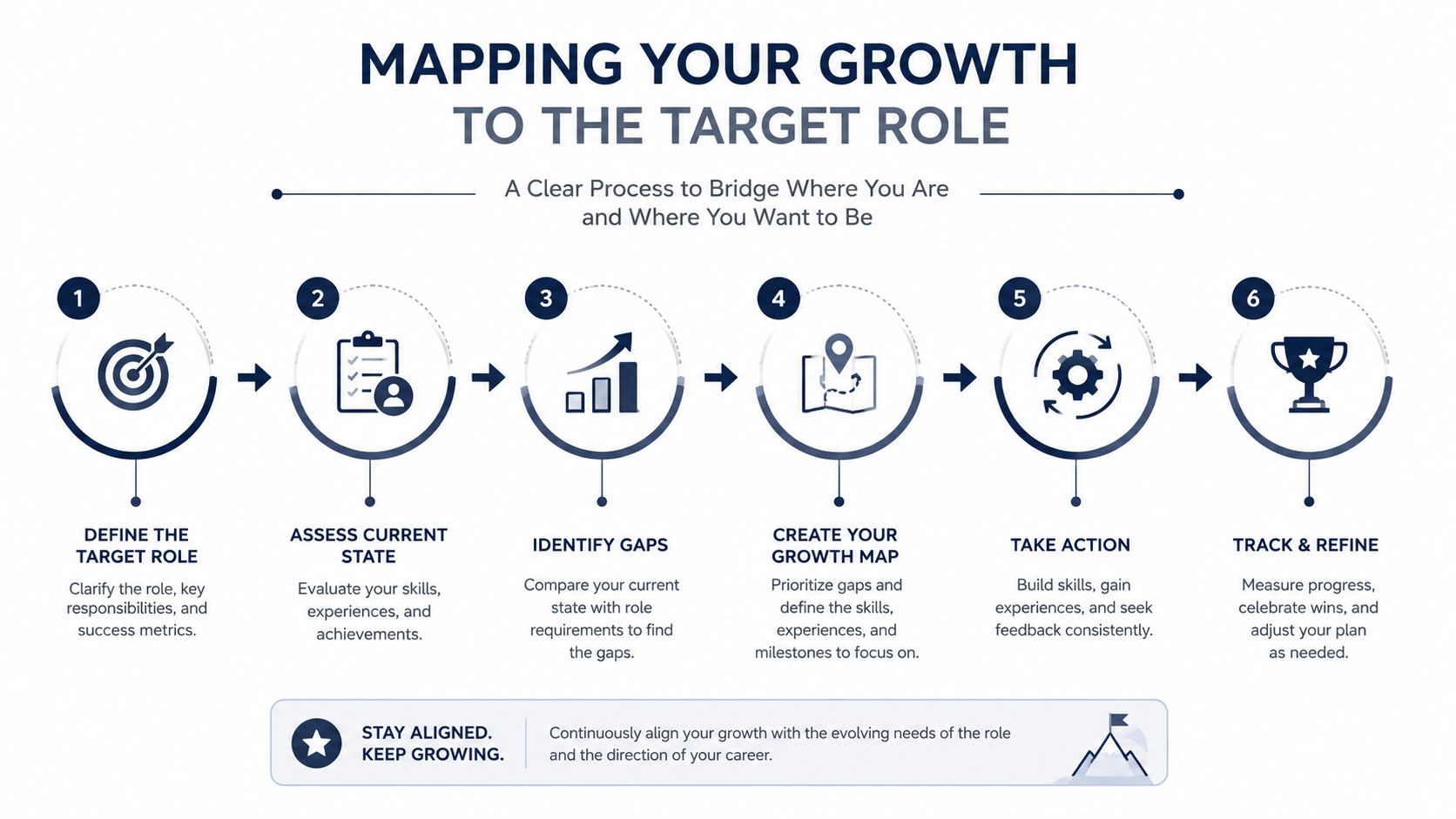
Start with the internal job posting, not with your existing resume. The posting gives you the employer's definition of success, while your current resume reflects how you've described yourself in the past.
Save the posting as a document or PDF before the role closes. Then separate its content into three groups:
- Required capabilities: skills, methods, systems, and knowledge the role explicitly demands.
- Expected outcomes: improvements, deliverables, decisions, or business results attached to the position.
- Scope signals: leadership, cross-functional ownership, strategic planning, budget responsibility, or stakeholder management.
A practical internal-promotion workflow recommends extracting the exact requirements and mapping each one to verifiable achievements from the last 12 to 18 months (internal promotion resume workflow). This timeframe keeps the document focused on recent evidence that reflects your current operating level.
Build a requirement-to-proof map
Create a private working table before you edit the resume.
| Posting requirement | Your evidence | Proof to include |
|---|---|---|
| Lead cross-functional initiatives | Coordinated work across teams | Stakeholders, decision, outcome |
| Improve operational performance | Changed a process or workflow | Before-and-after result |
| Manage senior relationships | Presented recommendations to leadership | Decision influenced or issue resolved |
| Own reporting or governance | Built a recurring review process | Adoption, clarity, or risk reduction |
Use the posting's wording where it accurately describes your experience. If the role asks for “stakeholder management,” don't hide that evidence beneath “worked with different teams.” If it calls for “program governance,” use that phrase when your work involved governance.
For each requirement, write the strongest available achievement bullet. Begin with an action, explain the work, and finish with the result. “Managed weekly reporting” is a responsibility. “Established a weekly performance review that gave Operations and Finance a shared view of delivery risks” is closer to promotion evidence.
Prune without hiding your history
Remove older experience that doesn't support the target role, or compress it into a brief prior-experience entry. Internal reviewers rarely need every task you've completed. They need the clearest proof that your recent work prepares you for expanded responsibility.
For additional guidance on matching a resume to a specific posting, use this resume tailoring guide. The final document should feel selective. Keep the strongest three to five outcome-based bullets per role, and make each one earn its place by connecting to a target requirement.
Formatting for Upward Mobility and Scope
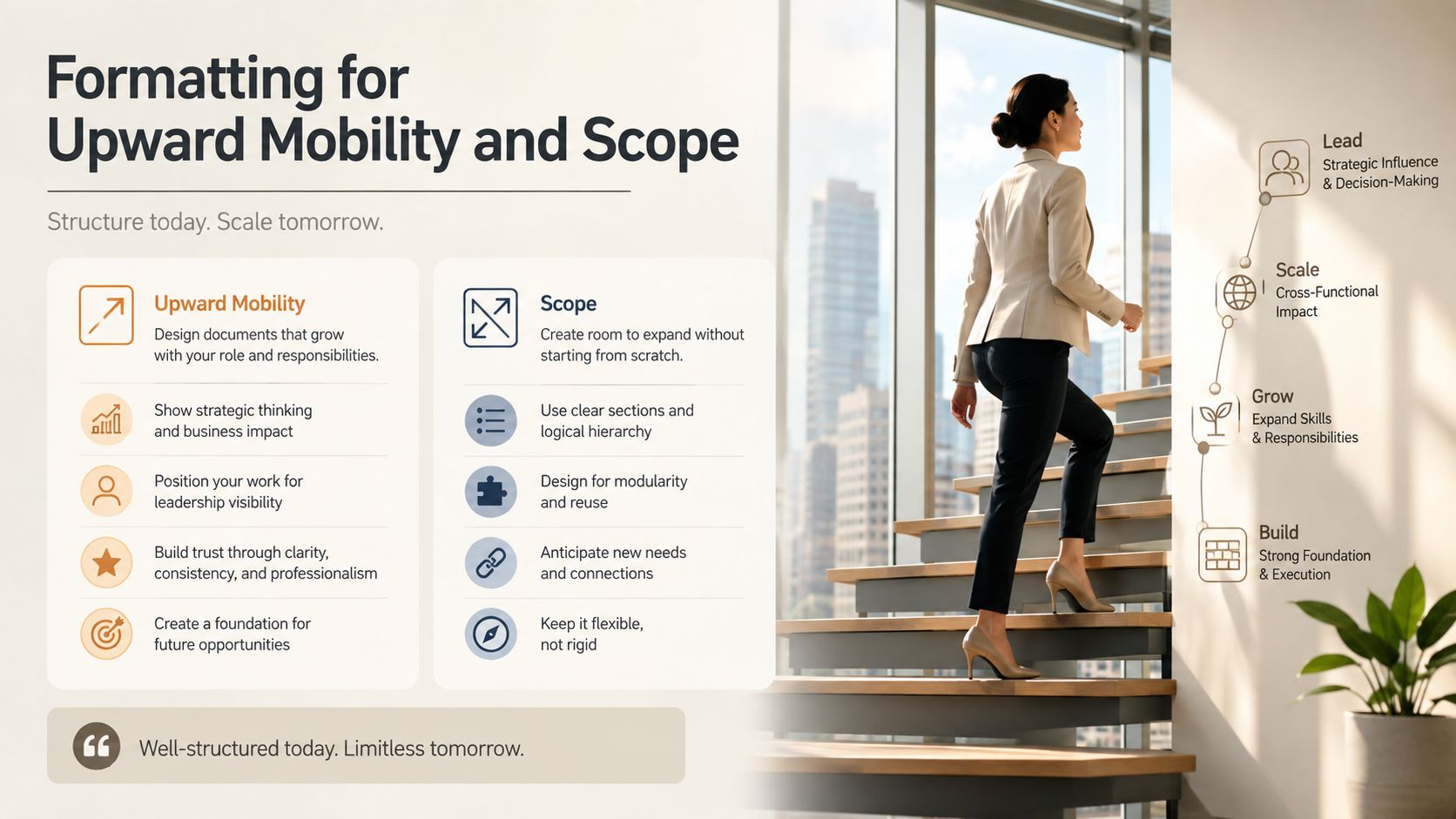
Your experience section should show progression before a reviewer studies the bullets. If someone has to reconstruct your career path from scattered titles and dates, the resume is making them work too hard.
Use a chronological structure with the company name as the organizing heading. Under it, display your current title first, followed by earlier titles and dates. Expert guidance on internal promotion resumes recommends either stacked titles under one company heading or separate entries when the role change substantially changed your responsibilities (internal promotion resume format guidance).
Choose stacked or separate entries deliberately
Stack titles when the work remained broadly similar and the promotion mainly reflects increased seniority, ownership, or complexity.
Example:
Company Name
Senior Operations Analyst, current
Operations Analyst, previous
Associate Operations Analyst, earlier
Place shared achievements beneath the progression if the bullets apply across the role history. Make the upward movement obvious through stronger verbs and broader scope.
Use separate entries when the promotion changed the nature of the work. A move from individual contributor to people manager, or from delivery to strategy, deserves its own bullets because the reviewer needs to see the new responsibilities and outcomes.
Example:
Company Name
Program Manager, current
Bullets focused on portfolio ownership, governance, and executive communication.
Project Coordinator, previous
Bullets focused on delivery support, process coordination, and documentation.
Don't disguise a substantial promotion inside a single block. It can make you look consistent, but it may hide the very evidence you want leadership to notice.
Make the page easy to parse
Use a short, role-aligned summary beneath your contact details. State your current role, the capabilities you've developed, and the type of scope you're prepared to own next. Standard headings such as Summary, Skills, Experience, Education, and Certifications help internal HR systems interpret the document.
Keep the layout clean and one-column. Avoid text boxes, decorative sidebars, complex tables, and graphics that could interrupt parsing. A polished resume doesn't need to look like a marketing brochure. It needs to make your title progression, recent achievements, and target-role alignment immediately visible.
If your LinkedIn profile contains the same career history, check that the dates and titles match before exporting a document. This LinkedIn-to-resume guide can help you approach that conversion systematically.
Translating Internal Jargon into Business Impact
Internal language creates a subtle trap. A project codename may be meaningful to your immediate team and meaningless to a hiring manager in another department. Acronyms can signal belonging, but they don't automatically communicate value, and an ATS may not connect them to the capabilities listed in the posting.
Translate every internal term into three elements: what the work was, who it affected, and what changed because of it.
“Owned Project Northstar” is too vague. Try “Led a cross-functional rollout that standardized customer escalation handling across Support, Product, and Operations.” The second version replaces a private label with a business description and makes your influence visible.
Use the internal name only when it helps
You don't have to remove every company-specific term. Keep an internal system or process name when the target role requires knowledge of it. Pair it with a plain-language explanation the first time it appears.
- Weak: “Managed QBR readiness for Falcon.”
- Stronger: “Prepared quarterly business review materials for the Falcon customer program, aligning account risks, delivery milestones, and executive decisions.”
- Stronger still: “Led quarterly business review preparation for a strategic customer program, aligning Sales, Delivery, and Finance on risks and next actions.”
The right version depends on the audience. If the target manager knows Falcon, retaining the name may add useful context. If the application is reviewed by HR or a hiring panel outside your group, the business description carries more weight.
Turn collaboration into evidence
Avoid writing “partnered with everyone” or “was the go-to person.” Those phrases rely on reputation rather than proof. Name the functions involved and explain the decision or result that followed.
For stakeholder relations, write about alignment, escalation management, negotiation, or decision support. For budget work, identify planning, forecasting, controls, or trade-offs. For cross-functional leadership, show how you created agreement without relying on formal authority.
Insider knowledge only helps when the reader can see how you used it to produce a result.
Use numbers when you have reliable records, but don't manufacture precision. If you can't disclose a confidential amount, describe the scale qualitatively, such as a regional program, a high-volume workflow, or a portfolio spanning several functions. You can also show impact through standardization, reduced risk, faster decisions, fewer escalations, stronger controls, or adoption by other teams.
The finished bullet should sound credible to someone who knows the business and clear to someone who doesn't. That balance is the heart of internal translation.
Optimizing for the Internal ATS Screening
Internal candidates still face formal screening. One 2025 industry analysis states that 75% of resumes sent to larger businesses are filtered before a recruiter sees them, while clarifying that filtering affects queue visibility and doesn't necessarily mean automatic deletion (ATS queue visibility analysis). Your manager's support can't help if the application never reaches the active review queue.
Start with the target title. Use the exact title in your summary or headline when it truthfully reflects the role you're applying for. Then mirror the posting's terminology in your skills section and achievement bullets, but never insert keywords for work you haven't done.
Check alignment, not keyword density
An ATS match score is role-specific. A 2026 ATS scoring guide describes the score as a comparison between your resume and a particular job description, with practical thresholds including below 50% as very likely to be filtered, 65% to 74% as a solid but competitive range, and 75% or higher as likely to pass initial screening (ATS scoring guidance).
Those thresholds are directional, not a substitute for judgment. A high score can still accompany weak evidence if your bullets merely repeat the posting. A lower score may reveal missing language that accurately describes work you've performed.
A 2026 study-style analysis of 10,000 Q1 2026 resume scans reported that 71.4% scored below 75 against their target job description, while 11.2% scored above 85 (resume scan analysis). The useful lesson is practical: tailor the document to the specific role instead of relying on generic wording.
Run a technical review
Use a clean, single-column layout with standard section headings. Export to PDF if the internal application accepts it, then open the file and check that text can be selected, dates remain readable, and no content has shifted.
A tool such as GetTheCall's ATS resume checker can compare a resume with a specific job description and identify parsing or keyword issues. Treat the output as an editing aid. Add a missing term only when it accurately reflects your experience, and rewrite the surrounding bullet so the keyword appears in meaningful context.
Finalizing Your Internal Promotion Case
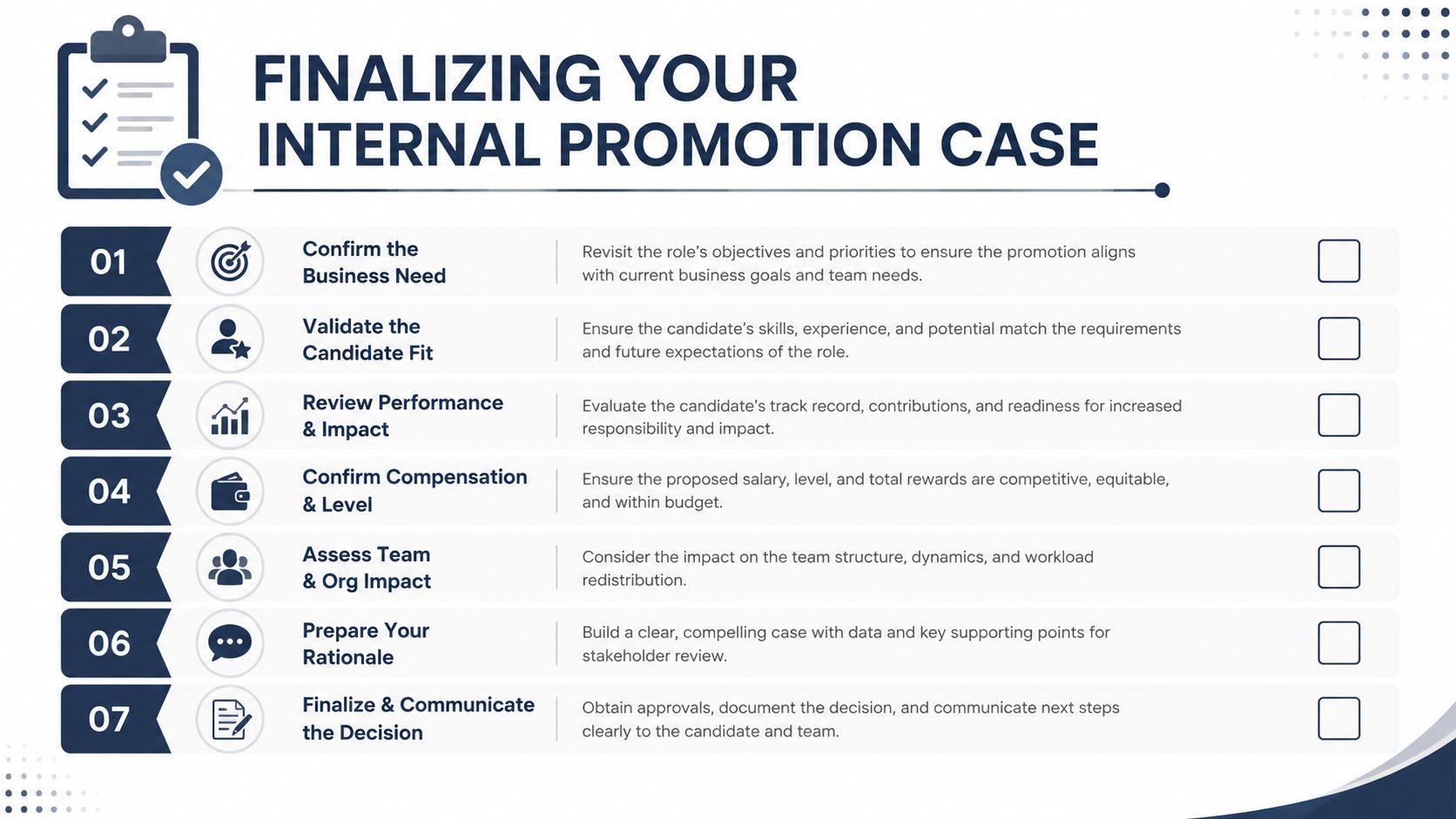
A strong resume supports the formal application, but an internal promotion also depends on the informal case around it. Decision-makers consider your manager's support, whether relevant leaders understand your contribution, and whether your current behavior already reflects the target level.
Before submitting, ask your manager for a direct conversation if company norms allow it. Bring the target posting and your requirement-to-proof map. Ask whether the evidence is accurate, complete, and aligned with how leadership evaluates readiness. This conversation can expose a weak example before it reaches the panel.
Coordinate the formal and informal process
Internal interviews may feel casual because some participants already know you. Treat them as structured evaluations. Familiarity can remove needed context, especially when leaders from outside your team are involved.
Prepare concise examples that demonstrate:
- Expanded scope: Work that moved beyond your original responsibilities.
- Judgment: A difficult trade-off, escalation, or decision you handled.
- Influence: Alignment across teams without relying only on authority.
- Readiness: A situation in which you operated at the level the new role requires.
Use relationships as context, not evidence. A referral or manager endorsement can bring attention to your application, but the resume must explain the achievement to a reviewer who was not present. Translate internal project names and team language into business-impact terms. The hiring manager may know the work, while an internal ATS may only recognize the role's stated requirements.
Complete the final review
Check that your title history is accurate, dates are consistent, and every bullet supports the target role. Remove confidential details, internal complaints, and political references. Read the summary and opening bullets as a reviewer would, then confirm they answer one question: why are you ready now?
Internal advancement can be an important path at senior levels, particularly when leaders can connect your record to the next role's scope. That possibility does not guarantee an outcome. A clear application gives advocates useful language and gives decision-makers evidence they can defend.
Your final resume should be concise, truthful, readable, and specific to the role. It should not claim that you already hold the position. It should show that your current achievements make the next level a logical, evidence-based step. Review the document once for human readers and once for the internal ATS, keeping every keyword grounded in work you have performed.
GetTheCall can import an existing resume or LinkedIn profile, compare it with a target posting, and help align real experience with the role's language while providing a live match score and ATS-ready PDF options. Visit GetTheCall to organize your internal promotion evidence into a focused application.