Resume for First Job No Experience: 2026 Guide
Build a resume for first job no experience with proven templates and transferable skills that get interviews in 2026.
You're staring at a blank document, the job posting is open in another tab, and every line you try to write feels thin. That's normal. A resume for first job no experience is not a confession that you've done nothing, it's a compact argument that you can already do the work if someone gives you a chance.
The mistake most first-time applicants make is simple. They try to write a life story when the employer only wants proof of fit. Recruiters can spend about 7 seconds on the first scan, and a single corporate opening can draw an average of 250 applications, so your page has to do fast, precise work with education, projects, volunteering, certifications, and skills instead of wasting space on emptiness. Industry sources also report that 80%+ of résumés don't make it past the first screening, and the average résumé includes only about half of the keywords from the job description, which is why keyword alignment matters so much for first-job candidates (resume statistics).
Table of Contents
- Why a No-Experience Resume Feels Impossible And Why It Isn't
- The Section-by-Section Blueprint for a First-Job Resume
- Turning School Projects and Volunteering Into Real Bullet Points
- Matching Job-Description Keywords Without Sounding Fake
- Common Mistakes That Get First-Job Resumes Rejected
- Your One-Page Sample Layout and Final Checklist
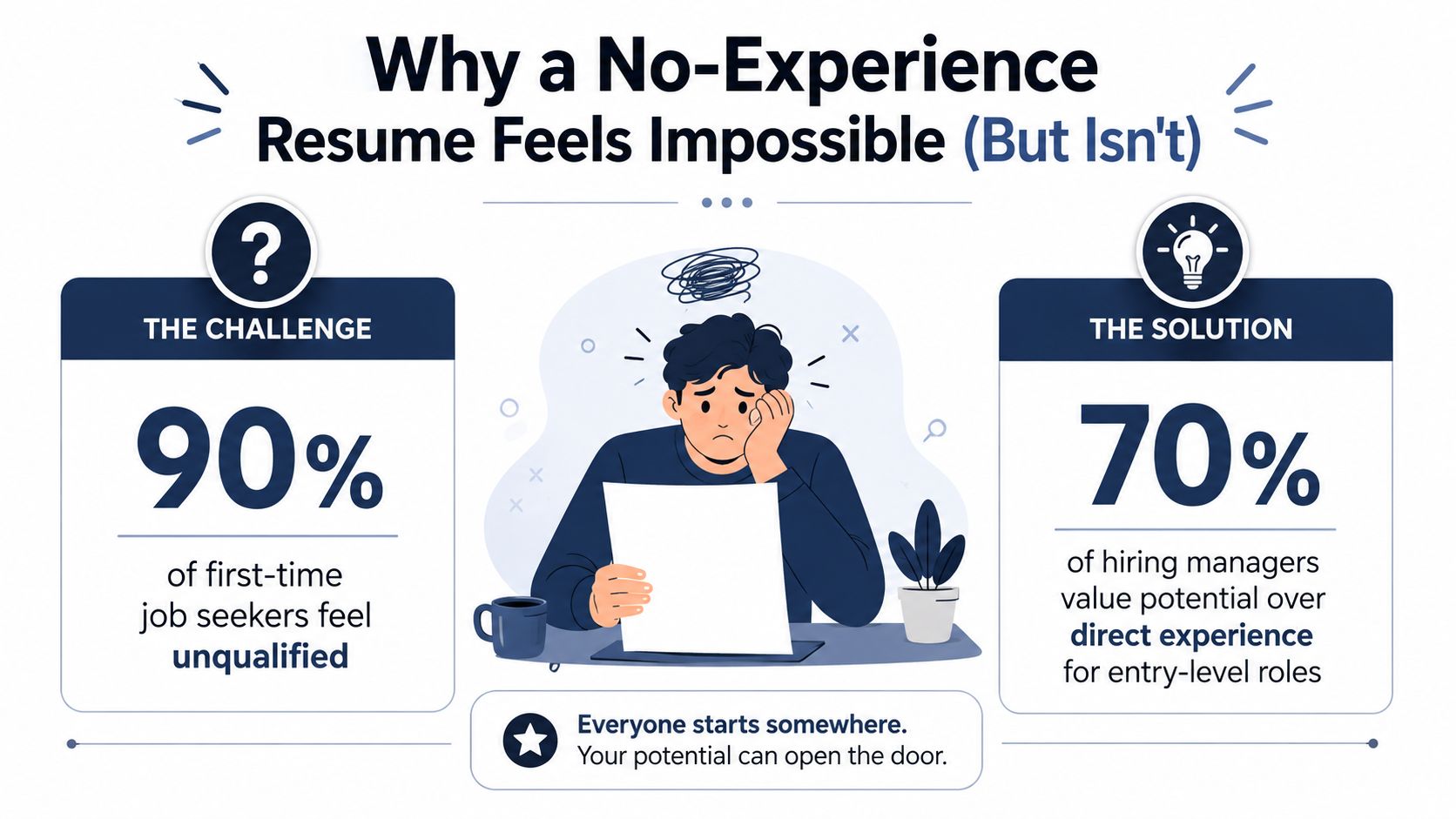
Why a No-Experience Resume Feels Impossible And Why It Isn't
You're probably looking at a final-year student applying for a marketing coordinator role and thinking, “I don't have a real résumé.” That feeling comes from confusing job history with job readiness. Employers don't need a decade of payroll records for an entry-level role, they need clear evidence that you can write, organize, learn, and deliver.
What recruiters are actually scanning for
A first-time résumé has one job, prove potential with relevance. That means the strongest page is usually a clean argument built from school projects, clubs, volunteering, coursework, and skills, not a blank work-history section that apologizes for itself. The reader should see a narrow, job-specific story, not your entire life inventory.
Practical rule: if a detail doesn't help you look more relevant for that role, cut it.
Hiring has also become more algorithmic and more selective, which is why first-job résumés need to be tighter than many people expect. One guide says lack of customization is a top rejection reason for 54% of applications, and impersonal applications account for 84%. Another source reports that résumés with hard numbers can have up to a 40% higher chance of earning an interview, while only 26% of résumés include at least five measurable results or metrics (resume statistics). That's a significant gap for beginners. It isn't that they have nothing. It's that they often fail to package what they have in a way recruiters can trust quickly.
The mindset shift that fixes the blank page problem
Stop trying to write a “good enough” résumé and start writing a targeted one. If you volunteered at an event, completed a class project, or handled social media for a student club, those experiences can absolutely carry weight when they're described with precision. The trick is to use the space to prove fit, not to prove you've been busy.
A useful way to think about it is this. The résumé is a screenable summary of evidence, not a full autobiography. Once you accept that, the blank page stops looking like a judgment and starts looking like a structure problem.
The Section-by-Section Blueprint for a First-Job Resume
A first-job résumé should be short, clean, and easy to scan. If you do not have paid experience, do not make the page busier to compensate. Use a simple structure, put the strongest evidence near the top, and make every section earn its place. The primary bottleneck is keyword alignment without sounding fake, so each section should give you a place to prove fit with school work, clubs, volunteering, or personal projects.
The order that works
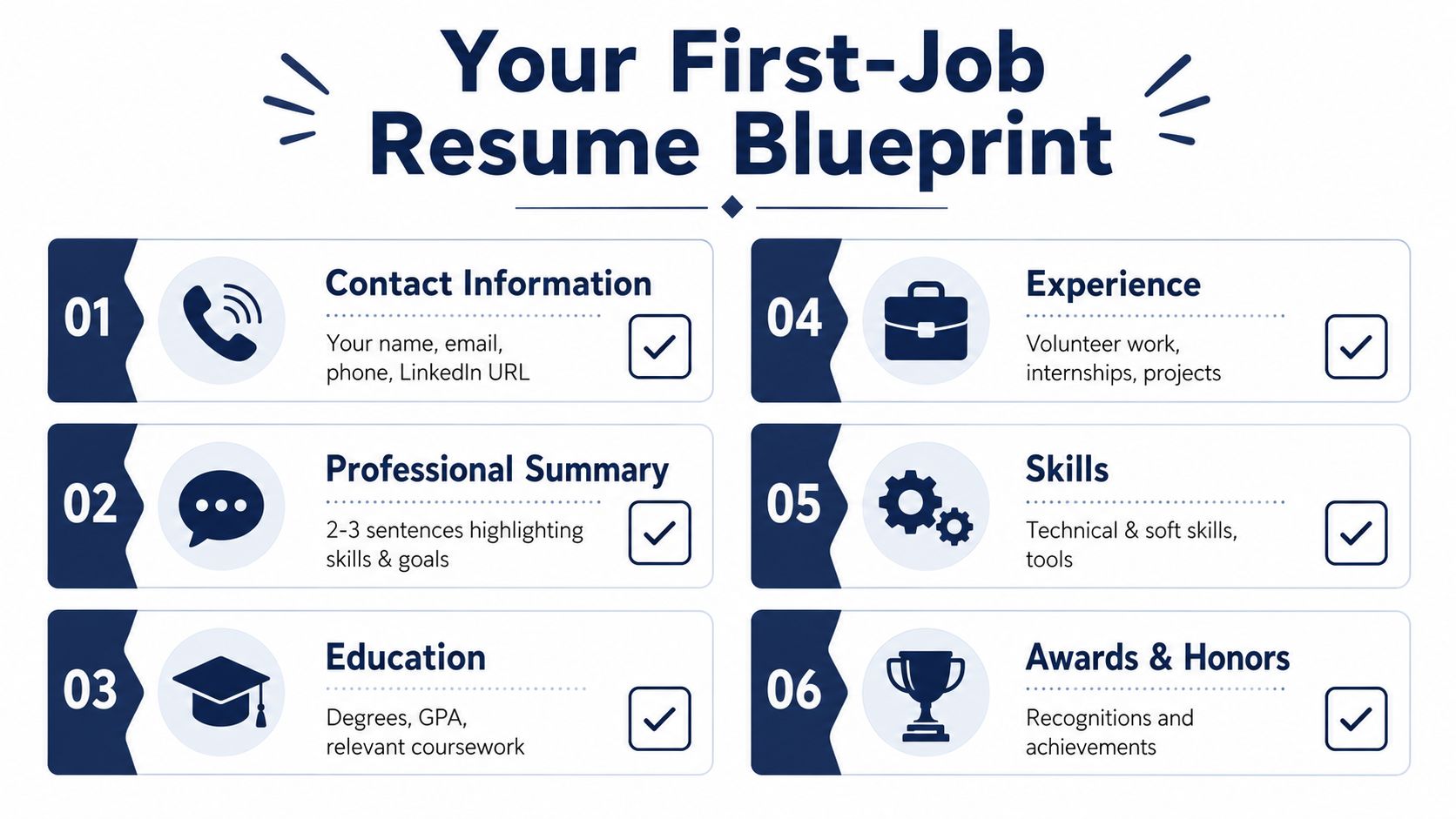
Start with contact information, then a brief professional summary of two to three sentences. After that, move into education, then skills, then projects, volunteer work, or extracurriculars, followed by optional sections like awards and honors or certifications if they strengthen the case. That structure follows the advice to keep the résumé one page, use clear headings, and keep formatting simple so both human readers and ATS systems can parse it easily (writing a résumé with no experience).
Strong default: if paid experience is missing, use a functional or hybrid layout, but keep the content honest and easy to trace.
Each section has a job to do.
- Contact information: Your name, professional email, phone number, and LinkedIn if it is presentable. Keep it plain.
- Professional summary: Two or three sentences that say who you are, what role you want, and the best proof you can point to right away.
- Education: School name, degree, dates, and relevant coursework that matches the role.
- Skills: Use about 10 to 15 skills total, mixing hard and soft skills, not a random pile of every app you have used. Keep the list tied to the jobs you want (first-job résumé guidance).
- Projects or experience: School projects, volunteer work, internships, campus leadership, or personal builds, each with 2 to 3 bullets that show what you did and why it matters.
- Awards and honors: Keep them only if they support the role. If they do not, leave them out.
The page should read like proof of readiness. Use the sections that help you match the posting, cut the rest, and leave out hobbies, filler, and vague claims that do not connect to the job. A clean layout beats a crowded one every time.
Turning School Projects and Volunteering Into Real Bullet Points
Most first-job bullets are weak because they describe tasks instead of impact. “Helped with event planning” tells me almost nothing. I want to know what you did, how you did it, and what changed because you were there.
Use the action verb plus task plus result formula
The cleanest formula is action verb + duty or task + measurable impact. That structure keeps your bullets specific without sounding inflated. It also matches the advice that strong entry-level bullets should show what you did and what happened, using numbers whenever you have them (first-job résumé advice).
Bad bullet. Helped organize campus event.
Better bullet. Coordinated a student orientation event, managed room setup and volunteer schedules, and helped keep the program running on time.
Best bullet. Coordinated a 12-person student team for a two-day orientation event, managed setup and schedules, and supported attendance of 300 new students.
That same pattern works for tutoring, club work, and side projects.
- Class project rewrite: Instead of “Worked on a marketing project,” write, “Researched audience trends for a class campaign, built the slide deck, and presented recommendations to a panel of classmates.”
- Volunteer rewrite: Instead of “Tutored younger students,” write, “Tutored middle-school students in math twice a week, adapted explanations to different skill levels, and helped them finish weekly assignments on time.”
- Side project rewrite: Instead of “Made a portfolio website,” write, “Built a personal portfolio site to showcase design projects, organized work samples by category, and refined the layout based on peer feedback.”
The point is not to sound corporate. The point is to sound credible. If you can count people, sessions, deadlines, submissions, or tools, use those details. If you can't, use context that shows scope and responsibility.
Where to pull the evidence from
Look at the project brief, the club assignment, the volunteer schedule, or the tools you used. Those details are usually enough to write a strong bullet. If you need a practical way to tie your LinkedIn profile to résumé content, this LinkedIn to résumé guide is a useful reference point for organizing real experience into usable language.

Matching Job-Description Keywords Without Sounding Fake
Most first-job résumés fail at this point. Candidates either ignore the posting completely or stuff the page with buzzwords they can't back up. Neither works. You need a match that feels real because it is real.
Read the posting for repeated language
Read the job description twice. The first pass is for duties. The second pass is for repeated words, tools, and outcomes. If a posting keeps mentioning communication, scheduling, Excel, collaboration, or customer support, those terms are signals. Map each one to a section where you can prove it, such as coursework, a project, volunteer work, or your skills list.
A strong way to think about it is section ownership.
- Education: Use for coursework, academic projects, research, and relevant honors.
- Projects: Use for technical tools, design work, writing samples, analytics, or process improvement.
- Volunteering: Use for teamwork, coordination, service, communication, or reliability.
- Skills: Use for the exact tools and competencies you can defend.
Practical rule: if a keyword appears in the posting but you can't show it anywhere on the page, leave it out or replace it with a closer honest match.
That keeps you from sounding fake. It also keeps you from overstuffing the document with repeated jargon that ATS software may parse as noise. A clean, standard structure matters too. One source notes that 82% of ATS systems are built to parse reverse-chronological résumés, which is why you should keep the layout readable and predictable while tailoring the language to the role (first-job résumé structure).
Use a live match score as a gut check
A live role-match score is useful because it stops guesswork. If you edit a summary, add a project bullet, and the match score rises while the wording stays honest, you're moving in the right direction. If the score spikes because you pasted in five unrelated keywords, you've gone too far. This is the difference between tailoring and stuffing, and it matters for students and career changers who have to prove fit with limited evidence.
Here's the rule I use. One keyword should map to one real proof point. If the proof point is weak, change the wording to something closer to the evidence instead of inventing a stronger story.
For a cleaner job-specific rewrite process, this guide to tailoring a résumé to a job description is a practical companion.
Common Mistakes That Get First-Job Resumes Rejected
A bad first-job résumé usually fails for ordinary reasons, not dramatic ones. It's too broad, too decorative, or too vague. Fix those three problems and the page gets better fast.
The mistakes that hurt entry-level applicants most
The first mistake is listing every skill you've ever heard of. That looks like keyword stuffing, not competence. A better move is to keep a focused skills section with only the tools and abilities you can defend, because relevance beats volume.
The second mistake is using a flashy template that breaks parsing. Fancy columns, text boxes, icons, and heavy graphics can make ATS reads messy. Clean section headings and simple formatting are safer, especially when the goal is to get past software and reach a human reviewer. That matches the earlier point that ATS systems are built to parse standard structure, not design experiments.
The third mistake is padding the page with every club, hobby, or random detail. If it doesn't support the job, it dilutes the case. A student résumé is not stronger because it is longer.
A few more habits deserve to die:
- Generic bullets: “Responsible for social media” says almost nothing. Replace it with the platform, the task, and the result.
- Long paragraphs: Recruiters don't read blocks of text on a first scan. Use bullets.
- Unfocused summaries: “Hardworking student seeking growth” is filler. Say what role you want and what you bring.
- Typos and sloppy formatting: Small errors signal carelessness, and employers notice them quickly.
Restraint matters. A shorter, sharper résumé almost always beats a crowded one for someone with no formal work history.
Your One-Page Sample Layout and Final Checklist
Use this as a working model, not a script to copy blindly. The point is to keep the page tight, relevant, and easy to skim.
| Section | What to include | Length on page |
|---|---|---|
| Contact Information | Name, phone, email, LinkedIn | 2 to 3 lines |
| Professional Summary | 2 to 3 sentences tied to the role | 3 to 4 lines |
| Education | School, degree, dates, relevant coursework | 4 to 6 lines |
| Skills | 10 to 15 total hard and soft skills | 4 to 6 lines |
| Projects | 2 to 3 bullets per project | 1 short block |
| Volunteering | Role, dates, 2 to 3 impact bullets | 1 short block |
| Awards and Honors | Only relevant recognitions | 2 to 4 lines |
A final pass should be ruthless. The résumé should be customized to the job, stay on one page, use measurable bullets where possible, and avoid clutter. If the document still feels full but unconvincing, cut more. If the wording still sounds vague, replace general claims with specific actions.
Final checklist
- Adapted to the posting
- One page
- Clear headings
- 2 to 3 sentences in the summary
- About 10 to 15 skills
- Bullets start with strong action verbs
- No typos
- Saved as a PDF
- Filename looks professional
A first-job résumé doesn't need to impress everyone. It needs to make one honest, specific case to the right employer.
If you want a faster way to turn a basic draft into an ATS-ready, job-specific résumé, GetTheCall can help you tailor the wording, check fit against the posting, and export a clean PDF without fighting formatting tools. Visit GetTheCall and use it to tighten your résumé before you apply, especially if you're turning school work, volunteering, and projects into proof that matches the job.