How to Write a Resume for Babysitter Jobs
Learn how to write a resume for babysitter jobs that stands out. Step-by-step guide with examples, keywords, and ATS tips for families and agencies.

You've looked after children for siblings, neighbors, or family friends, and you know parents trust you. But when you open a blank document, the experience can feel impossible to describe professionally. “Watched kids” doesn't capture the safety decisions, routines, communication, and responsibility involved in good childcare.
A well-written resume for babysitter jobs translates that real experience into language families and agencies can evaluate quickly. It shows what ages you've cared for, which responsibilities you've handled, and how your background matches the role, without exaggerating informal work or turning your application into corporate jargon.
Table of Contents
- Why Babysitter Resumes Need a Professional Touch
- Essential Sections for a Babysitter Resume
- Tailoring Your Resume for Families vs Agencies
- Keywords and ATS Tips for Babysitter Resumes
- Using Tools to Streamline Your Resume Creation
- Common Mistakes to Avoid on Your Babysitter Resume
Why Babysitter Resumes Need a Professional Touch
A common mistake is treating babysitting as “just helping out.” Someone who regularly cared for younger siblings may have managed meals, bedtime, homework, play, hygiene, and unexpected problems. Someone who watched a neighbor's children may have handled evening routines, parent updates, and safety decisions independently. Those are meaningful responsibilities, but they lose value when they appear as a vague line such as “looked after children.”
Families and agencies want evidence that you're dependable and prepared. They need to understand the children's age groups, the setting, the type of care you provided, and the responsibilities you can manage without constant supervision. A resume gives them that information before they decide whether to contact you.

Turn personal experience into evidence
Start by listing each childcare situation, even if it wasn't a formal job. Include care for relatives, regular work for friends, neighborhood arrangements, volunteer activities, youth groups, camps, tutoring, and daycare support. Then record the details that make each experience credible:
- Age groups: State whether you cared for infants, toddlers, school-age children, or teenagers.
- Care setting: Identify whether the work took place in a private home, daycare, camp, or community setting.
- Responsibilities: Mention meal preparation, bathing, diapering, homework help, bedtime routines, outdoor activities, or transportation when applicable.
- Communication: Explain how you updated parents, followed instructions, or reported concerns.
- Safety: Include supervision, first aid, water safety, allergy awareness, or emergency procedures only if you directly handled them.
Use action verbs such as organized, supervised, prepared, supported, monitored, communicated, and followed. These words make your contribution clear without overstating the role.
Practical rule: Never invent a job title, credential, or result. Professional wording should clarify your experience, not make it sound larger than it was.
Babysitting also deserves serious presentation because it's a measurable occupation, not merely an informal favor. Workforce sources report different totals because they classify the work differently, including 48,204 employed babysitters in one profile and an estimated 520,180 babysitters nationally in another. The same data reports an average age of 37, with 85.8% women and 14.2% men, showing that applicants can be teenagers, students, parents, or adult caregivers. You can review the underlying babysitter resume and workforce overview for that context.
Your resume doesn't need to sound stiff. It needs to make trust visible. A clean document with specific responsibilities helps a parent see how you work, while an agency can quickly compare your background with its requirements.
Essential Sections for a Babysitter Resume
The strongest layout is usually a one-page reverse-chronological resume with contact details, a short summary, relevant experience, education, certifications, and skills. A clean sans-serif font, readable headings, and concise bullets make the document easier for both people and ATS software to scan.
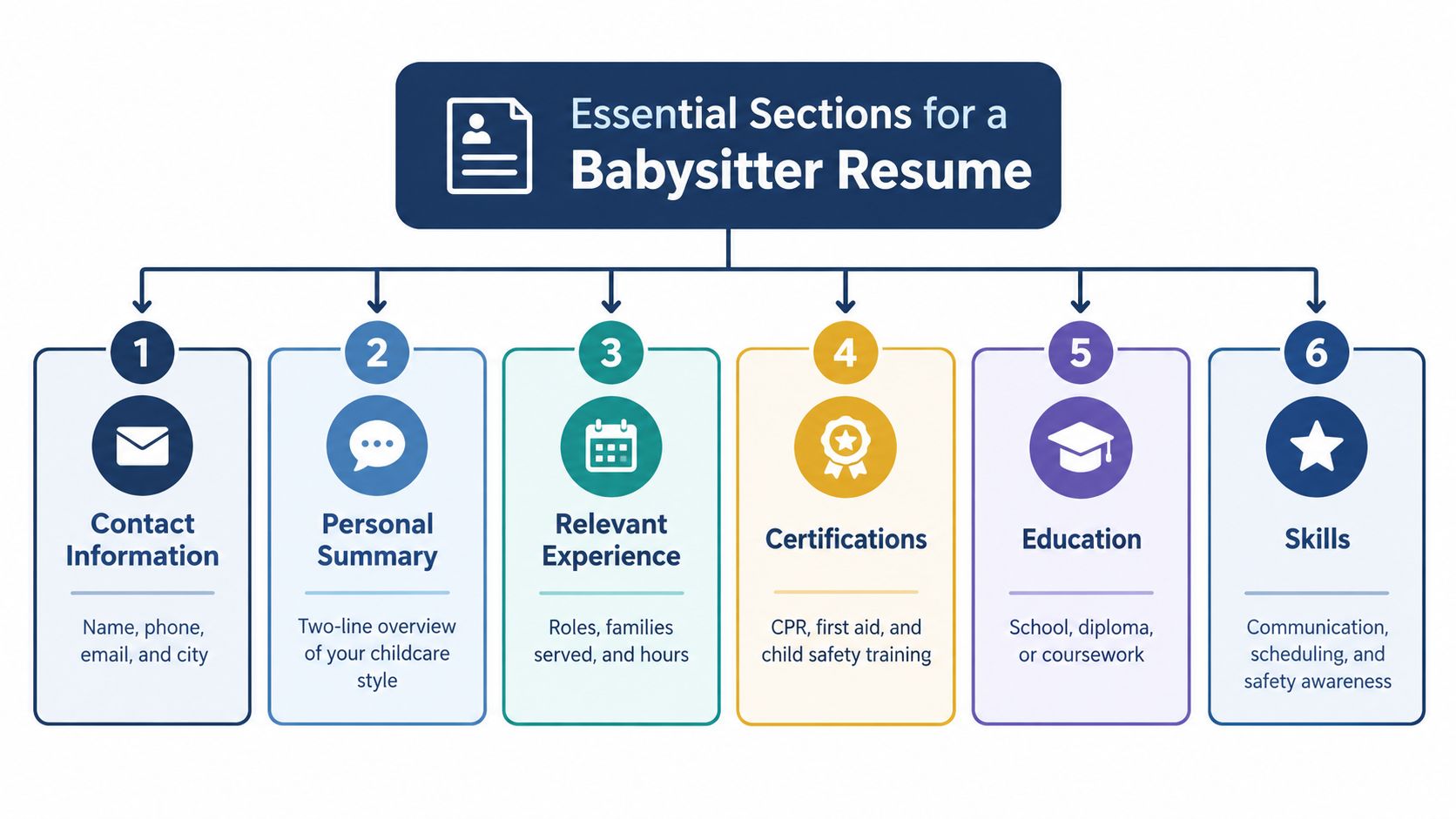
Contact information and summary
Place your name, phone number, professional email address, and city or general location at the top. Don't include your age, gender, marital status, or other personal details that don't help someone assess your childcare ability. Your email should be simple and appropriate for applications.
Follow with a two or three-line summary. Mention your experience level, the children or settings you've worked with, and your strongest relevant qualities. For example:
Responsible babysitter with experience supporting school-age children with meals, homework, creative activities, and evening routines. Known for clear parent communication, dependable scheduling, and calm supervision.
If you have little formal experience, use an objective that focuses on the value you can offer. Don't apologize for being new. State the relevant experience you do have, such as family care, tutoring, volunteering, or youth activities.
Experience with enough detail
For each entry, include a clear role title, the family or organization when appropriate, location, and dates. “Family Childcare Provider” can be accurate for regular unpaid care in your household, while “Babysitter” works for private arrangements. Label family-based experience accurately rather than disguising it as agency employment.
Write concise bullets that show responsibility and context:
- Supervised children: Cared for two school-age children during afternoon and evening routines, including snacks, homework, play, and bedtime preparation.
- Communicated with parents: Shared updates about meals, activities, behavior, and schedule changes at the end of each shift.
- Planned activities: Organized age-appropriate games, reading time, and outdoor play based on the children's interests.
- Supported daily care: Prepared simple meals, maintained a safe play area, and followed household instructions.
Include ages, average hours, dates, and locations whenever you can do so accurately. The Indeed guidance on adding babysitting to a resume specifically supports making these details visible because they help employers evaluate informal experience quickly.
Certifications, education, and skills
Create a separate Certifications section for CPR, first aid, water safety, babysitting courses, or other relevant training. Write the exact credential name and issuing organization if you know it. If a certification has an expiry date, include that date rather than implying it's current indefinitely.
Education can be brief. List your school, diploma, current program, or relevant coursework. Add youth leadership, tutoring, camp, volunteer, or community activities when they demonstrate responsibility around children.
Your skills section should combine practical capabilities and personal strengths:
- Childcare skills: Infant care, meal preparation, diapering, homework support, bedtime routines, and activity planning.
- Safety skills: CPR, first aid, water safety, allergy awareness, and emergency communication, but only where trained or experienced.
- Professional skills: Communication, reliability, organization, patience, time management, and ability to follow directions.
A babysitter resume guide from Care.com also recommends showing children's ages, employment dates, relevant training, and education. That combination gives a reader enough information to understand both your practical experience and your preparation.
Tailoring Your Resume for Families vs Agencies
A family and an agency may read the same resume with different questions in mind. A parent often wants to know whether you'll fit the household, communicate well, and handle the children's routine safely. An agency usually needs a broader picture of your availability, age-group experience, flexibility, credentials, and ability to meet different client requirements.
| Family application | Agency application |
|---|---|
| Emphasize reliability, communication, household routines, and compatibility with the children. | Emphasize varied care settings, age groups, availability, certifications, and transferable duties. |
| Mention how you follow parent preferences and provide updates. | Use clear titles, dates, responsibilities, and keywords that allow quick matching. |
| Tailor the summary to the family's schedule and needs. | Keep the summary adaptable to multiple placements while matching the specific listing. |
The same experience can support either application, but the emphasis should change. For a family seeking evening care for a young child, describe bedtime preparation, meal routines, calm transitions, and parent communication. For an agency seeking flexible sitters, highlight experience with different ages, changing schedules, activity planning, and following distinct household instructions.
Read the listing before editing. Circle repeated terms and requirements, then use accurate versions of those terms in your summary, experience bullets, and skills section. Don't copy an entire advertisement or force keywords into sentences that don't describe your work.
For a practical workflow, use this guide on tailoring a resume to a job description. The useful principle is simple: create one truthful base resume, then adjust the most relevant evidence for each role.
Availability deserves careful wording. If you can work evenings, weekends, holidays, school pickups, or short-notice assignments, state that clearly. If your schedule is limited, be just as direct. A precise schedule builds trust, while vague claims such as “flexible” can create problems later.
Families hire for trust and fit. Agencies hire for fit across several possible placements. Your resume should make the relevant version of your reliability easy to find.
Keywords and ATS Tips for Babysitter Resumes
A babysitter resume may begin with informal experience, such as caring for younger relatives or helping a neighbor, yet it still needs to work inside a formal hiring system. Applicant Tracking Systems collect, sort, rank, and review resumes before a recruiter, agency, or family sees them. The University of Texas ATS guidance explains that an ATS compares resume content with the position description and ranks candidates by fit. Unusual wording, graphic-based qualifications, and implied skills can therefore hide relevant experience.
A 2025 recruiter survey summarized in the ATS statistics summary reported that 99.7% of recruiters use keyword filters. Common filters included skills at 76.4%, education at 59.7%, job titles at 55.3%, and certifications or licenses at 50.6%. Name your qualifications plainly so both software and human readers can find them.
Build the document in a sensible order
- Start with the job ad: Extract the exact terms for care duties, safety, schedules, age groups, and communication. Use them only when they accurately describe your experience.
- Add your strongest credentials: List CPR or first aid certification in its own section, then refer to it in a relevant experience bullet when it supports the role.
- Describe childcare directly: Use terms such as child care, infant care, meal preparation, homework help, activity planning, supervision, and parent communication when they fit your work.
- Match the role language: If the listing asks for “ability to follow directions,” show that skill through a bullet about following household routines or parent instructions.
- Check the file and formatting: Use a standard PDF or DOCX when the employer permits it, and make sure the text can be selected and copied. Avoid text boxes, complicated columns, icons that replace words, and decorative graphics. For a deeper checklist, see the ATS-friendly resume guide.
These choices matter for both agency submissions and direct family applications. GetTheCall's tools can help organize the wording you need to adjust, but you still need to confirm that each keyword reflects real childcare work.
An independent analysis of hundreds of babysitter job ads found that CPR certification appeared in 50% of ads, with 481 mentions, while child care appeared in 48%, with 462 mentions. Communication skills appeared in 43%, with 412 mentions, first aid certification in 37%, with 358 mentions, and ability to follow directions in 35%, with 335 mentions. The analysis also found activity planning in 34% of listings, with 327 mentions, compared with positive attitude in 7% and nurturing attitude in 3%. The figures and related keyword guidance appear in Monster's babysitter resume resource.
Use keywords to clarify evidence, not to fill space. “Caring and fun” states a personal quality. “Planned age-appropriate activities and followed parent-approved routines” gives the hiring reader specific work to assess.
Using Tools to Streamline Your Resume Creation
Tailoring a resume by hand becomes repetitive when every family or agency uses different wording. The efficient approach is to keep a complete record of your genuine experience, then adapt the presentation for the role instead of rewriting your history from scratch.
Start with a source document that contains everything you may need: childcare arrangements, dates, children's ages, responsibilities, certifications, education, availability, references, and relevant volunteer work. Mark anything you still need to verify, such as an exact date or the formal name of a course. Accuracy matters more than filling every line.
A practical tailoring workflow
Import your existing material. A tool can extract career history from a LinkedIn profile or an uploaded PDF, DOC, or DOCX file. For a babysitter, that may mean importing a general resume and then adding informal care experience manually so it isn't overlooked.
Parse the target listing. The system identifies required skills, responsibilities, job titles, certifications, and schedule language. Review the results yourself. Automated parsing can surface useful terms, but you remain responsible for deciding whether each term applies to your background.
Generate role-specific content. GetTheCall can use verified experience from an imported profile or file to produce customized resume content, align bullets with the target listing, and provide a live ATS Role Match score as edits are made. It also offers multiple layouts and PDF export, which can reduce the formatting work between drafting and submission.
Edit for honesty and warmth. Never accept a suggested bullet just because it contains a valuable keyword. Change “managed infant sleep routines” to a truthful description of your work, or remove it if you've never done it. A family may ask follow-up questions, and your resume should make those conversations easier.
Review the final PDF. Check that dates, ages, contact details, certification status, and availability are correct. Open the exported file on another device and select the text to confirm that the document remains readable outside the editor.
A free ATS resume checker can help identify parsing and keyword issues before you apply. Use any score as a diagnostic, not as permission to add unsupported skills. A strong babysitter resume still needs clear evidence, a natural voice, and details that help a parent picture how you'll care for their children.
Common Mistakes to Avoid on Your Babysitter Resume
A resume can lose credibility through small choices. The fix is usually straightforward, but you need to review the document as a cautious parent or busy agency coordinator would.
- Leaving out certifications: If you have CPR, first aid, water safety, or babysitting training, give it its own section. Don't bury it in a paragraph.
- Using casual descriptions: Replace “hung out with kids” with an accurate responsibility such as “supervised play, prepared snacks, and supported the evening routine.”
- Hiding informal experience: Family care, regular neighbor arrangements, tutoring, volunteering, and youth activities can count when you describe the responsibilities you held.
- Adding unsupported claims: Don't say you administered medication, transported children, handled special needs, or managed emergencies unless that reflects your real experience and training.
- Including irrelevant work history: Keep jobs that demonstrate reliability, communication, organization, safety, or responsibility. Remove unrelated details that crowd out childcare evidence.
- Overdesigning the page: Complex columns, graphics, tiny text, and decorative templates can make a resume harder for an ATS or human reader to process.
- Using poor contact details: Choose a professional email address, verify your phone number, and include your city or general location.
- Skipping the final match: Compare the finished document with the job ad. Confirm that the relevant age group, schedule, certification, and responsibilities are visible.
Aim for a concise, readable page with two or three strong bullets per role when possible. Proofread names, dates, spelling, and certification details, then save a customized version for each serious application. Your next step is to list every genuine childcare responsibility you've handled, turn each into an evidence-based bullet, and match the strongest bullets to the role you want.
GetTheCall can import an existing resume or profile, analyze a babysitting job listing, tailor content from your verified experience, check ATS fit, and export a submission-ready PDF. Visit GetTheCall to prepare a clearer, job-specific resume for your next family or agency application.