Resume Executive Summary Statement: How
Learn how to write a resume executive summary statement that passes ATS and impresses recruiters. Includes templates, examples, and dos and don'ts

You've spent an evening polishing your resume, checked every date, and rewritten your strongest accomplishment. Then you reach the top of the page and type, “Results-oriented professional with excellent communication skills.” That small paragraph may be the weakest part of an otherwise credible application.
A strong resume executive summary statement isn't a decorative introduction. It's a compact argument for relevance. It tells a recruiter what you do, where you've created value, and why your background fits this particular role before they decide whether the rest of the resume deserves their attention.
Table of Contents
- Why Your Resume Executive Summary Statement Matters More Than You Think
- The Anatomy of a Strong Resume Executive Summary Statement
- Resume Executive Summary Statement Examples by Career Level
- When to Skip the Summary Entirely
- How to Tailor Your Summary to a Specific Job Description
- Common Mistakes and How to Fix Them
Why Your Resume Executive Summary Statement Matters More Than You Think
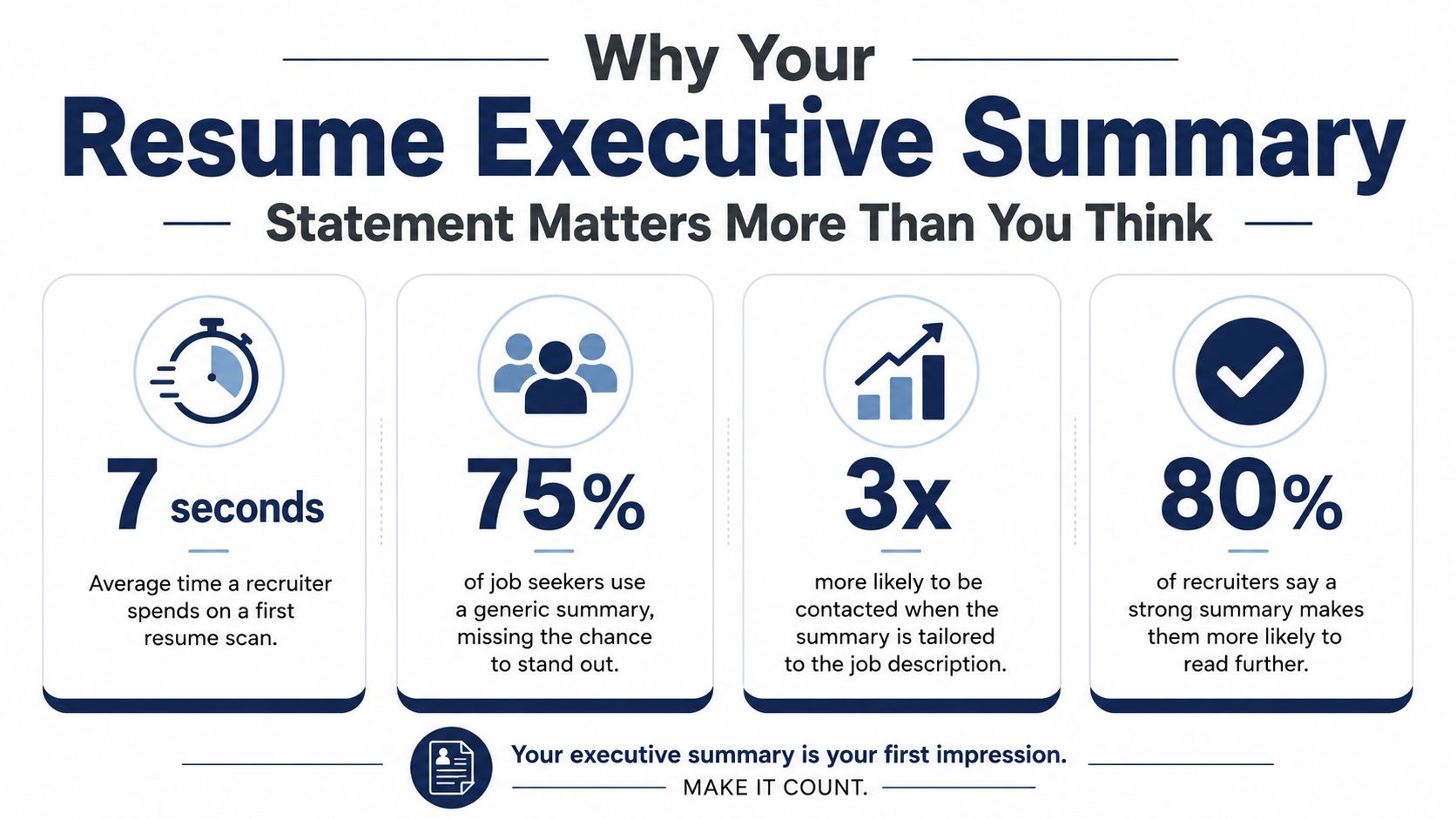
A recruiter reviewing your resume may be moving through a crowded queue. They scan your name, target role, recent employers, and opening section for an immediate match. Multiple industry summaries report that recruiters spend about 6–8 seconds on an initial resume review, as documented in this resume statistics roundup. The point is not that every recruiter uses a stopwatch. Your first impression must earn attention before the reader has invested much of it.
Your resume may also pass through an applicant tracking system before a person sees it. ATS software parses text, identifies terms related to the vacancy, and helps rank or filter applications. It will not interpret “dynamic leader” with the judgment a human reader might apply. It can recognize a target title, functional skill, certification, or industry term when that information appears in a clear, text-based section.
The top third of the resume must satisfy two readers with different needs. The ATS looks for recognizable language in a logical location. The recruiter wants a quick explanation of your professional identity and fit. Keyword optimization helps only when the wording remains readable. A summary packed with disconnected terms may match software while giving a person no clear reason to continue.
The cost of a generic opening
Consider two openings for a product marketing role.
“Experienced professional with a strong background in marketing, communication, and teamwork. Seeking an opportunity to grow with an innovative organization.”
The statement establishes no level, specialty, market, or likely contribution. It could describe a recent graduate, a marketing coordinator, or a vice president.
Now compare:
Product marketing manager with experience positioning B2B software, translating customer research into go-to-market plans, and partnering with sales and product teams. Brings strengths in messaging, competitive analysis, and launch planning, with a track record of connecting market insight to commercial priorities.
The second version gives screening systems relevant terms and gives people a coherent professional profile. The title and specialty improve classification, while the supporting language explains how the candidate works. It also avoids claims the candidate cannot prove, creating a sound reason to read further.
A 2026 resume statistics roundup reports that 90% of hiring managers say a clear resume summary makes candidates easier to evaluate quickly, while another 2025 U.S.-focused summary reports an average of 250 resumes per live job advert. The same broader data set notes that fewer than 1 in 10 resumes may reach the hiring manager in advertised roles. These figures appear in the StandOut CV resume statistics source. Together, they support a practical conclusion: clear wording at the top matters because many applications never receive a leisurely, line-by-line reading.
A professional summary also has measurable visibility value. Resumes with one receive 36% more views than resumes that move directly into work experience, according to Enhancv's resume statistics roundup. The summary cannot compensate for irrelevant experience or weak achievements, but it can place strong evidence in context before the reader reaches it.
The Anatomy of a Strong Resume Executive Summary Statement
A hiring manager may understand your target role in seconds, while an ATS looks for matching terms. A strong summary handles both jobs: it states your professional identity clearly, uses relevant language naturally, and gives a reader a reason to continue.
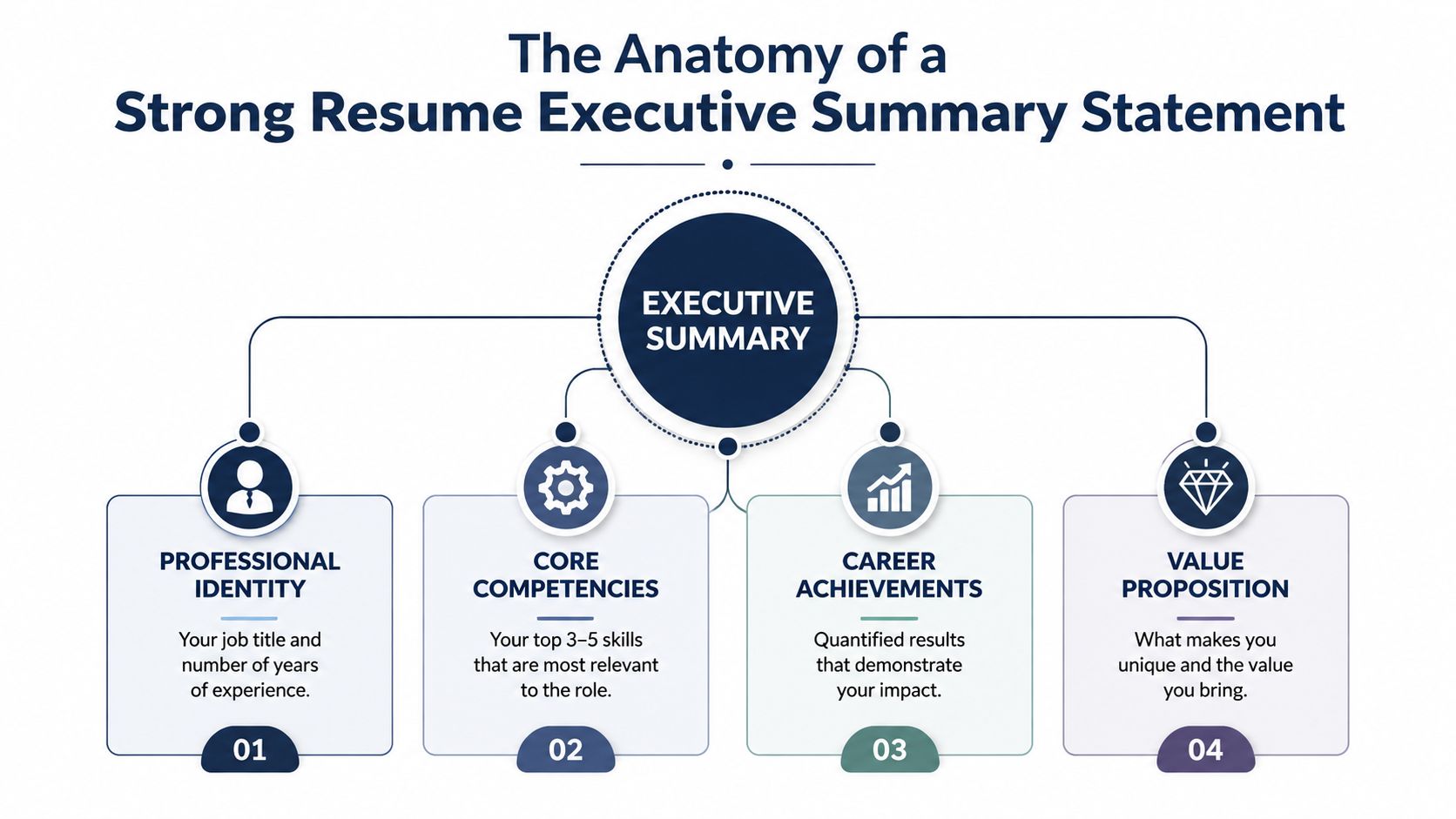
A useful summary answers four questions in a tight sequence:
- Who are you professionally?
- What scope or capability do you bring?
- What evidence shows your impact?
- What role or business need does your background support next?
Start with professional identity
Use the target title, or a truthful functional equivalent, in the first line. “Senior Operations Director,” “Data Analyst,” and “Enterprise Account Executive” give the reader and screening software more useful information than “accomplished professional.” For executive applications, include relevant context such as industry, company size, revenue, budget, team scale, or strategic strengths drawn from the vacancy. Coursera's guide to resume keywords explains why prioritized sections, including the summary, job titles, and skills, support ATS readability.
Choose one clear identity instead of listing every credential. The opening should make the rest of the resume easier to interpret.
Add scope, not inflated status
Scope shows the complexity of your work. Mention the operation, customer group, market, product, or team you handled when it supports the target role. An operations leader might reference multi-site distribution, cross-functional teams, or process improvement. A finance candidate might mention planning, forecasting, or budget ownership.
Use facts you can support elsewhere in the resume. If you managed a team, name its context. If you influenced a budget without owning it, write “supported” or “partnered on,” not “directed.” Precise wording protects credibility and gives the ATS context without turning the summary into a keyword list.
Choose a small set of relevant competencies
Select the hard skills that carry the most weight in the job description. Place 3–5 hard-skill keywords in the summary and use roughly 4–6 primary keywords there, while the broader resume may target 15–25 relevant keywords. These benchmarks appear in the Pass the Scan ATS keyword guide.
Relevance matters more than volume. “SQL, Tableau, cohort analysis” fits a data role when those are genuine capabilities. “Leadership, communication, strategic, results-driven” contributes little unless the sentence shows what you led, communicated, or improved. Write for the person who must quickly understand your value, then confirm that the important job terms appear in a natural context.
Finish with proof and forward relevance
One achievement can turn a description into evidence. Choose a result that matches the employer's priorities, and include a metric only when it is accurate and supported by the experience section. If the outcome cannot be quantified, describe the concrete change without inventing precision.
Connect your background to the target role in the final sentence. Avoid a personal wish such as “seeking growth opportunities.” State the value you are prepared to bring, for example, “Positioned to lead product launches across a growing B2B portfolio.”
A summary usually runs two to four sentences directly below the resume header. MyPerfectResume's summary advice supports keeping the opening concise. A short paragraph or a paragraph followed by a strengths list can suit senior candidates, but every line must earn its space.
Resume Executive Summary Statement Examples by Career Level
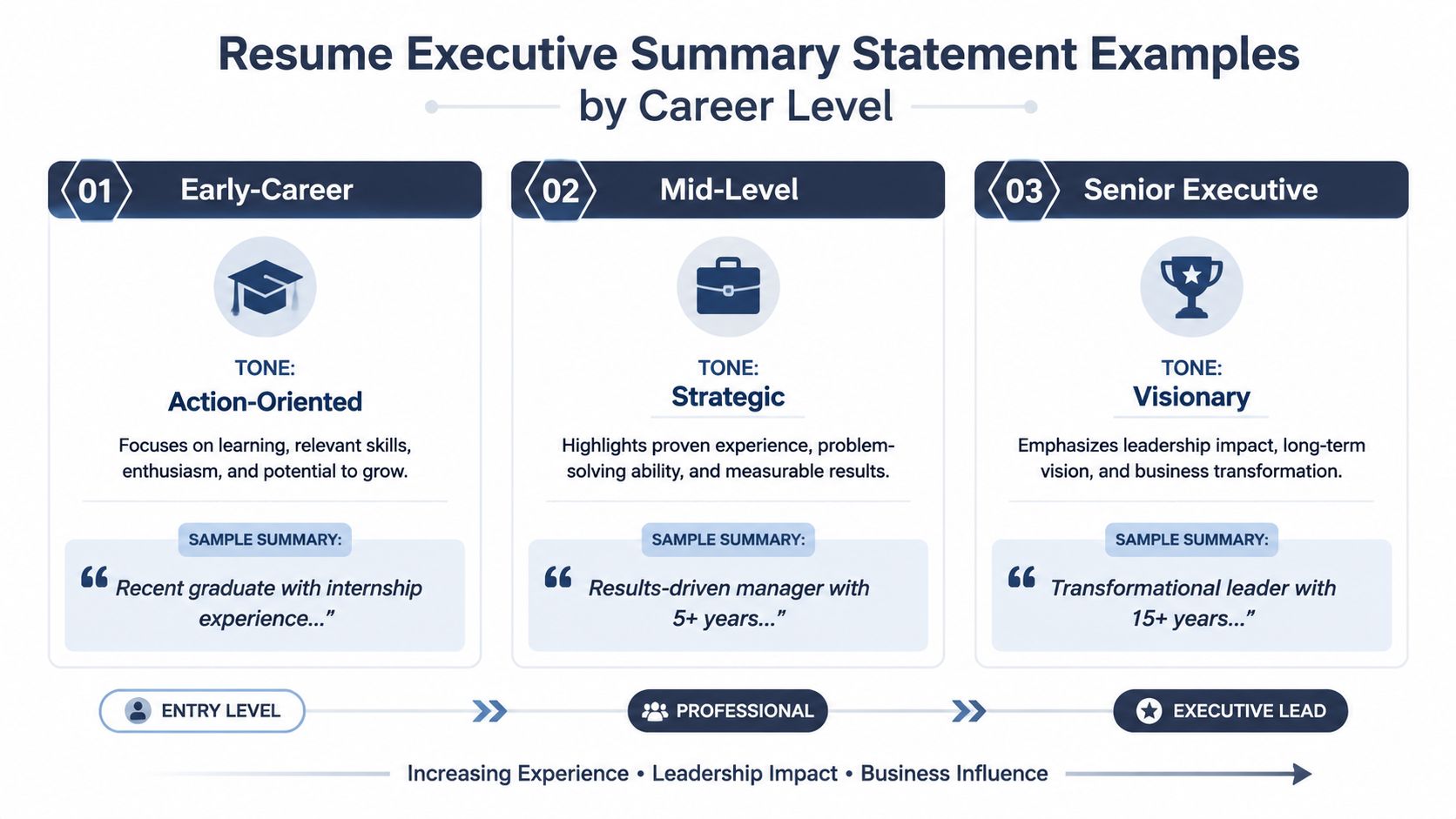
A summary should sound different at different career stages. Early-career candidates need to establish direction and transferable evidence. Mid-level professionals should show ownership and business judgment. Senior executives need to communicate scale, transformation, and strategic scope without drifting into slogans.
Early career
Weak: “Motivated recent graduate with excellent communication and teamwork skills seeking a challenging position.”
This opening is pleasant but empty. It says what the candidate wants and uses qualities that almost everyone claims.
Stronger: “Recent marketing graduate with internship experience supporting content planning, social media reporting, and customer research. Skilled in Google Analytics, campaign coordination, and presentation development, with a practical interest in helping consumer brands turn audience insight into clearer marketing decisions.”
The stronger version names a direction, relevant exposure, and usable capabilities. It doesn't pretend that internships equal extensive professional ownership. For students and graduates, coursework, projects, volunteer work, and internships can supply the evidence, provided the summary makes their relevance clear.
Mid-level
Weak: “Results-driven manager with excellent leadership skills and a proven ability to succeed in fast-paced environments.”
The problem isn't the word “manager.” It's the absence of management context. What kind of team? What kind of work? Which business problem?
Stronger: “Customer operations manager with experience leading service teams, improving escalation workflows, and using CRM reporting to identify recurring customer issues. Combines workforce planning, process improvement, and cross-functional communication to strengthen service delivery and support retention priorities.”
This version makes a positioning choice. It presents the candidate as an operator who improves customer systems, not as a generic people manager. If the job emphasizes contact-center performance, the summary can mirror that language. If it emphasizes customer success, the same career history may need a different opening.
Career changers should make the bridge explicit rather than apologizing for the pivot. “Project coordinator with experience managing vendors, timelines, and stakeholder communication, now focused on applying that delivery discipline to implementation operations” is stronger than “Looking to transition into a new career.” Return-to-work candidates can emphasize current capabilities, relevant projects, professional development, or volunteer work without turning the summary into an explanation of personal history. A targeted LinkedIn-to-resume workflow can also help identify which parts of an existing professional profile belong in the opening.
Senior executive
Weak: “Transformational leader with extensive experience driving growth and leading high-performing teams.”
That statement could sit on almost any executive resume. It offers status without scale or substance.
Stronger: “Chief operating executive with experience guiding multi-market organizations through operating model redesign, commercial expansion, and leadership development. Advises boards and executive teams on translating strategy into accountable execution across finance, technology, and customer operations.”
The senior version focuses less on a long task list and more on enterprise scope, decision context, and the relationships that matter at that level. Senior candidates should resist squeezing every achievement into the summary. Select the themes that define the next role, then let the career history provide the fuller record.
When to Skip the Summary Entirely
The common advice is to put a summary on every resume. That's too rigid. A summary earns its place only when it helps the reader understand your fit faster than the rest of the document could on its own.
Use this decision test:
- Include it when your background needs framing. A career changer, returning professional, or candidate with experience across several functions often benefits from a concise explanation of the target direction.
- Include it when your level or specialization isn't obvious. A senior title, technical niche, or hybrid background may need context before the reader reaches the detailed history.
- Skip it when it repeats obvious information. If the target role, recent title, skills, and strongest accomplishment already appear clearly in a compact resume, another paragraph may dilute the opening.
- Skip it when space is more valuable elsewhere. An early-career candidate with limited experience may gain more from a strong project section, relevant coursework, certifications, or technical skills.
- Skip it when the summary would be generic. Don't add “hardworking team player” just because a template says the page needs an opening statement.
Highly technical candidates sometimes need to lead with a focused skills profile or selected projects. That choice works when the projects immediately demonstrate role fit. It fails when the skills list becomes an unstructured inventory with no indication of what the candidate built, analyzed, maintained, or improved.
Summary versus objective
A summary describes what you've done and the value you bring. An objective describes what you want. Objective statements can still help career changers or candidates pursuing a clearly defined first step, but a vague objective puts the employer in the background.
Compare:
“Seeking a position that offers professional growth and the opportunity to use my skills.”
That sentence explains almost nothing about the candidate's contribution. A better alternative is a value-led summary that names the target role, relevant evidence, and transferable capabilities. Indeed's guidance on executive summaries reflects the unresolved debate about when a summary adds value, especially for early-career applicants, technical professionals, and people changing direction.
Ask one final question: Does this paragraph help a stranger classify my fit in seconds? If the answer is no, remove it or rewrite it. A clean resume without a summary is stronger than a resume carrying empty branding.
How to Tailor Your Summary to a Specific Job Description
A hiring manager may spend seconds deciding whether your resume deserves closer review. Your summary has to satisfy two readers at once: an ATS looking for relevant language and a person looking for a credible match. Tailoring means choosing the right terms, evidence, and emphasis without turning the paragraph into a keyword list.
Read for priorities, not decoration
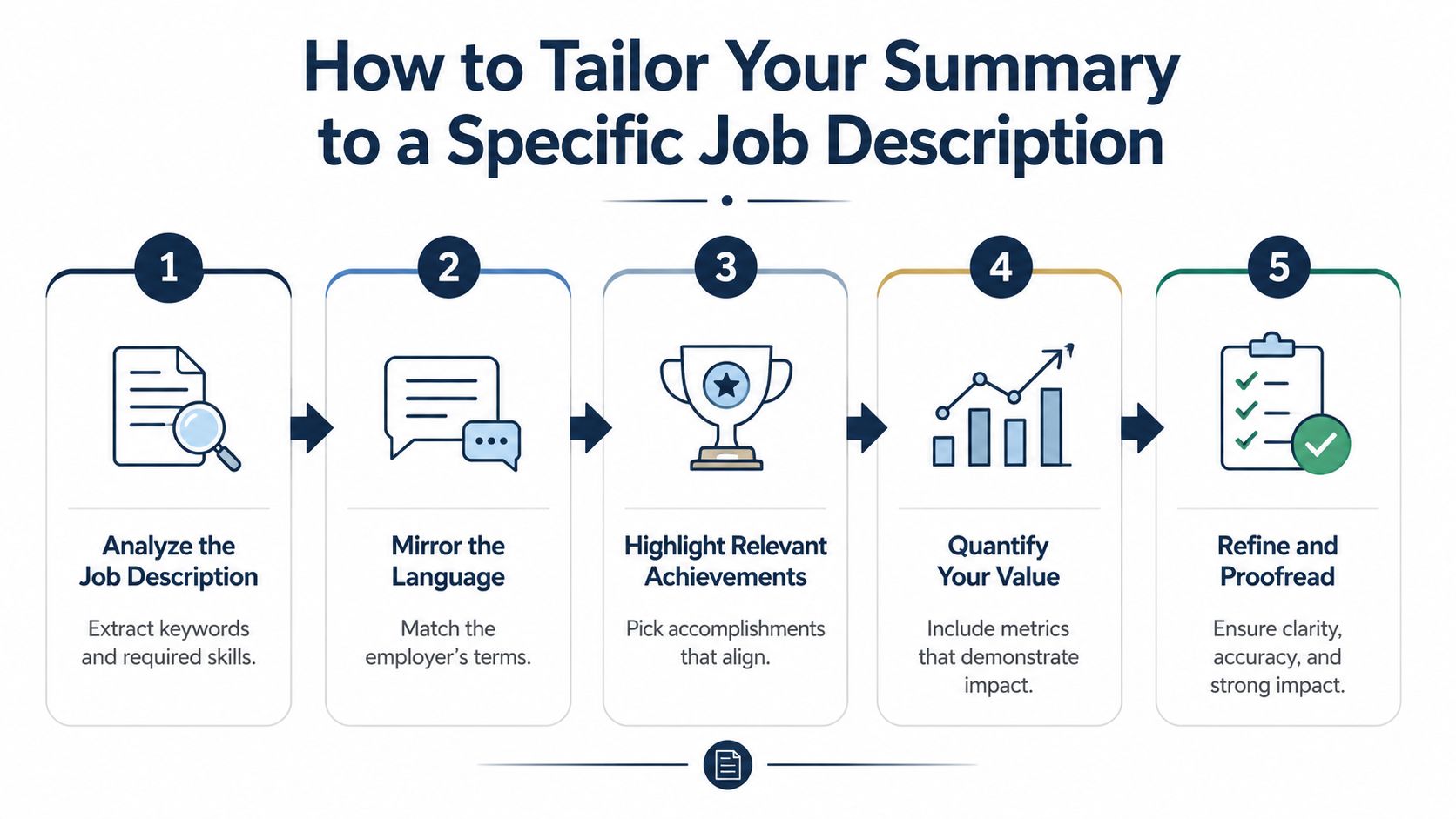
Start with the job title, required qualifications, repeated responsibilities, tools, and outcomes the employer emphasizes. Compare 3–5 similar job descriptions to identify language that appears consistently, then separate genuine requirements from incidental wording.
Use a term in your summary only when your background supports it. If the posting repeatedly names “stakeholder management” and you have managed stakeholders, include that phrase. If you have only viewed reports in Salesforce, do not claim “Salesforce administration.” Accurate alignment helps parsing, while unsupported keywords create problems when a person checks the rest of the resume.
Mirror language without copying the posting
Place the target title near the beginning, then connect a few relevant hard skills to work you have performed. Exact terms can help an ATS recognize fit, but pasted fragments make the summary sound mechanical.
Instead of listing “strategic planning, cross-functional collaboration, stakeholder management, KPI reporting,” write:
“Program manager experienced in strategic planning and cross-functional delivery, using KPI reporting and stakeholder management to keep complex initiatives aligned with business priorities.”
The keywords remain searchable, but the sentence also explains how they relate. That connection is what makes the summary readable to a hiring manager.
Match evidence to the vacancy
Choose proof that answers the employer's main concern. An operations-focused role calls for evidence of process improvement, delivery, quality, or resource management. A growth-focused role calls for relevant experience with acquisition, expansion, launches, or commercial performance.
Use a metric when you have one and can state it accurately. Without a metric, describe a concrete result, such as improving handoffs, reducing rework, strengthening reporting consistency, or helping teams adopt a new workflow. Robert Half's resume summary guidance recommends connecting relevant strengths and accomplishments to the specific position instead of relying on one universal statement.
Run a final human-read test
Read the summary aloud. Remove any keyword that feels detached from the sentence or unsupported elsewhere in the resume. Then ask whether a recruiter can answer three questions quickly: What role does this person perform? What environment do they know? What can they contribute here?
Keep a master version containing verified evidence, then create targeted versions by changing the title, competency group, and proof point. A resume tailoring workflow for job descriptions follows the same principle, using each listing to decide which experience deserves emphasis. The final paragraph should pass both tests: it should parse cleanly and sound like a professional explaining relevant work, not a database of keywords.
Common Mistakes and How to Fix Them
Use this audit before submitting:
- Vague buzzwords: Replace “strategic thinker” or “results-oriented professional” with the work you led and the result it produced.
- Recycled objective statement: Focus on the value your background offers the employer, rather than what you hope to gain.
- Keyword stuffing: Include the target title and a focused group of relevant hard skills, then connect them in readable sentences. An ATS-friendly resume guide can help you check keyword alignment without turning the summary into a list.
- Repeating your resume: Show the career pattern and strongest evidence. Do not compress every job into the opening.
- Excessive length: Keep the summary to about two to four sentences. Cut details that belong in the experience section.
A summary can satisfy an ATS and still sound natural to a recruiter. Use the exact job title when it is accurate, include only skills you can support elsewhere, and write each keyword into a sentence that explains your contribution. Avoid acronyms unless you write them out once when useful.
Check plain-text formatting so the file parses cleanly. Edit the summary after identifying the vacancy's priorities, then proofread it separately and ask whether a reader can understand your fit without guessing.
GetTheCall can turn a LinkedIn profile or existing resume into a job-specific, ATS-optimized PDF with customized content, professional layouts, and a live role-match score based on the target listing. Visit GetTheCall to refine your resume executive summary statement.