Resume Checker with Job Description: Match Score Guide
Learn how a resume checker with job description matching works, what scores actually mean, and how to tailor your resume honestly so it clears ATS filters
A high resume match score won't get you an interview by itself. It may only show that your document uses language a screening system can recognize. The popular advice, “add the missing keywords until the percentage rises,” is incomplete and sometimes harmful. It can push you to claim skills you don't have, flatten your experience into generic AI-written bullets, and mistake a diagnostic signal for a hiring decision.
A resume checker with job description works best as a translation tool. It compares your actual experience with the vocabulary, requirements, and priorities in one specific vacancy. Used carefully, it can show that your “client reporting” experience is relevant to a posting asking for “stakeholder reporting.” Used carelessly, it can encourage keyword stuffing that falls apart as soon as a recruiter asks a follow-up question.
Table of Contents
- Why a Job Description Changes Everything
- How a JD-Aware Checker Reads Your Documents
- What Your Match Score Is Really Telling You
- The Tailoring Workflow Step by Step
- Where Over-Tailoring Quietly Backfires
- A Worked Example From a Real Job Description
- Treating the Score as Guidance, Not a Verdict
Why a Job Description Changes Everything
A generic resume checker can catch surface problems. It may flag spelling, missing sections, inconsistent dates, or formatting that breaks when software tries to read it. Useful, yes. But that kind of review answers a narrow question: Is this document readable and complete?
A checker that uses the job description answers a different question: How clearly does this resume express the evidence this particular employer is looking for? That shift changes everything. The same document can look strong for one opening and ordinary for another because each employer emphasizes a different mix of tools, titles, certifications, responsibilities, and level of ownership.
A job description works like a filter, not a mirror. It does not ask whether your resume is good in the abstract. It asks whether your experience is legible for this role, in this company's language, with this set of priorities.
That is why the wording matters so much. The Harvard Business School and Accenture Hidden Workers research reported that more than 90% of employers use automated screening software for an initial cut, while 88% acknowledged that qualified applicants can be screened out when their resumes don't match stated job criteria closely enough. That does not mean every ATS makes a hard reject on its own. It means relevant experience can disappear in plain sight if your wording and the posting never connect.
The score isn't an interview prediction
A match score is narrower than many applicants assume. It does not measure judgment, presence, writing voice, or how well you would solve the team's real problems. In most cases, it reflects how much recognizable evidence your resume contains for selected parts of the posting.
That creates three common blind spots:
- Score dependence: You can start treating the number as a verdict instead of a clue, even when the suggestions stretch past your real background.
- Keyword stuffing: You can add terms to a skills section without proving where you used them, which makes the resume easier to question in an interview.
- AI-sounding bullets: You can polish away the specifics that make your work believable and end up with language that sounds tidy but generic.
Practical rule: Use the score to decide what to investigate, not what to believe.
A good checker should help you translate experience, not manufacture it. If your resume says “client reporting” and the posting asks for “stakeholder reporting,” that may be a wording gap. If the posting requires a certification or responsibility you have never had, the gap is real. A lower score in that case is not the tool being unfair.
The best results come from combining software with judgment. Check whether the tool read your resume correctly, whether it recognized the posting's real priorities, and whether every edit would still sound honest if a recruiter asked, “Tell me more about that.”
How a JD-Aware Checker Reads Your Documents
A useful checker reads your resume and the job description more like a sorting system than a simple counter. It is trying to answer four separate questions in order: what is on the page, what the employer is asking for, which phrases point to the same idea, and which matches should matter most. If you understand those stages, the score stops feeling mysterious.
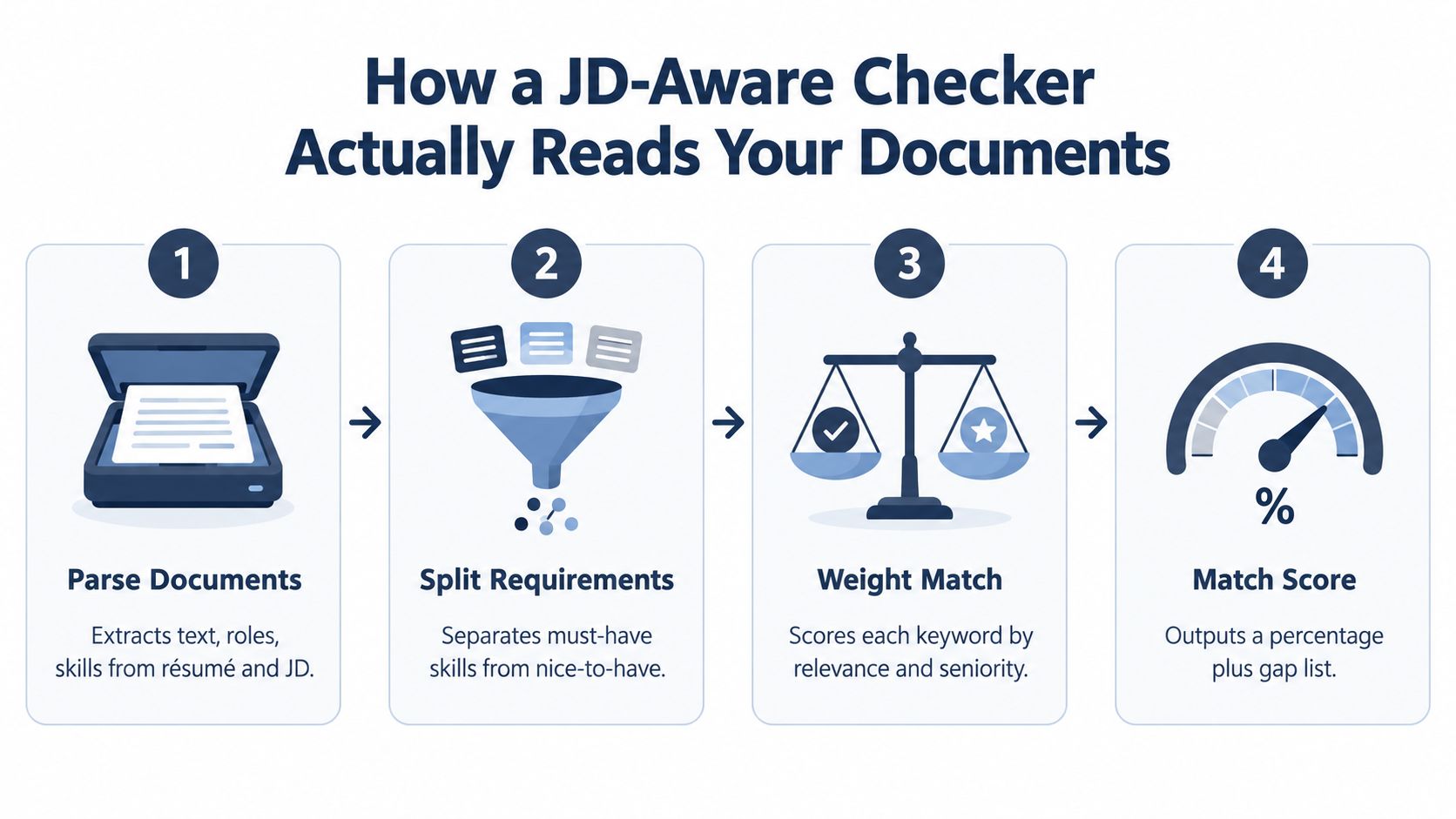
Step one is document parsing
The system starts by extracting text from both documents. It tries to identify section headings, employers, job titles, dates, education, certifications, skills, and bullet points. That sounds basic, yet this is the stage where many resumes lose usable information. If key details sit inside graphics, tables, text boxes, or uneven columns, the checker may read them poorly or miss them altogether.
Formatting is only part of the problem. The tool also has to classify what it sees. “Marketing Analyst” should be recognized as a title, “Google Analytics” as a tool, and “improved campaign reporting” as evidence of a responsibility or result. If you want a clearer picture of the formatting side, this ATS-friendly resume guidance from GetTheCall gives practical examples of layouts that are easier for systems to process.
Step two separates the posting's requirements
A job description is not one flat block of text. A stronger checker separates different kinds of employer signals so it does not treat every phrase as equally important.
It should distinguish:
- Required qualifications, such as a named certification or a core technical skill.
- Preferred qualifications, which may help but are not always mandatory.
- Hard skills and tools, such as SQL, Salesforce, or project management software.
- Responsibilities, such as managing vendors or preparing forecasts.
- Seniority and outcomes, such as leading a team or reducing reporting delays.
A vague soft-skill term should not carry the same weight as a required license, which is why this distinction matters. Context is also important. Seeing a word once is not the same as showing credible evidence for it in your work history.
Step three maps related language carefully
This is the stage applicants often oversimplify. Matching is not just “did the same keyword appear twice?”
Suppose a fictional posting says:
Build machine-learning models and apply ML techniques to customer data.
A resume might say “developed machine learning models,” “applied ML methods,” or “trained machine-learning models.” Those phrases point in a similar direction, but they should not receive automatic full credit as if they were identical. A careful checker keeps the original wording, maps close synonyms with restraint, and shows why it linked one phrase to another.
That kind of mapping is more useful than a raw word count. In practice, uncommon, role-specific terms usually signal more than generic language.
The video below gives another visual explanation of how resume and job-description matching can work:
Step four produces a weighted comparison
The final score comes from combining those classified matches. Required hard skills may matter more than broad competencies. A recognized title may count more than a repeated adjective. Evidence in recent experience may carry more weight than an isolated term in a skills section.
Different tools use different formulas, so a percentage is not an industry standard. The useful part is the explanation underneath: which requirements were matched, what resume evidence supported each match, and which items the tool could not verify. That is where the score becomes guidance instead of theater.
What Your Match Score Is Really Telling You
A match score is less like a verdict and more like a symptom. Two people can get the same low percentage for very different reasons. One has the right experience but describes it in language the checker does not connect well to the posting. The other is missing a required license, tool, or level of ownership. The score can point to both problems. It cannot tell you which one you should try to fix, or whether it is even fixable.
That is why the gap list matters more than the headline number.
If a posting asks for “client onboarding” and your resume says “implemented customer account launch processes,” the gap may be about translation. The work sounds related, but the wording is far enough apart that the tool may score it cautiously. If the posting requires a credential you do not have, that is a real qualification gap. Editing your bullets may change the percentage. It will not create the credential.
Why panic over a low percentage is usually a mistake
The familiar claim that 75% of resumes are rejected before human review has no clear published study behind it. Treat that line as internet folklore, not as a hard rule. A safer takeaway is simpler: automated screening is common, wording can affect visibility, and employers do not all configure their systems the same way.
Survey evidence supports that more measured view. A 2025 recruiter study summarized by Scult reported that 92% of surveyed recruiters said their systems didn't automatically reject resumes based on formatting, design, keywords, or AI scores. That matters because filtering is not the same as instant rejection. A system may sort, rank, or flag applications for review without throwing them out completely.
Use the score the way you would use a draft grade on an essay. It shows where the document may be underselling you. It does not decide your value, and it does not know the hiring manager's real priorities.
| Score Range | Likely Cause | Recommended Action |
|---|---|---|
| Below 50% | Major terminology, structure, or requirement gaps | Check parsing first, then compare required qualifications with your real background |
| 50% to 69% | Some relevant evidence exists but isn't clearly expressed | Reorder relevant bullets, add accurate role language, and inspect missing requirements |
| 70% to 84% | Solid alignment with room for clearer evidence | Strengthen the most important accomplishments and remove distracting content |
| 85% and above | Strong textual alignment, not guaranteed selection | Proofread for credibility, preserve your voice, and stop adding keywords |
These ranges are working categories, not universal hiring thresholds. Different checkers weigh titles, skills, recency, and phrasing differently. A strong score can still sit on top of weak evidence. A weaker score can still belong to a qualified candidate whose resume is written in broad or company-specific language.
A 2025 analysis of 944 resumes across 529 job titles reported an average job-description match score of 57.6%, with 72% below a stated 70% threshold. Because that dataset came from a resume-optimization company, it should not be treated as a benchmark for every applicant or every tool. It is still useful for one reason. It shows how easy it is to misread a number in isolation. A 58% score may signal weak fit. It may also be ordinary for the tool and the sample behind it.
The useful question is never “How do I force this to 90%?” It is “What is this score really measuring, and what is it missing?”
The Tailoring Workflow Step by Step
Tailoring works better as collaborative editing than automatic rewriting. Start with your source material, compare it with one target posting, and make only changes you can support with evidence.
1. Import your real experience
Begin with the resume, LinkedIn profile, project notes, or career history that contains your actual work. Don't start from the job description. Starting there makes it easier to copy the employer's claims into your own document without noticing that you've crossed from translation into invention.
Identify the accomplishments behind each role. Note the tools you used, the people or teams you supported, the process you owned, and the outcome you produced. A bullet such as “managed weekly reporting” may conceal valuable evidence about data preparation, stakeholder communication, or process improvement.
2. Add one target job description
Paste the full vacancy into the checker when possible. A complete posting gives the system context around each term and helps separate mandatory qualifications from preferred language.
A guide to tailoring a resume to a job description can help you understand the manual process, but the principle is simple: tailor for the role in front of you, not for an imagined universal ATS.
3. Review ranked requirements
Look at the requirements in priority order. For each one, ask:
- Do I have direct evidence?
- Do I have transferable evidence that needs clearer wording?
- Is this a genuine gap?
- Is the term preferred rather than required?
Reject any suggestion that asks you to claim a tool, certification, responsibility, or result you can't demonstrate. A checker should show the evidence behind its recommendation. If it can't, treat the suggestion as a prompt for review rather than an edit to accept.
4. Rewrite the highest-leverage bullets
Put the most relevant evidence near the top of the relevant role. Replace responsibility-only language with accurate action and context.
Before:
Responsible for coordinating monthly client reports.
After:
Coordinated monthly client reporting by consolidating account data, checking discrepancies, and presenting findings to account managers.
The revised bullet uses more concrete language, but it doesn't invent a result, tool, or scope. If you used Salesforce or reduced preparation time, add that evidence. If you didn't, leave it out.

5. Re-score, then edit manually
Read the updated resume as a recruiter would. Check whether the opening summary reflects the role, whether the strongest matching evidence appears early, and whether the document still sounds like one person with a coherent career history.
The score should move because the evidence became clearer. If it rises because you repeated a term without adding context, the improvement is cosmetic. Stop when the document communicates fit plainly, even if a tool continues to suggest more synonyms.
Where Over-Tailoring Quietly Backfires
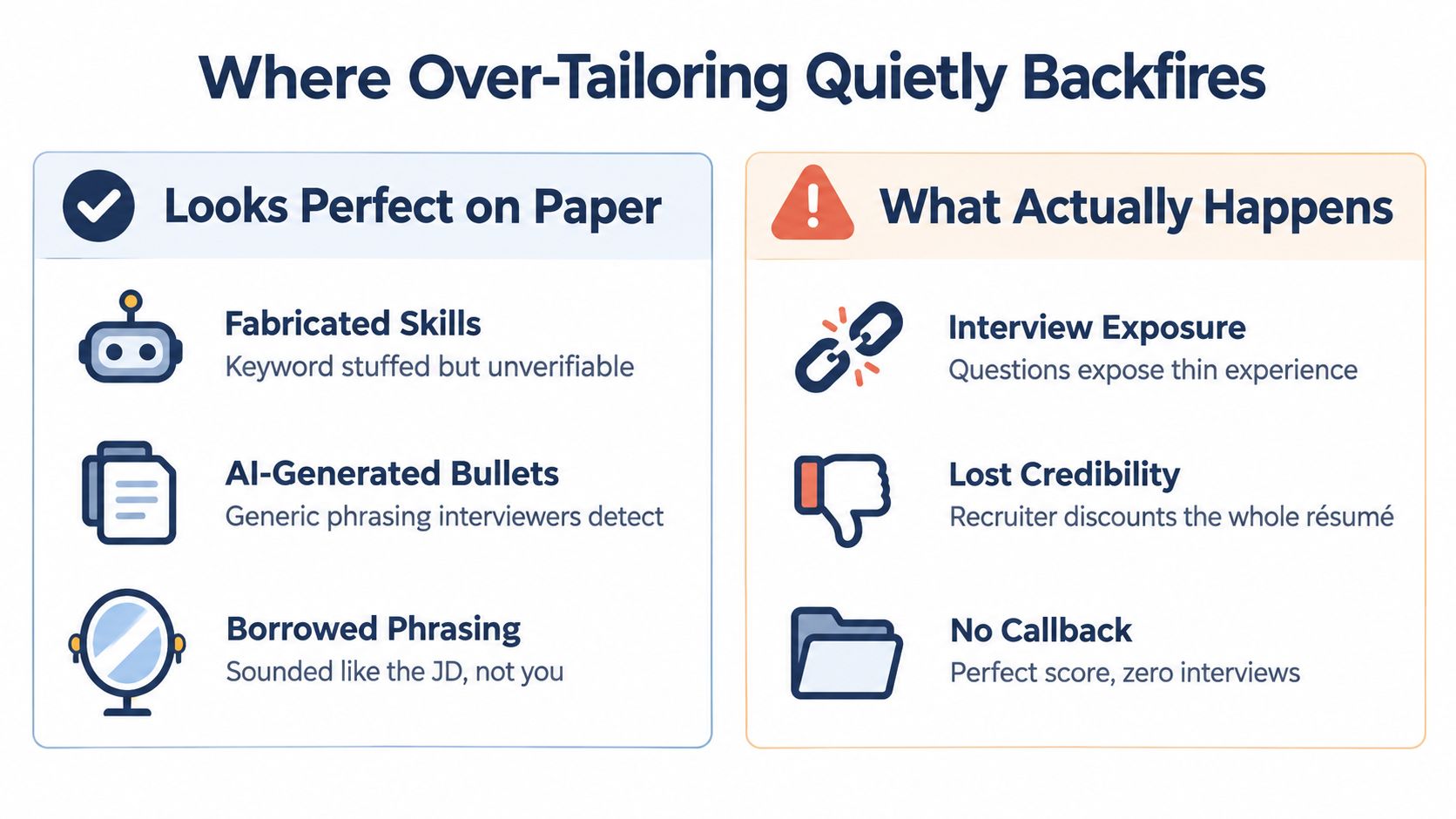
A higher match score can still produce a weaker application. If the score rises because you inserted claims you cannot explain, copied the posting's tone, or let AI smooth every bullet into the same bland voice, the resume may look more aligned on screen while becoming less credible in a real hiring process.
That tradeoff matters. A 2025 TopResume survey of 600 U.S. hiring managers found that 19.6% would reject a resume or cover letter they believed was AI-generated, while 33.5% said they could identify AI-generated resume content in under 20 seconds. The same coverage also reported that 82% of job seekers who used AI to create resumes encountered suspected ATS rejection or overlooking. Those figures do not prove that AI wording alone causes rejection. They do show why a polished score is not the same as a trustworthy document.
Three ways excessive matching causes trouble
Fabricated skills create interview exposure. Resume checkers reward overlap. Interviewers test proof. If you add “budget ownership” because the job description repeats it, expect follow-up questions about the size of the budget, the tradeoffs you managed, and what changed because of your decisions. A keyword may help you surface in a scan, but it cannot carry a conversation.
Generic AI language erases useful detail. “Used cross-functional synergies to drive strategic outcomes” sounds like it belongs to everyone and no one. Hiring teams learn more from plain specifics: what tool you used, who you worked with, what constraint you handled, what output you produced. General language can raise similarity while lowering believability.
Borrowed wording can make the resume feel interchangeable. When every line mirrors the posting, the document reads like a paraphrase exercise instead of a work history. Recruiters still need to picture your actual role. They need enough detail to tell whether you executed the work, supported it, or only worked near it.
This backfires fastest for career switchers and international applicants, because translation is necessary but relabeling is risky. If you coordinated stakeholders across teams, say that. If your work informed a project manager, say that. Do not rename that experience as formal program management unless your responsibilities truly matched the title.
Use three guardrails:
- Defend every bullet: Be ready to explain the action, context, and outcome in conversation.
- Preserve real detail: Keep measurable outcomes and concrete project information from your source experience.
- Stop at honest alignment: Once the score stops improving through meaningful edits, do not mirror more language just to chase a higher percentage.
A Worked Example From a Real Job Description
Consider this fictional operations posting excerpt:
Manage vendor coordination, improve order accuracy, prepare weekly performance reports, and communicate issues to internal stakeholders. Experience with process improvement is preferred.
A candidate's original bullet says:
Managed suppliers and prepared weekly reports for the operations team.
The checker may recognize “suppliers” as related to “vendors,” and “weekly reports” as a direct match. It may miss the connection between “managed” and the posting's emphasis on coordination. It also can't know whether the candidate improved accuracy unless the resume says so.
What the candidate should inspect
The candidate checks the source experience before rewriting:
- Did they coordinate delivery schedules or only send purchase orders?
- Did they verify order information?
- Did they communicate issues to sales, warehouse, or finance teams?
- Did they change a process, or only follow one?
Suppose the answers support this fuller bullet:
Coordinated vendor delivery updates, verified order information, and prepared weekly performance reports for operations and finance stakeholders.
This version introduces the posting's language naturally. It makes coordination, verification, reporting, and stakeholder communication visible without claiming a process-improvement project that didn't happen.
The soft-skill phrase “communicate issues” shouldn't dominate the score. It matters because the role involves coordination, but it carries less evidence than a concrete responsibility or required system. A checker that gives equal credit to “communication” and a named operational tool would be overstating the match.
If the candidate did improve an order process, they could add that outcome with accurate detail. If they didn't, the honest gap remains. A guide for turning a LinkedIn profile into a resume can support source gathering, but the candidate still has to verify every line against lived experience.
Treating the Score as Guidance, Not a Verdict
A job-description-aware checker translates your experience into one employer's vocabulary. It doesn't decide whether you're qualified, whether a recruiter will respond, or whether an accommodation should be considered.
The U.S. Equal Employment Opportunity Commission and Department of Justice guidance warns that software and algorithms used to score resumes may unlawfully disadvantage people with disabilities. Employers should consider how tools affect different disabilities and maintain processes for reasonable accommodations. A formatting or keyword gap isn't proof of ability, and you shouldn't disclose medical information to improve a score.
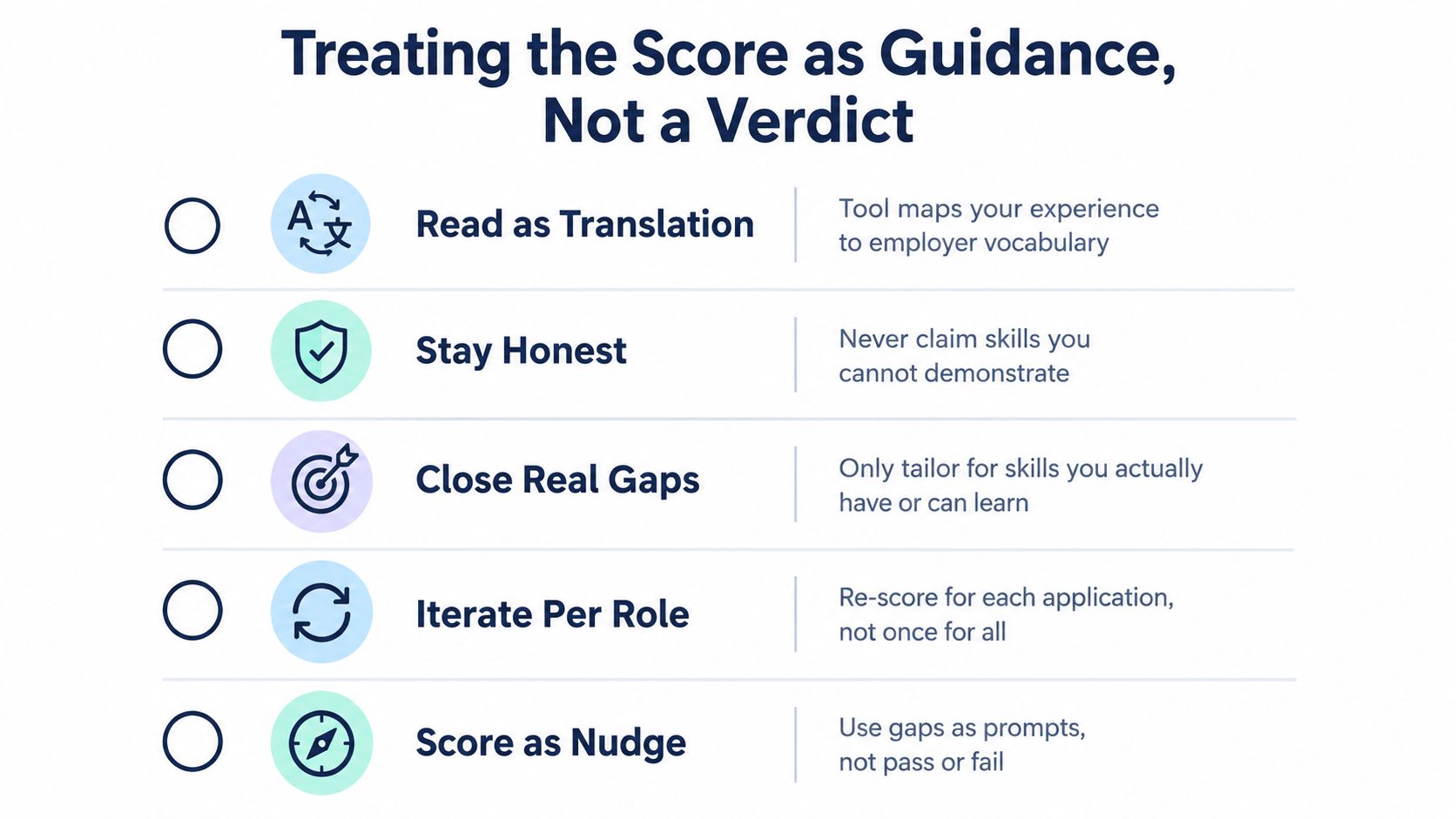
Save this checklist for each application:
- Verify every claim. Keep only skills, responsibilities, titles, and outcomes you can demonstrate.
- Separate required from preferred. A missing preferred term may be less important than a missing essential qualification.
- Check the parser's reading. Confirm that headings, dates, titles, and skills appear in the right sections.
- Translate before you rewrite. Use the employer's terminology when it accurately describes your experience.
- Treat the score as a nudge. Investigate gaps instead of treating the percentage as a verdict.
GetTheCall turns a LinkedIn profile or existing resume into a job-specific, ATS-oriented PDF, compares it with a target listing, and provides a live role-match score based on the supplied experience. If you want to test that workflow on your next application, visit GetTheCall and use the checker to review parsing, terminology, and evidence before you submit.