Operations Manager CV Examples: 8 Proven Layouts for 2026
Operations Manager CV Examples for mid-career to senior roles, with KPI-driven bullets, ATS keyword tips and layout notes you can adapt quickly.

A capable operations manager can run a busy warehouse, keep several shifts on track, and solve problems before customers notice. Yet their CV may still read like a job description: managed staff, oversaw inventory, improved processes. Without scale or results, a recruiter can't tell whether that person coordinated a small team or led a complex operation.
Strong operations manager CV examples make scope visible. The occupation spans a large range of responsibilities and pay levels: the U.S. Bureau of Labor Statistics reported about 3.5 million people employed as general and operations managers in May 2025, with an annual mean wage of $134,940. Its broader occupational profile recorded about 3.6 million jobs and a median annual wage of $105,770 in the same period. That variation makes it important to show what you owned, whether that's people, budgets, sites, service levels, or production outcomes (BLS occupational data).
This guide offers eight CV layouts, from an early-career coordinator to a senior operations director. Each example pairs a realistic sector or career context with relevant KPIs, ATS keywords, and a practical tailoring step. Use the structures as models, then replace every illustrative figure with information you can verify from your own work.
Table of Contents
- 1. Entry-Level Operations Coordinator Moving Toward Management
- 2. Mid-Career Manufacturing Operations Manager
- 3. Supply Chain and Warehouse Operations Manager
- 4. Retail Operations Manager
- 5. Healthcare Operations Manager
- 6. Tech and SaaS Operations Manager
- 7. Career Switcher into Operations Management
- 8. Senior Director of Operations
- 8 Operations Manager CV Examples Compared by Role and Experience
- Turn These Examples Into Your Own Operations CV
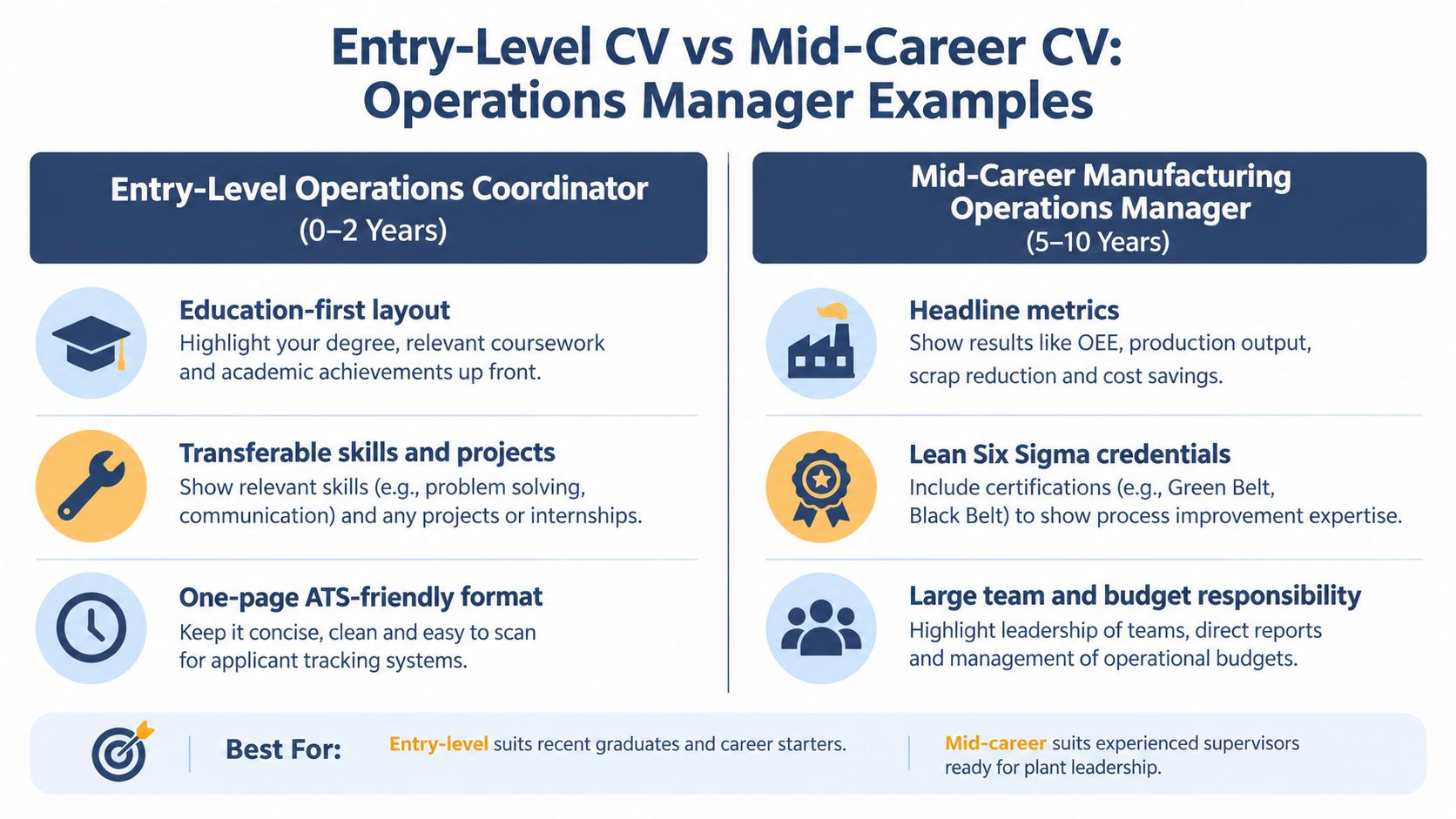
1. Entry-Level Operations Coordinator Moving Toward Management
You don't need a long management history to show operational promise. If you're a recent graduate or have experience from shift supervision, an internship, part-time work, or a project, make your coordination responsibilities easy to understand. A recruiter should see what you organized, the scale of the work, and what changed as a result.
Example bullets
- Coordinated weekly shift schedules for a team of 12, reducing overtime requests by roughly 15% over one quarter.
- Tracked inventory discrepancies in Excel and flagged recurring supplier delays, helping the team renegotiate two delivery schedules.
Treat these as illustrative patterns, not claims to copy. The first bullet connects scheduling to team scale and an outcome. The second shows analysis and follow-through, even without a dramatic percentage. That's stronger than claiming you were “responsible for operations” when you didn't own the whole function.
Keywords and tailoring
Pull six to eight relevant keywords from the job listing, such as process improvement, scheduling, KPI tracking, inventory control, or supplier coordination. Work them naturally into your summary and experience bullets, but only when they describe work you've done. O*NET lists coordinating others, controlling resources, developing objectives, systems evaluation, and critical thinking among important operations-management activities and skills (O*NET occupation profile).
If you've used GetTheCall, you can import your LinkedIn profile, compare your résumé with a target listing using the live ATS Role Match score, and check which requirements still need evidence. Choose a clean, single-column layout, then run the free ATS résumé checker before exporting. For an entry-level application, even modest, accurate measures of workload, time saved, or errors handled can help the reader understand your contribution.
2. Mid-Career Manufacturing Operations Manager
A manufacturing CV earns attention by showing what the operation produced and what you improved. A hiring manager for a mid-career role may screen for line performance, quality, safety, throughput, and experience leading teams across shifts. Put the strongest evidence first, with enough context to show the scale of your work.
Example KPI bullets
- Led a Lean Six Sigma project on Line 3, reducing changeover time by 30% and adding about 40 production hours per month.
- Managed a 120-person, three-shift operation against an OEE target of 85%, achieving 87% over 12 months.
Use these as patterns, not claims to copy. A clear formula is action + operational lever + measured result. Name the line, process, or quality control you changed, then give the result and timeframe you can substantiate. Penn career-services guidance recommends three to seven bullets per employment entry and quantifiable details where possible (Penn career-services résumé guidance).
Practical rule: Name an improvement method only if you used it. “Lean Six Sigma” carries more weight when tied to a specific project than when listed alone.
For ATS matching, select six to eight terms from the job listing that accurately describe your experience. Depending on the role, these might include OEE, yield, scrap reduction, safety compliance, DMAIC, production planning, or quality assurance. Use the certification wording in the listing, such as Lean Six Sigma Black Belt, only if you hold that credential. A keyword should have evidence in your work history, not just a place in your skills section.
Keep older roles brief when they do not explain your current manufacturing scope. Then tailor the summary and bullets to the posting, and export a clean PDF. For layout and parsing guidance, see this guide to an ATS-friendly résumé.
3. Supply Chain and Warehouse Operations Manager
A distribution centre's daily order volume can make a CV feel specific, but volume alone does not show control. Pair the operating scope with the result the target role values, such as order accuracy, inventory control, or service performance.
Example bullets
- Managed a 250,000-square-foot distribution centre handling 18,000 orders per day, maintaining 99.4% order accuracy.
- Introduced cycle counting across three zones, lifting inventory accuracy from 94% to 98.5% within six months.
Use these figures as placeholders, replacing them with the facility size, workload, and outcomes you can support. A strong KPI bullet gives the starting point, names your action, and shows the endpoint. If a team or system delivered the result, describe your part accurately. For example, distinguish work you led from a wider project you supported.
Name the tools you have used, such as a WMS, TMS, or ERP platform. Choose ATS terms from the listing that match your work, including inventory control, carrier management, fulfilment, capacity planning, peak-season planning, safety, or service-level performance. A short, relevant keyword set is stronger than a crowded list.

Moving between retail distribution, food logistics, or third-party logistics? Tailor one bullet to evidence that transfers across sectors: volume handled, accuracy maintained, staffing coordinated, or service delivered. Compare the posting's purchasing language with your own experience using this associate manager purchasing job-listing template, and include only requirements you can support. Keep the CV in a simple layout without tables or multiple columns so hiring teams and parsing software can read the details clearly.
4. Retail Operations Manager
A regional retail role may cover a handful of stores or a large portfolio. Make your actual scope easy to see: store count, format or region, team size, and financial responsibility. Hiring managers need evidence that you can protect customer service while controlling costs, not a list of routine duties.
Example KPI bullets
- Oversaw 14 stores generating $62 million in annual revenue, reducing shrink from 2.1% to 1.4% through a revised cycle-count and receiving process.
- Led a workforce scheduling tool rollout across nine stores, cutting labour overspend by 6% in the first quarter.
The $62 million and 14-store figures are placeholders. Replace them with your own portfolio figures, and keep the link between your action and the result clear. Use led when you owned the work, implemented when you delivered it, and supported when the outcome belonged to a wider team. That distinction makes your contribution credible.
For a regional oversight role, bring the evidence forward rather than burying it in a general summary. A focused keyword set might include multi-site operations, P&L responsibility, shrink control, labour scheduling, store standards, merchandising execution, customer experience, and workforce planning. Match the job listing's wording where it accurately describes your experience.
Tailor the bullets to the employer's priorities. If the posting emphasizes loss prevention, lead with the shrink result and the process you changed. If it stresses staffing, foreground scheduling and labour spend. A number without your role is hard to assess; an action without a measure is hard to compare. Use a defensible indicator, such as shrink, service score, labour spend, or rollout scope, where you have one. Keep the PDF clean so store names and results are easy to scan.

5. Healthcare Operations Manager
An outpatient clinic can shorten waits without rushing patients or weakening checks. Healthcare operations CVs should show how you improved the service while protecting compliance, patient experience, and staff capacity. State what changed, how the team measured it, and which safeguards remained in place.
- Redesigned the outpatient appointment process, reducing average patient wait times from 42 to 27 minutes over six months.
- Managed budget and staffing for a 60-person clinical support team, maintaining full compliance during two regulatory inspections.
Use these as example structures, not claims to copy. Protect patient privacy: describe outcomes with aggregated operational measures, never identifiable details. Link process changes to clinical outcomes only when you can substantiate that connection.
For a healthcare role, the right keywords depend on the framework and location. Name CQC or Joint Commission standards only if you have worked with them. Other relevant terms include clinical governance, patient flow, capacity planning, appointment scheduling, quality assurance, regulatory compliance, and workforce planning. Use the job description's wording where it matches your experience.
The CV itself should make evidence easy to assess. A clean, conservative layout helps hiring teams scan your experience, while relevant professional memberships and continuing professional development show how you maintain your knowledge. Tailor the evidence to the service: name the scheduling or workflow change, the measure used to assess it, and what patients experienced afterward. For example, explain whether a revised booking process changed waiting times or appointment access. That is more credible than claiming you “improved patient care” without showing what changed.
A useful bullet formula is: action + process + operational measure + safeguard. Keep the measure within your actual remit, and distinguish work you led from work delivered by the wider team.

6. Tech and SaaS Operations Manager
A SaaS operations CV needs to show how systems and workflows support a specific function. Recruiters may look for experience with sales onboarding, tool ownership, reporting, or cross-team process design. Name the team you supported and the operational change you made.
For example, the 90-to-61-day reduction only works if you can explain the Salesforce workflow you built and how the team measured time to first closed deal. If those figures do not match your results, keep the before-and-after structure and use a metric you can substantiate.
- Designed a Salesforce onboarding workflow for a 40-person sales team, reducing time to first closed deal from 90 to 61 days.
- Consolidated 14 SaaS tools into nine and assigned clear ownership, saving approximately $48,000 a year in licence costs.
For each bullet, make your ownership clear: say whether you designed and led the change or contributed to a team effort. A useful formula is action + workflow or tool + team or scope + measurable result. Keep the measure tied to work you can explain in an interview.
“A smaller, well-explained improvement is more persuasive than a big number with no scope or ownership.”
Tailor the systems and keywords to the role. Group tools by function, such as CRM, finance, reporting, or project management, when that makes your hands-on experience easier to scan. Relevant terms may include workflow automation, vendor management, cross-functional coordination, business operations, revenue operations, forecasting, KPI reporting, and process design. Use only those that describe work you have done.
Show growth through the team, workflow, or function you supported. Avoid claiming company-wide performance changes unless you can connect them to your contribution. If you use an ATS match tool, treat suggested terms as prompts to check against your experience. A minimal template can work for a tech employer; clear links between tools, actions, and results matter more than decoration.
7. Career Switcher into Operations Management
A recruiter may not recognize “platoon logistics” or “mission planning.” Translate those duties into the civilian scope they show: people, resources, schedules, safety, and delivery. The same method works for facilities roles and career returns. Start with the operational problem you handled, then show the team or process involved.
For example, “Platoon Logistics Sergeant” might become “Logistics Supervisor managing 45 personnel and $2.3 million in equipment inventory,” if that accurately describes your responsibility. Another bullet could read: “Coordinated transport, supplies, and schedules across three locations for multi-team deployments.” Keep the original title where accuracy requires it, and explain specialized terms in plain language. The goal is clarity, not a larger-sounding title.
A useful bullet formula is action + workflow or resource + scope + result. Add a measurable result only when you can explain how it was achieved. If you are returning after a career break, include relevant responsibilities and skills from that period, even if the role title does not sound operational.
Build a civilian keyword set
Choose terms from the target posting that match your actual work. Depending on the role, these might include resource planning, logistics coordination, inventory control, team leadership, scheduling, safety, facilities operations, or vendor management. Add Lean, PMP, CSCP, or a Six Sigma credential only if you hold it. Mark any course or certification in progress clearly.
For a career-switcher CV, put the target role's closest match first: logistics coordination for a supply chain job, or safety and facilities operations for a site role. Then tailor one or two bullets to show the relevant scope and outcome. This makes the connection easy to scan without implying experience you do not have.
A job-specific tailoring tool can help compare your experience with a posting, but the examples and evidence must remain yours. For practical guidance on converting profile details into résumé content, use this guide to turn a LinkedIn profile into a résumé.
Before applying, check unfamiliar military terms against a plain-language equivalent. Keep a glossary out of the final CV unless the employer would find it useful. Make your operational experience recognizable at a glance.
8. Senior Director of Operations
A senior director's CV needs to show the scale of responsibility and the decisions behind the results. Start with the functions, sites, budget, or regions you owned. Then select a few outcomes that show how you shaped priorities, governance, and performance.
Example KPI bullets
- Led a three-year operational transformation across 22 sites, improving operating margin by 4.2 points while maintaining service levels.
- Oversaw a $180 million operations budget and a 1,200-person workforce across North America and Europe.
Use those figures as a template for scope, not as numbers to copy. Anchor your own CV in the budget and headcount you can document. Be precise about your contribution: use “owned” for formal accountability, “led” when you directed the work, and “contributed to” when the result depended on a wider leadership group. A useful formula is action, organizational scope, measurable outcome, and how service or performance was affected.
For ATS screening, draw relevant terms from the posting: multi-site operations, P&L accountability, transformation, governance, strategic planning, organizational design, cost control, change management, and executive reporting. Keep only terms that reflect your actual remit, and order them to match the role. For board-facing posts, foreground governance and investment evidence. For transformation roles, lead with integration, service continuity, or operating-model change.
Keep the CV focused, with particular care in the opening profile and achievements. Align your LinkedIn profile with the same core responsibilities and results, so recruiters see a consistent account of your scope and contribution.
8 Operations Manager CV Examples Compared by Role and Experience
| CV Example | 🔄 Implementation Complexity | ⚡ Resource Requirements | 📊 Expected Outcomes | ⭐ Ideal Use Case and Key Advantage |
|---|---|---|---|---|
| Entry-Level Operations Coordinator (0–2 Years) | Low; organize transferable skills, projects, and education | Job listing keywords, coursework, and any measurable results | Shows readiness for entry-level roles without overstating management experience | Recent graduates and early-career candidates; highlights potential and relevant experience |
| Mid-Career Manufacturing Operations Manager (5–10 Years) | Moderate; select accurate production metrics and relevant credentials | OEE, quality, safety, team, and production data; Lean or Six Sigma credentials if held | Makes efficiency gains, quality results, and leadership scope clear | Manufacturing leaders; emphasizes measurable operational improvements |
| Supply Chain and Warehouse Operations Manager | Moderate; document systems, scale, and logistics performance | WMS/TMS platform names, throughput, accuracy, and fulfilment metrics | Demonstrates ability to manage volume, inventory, and peak periods | Warehouse, e-commerce, retail distribution, and 3PL roles; highlights logistics outcomes |
| Retail Operations Manager (Multi-Store) | Moderate; summarize site scope and contextualize performance figures | Store count, revenue or headcount, shrink, labour, and customer metrics | Shows multi-site leadership and the balance of cost control and service | Regional and multi-store retail roles; makes responsibility and results easy to assess |
| Healthcare Operations Manager | Moderate to high; align terminology with the target region and regulations | Applicable regulatory knowledge, staffing and patient-flow metrics, and EHR systems | Demonstrates operational impact alongside compliance and patient-focused improvements | Clinics, hospitals, and care services; foregrounds regulatory awareness and patient experience |
| Tech and SaaS Operations Manager | Moderate; connect tools and cross-functional work to business results | Actual software platforms, process metrics, and company growth context | Shows scalable processes, effective tool management, and support for growth | SaaS, fintech, and scaling companies; emphasizes systems building and cross-functional impact |
| Career Switcher into Operations Management (Military Veteran Transition) | Moderate to high; translate prior-role terminology into civilian language | Scope indicators, transferable skills, and relevant civilian credentials if held | Makes leadership, logistics, and planning experience understandable to civilian employers | Veterans and career switchers; surfaces transferable operational experience |
| Senior Director of Operations (12+ Years) | High; select concise, credible enterprise-level achievements | Verified budget, workforce, site, financial-impact, and strategic-scope data | Communicates executive-level scale, transformation, and business impact | Director, VP, and COO searches; quickly establishes seniority and strategic results |
Turn These Examples Into Your Own Operations CV
Choose the example closest to your current level and sector, then adapt its structure to the vacancy in front of you. An entry-level coordinator can lead with scheduling, analysis, and project responsibility. A warehouse manager should make throughput and accuracy easy to find. A senior director needs to show the scale of accountability and the decisions that changed performance.
Build the CV around three moves. First, mirror the listing's language where it accurately describes your experience. If the employer asks for capacity planning, vendor management, or clinical governance, use those terms in context rather than relying on a generic skills list. O*NET's profile reflects how operations work combines coordinating people, controlling resources, setting objectives, and evaluating systems. Your CV should show where you've used those capabilities, not just claim them.
Second, anchor each important bullet to evidence. Start with the action, name the operational lever, and finish with a measurable result or clear scope. Useful indicators include team size, sites, orders handled, cycle time, service-level performance, cost, quality, safety, or budget responsibility. If you don't own revenue or have clean before-and-after records, use a defensible denominator such as workload, locations, staffing, or audit findings. Be clear about whether you managed, implemented, or supported the work. An accurate contribution is more convincing than an impressive figure you can't explain.
Third, check the document before you send it. A single-column layout and straightforward headings help keep the information readable and machine-parsable. Read the PDF yourself, too. Make sure the key figures, systems, and job titles display correctly, and remove anything that overstates your role.
GetTheCall can support that workflow by importing an existing résumé or LinkedIn profile, analyzing a target listing, and suggesting job-specific revisions based on the experience you provide. Its live ATS Role Match score updates as you edit, and you can use its templates and PDF export to prepare an application. Keep the final review personal: every keyword should be truthful, every metric should be verifiable, and every bullet should help a hiring manager understand the work you did.
To turn your operations experience into a focused, job-specific CV, start with the role you're applying for and make your scope and results easy to verify. GetTheCall can help you import your existing résumé or LinkedIn profile, compare your experience with a job listing, and export an ATS-ready PDF.