8 Interior Design Resumes That Win Interviews
Explore 8 interior design resumes across experience levels, with ATS-friendly layouts, portfolio linking tips, and sample bullet phrasing that wins interviews.
You've refreshed your inbox for the tenth time this week. You sent out polished applications to firms you admire, your portfolio is strong, and still, silence. It's a frustrating spot, and it's rarely about talent.
Most interior design resumes get overlooked for a simpler reason. They don't communicate fit fast enough, first to software, then to a busy hiring manager skimming between meetings. A beautiful layout with text trapped in graphics can fail parsing. A list of duties like "designed spaces" or "worked with clients" tells a reviewer almost nothing about scale, tools, or results. And a generic resume sent to every firm misses the exact language that firm uses for its work.
The portfolio matters, too, but it can't rescue a resume that never gets seen. A 2025 analysis found 78.7% of 1,000 live interior-designer job descriptions required a portfolio, according to the analysis of live interior-designer job descriptions. Your resume still has to earn that click, in plain, searchable text.
The eight examples below cover different career stages, from recent graduate to studio owner. Each shows how to structure your story, phrase bullets with proof, and link your portfolio so both systems and people can follow your work. Pick the one closest to where you are now, then adapt its logic to your next application.
Table of Contents
- 1. Entry-Level Interior Designer (Recent Graduate Resume)
- 2. Residential Interior Designer (Client-Focused Resume)
- 3. Commercial and Hospitality Interior Designer (Scale-Focused Resume)
- 4. Senior Interior Designer and Project Manager (Leadership Resume)
- 5. Career Switcher into Interior Design (Transferable Skills Resume)
- 6. Sustainable and Wellness-Focused Interior Designer (Specialist Resume)
- 7. Interior Design Principal or Studio Owner (Business Leadership Resume)
- 8. Returning-to-Work or Freelance Interior Designer (Gap-Friendly Resume)
- Interior Design Resume Examples: 8-Point Comparison Guide
- Your Next Step to a Standout Interior Design Resume
1. Entry-Level Interior Designer (Recent Graduate Resume)
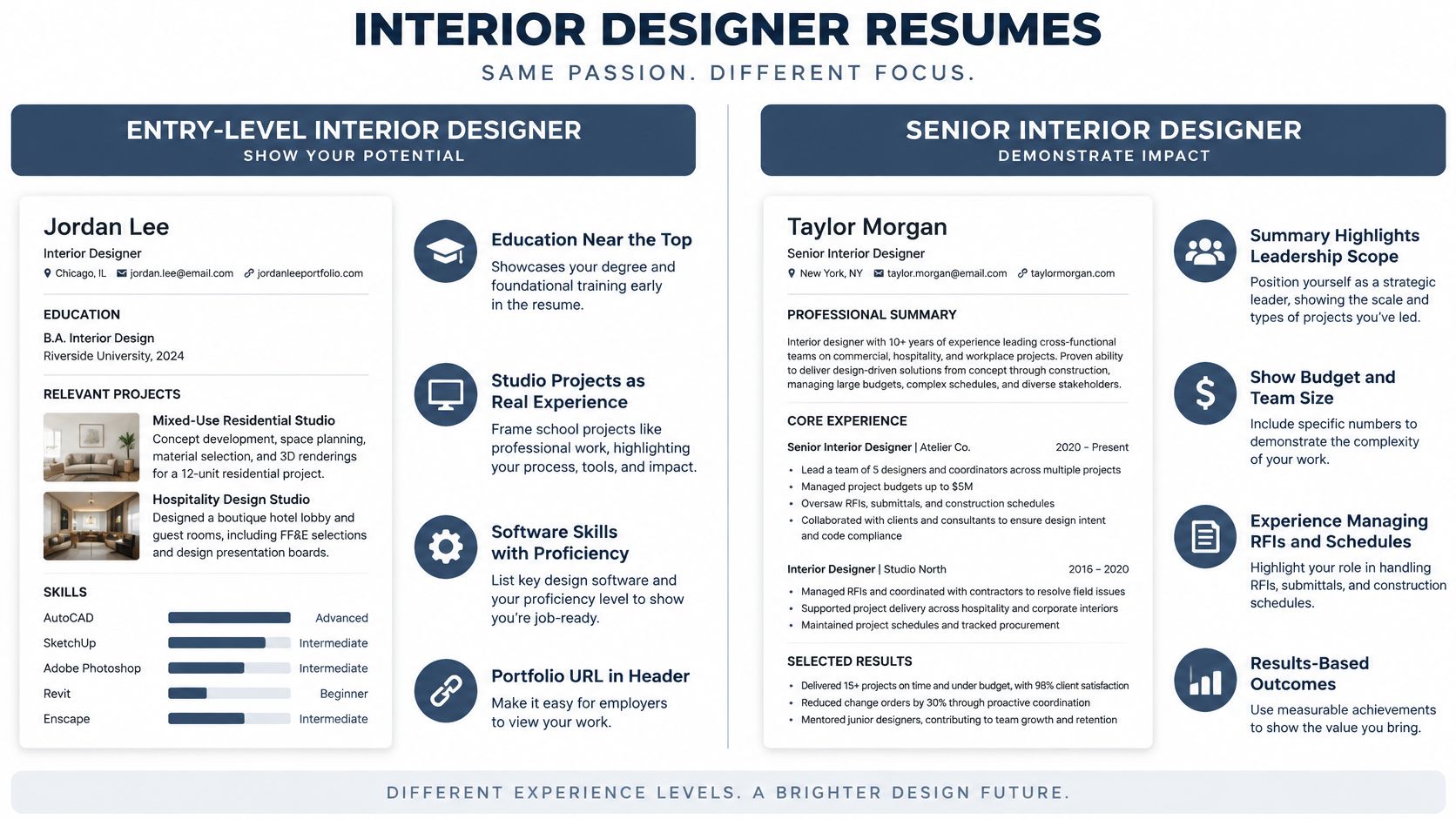
You don't have years of firm experience yet, and hiring managers know that. What they're checking is whether you can draft, render, organize a finish schedule, and support a real project without heavy hand-holding. Education, studio work, and internships carry the weight here, so treat them like professional experience, with scope and deliverables named clearly.
A strong version leads with a capstone hospitality lobby, giving square footage, material palette, and software used, then links to the full case study. Another lists a summer internship at a commercial firm, noting finish schedules produced for an office fit-out. Both examples work because they answer a practical question. What could this person do on Monday morning?
Make Student Work Read Like Production Work
Quantify where you can, using numbers from your own projects, such as specification sheets completed for a multi-floor residential renovation. Mirror the posting's truthful terms, like space planning or construction documentation, instead of vague claims about creativity.
- Format for parsing: The Social Security Administration's Choose Work guidance recommends fonts such as Calibri or Arial and body text between 10 and 12 points, as outlined in its guidance on making a resume ATS friendly.
- Keep visuals separate: Link your portfolio rather than embedding images in the resume, since graphics and columns can confuse parsing.
- Check keyword gaps: Use GetTheCall to import your resume or LinkedIn profile, paste the job listing URL, and see what's missing, then review the approach in this guide to tailoring a resume to a job description.
2. Residential Interior Designer (Client-Focused Resume)
Residential firms aren't just hiring taste. They're hiring someone a homeowner can trust through approvals, budget conversations, delays, and installation day. Your resume should show a clear design point of view, then back it with evidence that you manage clients, vendors, and money calmly.
One effective example describes a kitchen and great room refresh for a family home, naming the budget, timeline, and custom millwork coordination. Another highlights repeat clients and a regional magazine feature. Those details signal trust in a way adjectives can't, and they give a hiring manager something concrete to ask about in an interview.
The wider market rewards that specificity. The Bureau of Labor Statistics estimated 67,760 interior designers nationally in May 2023, with a mean annual wage of $68,530, in its occupational employment data for interior designers. In a field that size, project type, location, and responsibility help you stand apart.
Turn Client Work Into Measurable Bullets
Replace "worked with clients" with the phase, decision, and outcome you owned. For example, managing approvals across design phases with a defined response turnaround tells a firm how you communicate.
- Use employer language: Run the listing through GetTheCall and match truthful terms such as client presentations or procurement to your bullets.
- Protect readability: Keep generous white space, but skip icons and photo placeholders that can interfere with parsing.
- Let style support proof: Mention your aesthetic in the summary, then prove it with completed rooms, budgets handled, and vendors coordinated.

3. Commercial and Hospitality Interior Designer (Scale-Focused Resume)
Scale changes everything. A hotel, workplace, restaurant, or healthcare project brings brand standards, codes, consultants, phased occupancy, and procurement packages that a single-family home rarely does. Commercial employers scan first for sector, square footage, and delivery responsibility, so put those facts where they can't be missed.
Consider a bullet that names a designer as interior design lead for a large boutique hotel renovation, coordinating FF&E specifications within a major procurement package. Or a workplace project delivered in phases while the client remained in place. Both tell a reviewer you understand sequencing, documentation, and coordination, not just finishes.
Practical rule: Pair every tool with a deliverable and a scale. "Produced Revit construction documents and coordinated FF&E selections for a 50,000-square-foot workplace renovation" is the model cited in the guide to measurable interior-design resume bullets.
Handle Confidential Work Without Going Vague
If you can't name a client, describe sector, scope, and your role instead. "Led FF&E selections for a confidential luxury resort" is honest and still useful.
Paste the commercial listing into GetTheCall to check for terms like specification, code compliance, and procurement, and keep the layout clean enough for dense technical bullets to parse accurately. This overview of an ATS-friendly resume format helps you check structure before you apply. Name exact software too. Revit, AutoCAD, and SketchUp shouldn't hide behind a broad phrase like CAD software.

4. Senior Interior Designer and Project Manager (Leadership Resume)
At senior level, nobody doubts you can build a palette. They want proof you can protect a schedule, hold a budget, mentor junior designers, and keep clients and consultants aligned when a project gets difficult. Your bullets should shift from tasks you performed to outcomes you owned.
A compelling example reports leading a sizable office fit-out with a small team and delivering ahead of schedule. Another describes building a standardized specification library that reduced procurement errors across projects. The second example is especially strong because it shows systems thinking, which is what firms promote people for.
Lead With the Result, Then Explain How
Start with delivery, savings, schedule variance, or team size when those details are truthful and documented. Follow with the method, such as phased documentation, weekly consultant coordination, or a revised review process. That order helps a skim reader grasp your level in seconds.
Keywords still matter at this stage. SHRM recommends incorporating relevant terms across the summary, skills, job descriptions, and achievement statements, as it explains in its advice on using resume keywords effectively. Use GetTheCall's live match score to test whether your leadership bullets align with a senior posting, rather than guessing.
Keep the document to two pages. Put your strongest leadership evidence near the top, and keep enough design authorship visible so you don't read as a pure administrator who's left the creative work behind.
5. Career Switcher into Interior Design (Transferable Skills Resume)
A career switch doesn't need an apology. It needs a translation. Visual merchandising, set design, retail, real estate, architecture, and fine arts all build spatial thinking, client judgment, and visual communication. Your job is to state that connection plainly, then support it with design training or projects.
A retail visual merchandiser might reframe store layouts as space planning and customer flow analysis, which maps directly to residential and retail interiors. An architectural drafter might add a freelance staging project to show client-facing interior work alongside strong documentation skills. Neither example invents experience. Both rename real experience in language a design firm recognizes.
Be Precise About Credentials and Limits
That honesty matters even more across markets. One career overview reports 17,447 active CIDQ certificate holders, up 14.3% year over year, in its summary of interior designer career data. Credentials carry legal meaning that varies by jurisdiction, so never imply authorization you don't hold.
- Explain the move briefly: One or two summary sentences are enough, such as naming your prior field and the design focus you're moving toward.
- Add a projects section: Include at least two design-focused examples, including personal or volunteer work if that's your honest starting point.
- Find the language gaps: Import your resume into GetTheCall, paste a target listing, and rewrite transferable bullets with clearer design terminology.

6. Sustainable and Wellness-Focused Interior Designer (Specialist Resume)
Specialist resumes win on clarity. If a firm is hiring for healthy materials, daylighting, acoustics, or certification support, it will search for exact credential names and project evidence. Burying LEED or WELL experience inside a general design bullet wastes your strongest screening advantage.
One strong example lists a WELL project with daylight access improvements and low-VOC material specification. Another highlights a certified office interior where material selections contributed to specific credits. Notice the pattern. Each pairs a credential or framework with an applied decision, rather than treating sustainability as a personal value statement.
Credentials have deep roots in this profession. The NCIDQ examination was first administered in 1974, and by 2004 more than 18,000 certificates had been issued, according to the history of NCIDQ requirements and certification. Reviewers expect precise status for a reason.
Label Every Credential Exactly
Write names as issued, such as LEED Green Associate or WELL Accredited Professional, and distinguish completed credentials from exams in progress. Place them in a dedicated section near the top.
Only claim outcomes you can document, like a certification level achieved. Use GetTheCall to check sustainability keywords against the posting, especially if your background started on LinkedIn, as covered in this guide on turning LinkedIn into a resume.

7. Interior Design Principal or Studio Owner (Business Leadership Resume)
A principal's resume has a different audience and a different risk. It may support a partner search, a creative director role, or business development, and it can sound inflated if every line is about vision. Ground it in firm building. Revenue responsibility, team growth, repeat clients, sector expansion, and competitive wins show you can sustain a practice, not just direct a project.
One owner describes growing a small residential studio into a larger practice serving both residential and commercial clients. A creative director highlights winning a competitive request for proposals for a regional healthcare interior program. Both examples balance commercial judgment with design leadership, which is exactly the combination partners and executive recruiters look for.
Business metrics don't weaken your creative identity. They prove clients trusted that identity with real money, repeat work, and larger teams.
Balance Growth Proof With Design Authorship
Include at least three measurable business outcomes drawn from your own records, such as team size, repeat client work, or new sectors won. Add a short design philosophy statement in the summary, kept tight enough that the evidence still leads.
File mechanics matter even at this level. The Department of Labor's Veterans' Employment and Training Service advises using posting keywords in achievement statements and avoiding charts and images because many ATS tools can't read non-text content, in its federal resume essentials guidance. Use GetTheCall to tailor each leadership application, since principal postings often emphasize business development and firm strategy over production tools. Keep a shorter bio separately for press or client use. A full resume can feel too formal in those settings.
8. Returning-to-Work or Freelance Interior Designer (Gap-Friendly Resume)
A break for caregiving, health, or freelance work doesn't erase your skills. It does mean your resume should foreground recent activity and current tools, so a reviewer focuses on what you offer now. You don't need a long explanation of the gap, and you shouldn't list every small freelance job as if it were a separate employer.
One returning designer groups freelance residential projects, a recent Revit certificate, and a nonprofit volunteer project under a clear practice heading. A freelancer moving back into a studio highlights completed client work and refreshed SketchUp and Enscape skills. Both approaches create continuity without overstating employment history.
Structure helps you here. A John A. Logan College guide recommends a simple reverse-chronological layout with clearly defined sections, as explained in its guide to applicant tracking software. Standard headings like Summary, Skills, Experience, and Projects keep a non-linear history easy to parse.
Group Independent Work Cleanly
- Use one practice heading: "Independent Design Practice" lets you list strong projects with dates, scope, and outcomes underneath.
- Show currency early: Place recent training, certificates, and software near the top, before older roles.
- Check fit before sending: Import your resume into GetTheCall, paste the listing, and identify where recent work needs clearer keywords.
Keep your summary forward-looking. Name the project types you want, the tools you're current in, and the client or sector experience you bring back with you. That's a stronger opening than a paragraph explaining time away.
Interior Design Resume Examples: 8-Point Comparison Guide
| Resume Type / Career Stage | 🔄 Complexity & Resource Requirements | 📊 Primary Evidence / Expected Outcome | ⭐ Key Advantage | 💡 Ideal Use Case |
|---|---|---|---|---|
| Entry-Level / Recent Graduate | Low–moderate; requires education, project examples, software skills, and a portfolio link | Demonstrates design potential and readiness through studio work, internships, and technical skills | ⚡ Simple, ATS-friendly structure makes qualifications easy to scan | First interior design role or internship |
| Residential / Mid-Career | Moderate; requires project scope, budgets, timelines, client outcomes, and vendor details | Shows ability to manage client relationships and projects from concept through installation | Highlights client-facing skills and measurable residential results | Residential firms or independent client-focused practice |
| Commercial & Hospitality / Mid-Career | Moderate–high; requires project scale, technical standards, procurement, and team coordination details | Establishes experience delivering complex commercial projects and meeting code or brand requirements | Specialized keywords and project scale support ATS matching and credibility | Offices, hotels, restaurants, retail, or healthcare environments |
| Senior Designer / Project Manager | High; requires quantified budgets, team scope, delivery results, and project-management tools | Demonstrates leadership, accountability, and successful project delivery | Results-focused leadership evidence can support senior-level opportunities | Senior design, project management, or team-lead roles |
| Career Switcher | Moderate; requires transferable-skills mapping, design training, and relevant projects | Connects prior experience to design capabilities and builds credibility in the new field | Brings useful cross-industry experience into design work | Transitioning from retail, architecture, visual merchandising, or another field |
| Sustainable / Wellness Specialist | Moderate–high; may require relevant credentials, continuing education, and verifiable project outcomes | Shows expertise in healthy materials, wellness strategies, or sustainability standards | Specialized credentials and measurable outcomes help distinguish candidates | Roles focused on sustainable, healthy, or human-centered interiors |
| Principal / Studio Owner | High; requires business metrics, leadership history, and design direction | Demonstrates firm growth, business development, client retention, and creative leadership | Connects design vision with business performance | Principal, studio owner, creative director, or partnership opportunities |
| Returning-to-Work / Freelance | Moderate; requires grouped project history, recent training, and current software skills | Presents recent activity and current capabilities while reducing emphasis on employment gaps | Freelance work and recent learning show initiative and adaptability | Returning to a studio role or moving from freelance practice to employment |
Your Next Step to a Standout Interior Design Resume
A standout resume doesn't come from a prettier template. It comes from making three decisions well. You choose the right story for your career stage, you prove that story with project scope and outcomes, and you format the document so software and people can both read it without friction.
Start by picking the example closest to your situation. A recent graduate should lean on studio projects, internships, and production readiness, while a senior designer should lead with delivery, budgets, and team outcomes. A specialist needs exact credential labels, a career switcher needs honest translation, and a returning designer needs recent work grouped cleanly. Copying another stage's structure usually creates the wrong emphasis, even when the underlying experience is good.
Then rebuild your bullets. Swap duties for evidence by naming the tool, deliverable, project type, and scale wherever you can do so truthfully. Square footage, FF&E packages, number of stakeholders, schedule results, and procurement responsibility all help a reviewer judge readiness. If confidentiality limits client names, keep the sector and your role. Vague is never your only option.
Treat your portfolio as part of the same evidence system, not a separate gallery. Let the resume carry role, scope, tools, and measurable outcomes in searchable text. Let the portfolio show process, drawings, iterations, and finished spaces, with each case study labeled so a reviewer can connect it back to a bullet. That division keeps your application focused, and it's especially helpful if your experience comes from school, freelance work, or another field.
Tailoring is the step most designers skip because it takes time. It's also the step that changes results. Read the posting for repeated terms, project types, software, and responsibilities, then mirror only the language that accurately describes your background. Pair full terms with abbreviations where helpful, keep standard section headings, and save the file type the employer requests. Small formatting choices can decide whether strong work gets reviewed at all.
You don't have to do that comparison by eye for every application. Tools like GetTheCall can import your LinkedIn profile or existing resume, analyze a target listing, show a live match score as you edit, and export a polished, ATS-ready PDF. That doesn't replace your judgment about your own experience. It makes the gap between your resume and a specific job visible, so you can fix the wording before a screening system makes the decision for you.
Choose one live posting you want. Adapt the closest example above, tighten every bullet until it shows scope and result, link the matching portfolio projects, and send a version built for that firm, not for everyone. That's how good designers stop hearing silence.
Import your LinkedIn profile or current resume into GetTheCall, paste the interior design job you want, and use the live match score to close keyword and formatting gaps before you export a customized PDF. It's a faster way to turn the right example above into a resume built for one real firm, one real project type, and one real interview.