How to Write a Resume for a Career Change: 2026 Guide
Discover how to write a resume for a career change that highlights transferable skills and gets you interviews in 2026.

You're staring at a résumé that used to work just fine, and now it's getting ignored. The problem usually isn't your background, it's that you're still describing yourself in the old industry's language while the hiring manager is reading for the new one. A career change résumé has one job, to translate real experience into proof that you can do the next role.
Table of Contents
- The Mindset Shift That Makes a Career Change Resume Work
- Choosing the Right Resume Format for a Career Switch
- Writing a Summary and Skills Section That Land the First Six Seconds
- Turning Past Roles Into Target-Role Bullets With Real Numbers
- Calibrating Keyword Honesty Without Underclaiming
- Formatting, ATS Parsing, and a Pre-Submission Checklist
- Turning Your Career Change Resume Into a Steady Interview Pipeline
The Mindset Shift That Makes a Career Change Resume Work
Stop defending old titles and start converting each duty into capability proof for the role you want. A career-change resume fails when it reads like a job history written for your former industry. Hiring managers are scanning for evidence they can trust, and skills-based hiring makes that evidence matter more than title matching. A cited summary of the National Association of Colleges and Employers' Job Outlook 2025 survey says nearly two-thirds of employers use skills-based hiring for entry-level roles, and SHRM reporting puts overall adoption at 73%, up from 56% in 2022 (career-change hiring manager signals).
Translation is the job. A teacher moving into operations should show process coordination, stakeholder communication, scheduling discipline, and measurable improvements in workflow. A hospitality supervisor moving into sales should show customer research, objection handling, escalation management, and revenue-minded service. The point is not to hide the past. The point is to restate it in the language of the target role so the reader can see fit fast.

Start with a personal skill bank
Before you write bullets, build a working inventory of every job, project, volunteer role, side hustle, and awkward in-between assignment. Tag each one with the capability it proves, such as project management, customer research, budgeting, compliance, data analysis, leadership, or process improvement. That exercise shows how much usable value is already there, even when the old title looks far away from the new one.
Practical rule: if you cannot name the capability, you probably cannot sell it cleanly on the resume.
A former teacher may uncover parent communication, conflict resolution, reporting, curriculum planning, and classroom logistics. A barista may uncover queue management, team coordination, speed under pressure, and customer recovery. An accounts payable clerk may uncover audit trails, vendor communication, spreadsheet discipline, and policy compliance. Those are not random extras. They are proof points.
Group experience by capability, not by nostalgia
Chronology still matters, but capability grouping makes the pivot credible. You are building evidence around what the target employer values, then mapping your past work to that standard. A strong career-change resume starts by asking, “What proof do I have for the role I want?” not “What jobs have I held?”
Use three columns, role, capability, proof. If the target job rewards stakeholder management, list every time you coordinated people with different priorities. If it rewards operations, list every time you improved a process, prevented errors, or kept deadlines from slipping. If it rewards analysis, list every time you used data to make a decision or justify a change. That is your translation system, and the rest of the resume should pull from it with discipline.
Choosing the Right Resume Format for a Career Switch
A career switch doesn't need a flashy format, it needs a readable one. The wrong structure either buries the strongest evidence or hides so much that the reader starts wondering what's missing. A hybrid résumé is usually the right answer because it lets you lead with transferable value while still keeping chronology visible enough for recruiters to trust it. One résumé-writing analysis citing hiring-manager survey data reports that 43% of hiring managers prefer this format for mid-career professionals (hybrid resume preference).
The strictly chronological format is honest, but it can be too blunt for a pivot. It anchors the reader in old titles before they've seen why you matter in the new one. The fully functional format swings too far the other way, because it hides chronology and can make a recruiter feel like you're dodging the evidence. For a career change, the middle path wins.
What belongs in a hybrid layout
Lead with a concise summary, then a grouped skills section, then selected accomplishments, then reverse-chronological experience. Keep dates, employers, and titles explicit. Don't bury them, don't rename them, and don't get cute with layout tricks that make the document harder to classify.
| Format | Best Use Case | Risk for Career Changer | ATS Compatibility |
|---|---|---|---|
| Chronological | Stable career path, same field | Buries transferable evidence | Strong |
| Functional | Very unusual background or limited work history | Raises suspicion, weak chronology | Weaker |
| Hybrid | Career switch, mid-career pivot | None if the content is honest and targeted | Strong |
The practical decision is clear, use the hybrid format unless your work history is so thin that chronology adds almost nothing. It gives you room to show capability first, then preserves the employment trail. That balance matters because you want a recruiter to say, “I can see the fit,” not, “Why is this résumé trying to hide something?”
If you want a clean way to visualize the order and content of the top third, the résumé-to-LinkedIn mapping guidance at GetTheCall's guide is a useful reference point for organizing existing material into a job-specific layout.
Writing a Summary and Skills Section That Land the First Six Seconds
The top of the page has one job, answer the only question that matters fast, why should I keep reading? A recruiter doesn't need your life story. They need a target-role signal, a few proof points, and the confidence that you're not forcing a fit. A weak summary sounds generic because it talks about yourself. A strong one names the destination and proves relevance.
Write the summary like a position statement
Start with the role you want, not the role you had. Then add two or three lines that connect your past to the new job in plain language. Keep it specific, and cut anything that could apply to anyone.
Weak summary:
Experienced professional seeking a challenging new opportunity where communication and leadership can be used to make a positive impact.
Stronger summary:
Operations-minded professional moving into project coordination, with a background in process improvement, cross-team communication, and scheduling complex work. Known for keeping stakeholders aligned, solving problems before they escalate, and documenting systems clearly enough that teams can execute without confusion.
That second version works because it sounds like a person with a direction. It also names transferable skills the reader can immediately place against the posting.
Build the skills section like an evidence index
The skills block should not be a junk drawer. Group skills under headings that reflect the target role, such as Process Improvement, Stakeholder Management, Reporting and Analysis, Tools and Systems, or Customer Work. Put the strongest, most relevant items at the top, and only include terms you can defend somewhere else in the résumé.
Weak skills block:
Communication, teamwork, leadership, multitasking, detail oriented, hard working, motivated.
Stronger skills block:
Process Improvement, workflow documentation, onboarding coordination, service recovery, stakeholder communication
Reporting and Analysis, Excel, basic trend review, reporting, data cleanup
Tools, Salesforce, Asana, Google Sheets, internal ticketing systems
The skills section should make the reader think, “I see the fit,” not, “Someone copied a job description and hoped for the best.”
Treat keywords as evidence labels, not decorations. If the posting mentions a tool or capability more than once, and you have related experience, include it where it makes sense. If not, leave it alone. That's also where a custom drafting workflow helps, because career-change résumés work best when the summary and skills are built from the job description, then supported by the experience section below.
Turning Past Roles Into Target-Role Bullets With Real Numbers
Here the translation becomes visible. A bullet that describes your old job won't help much. A bullet that proves a target-role capability will. Use a simple pattern, action, method, context, measurable result. That structure keeps you honest and forces each line to earn its spot.
Teacher to operations lead
Old bullet: Managed classroom activities and supported students.
Translated bullet: Redesigned a weekly classroom workflow, coordinating materials, schedules, and parent communications, which reduced last-minute disruptions and kept instruction on track for the full term.
The teaching job didn't become operations work. The bullet shows process control, scheduling discipline, and stakeholder coordination in a way an operations hiring manager can recognize.
Hospitality supervisor to sales account manager
Old bullet: Supervised staff and handled customer complaints.
Translated bullet: Led a front-of-house team through daily service issues, resolved escalations quickly, and used guest feedback to improve repeat business conversations and service recovery.
That bullet doesn't fake quota ownership, and it doesn't need to. It shows customer handling, influence, and commercial awareness, which are all relevant in a sales environment.
Military logistics to project management
Old bullet: Coordinated supplies and tracked shipments.
Translated bullet: Coordinated equipment movement across multiple teams, tracked delivery status, and kept scheduling aligned with mission requirements, supporting on-time execution in high-pressure conditions.
That's credible project language without the overclaim. You're not calling yourself a project manager if you weren't one. You're showing the underlying behaviors that make project management plausible.
Calibration rule: one accomplishment can support more than one competency, but it can't support a title you never held.
Choose the strongest 8 to 12 achievements from your evidence map, not every line you can remember. Older or less relevant details should move down the page or disappear entirely if they confuse the story. Keep dates and titles honest, keep the narrative tight, and let the bullets do the selling.
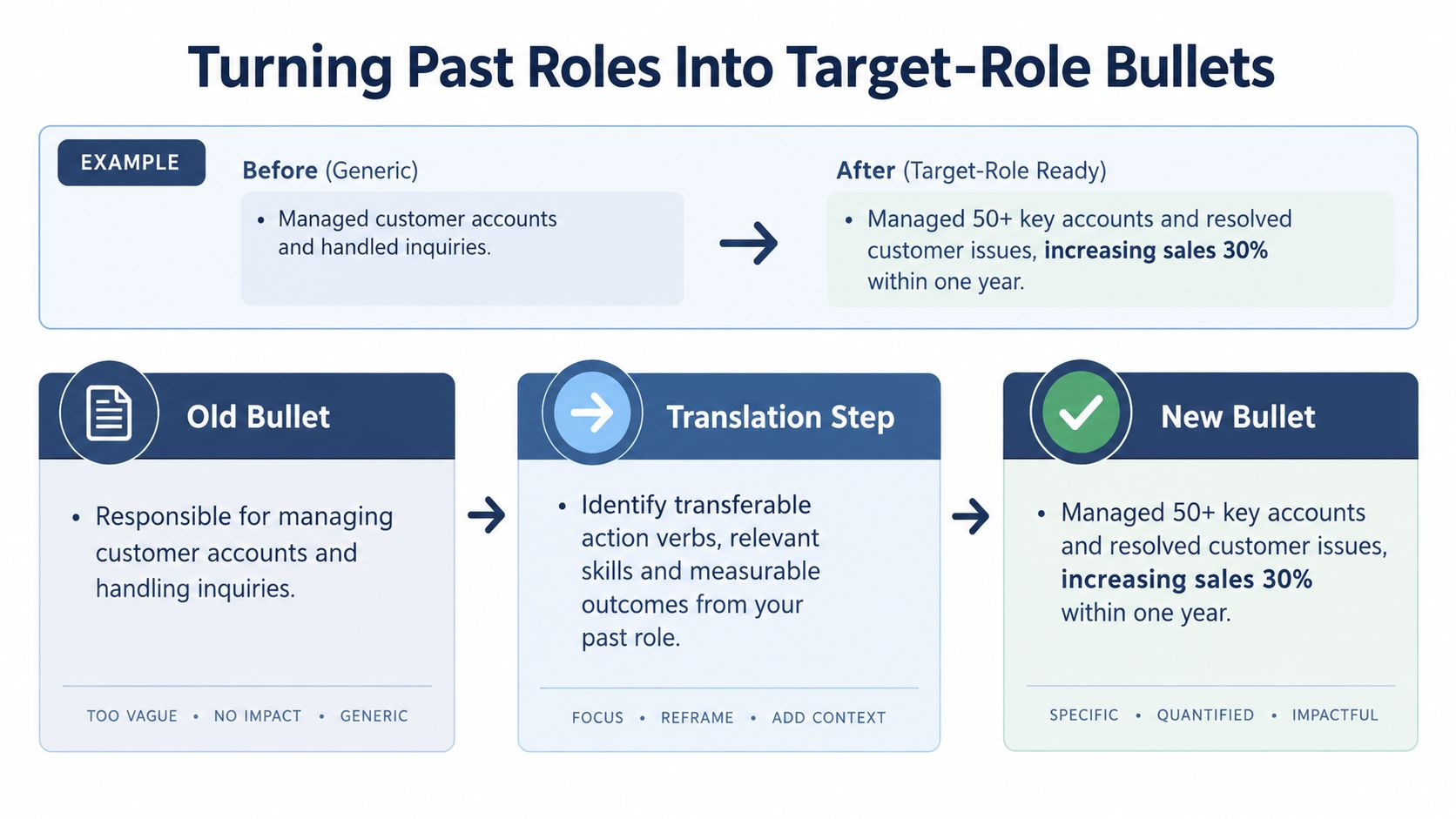
The cleanest way to think about this is simple. Old bullet, then translation step, then new bullet. Your job isn't to embellish, it's to convert the evidence into recruiter language that sounds natural in the target field.
Calibrating Keyword Honesty Without Underclaiming
A lot of career changers swing between two bad options, they either undersell themselves or pad the résumé until it breaks trust. Neither works. Employers are already evaluating candidates more directly, and some are using assessments earlier in the process, so your résumé has to feel specific and real, not inflated.
Use a three-tier evidence filter
The easiest way to stay honest is to sort every target keyword into one of three buckets.
- Demonstrated skills. These are backed by prior results, so they belong in the summary, skills section, and bullets.
- Adjacent skills. These are supported by comparable tasks, tools, stakeholders, or outcomes, so they belong when the overlap is real.
- Credentialed gaps. These need training, a certificate, a project, or a straightforward note that you're still building them.
That filter keeps you from claiming too much and helps you decide which missing terms are worth pursuing outside the résumé. It also solves the most common pivot mistake, stuffing a page with language you can't defend.
Match employer language only where it's true
If a posting asks for stakeholder management, use that phrase only if you've coordinated across clients, vendors, executives, or community partners. If a role wants SQL and you've never run a query, don't hide behind a fancy synonym. Say you're developing the skill, or move it out of the résumé until you have real evidence.
The same logic applies to keyword blocks. Repeating terms without context doesn't make the document stronger. It just makes it look artificial. A résumé earns credibility when the language is embedded in accomplishment bullets, because the reader can see both the term and the proof beside it.
If you want a practical tool for checking whether your language matches the target posting without drifting into overclaim, GetTheCall is built around tailoring real experience to the role description, not inventing a new background.
Update the résumé as skills become real
Your document should evolve as your adjacent skills become demonstrated. A course, a project, a certification, or a volunteer assignment can move something from “adjacent” to “demonstrated” once you have evidence behind it. That's how you keep the résumé honest while steadily widening the range of roles you can credibly pursue.
Never fabricate, always frame honestly.
That principle matters more than any keyword list. If you keep the evidence honest, you can be more aggressive about framing. If you fake the evidence, even a good layout won't save you.
Formatting, ATS Parsing, and a Pre-Submission Checklist
A strong pivot can still get mangled by bad formatting. The machine and the recruiter both need to read the same story, so use a simple, single-column structure with standard headings like Summary, Skills, Experience, and Education. Keep contact info in the body of the document, not hidden in a decorative header or footer, and avoid tables, text boxes, icons, and visual flourishes that can scramble the parse.
The safest move is boring on purpose. Use conventional date formats. Keep bullets plain. Export a clean PDF or DOCX, then copy all the text into a plain-text editor and check whether the order still makes sense. If dates, section names, employer names, or key keywords disappear, the document isn't ready.
Run the pivot checklist before you hit send
- Confirm role fit: The summary names the target role clearly and without hedging.
- Confirm evidence: Every key requirement is backed by a real accomplishment, project, or context.
- Confirm honesty: No fabricated tools, titles, or certifications slipped in.
- Confirm readability: The document still makes sense when stripped to plain text.
- Confirm mobile clarity: The layout doesn't fall apart when viewed on a phone.
That final pass matters because a résumé that looks polished can still fail if the parser can't read it. A visual template shouldn't outrank clarity. If a design choice makes the page prettier but harder to classify, drop it.
A 2025 audit cited by multiple reports found applicant-tracking systems on 489 of the 500 Fortune 500 career sites, or 97.8%, and separate recruiter research said 23 of 25 recruiters reported their systems did not automatically reject candidates solely for formatting or content (ATS site audit and recruiter handling). The point isn't that software is the enemy. The point is that your résumé has to survive software before a person can judge it.
For a cleaner submission workflow, GetTheCall's ATS-friendly resume guide fits naturally into the final check because it keeps the file readable while preserving the tailoring you need.
Turning Your Career Change Resume Into a Steady Interview Pipeline
A career-change résumé isn't a one-time rewrite. It's the first draft of a repeatable translation system. Lead with the target role, prove relevance with verified results, and respect ATS parsing without turning the page into keyword sludge. That's the operating principle.
Expect the first round of applications to teach you something. Some silence means the role is a poor match, some means the summary needs sharper language, and some means the market is slow. Don't treat early rejections like a verdict on your potential. Treat them like feedback on the translation.
Build a weekly rhythm that keeps you moving. Research the role, tailor the résumé, submit the application, and track what happened. Keep a small story bank for interviews that uses the same evidence map as the résumé, so your examples stay consistent. Pair that with a short cover letter and a focused networking message when the application deserves extra attention.
A targeted résumé can materially improve interview outcomes, and a report summarizing Jobscan's 2025 analysis of more than 2.5 million user applications says candidates whose résumé job title matched the position title had an interview rate 10.6 times higher than candidates whose title didn't match (title match and interview rate). That doesn't mean you should lie about a former title. It means you should lead with the destination and customize every application to the opening in front of you.
The next application isn't a verdict, it's a test of the translation. If you want help turning a LinkedIn profile or existing résumé into a job-specific version with ATS-aware formatting and role matching, visit GetTheCall and use it to build the next draft instead of polishing the same one forever.