How to Show Leadership on Resume: Key Tips for 2026
Learn how to show leadership on resume with proven tactics, metrics, and bullet examples that impress hiring managers and ATS in 2026.

Most advice on how to show leadership on resume starts with a verb swap. Replace “helped” with “spearheaded,” “worked with” with “orchestrated,” and suddenly your experience is supposed to sound senior. That advice is incomplete. Strong verbs can sharpen a bullet, but they can't prove that you had meaningful responsibility.
A hiring manager needs evidence of scope, accountability, and movement. “Led a team” doesn't explain how many people you influenced, what resources you controlled, or what changed because of your work. An ATS may recognize the word “led,” but a human reader still needs proof behind it. The strongest leadership resumes treat leadership as a measurable business claim, not a personality trait.
Table of Contents
- Why Strong Verbs Alone Won't Get You Hired
- The Three Numbers Every Leadership Bullet Needs
- Writing Each Bullet With Action and Metric
- Showing Leadership Without a Direct Report
- Building a Verifiable Evidence Chain
- ATS-Friendly Leadership Keywords That Back Themselves Up
- Putting It All Together and Staying Honest
Why Strong Verbs Alone Won't Get You Hired
Most resumes that claim leadership become interchangeable because they repeat the same vocabulary: led, managed, oversaw, directed, and coordinated. None of those words is bad. The problem is that they describe an activity without showing its scale or consequence.
Compare “managed operations” with “managed regional operations.” The second version adds context, but it still leaves major questions unanswered. How large was the operation? What did the candidate control? Did performance improve, costs fall, or delivery become more reliable?
Practical rule: A leadership verb earns its place only when the rest of the bullet proves what you actually owned.
Yale's guidance on writing impactful résumé bullets recommends accomplishment statements that quantify results and impact, using an action, project, and result structure. That principle matters because recruiters scan quickly for evidence they can compare. A duty tells them what appeared in your job description. An accomplishment tells them what you changed.
Leadership is a composite signal
Leadership becomes legible when several signals appear together:
- People scope: The size of the team, project group, or stakeholder network you guided.
- Resource scope: The budget, P&L, vendor spend, revenue responsibility, or cost exposure connected to your decisions.
- Business movement: The result your work produced, such as faster delivery, lower waste, stronger retention, or higher revenue.
You don't need all three signals in every bullet, but your resume should establish them clearly across its strongest leadership claims. A manager who writes “led a team” offers a title-like statement. A manager who shows team size, financial responsibility, and outcome gives the reader a reason to believe the leadership claim.
The shift from duty-based resumes to accomplishment statements has made vague leadership language less useful. Modern hiring readers want to understand what you were trusted with and what happened afterward. Start there, then choose the verb that accurately describes your role.
The Three Numbers Every Leadership Bullet Needs
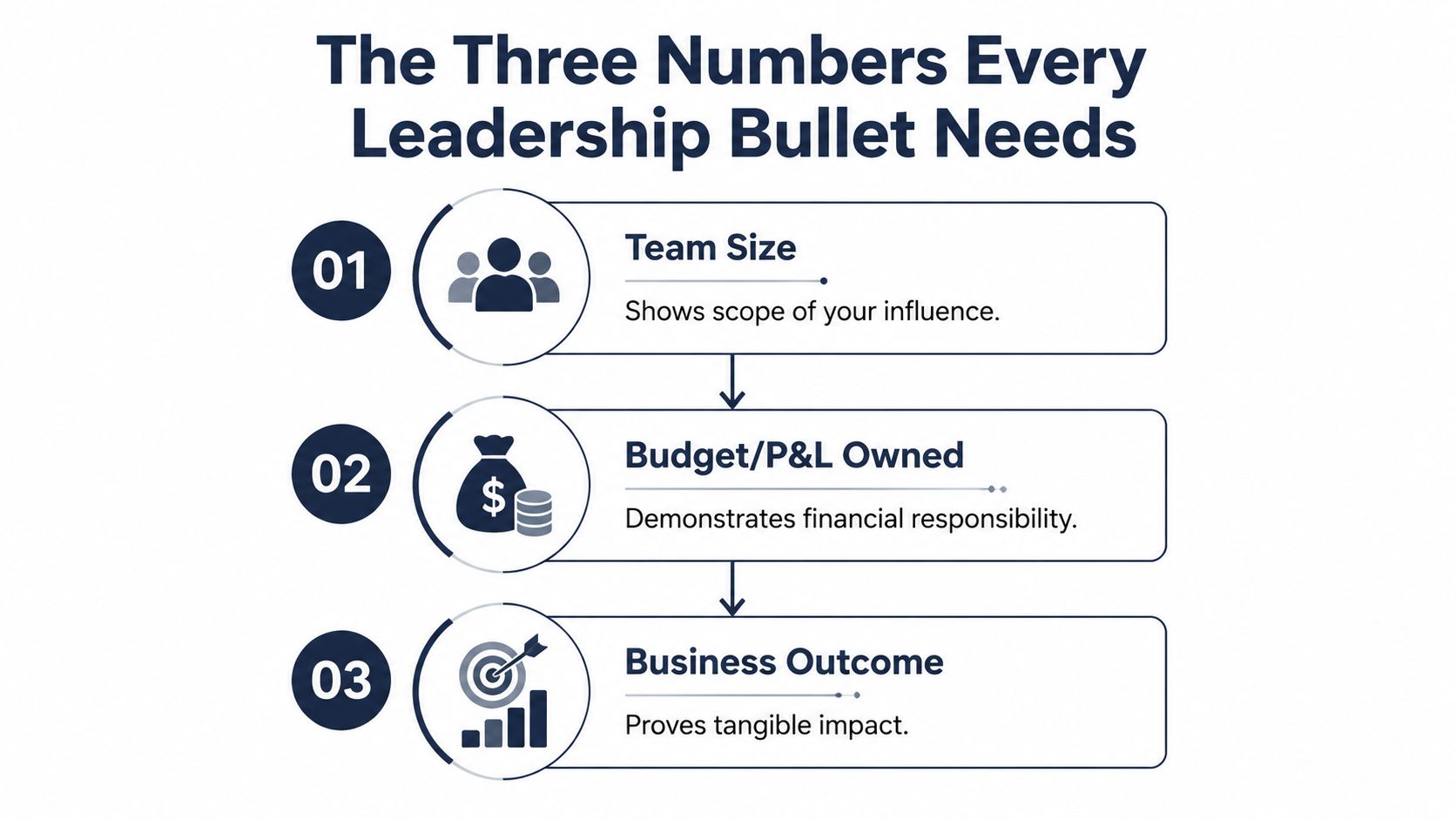
A practical leadership-resume rule is to prove leadership with three quantifiable elements: the size of the team you managed, the budget or P&L you owned, and the measurable business outcome you produced. This framework is presented as the “3 numbers every [leadership resume] needs” in ResuFit's leadership résumé guidance.
Start with people
Team size shows the scale of your influence. State the number of direct reports when you managed people, but don't stop there if your leadership extended across functions. A project group, sales territory, implementation team, or network of stakeholders can also establish scope, provided you describe your role accurately.
“Led a sales team” is weak because the reader can't distinguish a small working group from a substantial department. “Led a 12-person sales team” immediately communicates a clearer level of responsibility.
Add financial ownership
The second number is your budget or P&L responsibility. Use the figure you directly owned when you had formal financial accountability. If you didn't control a budget, show indirect financial influence through vendor management, procurement decisions, cost savings, or resource allocation.
For example, “managed vendor relationships” says little about scale. A stronger version might identify the spend you influenced or the savings your negotiation produced. Don't claim P&L ownership if you only supplied analysis. Precision makes the bullet credible.
Finish with business movement
The third number is the measurable outcome. It can describe revenue, delivery speed, waste, retention, cost, quality, or another result relevant to the role. The example from ResuFit's leadership résumé guide is direct: “led a 12-person team, managed a $1.8M budget, and improved delivery speed by 23%.”
That line works because it communicates scale, accountability, and impact without asking the reader to infer them. Gather your figures from performance reviews, finance records, CRM reports, project dashboards, vendor invoices, or operational analytics. Then choose the number that best supports the role you're targeting. Don't force three figures into every bullet if doing so makes the sentence crowded. Establish the full picture across the resume, and make each individual claim easy to understand.
Writing Each Bullet With Action and Metric
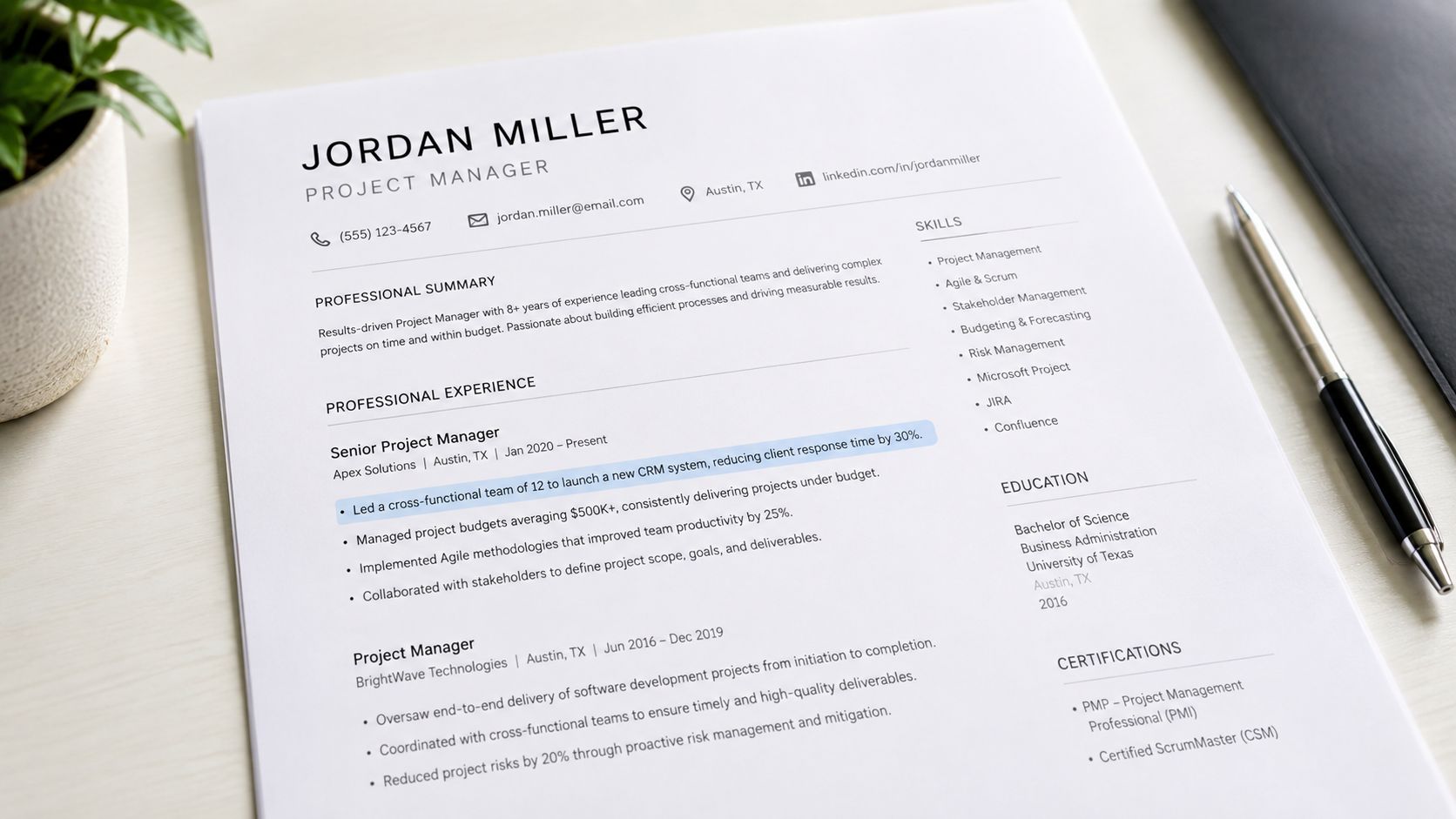
The most reliable leadership bullet follows a simple sequence: action, responsibility, metric, and result. Start with a verb that reflects what you did. Name the work you led, then make the outcome visible instead of burying it in a paragraph.
Yale offers a related formula, action + project + result, along with the structure “accomplished [X] as measured by [Y] by doing [Z].” You can apply either version depending on the complexity of the achievement.
Use one dominant result
A bullet should have one main point. If the reader has to search through several clauses to find the metric, the sentence has already lost force.
| Weak wording | Stronger wording |
|---|---|
| Managed process improvement initiatives | Reduced waste by 30% by leading a process redesign across operations |
| Oversaw annual expenses | Saved $75,000 annually by renegotiating vendor contracts and standardizing purchasing |
| Led delivery improvements | Improved on-time delivery to 94% by introducing weekly cross-functional planning |
| Responsible for team performance | Coached and developed a team through a structured performance-review process, improving accountability and execution |
The stronger versions put the result where the reader can find it. They also explain the mechanism briefly, which helps you defend the claim in an interview.
Choose verbs that match authority
Use owned when you had final accountability. Use led when you directed people or work. Use managed for formal responsibility over people, budgets, or processes. Use developed when you built a capability, system, or person. Use implemented when you put a new process, tool, or policy into operation.
Don't use “orchestrated” to make routine coordination sound strategic. Inflated language creates a mismatch between your resume and your interview answers. A clear verb paired with a strong result is more persuasive than a dramatic verb paired with no evidence.
Your resume should also match the language of the target role. If the job description emphasizes stakeholder alignment, project ownership, or team development, describe relevant achievements using those concepts where they truthfully apply. Tailoring your resume to a job description helps you decide which leadership evidence deserves the most space.
One focused accomplishment beats three broad claims about being a “visionary leader.”
Keep the bullet readable. Put the strongest number near the action or result, avoid stacking unrelated metrics, and remove adjectives that don't add proof. The purpose isn't to sound impressive. It's to make your contribution obvious.
Showing Leadership Without a Direct Report
You don't need formal people management to show leadership. Early-career professionals, individual contributors, career switchers, and return-to-work candidates often lead through project ownership, mentorship, stakeholder alignment, and influence without authority.
Consider an analyst who was asked to support a system rollout. No one reported to them, but they organized the project group, gathered requirements from several departments, trained colleagues, and kept decisions moving. “Supported system implementation” hides the leadership. “Coordinated a three-person project group, aligned stakeholders on rollout requirements, and trained colleagues on the new workflow” makes the influence visible without pretending to be a manager.
Find the leadership inside ordinary work
Look for moments when people relied on your judgment or coordination:
- Project ownership: You took responsibility for a deliverable, timeline, or rollout.
- Mentorship: You onboarded a new hire, trained peers, or created learning materials.
- Stakeholder alignment: You resolved competing priorities or brought teams to a decision.
- Process improvement: You identified a recurring problem and introduced a better way to work.
- Client leadership: You guided a client account, presentation, implementation, or decision process.
A career switcher from customer support might write, “Led a cross-functional service-improvement project by translating recurring customer issues into workflow changes for product and operations.” The line doesn't claim direct reports. It shows initiative, communication, and ownership.
A recent graduate might have trained a peer group on a software tool, coordinated a volunteer project, or organized a recurring program. The title matters less than the responsibility and outcome. If you have a measurable result, use it. If you don't, describe the concrete change, audience, and timeframe without inventing a figure.
Use accurate verbs for influence
Strong options include coordinated, facilitated, mentored, guided, organized, aligned, trained, initiated, contributed, and influenced. These verbs let you communicate leadership while staying honest about your authority.
Avoid underselling yourself with “helped” when you owned a meaningful part of the work. Replace it with a precise description of the action you took. “Helped with onboarding” might become “Created onboarding materials and guided new colleagues through the first stage of the workflow.” The revision shows what you did, not a title you didn't hold.
Your LinkedIn profile can provide additional context for projects that don't fit neatly into a resume. Use LinkedIn profile to resume guidance to keep the underlying facts consistent across both documents. A leadership claim becomes stronger when your resume, profile, and interview story all describe the same contribution.
Building a Verifiable Evidence Chain
A leadership bullet should survive an interview question such as, “How did you measure that?” The strongest structure contains five elements: company or team context, your specific role, the problem, a measurable outcome, and a timeframe. PM Resume's leadership-impact guidance highlights these elements because they turn a broad claim into a concrete account.
The five parts
- Context: Identify the function, team, product, account, or operating environment.
- Role: State what you personally led, owned, developed, or implemented.
- Problem: Explain the constraint or opportunity briefly.
- Outcome: Give the strongest defensible metric.
- Timeframe: Show when the change happened or how long you were accountable for it.
A useful pattern is: Led [work] for [context], addressing [problem], and achieved [outcome] within [timeframe]. If you have a baseline, make the movement explicit, such as “from $5M to $6.5M in 12 months.” That format shows direction and duration rather than presenting an isolated figure. The baseline and timeframe approach is also recommended in Resumly's evidence-chain guidance.
Pull from records, not memory alone
Start with CRM reports, finance systems, analytics dashboards, project documentation, performance reviews, and operational trackers. Choose the single number that best demonstrates the kind of accountability required by the target role. If the data is sensitive, round consistently and avoid implying a level of precision you can't defend.
Format numbers the same way throughout the document. Use consistent currency, decimal, and percentage conventions. Above all, know the source of every figure. You should be able to explain what changed, how it was measured, what you personally controlled, and which colleagues contributed.
Interview test: If you can't explain the baseline, measurement method, and your specific contribution, don't use the number yet.
Evidence doesn't mean claiming sole credit for a team result. Write “led,” “contributed to,” or “partnered with” according to your actual role. Honest attribution gives the bullet credibility and creates a stronger interview story than an inflated claim ever will.
ATS-Friendly Leadership Keywords That Back Themselves Up
ATS tools scan for language tied to the target role, but a keyword earns attention only when evidence follows it. Use led, owned, mentored, implemented, managed, and developed to describe work you performed. Keep unsupported verbs out of the skills list and work history.
ATS-friendly leadership guidance recommends connecting leadership terms with team size, responsibility scope, and measurable outcomes. That combination gives the parser context and gives the hiring manager a claim they can question in an interview.
Build a defensible keyword map
Read the job description and mark its repeated leadership concepts. Assign each relevant term to a resume bullet that demonstrates the work, the scope, and the result.
- Match the wording accurately: If the position requires stakeholder management and you performed it, use that phrase inside a relevant accomplishment.
- Support every claim: Pair “team development” with mentoring, coaching, onboarding, or performance work you completed.
- Avoid keyword stuffing: A crowded skills section cannot fix work history with no proof.
- Check interview defensibility: Every keyword should point to a specific story, action, and result.
JobWizard's manager keyword checklist supports using owned, led, managed, developed, and implemented when accurate, then linking them to outcomes such as reduced, improved, standardized, or increased.
Run the draft through a free ATS resume checker to review parsing and keyword alignment. Treat the result as a diagnostic, not a verdict. The test is whether each bullet gives the keyword a defensible meaning.
Use this short demonstration to check structure and readability before submitting:
Putting It All Together and Staying Honest
A credible leadership resume follows a simple discipline. Attach team scope, financial responsibility, and business outcome to your strongest claims. Write bullets with an action and a metric. Show leadership through influence when you haven't managed direct reports. Build each major bullet with context, role, problem, outcome, and timeframe.
Before submitting, run this check:
- Proof: Does each leadership claim show what you led or owned?
- Scale: Have you clarified people, project, client, or resource scope?
- Outcome: Does the bullet show what changed?
- Accuracy: Can you explain the number and your contribution in an interview?
- Relevance: Does the evidence match the target job's leadership requirements?
- Consistency: Are figures, titles, dates, and verbs formatted consistently?
Don't inflate numbers or claim ownership of results produced by a larger team. References, follow-up questions, and performance discussions can expose exaggeration quickly. A smaller, accurate achievement with a clear explanation is more valuable than a bigger claim you can't support.
Tailor the evidence to each job description, but keep the underlying facts stable. Your resume should make the reader think, “This person has handled the scale this role requires,” and your interview should confirm it.
GetTheCall turns your LinkedIn profile or existing résumé into a job-specific, ATS-optimized PDF, with keyword alignment, bullet rewriting, professional templates, and a live role-match score. Visit GetTheCall to strengthen the evidence behind your leadership claims and prepare a resume before you apply.