How to Rewrite Your Resume: From Generic to Hired in 2026
Learn how to rewrite your resume with specific before-and-after examples, ATS strategies, and actionable steps that turn generic bullets into interview-worthy
You can have a solid career on paper and still hear nothing back. The usual reason is not that your experience is weak, it's that the resume reads like a duty list while the employer is scanning for proof that you can solve their problem now. That gap is where how to rewrite your resume matters most, because the same background can look generic in one version and highly relevant in another.
Hiring has changed. Recruiters still read resumes, but software now handles the first pass in most cases, and the document has to work for both the system and the person who opens it next.
Table of Contents
- Why Your Resume Gets Buried in Six Seconds
- The Five-Step Rewriting Framework
- From Duties to Achievements - Before and After
- Designing for Machines and Humans
- Using AI Without Losing Authenticity
- Streamlining the Rewrite with GetTheCall
Why Your Resume Gets Buried in Six Seconds
A recruiter is often moving fast, and the first pass is brutally short. A recruiter eye-tracking study found that the initial resume review averages about six seconds, with roughly 80% of viewing time concentrated on the candidate's name, current title and employer, previous title and employer, employment dates, and education LinkedIn eye-tracking study. If the top of the page doesn't quickly explain who you are, what level you've reached, and why you fit, the rest often never gets real attention.
Duty statements don't answer the real question
Lines like “Responsible for sales,” “Managed projects,” or “Handled customer requests” describe activity, not value. The employer's silent question is simpler, what can you do for us, and those bullets rarely answer it.
That's why generic resumes disappear even when the candidate is qualified. The language is too broad, the evidence is buried, and the reader has to do extra work to connect the dots. In a six-second scan, that extra work usually loses.
Skills-based hiring changed the target
The other shift is that employers increasingly screen for capability, not just pedigree. A May 2025 NACE report says almost two-thirds of surveyed employers use skills-based hiring, especially in screening and interviews, while fewer than 40% screen by GPA for the third consecutive year NACE skills-based hiring report. That means the resume has to prove transferable skills, not just list job titles.
Practical rule: If a bullet doesn't show the skill, the context, and the result, it's just decoration.
The modern resume is judged on two fronts. Software needs it to be readable, and humans need it to feel obviously relevant. The strongest rewrites do both without stuffing keywords or inventing a new career story.
The Five-Step Rewriting Framework
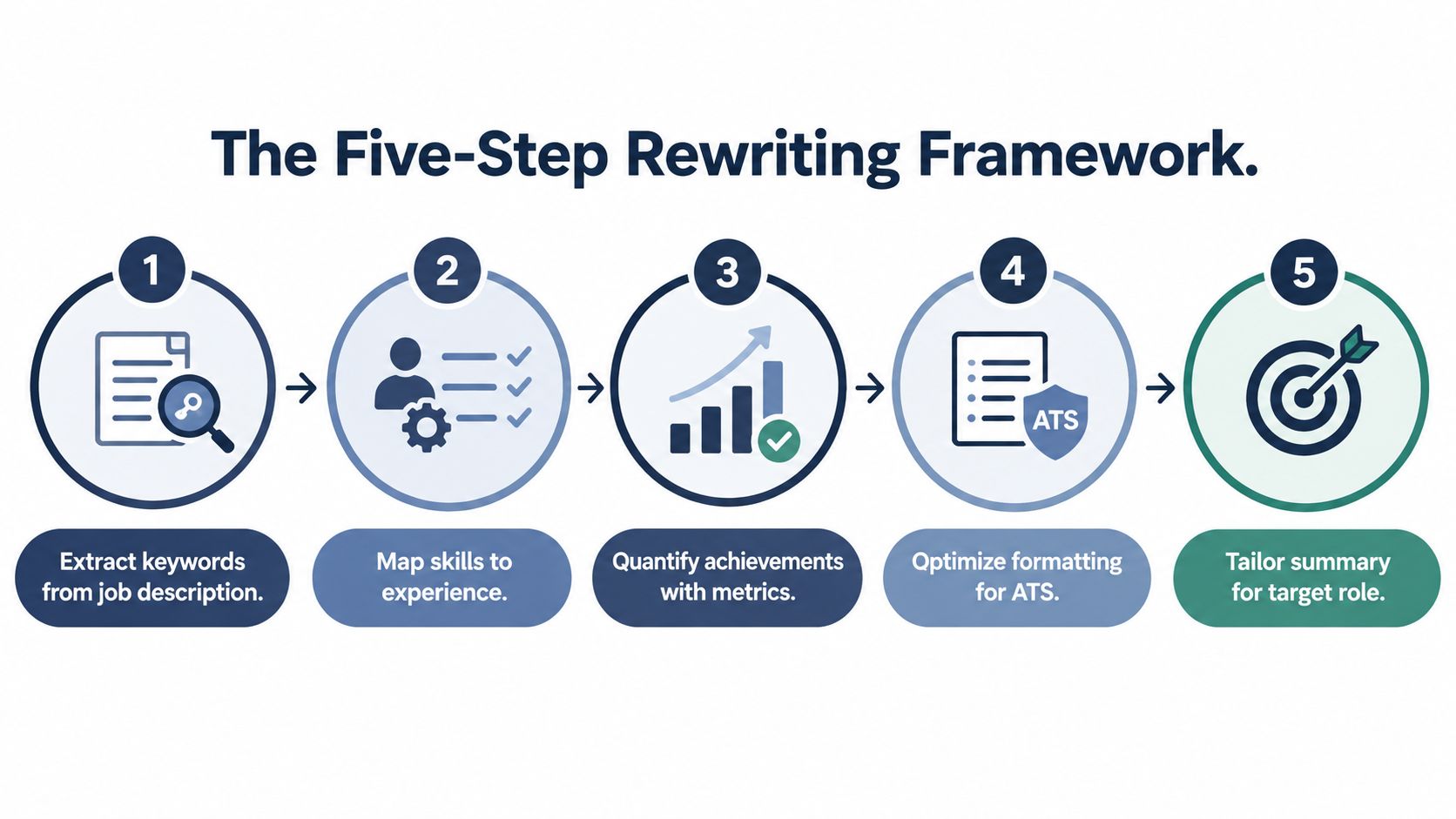
Treat each application like a small mapping exercise, not a full reinvention. The point is to line up the vacancy with evidence from your history, then write that evidence in language the employer recognizes.
Start with the posting, not your old resume
Pull out the hard requirements first, things like software, certifications, job title, location, years of experience, education, and repeated phrases in the posting. Then sort each item into one of three buckets, demonstrated, transferable, or not evidenced. Only the first two belong in the rewrite.
That classification keeps the document honest. It also stops the common mistake of trying to force every phrase from the job ad into the resume, even when there's no real proof behind it.
Use Project–Action–Result as your structure
Harvard FAS recommends the Project–Action–Result format, along with mirroring employer terminology where it truthfully matches your experience, naming tools and methods, and quantifying outcomes where possible Harvard FAS guidance via Jobscan. In practice, that means each bullet should say what you worked on, what you did, and what changed because of it.
A good rewrite does more than swap verbs. It turns “managed reporting” into a line that shows the reporting system, the decision it supported, and the outcome for the team or client.
Build the resume around evidence, not stuffing
Use the employer's wording where it's accurate, but don't paste phrases that don't fit your history. The point is semantic alignment, not repetition. If the job asks for stakeholder communication and you've done it under a different title, show the context, not just the phrase.
A simple way to audit the draft is this:
- Demonstrated: You've done it, can explain it, and can defend it in an interview.
- Transferable: You've done something close enough that the capability carries over.
- Not evidenced: You can't support it with real experience, so leave it out.
That audit protects credibility. It also keeps the resume focused on the signals that move the needle.
Write for the role, then validate the fit
After the rewrite, check that every critical requirement appears in a conventional section and is attached to evidence. If a skill matters but only shows up once in a buried line, it's too easy for both software and people to miss it. The strongest version of how to rewrite your resume is disciplined, selective, and truthful.
For a practical walkthrough of tailoring language to a specific posting, see the guide on how to tailor a resume to a job description.
From Duties to Achievements - Before and After
Generic bullets usually fail because they describe a function without showing impact. Strong bullets sound more specific because they connect the skill to the setting and the result.
Before and after examples
“Managed a team” becomes stronger when it becomes something like, “Led a cross-functional team through a product launch, coordinated timelines across functions, and delivered the release ahead of schedule.” The exact facts have to be true, of course, but the structure is the important part. It tells the reader what the team was, what the work involved, and what changed.
“Handled customer inquiries” can become, “Resolved escalated customer issues, tightened response workflows, and improved service consistency across the support queue.” The rewrite moves from task to contribution. It stops sounding like a description from a job board and starts sounding like a result someone would want to hire again.
“Prepared reports” is another common weak line. A stronger version names the report's purpose, the tool or method used, and the decision it informed. That makes the bullet useful to a hiring manager who wants to know whether you can do the same work in their environment.
If you can't show the outcome, show the context and the method. That's still stronger than a bare responsibility statement.
A simple formula that keeps you honest
Use this pattern when you rewrite:
- Identify the capability. What skill is the employer really asking for.
- Show the context. Where did you use it, and in what type of work.
- Describe the action. What did you do.
- State the result. What changed because of it.
That formula works well for career switchers, returners, and people whose job title doesn't match the target role. It lets you translate experience without pretending you had a different job than the one you really held.
What not to do
Don't turn every bullet into a mini headline. Don't cram in five keywords where two would do. And don't claim tools, systems, or responsibilities you never touched.
The best rewrites sound confident because they are specific, not because they are inflated. A hiring manager can feel the difference immediately. So can an interviewer who starts probing for details.
Designing for Machines and Humans
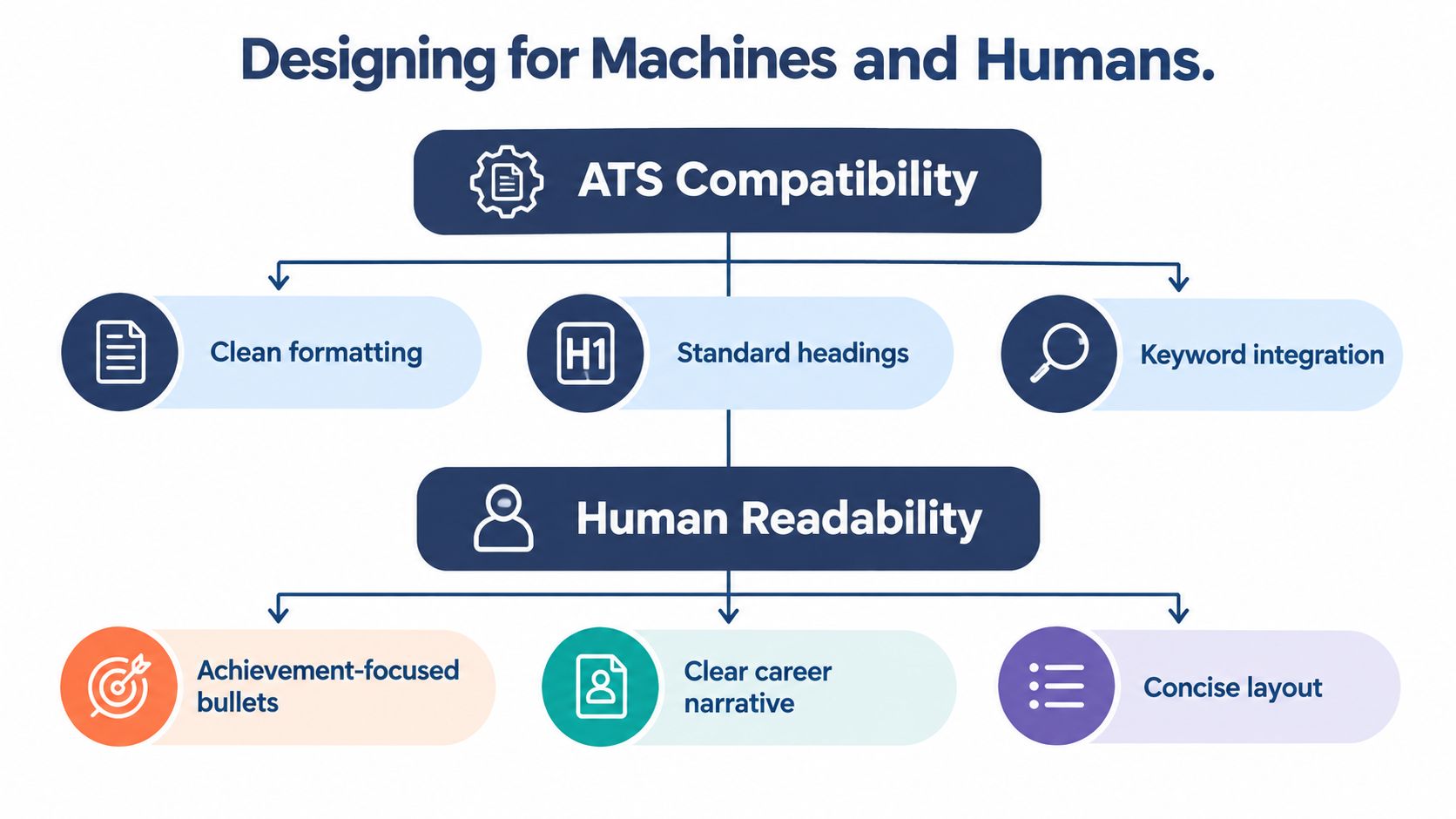
A resume has to survive parsing before it earns a human read. That means machine readability first, then relevance ranking, then visual clarity for the recruiter who opens the PDF.
Use standard structure and selectable text
Keep headings conventional, such as Summary, Skills, Experience, Education, and Certifications. Put contact information in the body of the document, use selectable text, and keep bullets consistent. Avoid text boxes, image-based elements, and layouts that force the parser to guess what comes first.
Research on an AI-powered ATS reported parsing accuracy of 96.7% for plain-text resumes and just 53.3% for image-converted resumes AI-powered ATS parsing study. That doesn't mean every system behaves the same way, but it does show why a visually clever resume can be a technical liability.
Check the document before you send it
A quick review catches most avoidable failures:
- Select and copy the text. If chunks disappear, the file may not parse cleanly.
- Check reading order. Make sure the top of the page reads like the top of the page.
- Confirm dates and titles. The parser should preserve job chronology without scrambling it.
- Compare the PDF to the visual layout. If what you see isn't what gets extracted, fix the format.
A recruiter can forgive a simple layout. They usually won't forgive a file that hides the candidate's history. That's why design matters, but only inside limits.
For a hands-on checklist, the ATS-friendly resume guide at GetTheCall is a useful reference point.
Keep the reader in mind too
Formatting should help the eye land on the important parts fast, especially the role, title, dates, and education. The earlier six-second scan is unforgiving, so the top third of the page has to do real work. Clean formatting doesn't replace strong content, it gives the content a chance to be seen.
Using AI Without Losing Authenticity
AI can save time, but it can also flatten your voice and make the resume harder to trust. In a 2025 survey of 2,000 U.S. jobseekers, 45% used AI to create or polish résumés, and 82% of AI-assisted users reported ATS problems they suspected caused rejection or reduced visibility TopResume jobseeker trends report. That's a clear warning that speed alone doesn't solve the problem.
Use AI for structure, not invention
Let AI help with rephrasing, reordering, and tightening language. Don't let it invent employers, certifications, software, or metrics. The safest use case is turning your real experience into clearer bullets and summary language that still matches what happened.
A good check is simple. If you can't explain the rewritten line in an interview, it doesn't belong on the page. If the claim sounds impressive but you can't defend it, delete it.
Keywords still need context
Keyword alignment is useful. Keyword stuffing isn't. The right terms should appear inside readable sentences that describe real work, not as a block of disconnected buzzwords.
That matters even more for people changing fields, because the system has to understand transferability. A resume that says the right thing in the wrong way still loses to a clearer one. AI can help translate the wording, but it can't replace the proof.
Best use of AI: draft faster, then verify harder.
If you're using AI in the rewrite process, keep the final pass human. Check the title, the dates, the scope, the tools, and the outcomes. The resume should sound like you on your best day, not like a template trying to sound employable.
Streamlining the Rewrite with GetTheCall
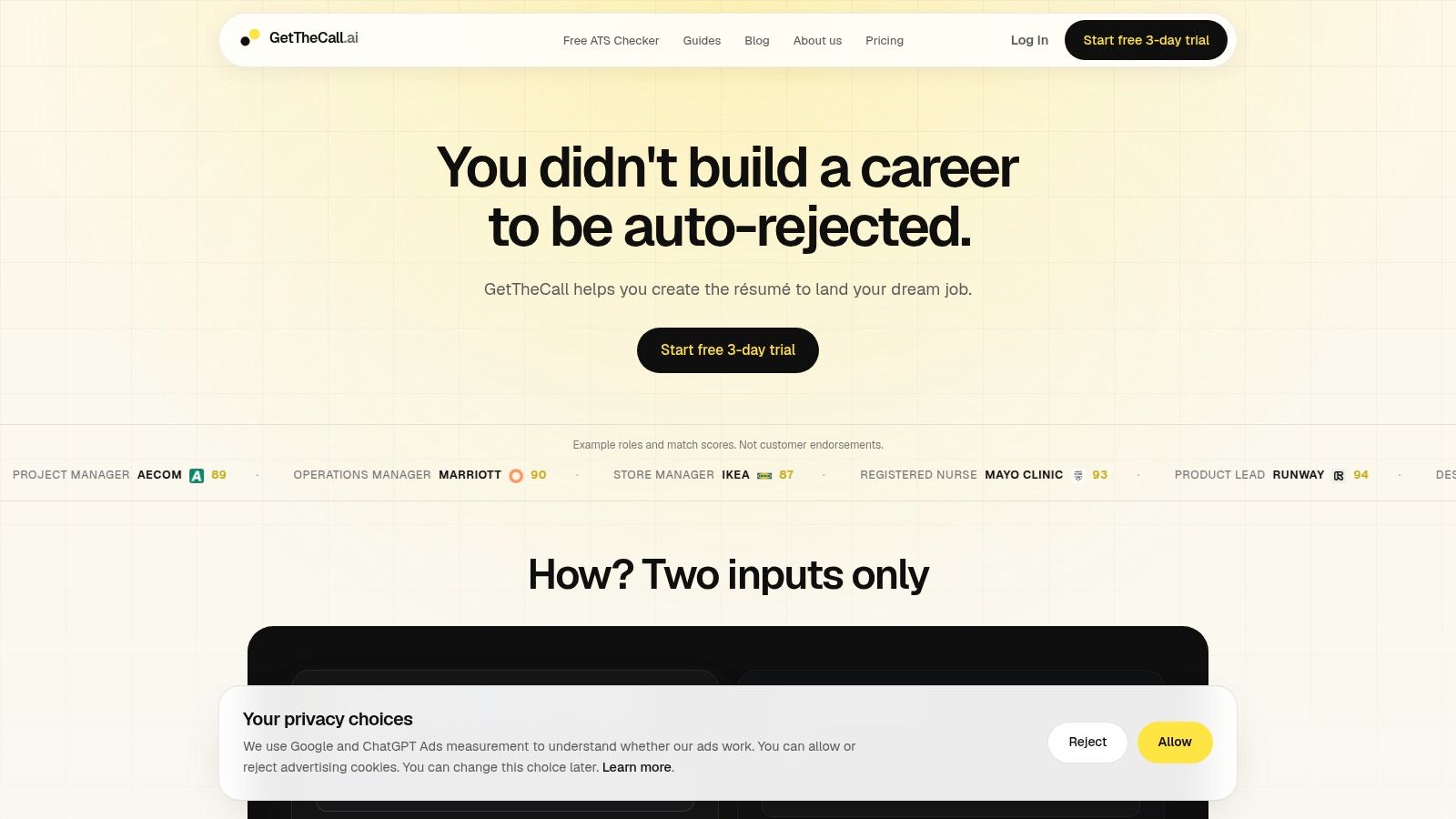
Tailoring several applications becomes easier when the workflow keeps evidence, wording, and formatting connected. GetTheCall provides an end-to-end path from resume import to a submission-ready PDF, with a live ATS Role Match score that changes as you edit. It also works from verified experience in the user's profile, helping prevent invented roles or skills. That combination supports the shift from keyword stuffing to skills-based evidence, where matching terms must still reflect work you can explain to a hiring manager.
What it does in practice
Role-specific tailoring keeps the resume responsive to each vacancy instead of treating one version as final. A strong rewrite is iterative: adjust the language, preserve accurate scope, and strengthen evidence where the listing exposes a gap.
Before submitting, use the ATS resume checker to identify parsing or keyword issues. Its result is a prompt for review, not a replacement for judgment. Confirm that the terms appear in readable statements about real skills, responsibilities, and outcomes.
For your next application, import your resume, paste the job listing, and apply the five rewriting steps above. Then review the match score, inspect every suggested change, and export the version that remains accurate, readable, and defensible in an interview.