How to Put Publications on a Resume in 2026
Learn how to put publications on a resume with selected entries, short citations, status labels, DOI links, and ATS-safe placement.
You've found a job you want, opened your résumé, and pasted in your publication list. Suddenly, your work experience has slipped down the page, the citations look dense, and you're not sure whether that manuscript under review belongs beside your published papers.
Learning how to put publications on a resume starts with a different question: what does each item prove you can do? For most nonacademic applications, your aim isn't a shorter bibliography. It's a small, convincing set of examples that connects your research, writing, or technical skills to the job.
Table of Contents
- Choose a Résumé List or a Full CV
- Label Work That Is Not Published Yet
- Write and Format Each Publication Line
- Place Publications by Career Stage
- Pick the Papers for This Application
Choose a Résumé List or a Full CV
A publication can be a main qualification or supporting evidence. Choose the document based on what the application asks for and what the reader needs to assess.
NACE distinguishes a résumé, a brief and targeted summary, from a CV, which records education and career achievements in greater detail. Academic, medical, and scientific applications may call for a CV with publications, presentations, fellowships, and grants. For many industry roles, a short selection is more useful than a full publication record.
Match the list to the application
What to list by role and document
| Situation | Document | Section name | How many | What to show |
|---|---|---|---|---|
| Faculty or research role | CV | Publications | Full or near-full list | Complete citations in reverse chronological order, split by type |
| Medical, scientific, or lab role | CV | Publications | Full list by category | Peer-reviewed work, books or chapters, proceedings, and labeled items under review |
| Nonacademic or industry role | Résumé | Selected Publications | 2 or 3 most relevant | Title, venue, year, and one skill or impact line |
| Early career with few outputs | Résumé | Research and Publications | 1 to 3 plus related outputs | Papers with posters, datasets, or technical reports |
| Long list and limited pages | Résumé plus link | Selected Publications | Top 3 on the résumé | A total-count line and a link to the full list |
A faculty search committee may need to review your publication history across a research program. Include complete entries and group them by type, such as articles, books or chapters, and proceedings. List entries in reverse chronological order within each category.
An industry hiring manager is looking for evidence that fits the opening. A paper about forecasting, for example, may show relevant modeling skills; an unrelated article may not help, even if it appeared in a prestigious journal. Use Selected Publications, or mention the paper in the experience bullet that describes the work behind it.
Practical rule: Keep the full academic record where completeness matters. On a résumé, show the two or three publications that best support your fit for the role.
Give related outputs an honest home
If you have a paper, a poster, and a public dataset, group them under Research and Publications rather than leaving an almost-empty Publications section. Label each item by type so a poster is not mistaken for a journal article.
For a long nonacademic list, put the total number of publications on the résumé and link to an ORCID, Google Scholar, or institutional profile. Check that the profile is public, current, and clearly yours. Keep enough detail on the résumé for the reader to understand your strongest examples without opening the link.
An ATS résumé checker can help identify formatting or parsing issues. It cannot determine whether an application calls for a résumé or a full CV, so follow the employer's instructions.
Label Work That Is Not Published Yet
A stranger should be able to identify your work without knowing your laboratory, discipline, or publication pipeline. Start with your name, the title, the source, and the year, using your field's citation style.
The University of Minnesota Duluth's résumé and CV guidance recommends including the publication title, source, and date in the citation style appropriate to the field. In APA style, surnames precede initials, authors stay in their original order, and a DOI belongs in the reference whenever one exists.
Make status visible before the contribution
On a tight résumé, volume, issue, and page range can usually go. The venue and year should remain for published work; unfinished work needs an explicit status instead of a date that could imply publication.
How to label publication status
| Status | Label to print | Put it on a résumé? | Add this |
|---|---|---|---|
| Formally published | Published or Peer-reviewed | Yes, if relevant to the role | Short citation and DOI when one exists |
| Accepted, not yet in print | In press or Accepted | Yes | Journal name and expected date |
| Submitted or under review | Manuscript submitted | Only when it proves a stated requirement | Peer-review note and your contribution |
| Public preprint | Preprint | Yes, if relevant and clearly labeled | Repository and identifier, never the word Published |
| Still being written | In preparation | Usually omit | Include only if the method matches the job |
The University of Pittsburgh's publication-listing guidance recommends labeling status and including the journal plus expected date for in-press work. Use an expected date only when you have a reliable one; don't turn a hoped-for publication schedule into a promise.
If your list needs separate groups, use Published/Peer-Reviewed, Accepted/In Press, and Manuscripts Under Review. Don't create a separate subsection for every possible stage of editorial review. On a short résumé, a visible status label at the start of each entry is often enough.
Show the difference at a glance
These illustrative templates use bracketed fields so you can replace them with accurate details:
- Published: Surname, A., & Surname, B. [Year]. [Article title]. [Journal]. [DOI]. Contribution: conducted data analysis.
- In press: Surname, A. [Article title]. [Journal]. In press; expected [month and year]. Contribution: developed the research protocol.
- Manuscript submitted: Surname, A. [Manuscript title]. Submitted to [journal] for peer review; not yet accepted. Contribution: designed the field survey.
A preprint needs its own precise wording: Preprint, followed by the repository and identifier. Public availability doesn't mean the work has completed peer review. If an article has both a preprint and a later journal version, avoid presenting them as separate achievements without explaining the relationship.
A status label tells the reader where the work stands. A contribution line tells the reader what you can do.
Your private-sector résumé isn't an NIH biosketch, but the caution is the same: accepted manuscripts, submissions, and preprints must not appear as completed publications. Students, career switchers, and international applicants shouldn't assume recruiters understand their field's conventions.
Omit in-preparation work unless the method directly addresses a requirement in the posting. When that exception applies, consider describing the work as a research project rather than making an unfinished manuscript carry the credibility of a publication.
Write and Format Each Publication Line
Build the entry around a job skill, then attach enough citation information for verification. The finished result should read as evidence of useful work, not as a reference copied from the end of an article.
For illustration, a hypothetical entry could read:
First author. [Article title]. [Journal], [publication year]. Analyzed records using Python and causal inference; findings informed a screening guideline.
This visual summarizes the path from choosing relevant details to placing a finished entry.
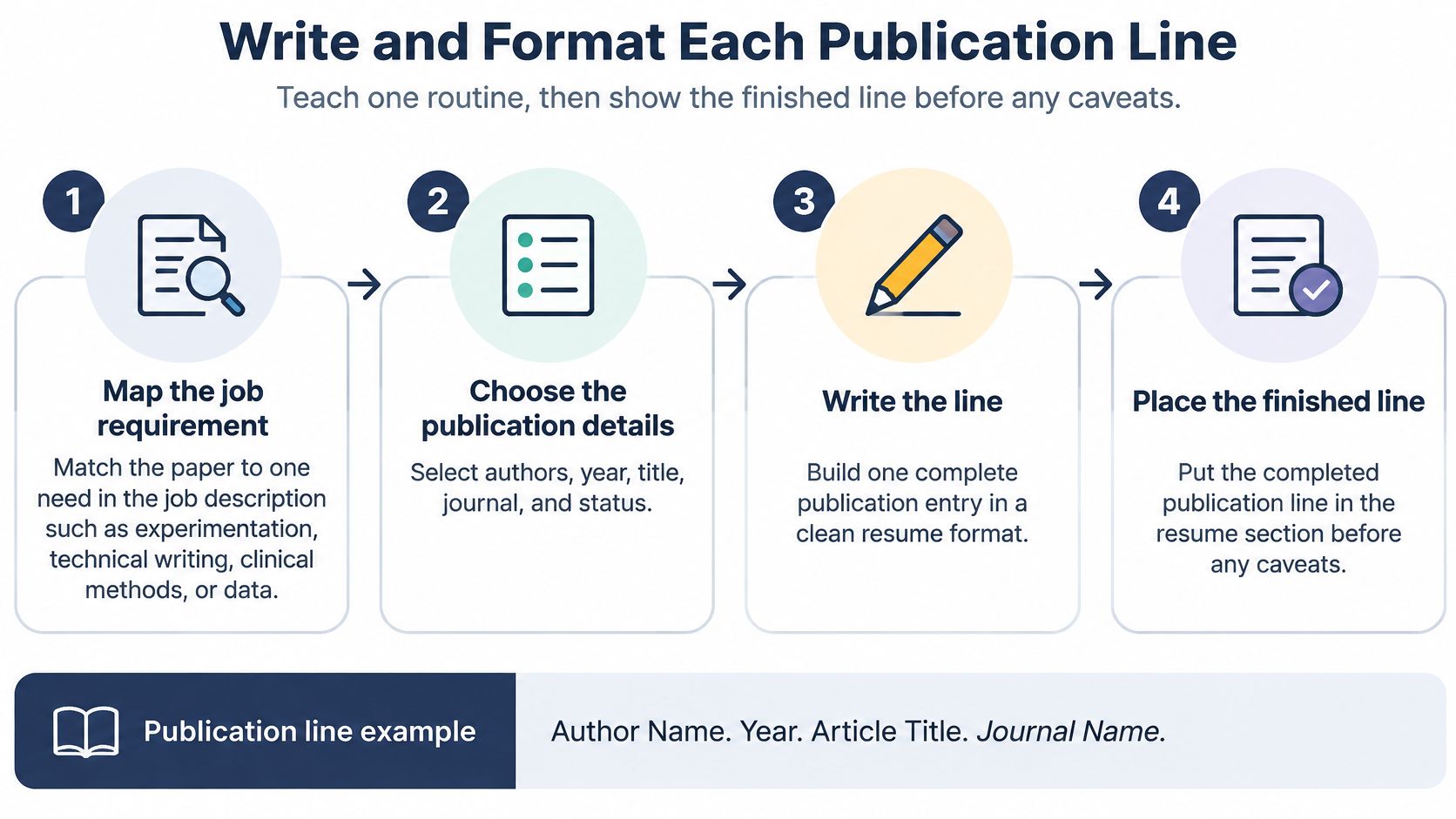
Start with the requirement, not the journal
Read the posting and identify a capability the publication supports. That might be experimentation, technical writing, clinical methods, statistical modeling, or communicating findings to a nontechnical audience.
Say you're applying for an analyst role that emphasizes Python and causal inference. A paper using those methods deserves consideration even if another publication has a more impressive venue. Your description should explain the relevant method and your part in applying it.
Use this drafting routine:
- Map the paper to a requirement. Write the employer's need beside the publication before drafting the entry.
- Identify your role. State first, corresponding, or senior author status when accurate and useful.
- Preserve identification details. Keep author information, title, journal or publisher, year, and any necessary status.
- Add a contribution or impact clause. Describe the method, dataset, result, adoption, or other outcome you can substantiate.
- Test its prominence. Put the strongest evidence where a reader can find it without working through unrelated material.
Authorship role and contribution aren't interchangeable. First author may indicate leadership within your field, but an industry reader still needs to know whether you designed the study, wrote the software, collected evidence, or drafted the manuscript. State the actual work rather than expecting author order to explain it.
Keep the citation short without changing credit
Use surname-first author names with initials when that matches your field's style, and preserve original author order. You can bold your own name to help readers locate it, but don't move it to the beginning of a citation if that changes the credited order.
For a very long author list, use the abbreviation convention accepted in your field. Keep the full citation available through the publication identifier or your profile. Abbreviation should save space, not make a middle-author contribution look like sole authorship.
A practical entry can occupy a citation line and a contribution line:
Selected Publications
[Your surname], [initials]., [Coauthor surname], [initials]. [Article title]. [Journal], [year]. [DOI]
Contribution: built the analysis pipeline and translated findings into recommendations for a nontechnical audience.
This format keeps the bibliographic details separate from your explanation. It also avoids squeezing an abstract into the résumé. Readers need the question you helped answer, the relevant technique, and your role, not every limitation or theoretical contribution.
Quantify only what you can defend
A measurable result can strengthen an entry, but it isn't a requirement. Dataset size, study population, a documented citation milestone, policy adoption, or product use may be appropriate when accurate and relevant.
The USC résumé format guidelines support concise, accomplishment-focused descriptions, quantified results where appropriate, and readable 11–12-point typography. Don't shrink the text to preserve material that should have been cut.
If you can't substantiate a result, describe the method instead. Developed a reproducible Python workflow is more credible than improved research efficiency when you never measured the improvement. Likewise, distinguish between findings that informed a decision and findings that directly caused an outcome.
- Strong method detail: Used regression analysis to evaluate the relationship between service access and reported outcomes.
- Clear collaboration detail: Coordinated manuscript revisions across clinical and statistical contributors.
- Useful writing detail: Converted technical findings into a public-facing policy summary.
None of those descriptions needs an invented percentage. Specific work is persuasive on its own.
Format for skimming and text extraction
In 2024, 81% of U.S. recruiters and hiring managers surveyed by ResumeGo spent less than one minute on the initial résumé review, according to StandOut CV's summary. Your entry should communicate its title, venue, year, and relevance without requiring a reader to decode a dense citation block.
Use Publications or Selected Publications as a standard heading in the document body. Don't place entries inside a text box, header, footer, icon, or multi-column table. The comparison tables in a career guide help explain choices; they aren't a recommendation to build your résumé as a table.
Keep the title, venue, and year prominent immediately after any short authorship label. Avoid unexplained journal abbreviations, inconsistent date formats, and styling that relies only on italics to distinguish important information. Use ordinary text that remains understandable when formatting disappears.
For a publication-heavy application, the strongest relevant entry may belong in the upper half of the first page. For other applications, don't displace stronger work achievements just to put a citation higher. Placement should reflect the importance of the evidence.
A visual walkthrough can help you review the finished layout alongside your own document.
Check the exported document
Write DOI or publication links as selectable text, not as an image or a standalone icon. Use descriptive linked text and make sure the entry still identifies the work if the hyperlink isn't opened.
Follow the employer's file-format instructions. If you export a PDF, copy its contents into a plain-text editor and check whether the heading, author information, status, and contribution appear in the intended order. An ATS-friendly résumé guide can help you review the broader document structure.
Finally, check every keyword against what you really did. A paper that discusses machine learning doesn't establish that you trained a model. Describe your contribution precisely enough that you could explain it comfortably in an interview.
Place Publications by Career Stage
A student and an experienced manager shouldn't give publications identical prominence. Place the section where it strengthens the story your application needs to tell.
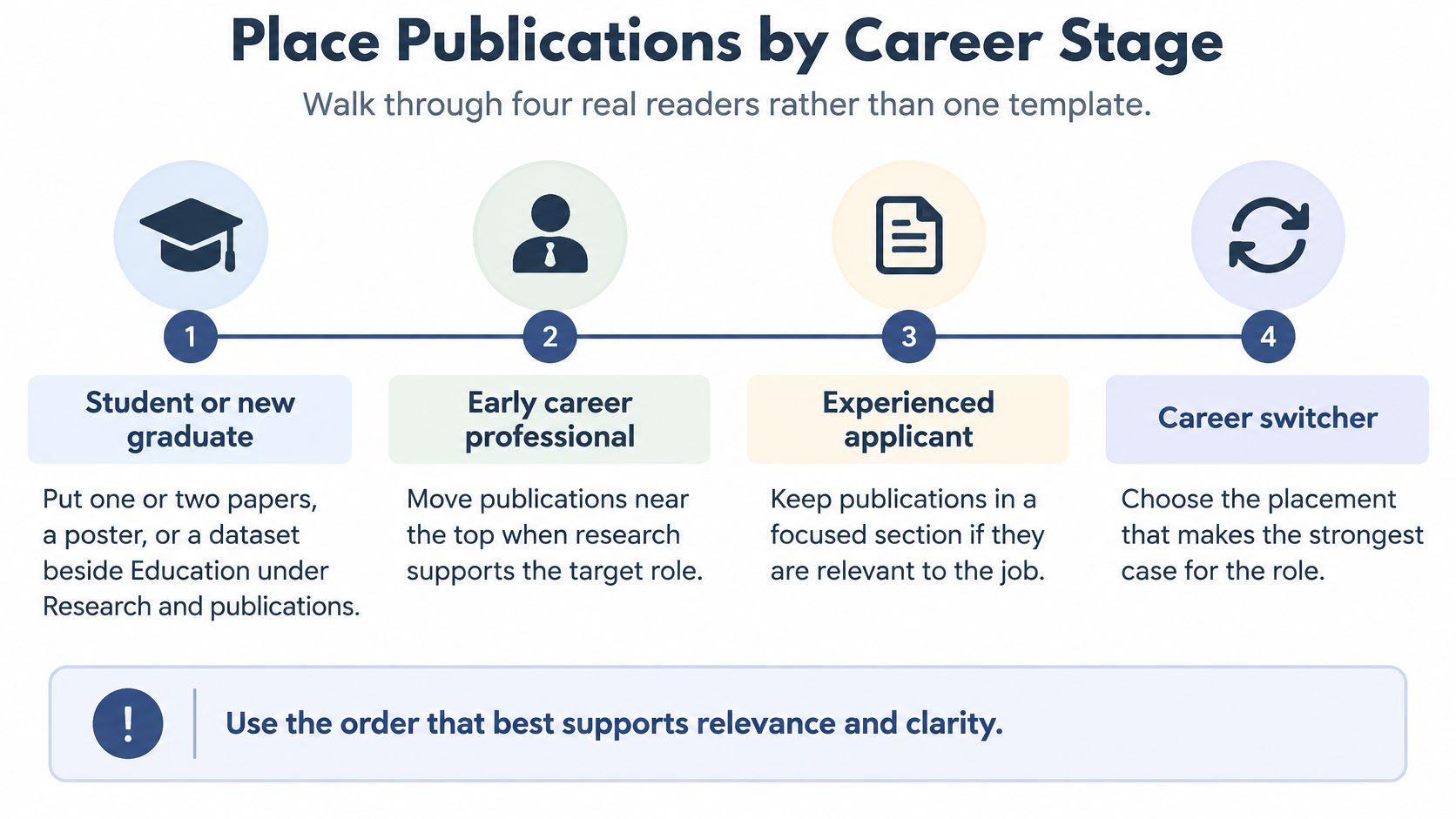
Use this career-stage overview to compare possible placements.
Students and early-career applicants
For a student or new graduate with limited paid experience, a paper, poster, or dataset may be the strongest evidence of research method and writing ability. Put Research and Publications beside Education, or use Selected Publications if the entries are all publications.
An early-career industry applicant should normally give job history and relevant skills priority. The University of California, Riverside's graduate résumé guidance recommends trimming publications to the top three most relevant works. Treat that as a practical résumé default, not a cap on an academic CV.
In a 2024 Resume Genius survey, 54% of 625 U.S. hiring managers said they favor a two-page résumé. That isn't a universal length rule, but a bibliography that pushes your strongest work results onto a third page is a poor trade-off for a conventional industry application.
Career switchers and research applicants
A career switcher needs to make the connection explicit. For a marketing-analytics application, emphasize experimentation, audience analysis, and visualization rather than journal ranking. Place the block after the experience or project that best establishes your fit for the new field.
Faculty, medical, and laboratory applications are the exception when employers request a full academic record. Their Publications section can extend beyond ordinary résumé limits because the publication history itself is part of the qualification. Place it prominently within the requested CV structure.
For a long nonacademic record, a count line can signal breadth without displaying everything. A hypothetical line might read Selected publications, 3 of 14, followed by a descriptive link to your complete profile.
A complete sample block
The following hypothetical block shows layout and contribution wording, not real publication claims:
Selected Publications
- First author: [Article title]. [Journal], 2024. Analyzed 2.1M records using Python.
- Co-author: [Paper title]. [Conference Proceedings], 2023. Built the data pipeline for a 12-site study.
- Manuscript submitted: [Manuscript title]. Submitted to [Journal], 2026, for peer review; not accepted. Contributed the field survey design.
Keep the standard heading Selected Publications consistent when using this publication-only block across application versions. Use Research and Publications only when the contents clearly include other research outputs.
Within a short industry selection, place the most relevant item first. Within an academic CV category, maintain the chronological convention expected by the field.
Pick the Papers for This Application
You don't need to rebuild your career history before applying. You need to make a defensible selection from work you've already done.
Open the job posting beside your résumé and mark the skills the employer repeats. Then ask which papers let you point to actual evidence of those skills, rather than merely a related topic.
Make the selection today
- Choose the strongest matches. Keep the two or three publications that best demonstrate the required methods, expertise, or communication skills.
- Give the rest a destination. Move the complete record to a CV, ORCID, Google Scholar, or portfolio, with an optional total-count line on the résumé.
- Adapt the contribution clause. Emphasize the part of your real work that matters for this opening, without changing authorship, status, or results.
- Check ownership and accuracy. Make your name and role visible, verify the status word, and confirm that the identifier opens the right work.
If you're applying to different kinds of roles, tailor your résumé to the job description rather than maintaining a universal publication list. The same paper may support a technical application through its analysis methods and a policy application through its written recommendations.
Keep the publication because it proves something useful, not because removing it feels like losing credit.
Before sending, skim the résumé without opening any links. Can you find the publication title, year or status, and relevant skill immediately? If not, cut another item before reducing the font.
Finish with a concrete export check: open the final file, select a publication entry, and paste it into a plain-text editor. Confirm that the status, your name, and the contribution remain readable and in order.
GetTheCall transforms an existing résumé or LinkedIn profile into a job-specific résumé, featuring a live role-match score and PDF export. Visit GetTheCall to align your selected publications and other experience with the job you're applying for, using skills and achievements you have.