How to Message Recruiters on LinkedIn in 2026
How to message recruiters on LinkedIn with short notes, six situations, weekday timing, one follow-up, and a check before you share a résumé.

LinkedIn messages of 400 characters or fewer received response rates 22% higher than the global average, according to LinkedIn's analysis of tens of millions of corporate recruiter InMails sent between May 2023 and April 2024. That's a useful reason to stop writing a cover letter in the message box.
Those were recruiters messaging candidates, not candidates messaging recruiters, so the finding isn't a promise about your inbox. Still, it offers a sensible starting point for learning how to message recruiters on LinkedIn: make your relevance easy to assess, offer evidence instead of a biography, and ask a question someone can answer quickly. Treat the exchange as a two-way check, too. You're assessing whether the recruiter and opportunity are legitimate, not just trying to earn their attention.
Table of Contents
- What Makes a Recruiter Reply
- Six Messages for Real Situations
- Write Honestly About a Partial Match
- Confirm the Recruiter Before You Share
- How to Write and Send the Note
- Follow Up Once Without Sounding Pushy
- Send One Strong Note This Week
What Makes a Recruiter Reply
Length and timing give you practical boundaries. LinkedIn's recruiting guidance says InMails between 200 and 400 characters are 16% more likely to receive a response than messages outside that range, while Saturday response rates are 16% lower than during the workweek, with Monday through Thursday performing better.
These findings describe recruiter outreach to candidates. Use them as drafting constraints, not as a forecast of your own response rate.
The same guidance reports that candidates marked open to opportunities are 75% more likely to respond, but that doesn't mean an open-to-work badge makes a recruiter more likely to answer you. For candidate outreach, the better targeting signal is the recruiter's hiring responsibility: your function, city, and seniority.
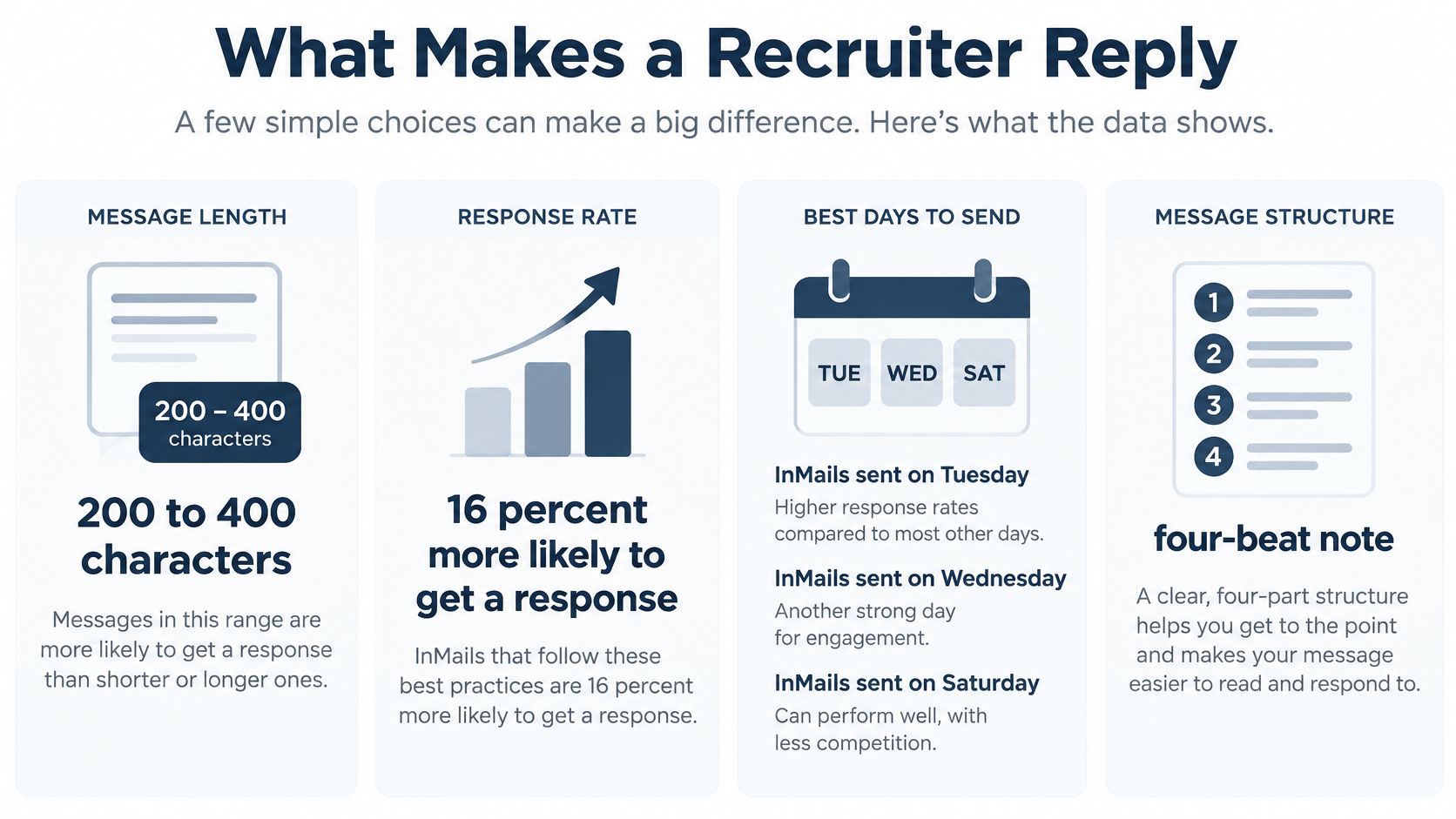
Give the recruiter a quick fit check
A useful four-beat note answers the questions a recruiter needs resolved before continuing:
- Who you are and which role you mean. Name your professional background and the exact opening.
- What you've delivered. Include a real result, a defensible number, or meaningful scope.
- Whether the logistics work. State relevant location, availability, or work-mode information.
- What you need next. Ask a single, easy question, such as whether they own the requisition.
For example, imagine an operations candidate contacting someone who recruits for customer support:
Hi Priya, I'm an operations coordinator interested in your Customer Support Coordinator opening. I rebuilt our onboarding checklist and reduced missed handoffs. I'm based in Austin and available for hybrid work. Are you handling this requisition?
The result doesn't need a percentage to count as evidence. A named process, customer group, project, or responsibility can establish scope when you don't have an approved metric.
Remove anything that delays the answer
Skip the full biography, unsolicited résumé attachment, and praise that could apply to any stranger. Saying you admire the company doesn't help someone determine whether you fit its support team.
Your profile should support the claim in your note. If the recruiter later requests a document, prepare an ATS-friendly résumé that makes the same experience easy to find.
Practical rule: Ask for the next useful answer, not the whole hiring process.
A question about requisition ownership is easier to handle than a request to review your résumé, find suitable vacancies, arrange an interview, and offer career advice.
Six Messages for Real Situations
Recruiter notes by situation
| Scenario | When to send | Length | Include | Ask |
|---|---|---|---|---|
| Cold note to an in-house recruiter | An open role matches your level and location | 200-400 characters | Role title and one real result | Are you the right person for this requisition? |
| Referral through someone you both know | A former colleague, alumni connection, or shared employer can connect you | Under 400 characters | That person's name and why this recruiter | Can you point me to the right owner? |
| Application follow-up | 5-7 days after you applied with no reply | Under 400 characters | Job title and the date you applied | Is this role still moving? |
| Reply to their message | They InMailed you or commented first | Under 400 characters | Their role title and your availability | What is the official job link and next step? |
| Note on a job they posted | They shared that role in the last week | Under 400 characters | The post and one matching result | How do you prefer candidates to apply? |
| Partial match or career switch | You can show the outcome but miss a listed tool or years | 200-400 characters | One transferable result and the gap in plain words | Is that missing item mandatory? |
Treat the timing in this table as a manageable outreach routine, not a platform rule. Each example below is a model to adapt, not a message to send unchanged.
Choose the note that matches your relationship
Cold outreach
Hi Maya, I'm an onboarding coordinator interested in the Customer Operations role in Austin. I rebuilt our new-hire checklist and reduced missed setup tasks. I'm available for hybrid work. Are you the right person for this requisition?
A genuine referral
Hi Leon, our former colleague Sam Patel suggested I contact you about finance hiring. I led month-end reporting at our shared employer and now support budgeting. Can you point me to the owner of the Finance Analyst opening?
Only mention someone referred you if they did. A shared employer provides useful context, but it does not grant permission to imply an endorsement.
After applying
Hi Aisha, I applied for the Product Designer role on [application date]. My recent work includes simplifying account setup for a subscription product. I'm based locally and remain interested. Is this role still moving?
Replying to inbound outreach
Hi Ben, thanks for contacting me about the Warehouse Supervisor role. My background includes shift handovers and team scheduling. I'm available to speak Thursday afternoon. Could you share the official job link and next step?
Responding to a public job post
Hi Erin, I saw your post about the Customer Success Associate opening. I recently rebuilt our customer handover process to prevent missed follow-ups. I'm available for the advertised work arrangement. How do you prefer candidates to apply?
A partial match
Hi Noor, I'm interested in your Operations Coordinator role. My restaurant-management background includes redesigning shift handovers and training new starters. I haven't used the scheduling tool listed and would need training. Is that tool mandatory at entry?
Replace broad claims with evidence
Compare these hypothetical opening lines:
Weak: I am a hardworking professional exploring opportunities.
Specific: I led onboarding for 40 new hires last year and saw your coordinator role in Austin.
Replace the 40-hire Austin example with your actual result and the recruiter's real opening. If you can't substantiate a number, describe the work's scope instead.
LinkedIn's published InMail advice reports that personalized recruiter InMails can increase acceptance rates by 40%, and referencing a former employer shared with the recipient increases the likelihood of a response by 27%. Those findings support relevant context, not manufactured familiarity.
The useful distinction is simple: a personalized note explains why this recipient and this role. Adding a name to a generic pitch doesn't do that.
Write Honestly About a Partial Match
A partial match isn't automatically a reason to stay silent. It's a reason to distinguish what you can already deliver from what you'd need to learn, whether you're changing careers, returning to work, or missing a listed tool.
Keep the message grounded in work you can explain in an interview.

Explain the transition without disguising it
Use a short progression rather than copying every keyword from the listing:
- Name your background. Give the recruiter an accurate starting point.
- Describe an outcome. Choose work that connects to the opening's responsibilities.
- Explain the overlap and gap. State what transfers and what you haven't done yet.
For a hypothetical restaurant manager moving toward a shift-lead opening:
My background is in restaurant management. I cut closing time by 20 minutes a night, which connects to your need for efficient shift handovers. I haven't used your scheduling software yet. Is that tool mandatory, or can it be learned on the job?
The time saving is an illustrative result, not a number to borrow. Replace it with evidence you could defend, including how you measured it and what you personally changed.
Personalization means making a credible connection between past work and future responsibilities. Employ's discussion of candidate communication and personalization accompanies reported outreach findings from more than 500,000 recruiting sequences: messages referencing actual work drew a 35.3% reply rate, compared with 24.1% for generic templates, a 46% relative lift.
Know when the gap is decisive
A missing software package may be trainable. A required professional license you don't hold is a different problem. Skip the application when you clearly lack a nonnegotiable qualification central to performing the job.
If the wording is ambiguous, ask whether the requirement is mandatory rather than trying to hide the mismatch. You don't need to apologize for a legitimate question.
For another way to approach the message, watch this walkthrough.
Your document should make the same honest case. When you tailor a résumé to a job description, reorder verified evidence and clarify transferable responsibilities. Don't invent a title, tool, credential, or metric to get through a screen.
Confirm the Recruiter Before You Share
Online job scams rose 19% year over year in the first half of 2025, causing nearly $300 million in reported U.S. losses, according to NBC News's reporting on fraudulent job opportunities. A polished profile and confident message aren't enough to establish that an opportunity is genuine.
Treat an inbound note as something to verify before sending documents or contact details. You can stay courteous while asking for information.
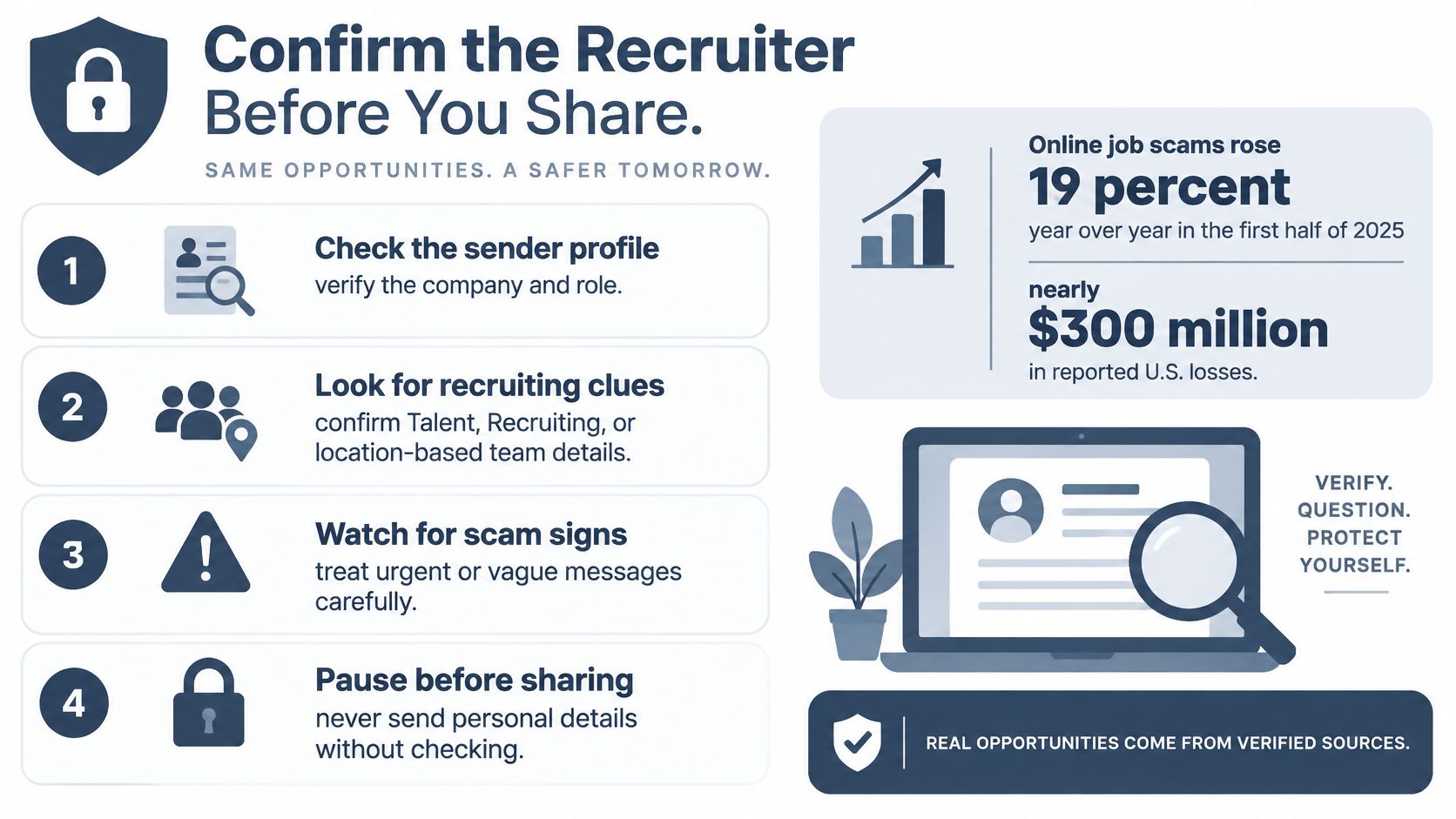
Run the profile, role, and channel checks
- Check the sender's employment. Look for a credible work history at the stated employer, recent activity, and connections consistent with their recruiting role. Treat verification indicators as supporting clues, not substitutes for checking.
- Find the role independently. Go to the employer's official careers page yourself. Compare the title, location, responsibilities, and requisition number rather than relying only on a link sent in chat.
- Assess the proposed channel. Be cautious if the sender immediately insists on WhatsApp, a personal email account, or an urgent off-platform exchange before providing basic job information.
Agency recruiters may not disclose a client immediately. That doesn't prove fraud, but it does mean you should establish the agency's identity and understand the opportunity before providing personal information.
A missing listing also isn't conclusive by itself. It's a reason to pause and seek confirmation through the employer or agency's independently located official contact channel.
Ask questions instead of handing over documents
Start with a small request:
Thanks for reaching out. Before I share my résumé, could you send the official job link and requisition number? I'd like to confirm the role and location.
Once those details align, clarify the reporting relationship, work mode, salary range if shareable, and next interview step. You don't have to put every question into the first reply.
A legitimate-sounding conversation still needs an independently verifiable employer and role.
Share a résumé only when the answers make sense. Leave off your home address, government identification, banking information, and unnecessary personal details; a headshot generally isn't needed for this exchange either.
Identity or financial documents belong only in an appropriate, verified employer process when required, not in an introductory LinkedIn chat. If someone pressures you to send them immediately, stop the exchange and verify independently.
How to Write and Send the Note
A good send process starts with the recipient, not the message box. Pick someone whose responsibilities give them a reason to understand your question.
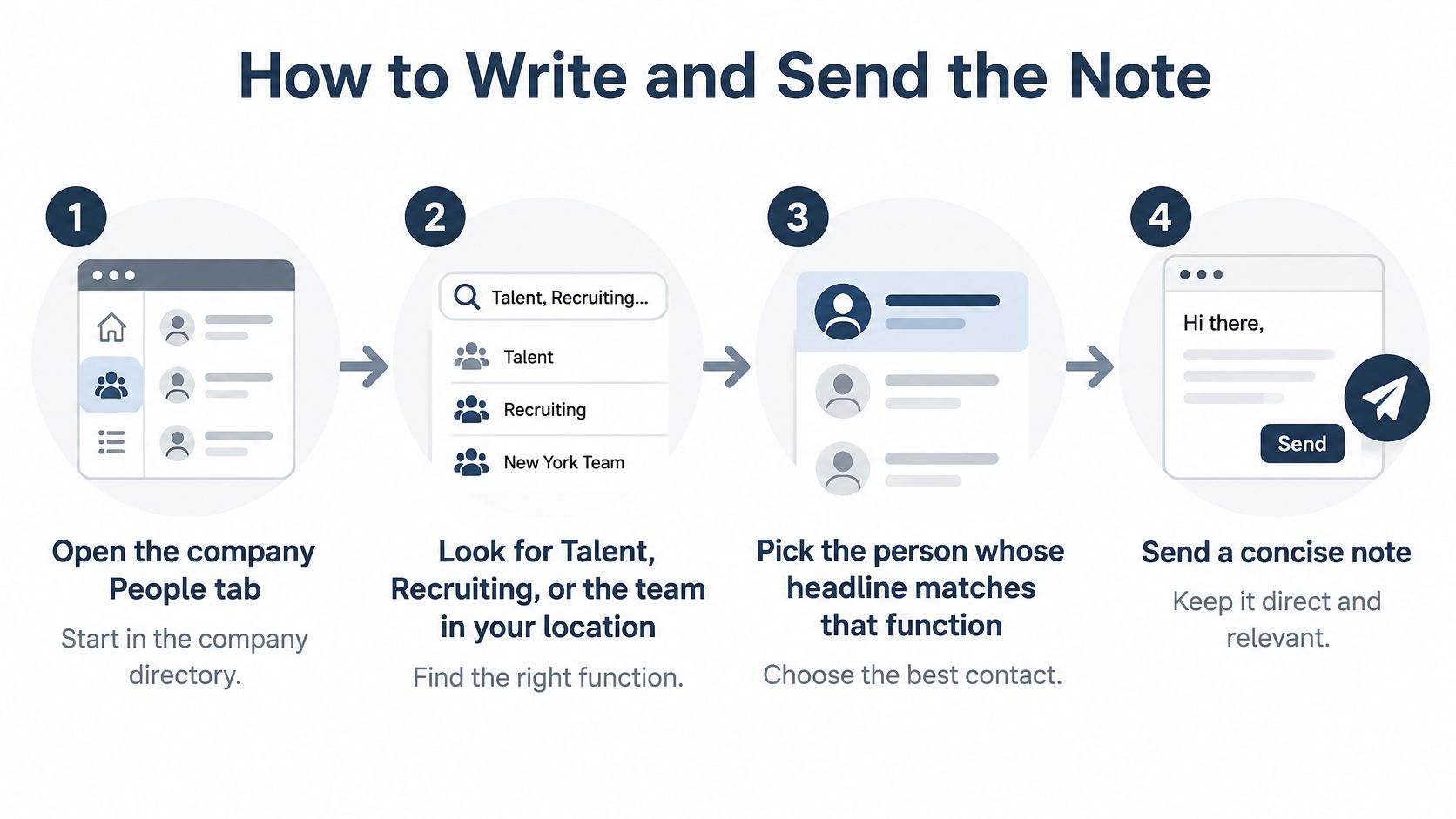
Find the owner and choose the channel
Open the company's People tab. Search for Talent, Recruiting, or the hiring function in your location. Choose the person whose headline matches the opening's team and level, rather than messaging a random employee with the right company name.
Read their About section and recent posts. Confirm that they appear to handle the relevant hiring area. Use a real vacancy or hiring post as context, not a personal detail unrelated to the job. If several recruiters seem plausible, select the closest match instead of contacting the whole desk.
Use the channel available to you. Message directly if you're already connected. Otherwise, use a connection-note box if LinkedIn shows one, staying within the limit displayed in your account. If there's no note box, connect and wait for acceptance before sending your message.
Use InMail when you already have access and the specific opportunity warrants direct outreach. Don't assume you need to purchase access just to ask about an opening.
Draft, check, and send
Write the four beats, then cut. Aim near 200 to 400 characters for a full initial message, while respecting any shorter channel limit. Keep the role, evidence, practical availability, and question; delete repeated interest statements. For an in-house recruiter, name the team. For an agency recruiter, ask which client the role serves when that hasn't been disclosed.
Add a subject only if the channel offers one. Use the role title plus your function, such as Customer Operations opening | Onboarding coordinator. If someone introduced you, Referral from [Name] gives useful context. Don't put a subject-style heading into an ordinary chat message.
Send during the recruiter's working week. Tuesday, Wednesday, or Thursday morning in their time zone is a practical routine, not a proven best hour. Before clicking send, check their name, the role title, your location statement, and whether the final question can be answered without opening an attachment.
Keep your profile and document consistent, especially if you're preparing a résumé from your LinkedIn profile. A different job title or unexplained date mismatch can distract from an otherwise clear message.
Connection requests aren't a loophole for bulk pitching. LinkedIn's professional-community guidance prohibits irrelevant, unwanted, excessively commercial, or repetitious outreach and says not to use invitations for promotional messages to people you don't know.
When a connection note is appropriate, keep it a relevant professional introduction: the role, a true result, and a light question. Don't paste an attachment-heavy résumé pitch across a recruiting team or try to bypass a recruiter's stated application instructions.
Follow Up Once Without Sounding Pushy
Send a single follow-up, then leave the unanswered thread alone. Waiting 5-7 days is a reasonable personal cadence, not a requirement or a guarantee of better results.
A follow-up should help the recruiter place your earlier message. It shouldn't ask them to explain their silence or read a new version of your life story.
When to write again and when to stop
| Touch | When | What to send | Stop when |
|---|---|---|---|
| First note | Tuesday to Thursday | The short situation note | They decline or say apply online only |
| One follow-up | 5-7 days later if silent | Two lines naming the role and the first note | No reply to this second note |
| Answer they asked for | As soon as you can the same week | Only the fact, link, or time they requested | The question is answered |
| Wrong-person check | Once, after they say it is not their role | A request for the right recruiter's name | You have asked once |
Make the reminder easy to place
A suitable follow-up might look like this:
Hi Maya, following up on my earlier note about the Customer Operations opening. Are you handling recruitment for that role?
There's no need to add guilt, artificial urgency, or a request for confirmation that they read it. If they decline, say not now, or direct you to apply online, acknowledge the answer and follow the stated process.
If they ask for availability, send availability. If they say they don't own the opening, ask for the right recruiter's name without restarting the whole pitch.
Resolve common stalls without escalating
- No answer after the reminder. Use the company careers page to apply or check the listing. Don't interpret silence as an invitation to contact everyone in the department.
- An immediate move to WhatsApp. Pause and recheck the sender and opportunity before continuing. Convenience isn't a reason to skip verification.
- Pressure to increase message volume. Keep messages manual and individually reviewed rather than installing a tool that sends invitations or messages on your behalf.
LinkedIn's User Agreement prohibits bots and other unauthorized automated methods for sending messages and adding contacts. A tool's availability doesn't establish that LinkedIn permits its use.
Keep a simple tracker in Google Sheets or Notion with the recruiter, company, role, sent date, follow-up date, and outcome. That's enough to prevent accidental duplicate messages and help you respect a closed conversation.
A quiet week doesn't establish that you're unqualified. It also doesn't justify another copy of the same paragraph.
Send One Strong Note This Week
Choose one live role posted within the last two weeks and one recruiter whose headline fits that team. This is a focused exercise, not a reason to build a mailing list.
Before drafting, confirm the sender's employment and locate the vacancy on the employer's careers page. Choose the situation that matches your relationship, then write with your own evidence rather than borrowing a sample's achievement.
Make the send small enough to finish
- Draft the relevant case. Name the role, use a genuine result, clarify practical availability, and end with an answerable question.
- Make room by cutting. Remove broad praise and background that doesn't help assess this opening.
- Set a stopping point. Send during the recruiter's workday and calendar the follow-up. If that also goes unanswered, leave the thread alone.
If a résumé needs to follow, use verified jobs and results that support the message. Read every line before attaching it, including any wording suggested by a writing tool.
After the opportunity looks legitimate, GetTheCall can help align your real experience with the listing's language and prioritize relevant evidence. Add a LinkedIn profile URL or upload an existing résumé; the job listing is optional, so you don't need to retype your history. Treat the output as a draft to review, not an interview promise: we don't guarantee interviews, callbacks, employment, compatibility with every applicant tracking system, or any particular result.
Send the note when it's accurate and clear. You don't need to make it sound impressive at the expense of making it true.
Bring your existing résumé or LinkedIn profile to GetTheCall to prepare a role-specific document using your real experience. Once you've verified the opportunity, use it to organize the evidence behind your recruiter message, review every suggested statement, and share a résumé you can confidently explain.