Executive Resume Formats: A 2026 Comparative Guide
Compare executive resume formats in 2026. Learn when to use chronological, functional, hybrid, or branded resumes and whichATS systems prefer most.
You've spent years building operating judgment, leading teams, managing risk, and delivering results. Then a carefully designed resume disappears into an application system, or a recruiter opens it and can't quickly tell what you owned. That experience is frustrating, but it's also diagnosable. The right executive resume format makes your scope easy to extract, verify, and understand before visual polish gets a chance to matter.
Table of Contents
- Why Executive Resume Format Matters More Than Design
- Comparing Executive Resume Formats at a Glance
- Reverse-Chronological Executive Resumes
- Functional Executive Resumes and Their Hidden Risks
- Hybrid and Branded Executive Resume Formats
- When to Choose Each Executive Resume Format
- Optimizing Executive Resumes for ATS and Human Reviewers
- Executive Resume Format Decision Framework
Why Executive Resume Format Matters More Than Design
Most executives don't fail because they lack credible experience. They lose consideration because the document makes that experience difficult for screening software or a busy reviewer to find. An executive resume is read by people, but it's often filtered by systems first.
Applicant tracking systems extract information into fields such as contact details, employment history, education, and skills. A conventional structure gives the parser clear signals, while columns, graphics, text boxes, and unusual headings can interrupt the reading order. ATS formatting guidance from Loopcv explains why standard headings and a plain single-column layout improve the odds of clean extraction.
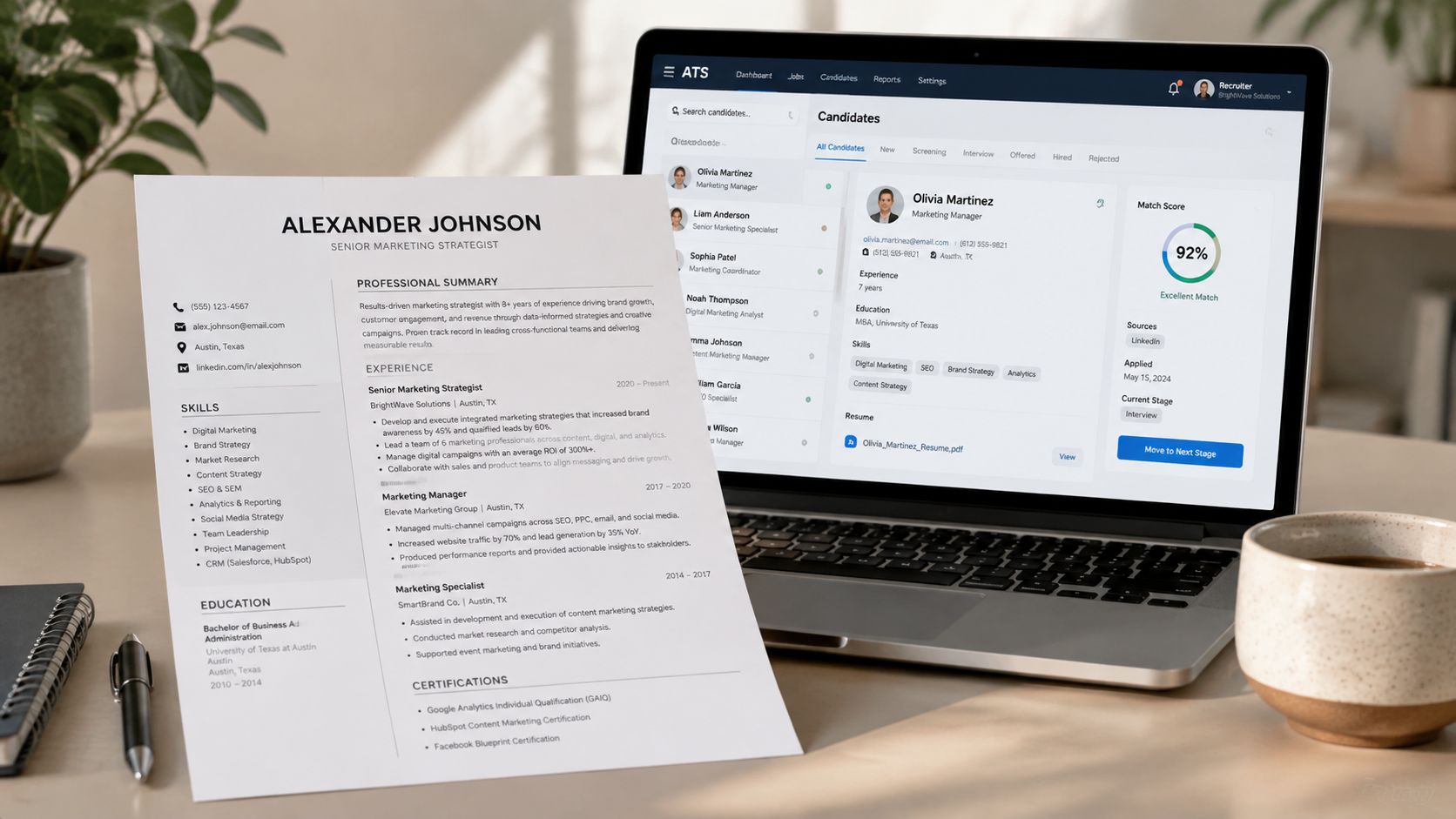
A polished document can still underperform if its most important evidence sits inside a visual element the system can't interpret. That matters even for senior searches. Search firms and employers may store resumes in databases, while direct applications can pass through an ATS before a person reviews them.
Evaluate format as a risk decision
Use three questions before choosing a template:
- Can software extract it: Are your name, contact information, dates, titles, employers, skills, and achievements in the main text flow?
- Can a recruiter verify it: Does the career sequence make your increasing scope clear without detective work?
- Can a hiring leader understand it quickly: Do the opening summary and recent roles establish the leadership problem you solve?
A 2026 hiring-insights report found that hiring managers rated text-based PDFs with no images or complex formatting at 53% and Word documents at 43% as the formats that work best with ATS software. Light-design PDFs scored 34%, while plain-text resumes scored 24%. The same report found that 75% of resumes are rejected by ATS before a human reviewer sees them. The report's resume-template guidance helps explain why executive formats increasingly favor conventional labels, readable fonts, and clean date sequencing.
Practical rule: Treat design as an enhancement to evidence, never as a substitute for evidence.
Comparing Executive Resume Formats at a Glance
The four formats below differ less in how attractive they look than in how they organize proof. A chronological document makes career progression obvious. A functional document puts capabilities first but can obscure the source of those capabilities. A hybrid structure combines an impact-led opening with a conventional employment history, while a branded format uses positioning language and curated sections to create a distinctive executive identity.
| Format | ATS Friendliness | Best For |
|---|---|---|
| Reverse-chronological | High when built in one column with standard headings | Executives with a clear progression and relevant recent leadership |
| Functional | Lower, particularly when skills replace employer-by-employer history | Limited situations where transferable capabilities genuinely outweigh chronology |
| Hybrid | High when the chronological core remains intact | Career transitions, portfolio leaders, and executives needing to foreground strategic impact |
| Branded executive | Variable, depending on restraint and structure | Senior leaders with a clear market position, board profile, or specialized leadership narrative |
The safest choice usually depends on the relationship between career evidence and target role. A chief financial officer applying for another finance leadership position generally benefits from making company, title, dates, and financial scope immediately visible. A fractional chief operating officer with several concurrent engagements may need a stronger opening capability section, but shouldn't erase the underlying chronology.
The format also needs to match the submission channel. A document sent directly to a retained search partner may receive close human review, while a file uploaded to an employer's application portal needs especially reliable parsing. That doesn't mean you need entirely different career stories. It means you may maintain a restrained search-firm version and an ATS-focused version when the context requires it.
What the table leaves out
No format can repair vague accomplishments. A reverse-chronological resume filled with responsibilities still leaves the reader asking what changed under your leadership. Conversely, a visually restrained hybrid resume can feel highly senior when its opening establishes P&L management, strategic planning, board governance, M&A, transformation, and measurable outcomes in context. Executive resume guidance from Introwhy emphasizes leadership and scope metrics rather than generic duties.
Reverse-Chronological Executive Resumes
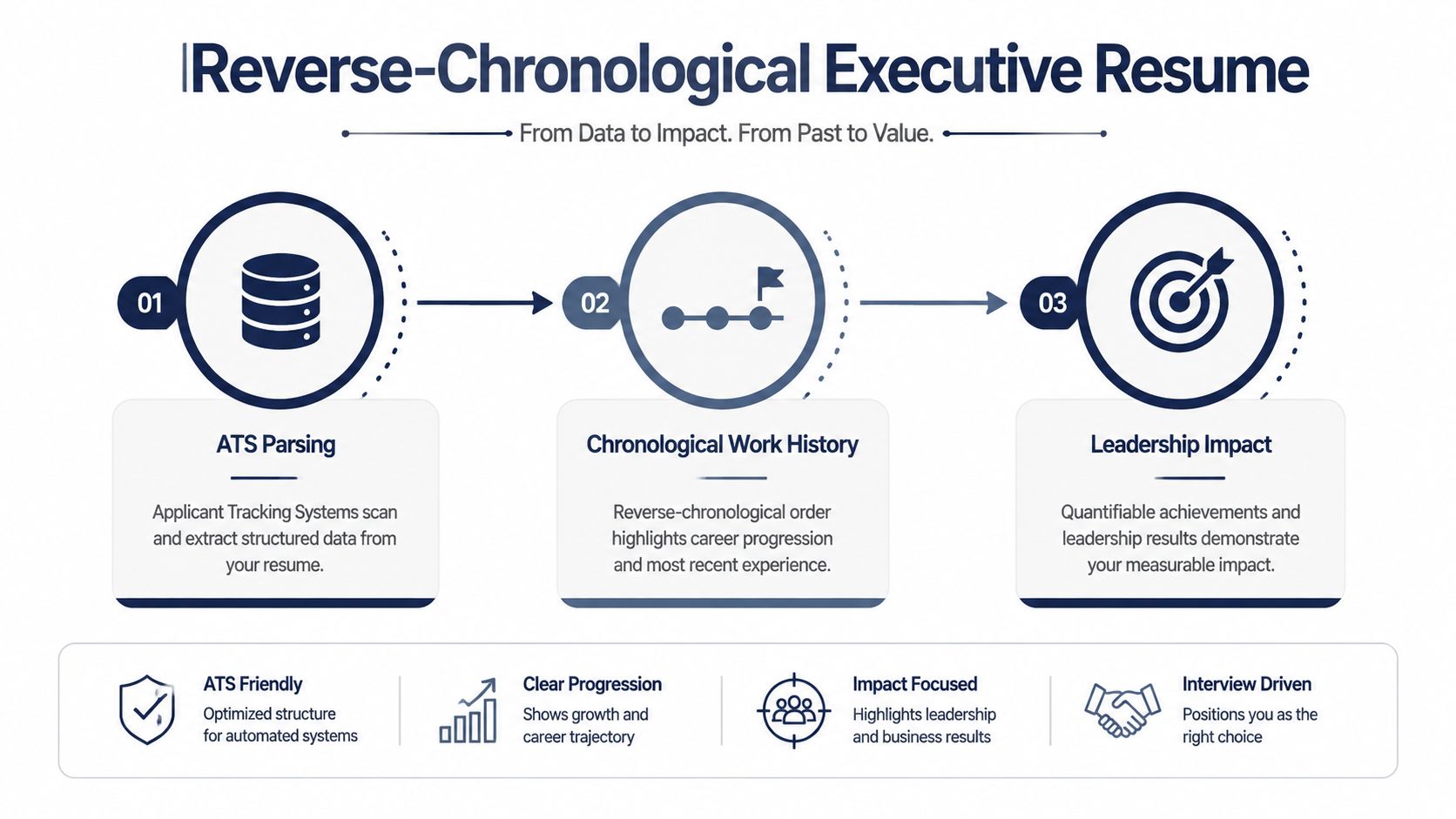
Reverse chronology places the most recent role first, followed by earlier positions in descending order. Each entry normally includes the employer, title, dates, location where useful, a concise scope statement, and accomplishment bullets. For executives, that sequence gives the reviewer a visible record of how responsibility expanded across businesses, functions, markets, and teams.
It also matches the way many ATS systems expect to find employment data. A 2026 ATS format test across Workday, Greenhouse, Lever, Taleo, and iCIMS found that a single-column reverse-chronological or hybrid resume with standard headings, a system font, and a text-selectable PDF parsed at 95% to 99% accuracy. The same test recommended 10–12 pt body text and literal labels such as Summary, Skills, Experience, and Education. The complete ATS format test provides the technical basis for keeping executive presentation polished but structurally simple.
Why conventional structure works
A conventional format reduces questions. The reviewer can see whether your recent role matches the target mandate, whether your scope is comparable, and whether your progression supports the level you're pursuing. It also gives keywords a clear home in the summary, skills section, and experience bullets.
Keep the opening focused on executive value, not a long biography. A strong structure might include:
- Executive headline: State the leadership lane and relevant domain.
- Summary: Connect scope, operating context, and the outcomes you're known for.
- Core skills: Use accurate terms from the target role, such as P&L management, board governance, M&A, or organizational transformation.
- Professional experience: Show scope and impact in the roles where that evidence was earned.
- Education and additional leadership: Include board, advisory, speaking, or certification information only when it supports the search.
Length should reflect complexity without becoming a career archive. A 2026 executive-resume guide recommends two pages for most executives, with three pages reserved for unusually complex backgrounds involving board roles or substantial published work. It also recommends a text-layered PDF or .docx, conventional section headers, and avoiding tables, charts, logos, headers, and footers because parsers may miss or garble them. The executive resume guide from CareerTuners outlines those constraints.
The reverse-chronological format isn't bland when the content is selective. It creates a clean frame for enterprise scope, leadership judgment, and outcomes.
Functional Executive Resumes and Their Hidden Risks
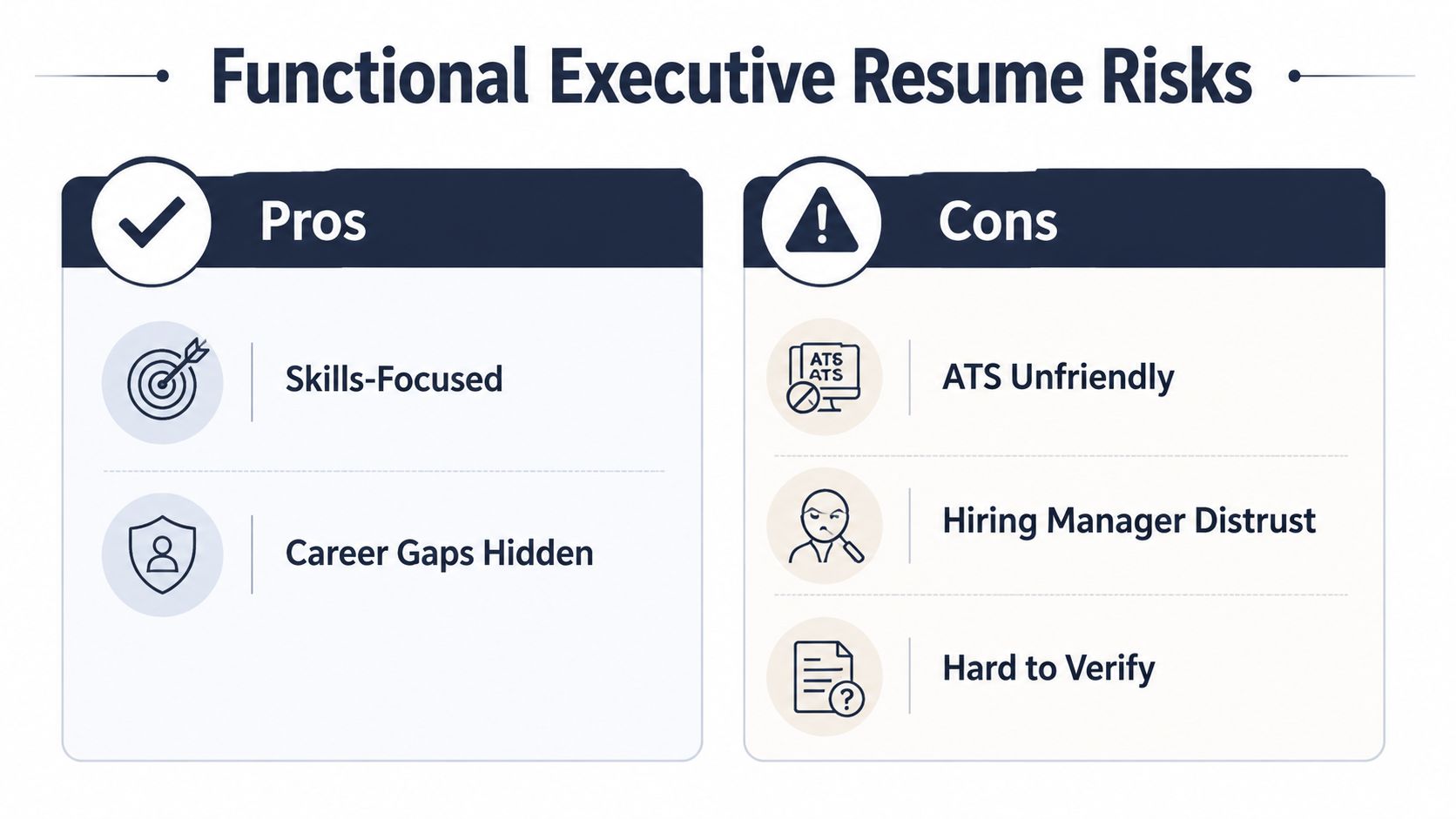
Functional resumes group experience by skills or capabilities instead of presenting a complete employer-by-employer timeline. That can appeal to executives with career gaps, a recent transition, or a portfolio of advisory work. The problem is that the format asks the reviewer to trust the narrative before showing where and when the claims were demonstrated.
The parsing risk is substantial. A 2025 blind-and-low-vision resume accessibility study reported that ATS systems correctly read 84% of resume content on average. Chronological and combination formats performed best at about 88% correct reading, while functional resumes performed worst at 55% correct reading. The accessibility study's resume findings make functional structures a poor default for senior candidates who need reliable extraction.
Why recruiters hesitate
A recruiter evaluating a senior leader needs to connect outcomes to context. “Turnaround leadership” means something different in a family-owned manufacturer, a venture-backed software company, and a public enterprise. Without clear employer, title, and date relationships, the reviewer may struggle to determine the scale, recency, and ownership behind each achievement.
Functional formats can also make a career gap more visible rather than less. If dates are vague or the timeline is compressed, the reader may spend attention trying to reconstruct it. That's an unnecessary credibility tax.
Use skill emphasis without abandoning chronology:
- Lead with capabilities: Put a concise Core Skills or Executive Expertise section near the top.
- Attach proof to roles: Repeat the relevant capability in the accomplishment bullet where you used it.
- Explain transitions briefly: Use a factual line for consulting, caregiving, study, or portfolio work where appropriate.
- Keep dates readable: Don't hide the sequence that establishes seniority and progression.
A functional format may have a narrow role in a carefully managed career-switch document, especially when transferable capabilities are central. Even then, a hybrid structure usually preserves more trust while allowing the new direction to appear early.
Hybrid and Branded Executive Resume Formats
A hybrid resume starts with a conventional chronological foundation, then layers an impact-oriented introduction above it. That opening might include an executive summary, selected leadership outcomes, core competencies, or a scope snapshot. The employment history still shows where the evidence belongs.
This approach suits leaders whose value doesn't fit a single title sequence. A fractional executive may have several concurrent clients. An interim leader may have short, high-intensity mandates. A board candidate may need operating history and governance experience to coexist. A hybrid structure can accommodate those realities without turning the document into a collection of disconnected highlights.
Build the hybrid in the right order
Start with the chronological core. Then add only the sections that help the target reader understand your fit:
- Leadership profile: Define the problems you solve and the environments where you've solved them.
- Selected impact: Choose a small group of outcomes that establish enterprise scope, transformation, financial stewardship, or growth leadership.
- Core competencies: Mirror accurate language from the job description, including terms such as strategic planning, stakeholder management, cross-functional leadership, or board governance.
- Portfolio experience: Separate board, advisory, speaking, and media work when those activities materially support the role.
- Professional experience: Preserve employer, title, date, and accomplishment relationships.
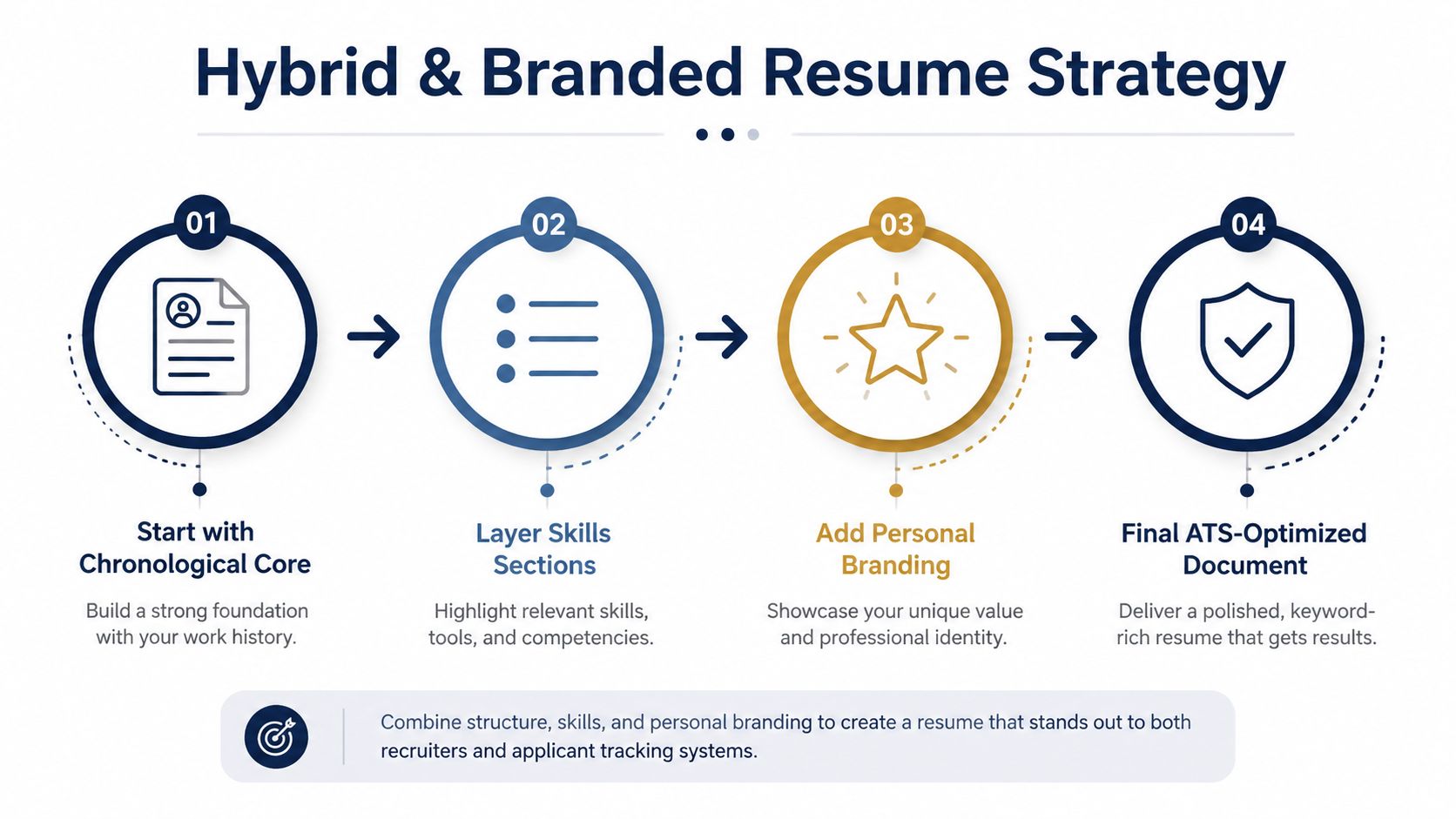
Branding should clarify positioning, not decorate the page. A headline such as “Technology Transformation Executive” can help when the target role values modernization, AI, remote or hybrid leadership, and digital fluency. It becomes counterproductive when it replaces recognizable job titles or relies on slogans that don't map to the posting.
Keep portfolio careers coherent
Give each type of work a clear label. “Board and Advisory Experience,” “Speaking and Media,” and “Fractional Leadership” are more useful than scattering those activities throughout the employment section. Use dates and concise descriptions so a human can understand the relationship between engagements.
A polished hybrid resume can still be ATS-safe if it uses one reading column, text-based content, conventional headings, and restrained visual hierarchy. The design should guide attention toward scope and outcomes, not force software to interpret a graphic composition.
When to Choose Each Executive Resume Format
Format selection becomes easier when you start with the hiring situation rather than a template gallery.
Traditional corporate advancement: Choose reverse chronology when your recent roles clearly match the next mandate. Put current scope, enterprise responsibilities, and outcomes near the top, then use earlier positions to show progression.
Portfolio or fractional leadership: Choose a hybrid structure. Group ongoing fractional, interim, board, and advisory work clearly, but retain dates and client or organization context. The reader should see a coherent leadership practice rather than a fragmented list.
Career switch: Use a hybrid format that leads with transferable capabilities and relevant outcomes. Keep the full employment history underneath so the change looks intentional, not concealed. Accurate keywords from the target role belong in the summary and skills section, not only in a separate keyword block. This guide to tailoring a resume to a job description can help you map existing evidence to the language of a specific opening.
Return to work: Avoid a purely functional resume. Explain the transition in a short, neutral line and use a combination structure to connect prior leadership with current readiness.
Specialized executive search: Use the format that makes the required proof easiest to verify. A CFO should make financial transformation, capital markets, risk, and board reporting visible. A CTO should connect technology strategy to organizational and business outcomes. A CEO should establish enterprise vision, P&L stewardship, growth, and stakeholder leadership.
The submission channel matters, too. If a search partner asks for a board-focused document, a separate board addendum may be appropriate. For a direct application, prioritize machine-readable structure and a text-selectable file.
Optimizing Executive Resumes for ATS and Human Reviewers
A strong executive resume serves two readers in sequence. The ATS needs recognizable structure and searchable language. The hiring leader needs a credible account of judgment, scope, and results.
Begin with the job description. Identify the exact terms that accurately describe your background, then place them naturally in three locations:
- Summary: Establish the leadership identity and the most relevant operating context.
- Skills: Create a scannable set of capabilities using conventional language.
- Experience bullets: Prove each capability through an outcome, decision, or transformation.
LinkedIn's resume keyword guidance recommends mirroring the posting's language where it's accurate and using keywords in the summary, skills, and accomplishment bullets rather than relying on visual elements.
Make seniority visible
Executives shouldn't write bullets that merely list activity. Show the decision you made, the scale you controlled, and the result that followed. Useful evidence may include revenue, budget, team size, margin impact, P&L ownership, acquisition integration, board exposure, or organizational transformation. Only use figures you can defend and explain in an interview.
Keep section titles conventional. “Professional Experience,” “Key Skills,” “Education,” and “Board Experience” are clearer to software and people than clever alternatives. Put contact information in the main body, not a header or footer, and avoid logos, charts, text boxes, decorative graphics, and complex columns.
File choice deserves a final check. This ATS-friendly resume guide covers practical safeguards such as readable structure, keyword alignment, and text extraction. Before submitting, select the text in your PDF and paste it into a plain document. If the order is scrambled or content disappears, revise the source file.
GetTheCall is one option for this workflow. It can import a LinkedIn profile or existing resume, parse a target job listing, generate job-specific content from verified experience, show a live role match score, and export an ATS-ready PDF through professionally designed layouts.
Executive Resume Format Decision Framework
Use this sequence before you send an application:
- Name the hiring channel. Direct application, recruiter database, referral, and executive search each create different review conditions.
- Check the career shape. Clear progression favors reverse chronology. Mixed portfolio work often calls for a hybrid.
- Test the narrative. Your first page should make the target role, leadership scope, and strongest relevant outcomes obvious.
- Audit extraction. Confirm that dates, titles, employers, contact details, skills, and achievements appear in a clean text order.
- Remove decorative risk. If an element doesn't improve comprehension, take it out.
- Tailor the language. Match accurate job-description terms without stuffing keywords or claiming experience you don't have.
If the document looks impressive but hides chronology, it's the wrong format. If it parses cleanly but reads like a task list, the structure is safe but the positioning is weak. Use the GetTheCall ATS resume checker to identify parsing and keyword issues before a real submission exposes them.
GetTheCall can turn a LinkedIn profile or existing resume into a job-specific, ATS-optimized document with keyword alignment, live match scoring, professional layouts, and PDF export. Visit GetTheCall to test your executive resume against the role you're targeting and make the next application easier to evaluate.