7 Event Organizer Resume Samples for ATS Success
Explore 7 ATS-friendly event organizer resume samples with annotated bullets, keyword mapping, and practical tailoring tips.
You've handled venue changes, negotiated with suppliers, and kept an event moving when the schedule slipped. Yet your resume still reads like a list of tasks, and a recruiter can't quickly see the scale of your work or the decisions you owned. You don't need more impressive adjectives. You need an event organizer resume sample that matches your experience and makes the relevant evidence easy to find.
A corporate conference planner, wedding business owner, and festival coordinator shouldn't submit interchangeable resumes. Their strongest evidence differs, from budget control and client relationships to production schedules, donor engagement, and exhibitor operations. Choose your starting point by industry, event scale, career stage, and the results you can substantiate.
Treat event organizing as full-cycle work, not just day-of logistics. The Bureau of Labor Statistics' event-planner occupational profile describes responsibilities spanning client consultation, venues, supplier bids, costs, registration, on-site monitoring, payments, and post-event feedback.
The samples below give you practical structures and adaptable wording. Replace the example language with your actual responsibilities and verified results, then align the document with the job you're applying for.
Table of Contents
- 1. Corporate Event Planner Resume (Reverse-Chronological)
- 2. Wedding and Social Event Planner Resume
- 3. Festival and Concert Production Coordinator Resume
- 4. Nonprofit Fundraising Gala and Events Manager Resume
- 5. Entry-Level Event Coordinator Resume for Students and Recent Graduates
- 6. Career Switcher Event Management Resume (Hybrid/Functional Format)
- 7. Trade Show and Conference Operations Manager Resume
- 7 Event Organizer Resume Samples Compared
- Tailor One Strong Resume for Every Event Role
1. Corporate Event Planner Resume (Reverse-Chronological)
Lead with your most recent position when you're moving between corporate event roles. Put the employer, job title, location, and dates together, then use accomplishment bullets to show conferences, product launches, retreats, or client meetings you delivered.
Keep the presentation restrained and the work history prominent.

A useful section order is Summary, Experience, Skills, Certifications, Education. Recruiters can follow your progression without reconstructing a timeline, while plainly labeled jobs and dates give an applicant tracking system, or ATS, readable information to extract.
Show Commercial Judgment, Not Just Coordination
For a sales conference, explain what you owned beyond booking rooms. Include agenda development, speaker logistics, audiovisual coordination, procurement, and budget reconciliation where they formed part of your role.
Adaptable bullet wording
- Conference delivery: Coordinated an annual sales conference, managing venue requirements, speaker schedules, supplier contracts, and budget reconciliation.
- Attendee experience: Revised session scheduling using registration demand and post-event feedback to address capacity problems.
- Financial control: Negotiated supplier proposals against the approved budget and documented purchasing decisions.
Strengthen these with records-backed attendance, budget, vendor counts, or satisfaction results. ProRes' event-planner resume guidance identifies event size, budgets, revenue, satisfaction, attendance improvement, and event volume as useful evidence of impact.
Mirror terms such as run-of-show, vendor negotiation, or request for proposal (RFP) when they accurately describe your work. Use the guide to tailoring a resume to a job description to connect the listing's language with your strongest experience, rather than inserting unsupported keywords.
Before submitting, check that the exported file preserves headings, employers, dates, and bullet order. Clear structure matters more than decorative branding.
2. Wedding and Social Event Planner Resume
Running weddings or private celebrations requires more than creative taste. Present yourself as someone who manages client expectations, contracts, budgets, suppliers, and delivery from consultation to completion.
For independent work, name your business clearly and include your role and dates of operation. Don't leave a recruiter guessing whether “wedding planning” describes a business, occasional volunteering, or a personal interest.
Your portfolio can show the finished event, while your resume explains your contribution.
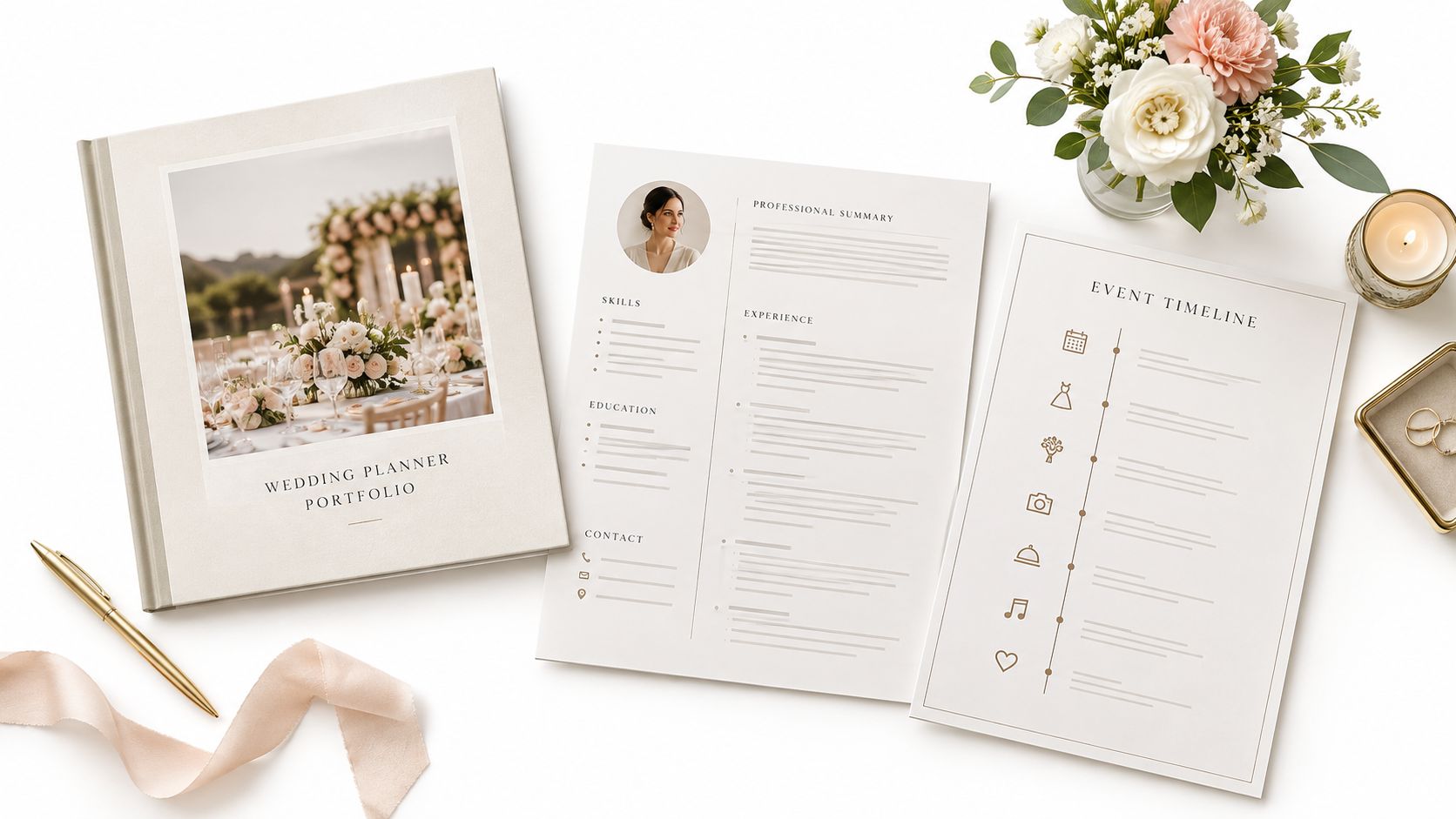
Make Full-Cycle Ownership Visible
A strong summary names the events you specialize in and the operational responsibilities you bring. For example, describe wedding and social-event experience covering client consultation, vendor selection, budget tracking, production timelines, and day-of coordination.
Under Experience, use language you can substantiate:
- Client management: Translated client priorities into an event plan, supplier brief, budget, and approval schedule.
- Vendor relationships: Maintained a preferred supplier network and coordinated availability, contracts, delivery requirements, and payments.
- Contingency planning: Prepared weather alternatives and communicated revised arrangements to clients, venues, and production teams.
Add verified event volume, sourcing improvements, or client feedback where your records support them. If you're applying to a corporate role, emphasize stakeholder communication, budget management, procurement, and risk planning instead of relying on wedding-specific terminology.
Portfolio rule: Show the finished work, but explain what you personally managed. Attractive photographs don't establish budget ownership or operational responsibility.
Keep your portfolio link short and readable, and make sure its projects match your resume claims. Follow the ATS-friendly resume guide for the application document; reserve elaborate visuals and styling for the portfolio.
3. Festival and Concert Production Coordinator Resume
A delayed supplier delivery, changed performance schedule, or missing crew member gives you a better resume story than “worked well under pressure.” Describe the disruption, your response, and the delivery outcome.
Use a straightforward document even when the production environment is visually creative.
For festivals, concerts, sporting events, and public gatherings, prioritize crew coordination, production schedules, permits, safety responsibilities, and supplier communication. Put relevant certifications near the top when they're important to the vacancy, including accurate issue dates and current status.
Translate Production Experience Into Readable Evidence
Group seasonal assignments under the same employer when appropriate, but retain the assignment dates and distinguish your responsibilities. Use load-in and load-out scheduling, then explain that this involved coordinating equipment arrival, installation, and removal if you're applying outside live entertainment.
Adaptable example: Coordinated production crews and supplier arrivals, revised the setup schedule following a delivery delay, and communicated updated readiness requirements to stage leads.
Add verified crew size, attendance, stage count, or schedule performance rather than broad claims about working on “large events.” Make responsibility boundaries clear: supporting safety documentation isn't the same as owning event-wide compliance.
For another presentation reference, use the video below alongside your own experience records.
Keep schedules and credentials in plain text, not graphic panels. In a 2023 test of 10 ATS platforms cited by ATSChecker's formatting guide, complex layouts caused data loss in 4 systems, while single-column Word or Google Docs exports parsed correctly in all 10.
Use the ATS resume checker to flag parsing and keyword issues, then inspect the exported document yourself.
4. Nonprofit Fundraising Gala and Events Manager Resume
Start with the mission, then prove the delivery. A nonprofit events summary should identify your fundraising or association-event experience and connect it to donor relationships, sponsorship, volunteer coordination, and responsible budget use.
Keep the summary specific to your background. Don't copy an organization's mission statement and present it as evidence of your own contribution.
A gala resume should explain the work behind the polished setting.

Separate Fundraising Results From Operating Responsibilities
Use a reverse-chronological work history with fundraising outcomes first, followed by sponsor management, donor communications, volunteer leadership, and event operations. If you supported revenue generation without owning fundraising strategy, say so clearly.
Adaptable accomplishment language
- Gala management: Led gala planning across venue coordination, supplier procurement, guest communications, and event-day delivery.
- Sponsor stewardship: Coordinated sponsor benefits, branding approvals, attendance arrangements, and post-event reporting.
- Volunteer leadership: Recruited and briefed volunteers, assigned guest-service responsibilities, and managed shift handovers.
Specify whether a fundraising figure represents gross proceeds, net proceeds, pledged support, or collected revenue. If you claim staffing savings, identify the comparison and calculation behind them.
Explain the conditions behind the result. A first-time fundraiser or a tightly constrained budget gives a hiring panel useful context for evaluating your contribution.
Use donor stewardship, sponsorship, and volunteer coordination where the vacancy and your experience align. Keep these terms in readable text and support them with actions, not just a skills list.
Include sustainability or accessibility work when you can describe an actual decision, such as reusable production materials or revised guest-access arrangements. The UK events industry's autumn recruitment report identifies experienced-talent availability as a continuing challenge; demonstrate your practical capabilities instead of relying on inflated soft-skill claims.
5. Entry-Level Event Coordinator Resume for Students and Recent Graduates
Your campus showcase, volunteer fundraiser, or internship can demonstrate genuine planning responsibility. Label the experience and explain what you personally handled, rather than presenting participation as event ownership.
Use Education, Projects, Campus Leadership, Experience, and Skills in an order that makes your strongest evidence easy to find. Keep paid employment under Experience and use clearly named sections for unpaid projects.
Education deserves visible space when you're starting out. BLS occupational-requirements data reports that a bachelor's degree was required for 53.9% of meeting, convention, and event planner positions, supporting a clear education section without replacing practical evidence.
Turn a Campus Event Into a Credible Project
For a career fair, identify the organizing group, your role, and the dates. Then explain employer outreach, registration, room allocation, volunteer assignments, or attendee communications, according to what you did.
Adaptable project bullets
- Partner outreach: Coordinated employer invitations and tracked participation confirmations for a campus career fair.
- Registration support: Maintained attendee records and prepared check-in materials for the event team.
- Event logistics: Organized room assignments, volunteer briefings, and supplier arrival instructions.
Replace general wording with figures from registration records, budgets, meeting notes, or attendance reports. Indeed's event-planner resume guidance illustrates quantified experience with 10 events averaging 200 guests; use that structure, not those figures, unless they match your records.
Evidence standard: Use an estimate only when you can explain how you calculated it. If the records aren't reliable, describe the scope without adding a number.
Tailor each application by rebuilding your most relevant project bullets first. Use plain headings and chronological project dates so recruiters can distinguish your education, employment, and leadership activities without ambiguity.
6. Career Switcher Event Management Resume (Hybrid/Functional Format)
You don't need to pretend your previous job was an event role. A hospitality manager, teacher, retail supervisor, customer-service professional, or military candidate can show relevant planning experience while preserving an accurate career history.
Choose a hybrid format rather than a purely functional resume. Begin with a concise summary and relevant skills, then connect those skills to evidence under identifiable employers and dates.
Explain the Transition With Confidence
A restaurant manager's summary might emphasize scheduling, supplier coordination, budget responsibility, and guest-service operations. A teacher's version can emphasize program planning, audience communications, facilities coordination, and managing changing schedules.
Keep the explanation brief and forward-looking. You're showing why your experience fits the work, not apologizing for your previous title.
- Operations management: Explain how you coordinated staff, suppliers, facilities, and deadlines in your original role.
- Financial responsibility: Distinguish budget ownership from purchasing support or invoice processing.
- Stakeholder communication: Describe the audiences you served and how you communicated changing requirements.
Adaptable example: Coordinated school-wide programs, aligning facilities, staff assignments, family communications, and delivery schedules.
Use a Relevant Experience section when it helps foreground event-related work, but include the employer, actual title, and dates with each entry. Retain a clear employment history rather than scattering undated accomplishments beneath skill labels.
This comparison provides a visual reference for how career stage can change emphasis.
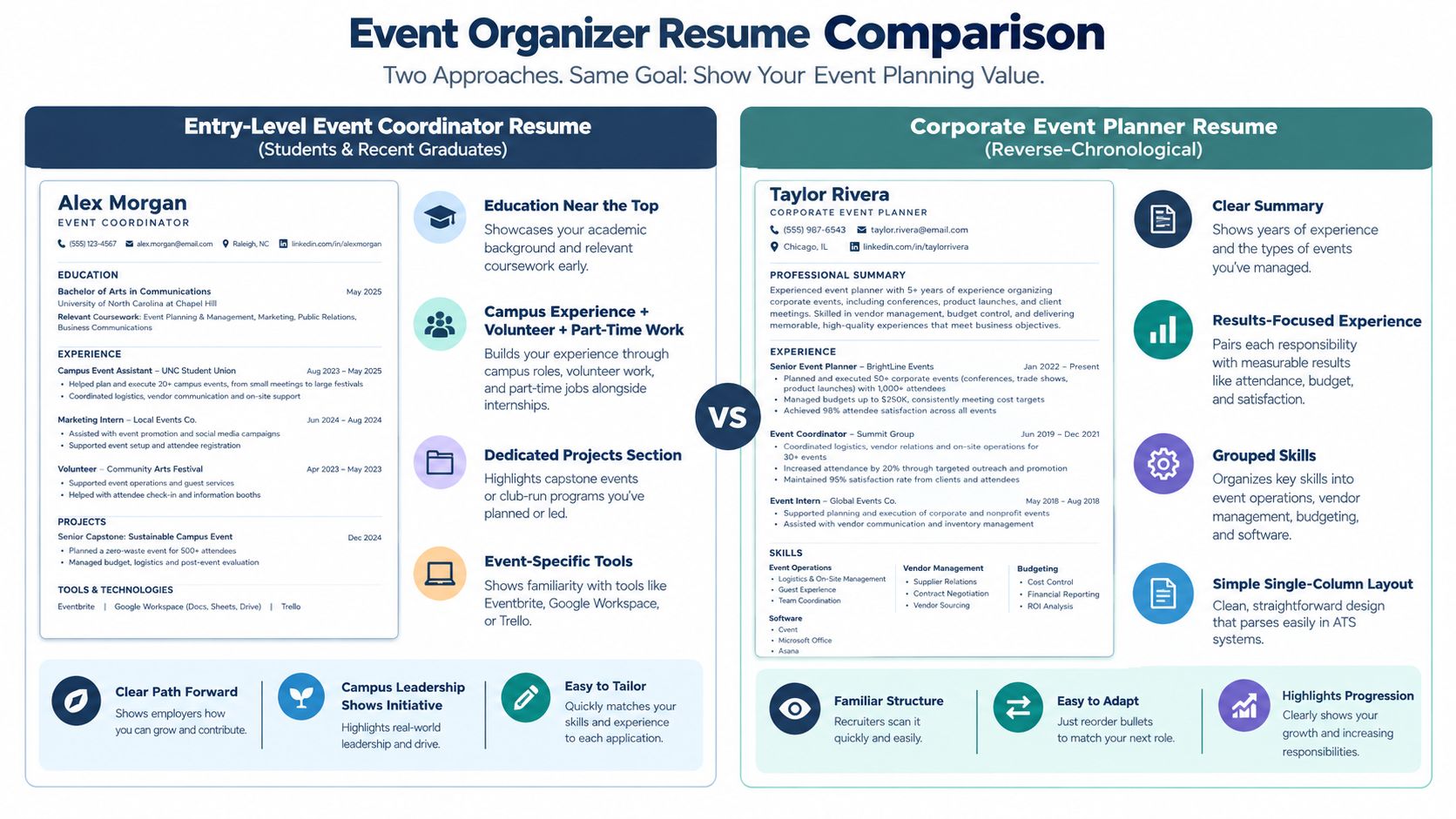
For recruiter review, make the transfer explicit: connect scheduling to event timelines and supplier management to vendor coordination. For ATS readability, keep official job titles intact and place relevant event terminology in the summary, skills, and supported bullets.
Don't relabel yourself as an event manager before you've held that responsibility. Demonstrate readiness through credible examples instead.
7. Trade Show and Conference Operations Manager Resume
Exhibitor services, registration systems, and on-site operations should lead this resume. For mid-career association or agency roles, show how you coordinated exhibitors, suppliers, venues, and attendee-facing teams across the event lifecycle.
Summarize travel-heavy responsibilities by city, region, or operating territory where relevant. Don't turn the experience section into an itinerary that obscures your actual responsibilities.
Prove System Ownership and Delivery Scale
Use a reverse-chronological structure with a focused technical skills section. Name the registration, virtual-event, or exhibitor-management platforms you used, then explain your work with them in the experience section.
Adaptable operational evidence
- Exhibitor services: Managed exhibitor communications, booth requirements, supplier handoffs, and setup-readiness tracking.
- Registration operations: Configured registration workflows, briefed check-in staff, and resolved attendee access issues.
- Conference delivery: Coordinated session schedules, speaker requirements, room readiness, and on-site escalation procedures.
Add supported booth counts, event duration, setup milestones, or check-in improvements. For any improvement claim, preserve the baseline and explain how you measured the result.
Digital delivery deserves more than a software name. The Events Industry Council's discussion of future event talent identifies phygital management, integrating physical and digital delivery, as an emerging source of demand.
If you supported a hybrid conference, specify platform administration, livestream coordination, remote speaker preparation, audience communications, or troubleshooting. Distinguish software familiarity from ownership of an operational workflow.
Spell out acronyms on first use and keep platform names in plain text. Recruiters can then assess your responsibilities alongside your technical knowledge, while ATS software has readable terms to extract.
End each major role with evidence of evaluation where available: registration analysis, exhibitor feedback, supplier review, or recommendations for the next event. This shows you didn't stop contributing when the venue closed.
7 Event Organizer Resume Samples Compared
| Resume Example | Implementation Complexity | Resource Requirements | Expected Outcomes | Ideal Use Cases | Key Advantages |
|---|---|---|---|---|---|
| Corporate Event Planner (Reverse-Chronological) | 🔄 Low; standard, ATS-friendly layout | 📊 Dates, event metrics, budgets, and software skills | ⭐ Clear career progression and measurable results | Corporate event roles and applicants with relevant work history | ⚡ Quick recruiter scanning; easy to tailor |
| Wedding and Social Event Planner | 🔄 Moderate; foreground client work and full-cycle ownership | 💡 Client results, vendor network, business dates, and portfolio | 📊 Demonstrates event delivery, client relationships, and repeat business | Wedding, agency, and venue roles | ⭐ Highlights entrepreneurship and end-to-end planning |
| Festival and Concert Production Coordinator | 🔄 Moderate; organize seasonal work, scale, and certifications | 📊 Crowd, crew, stage, safety, and schedule details | ⭐ Shows operational discipline and large-event experience | Festivals, concerts, sporting events, and live production | ⚡ Certifications and scale metrics establish credibility |
| Nonprofit Fundraising Gala and Events Manager | 🔄 Moderate; connect event results to mission | 📊 Funds raised, sponsorships, donor engagement, and volunteer data | ⭐ Makes fundraising and community impact measurable | Nonprofits, associations, and corporate social responsibility roles | 💡 Strong evidence of relationship-building and resource stewardship |
| Entry-Level Event Coordinator | 🔄 Moderate; build experience from projects and campus roles | 💡 Education, internships, volunteer work, projects, and tools | 📊 Shows practical event responsibility despite limited work history | Students and recent graduates | ⭐ Makes leadership and transferable skills visible |
| Career Switcher Event Management (Hybrid/Functional) | 🔄 Moderate to high; link skills to examples and retain work history | 💡 Transferable skills, specific outcomes, dates, and relevant training | 📊 Reframes prior experience for event roles while preserving transparency | Career changers and return-to-work candidates | ⭐ Brings relevant skills forward without hiding employment history |
| Trade Show and Conference Operations Manager | 🔄 Moderate; organize systems, logistics, and multi-city work | 📊 Exhibitor, booth, registration, platform, and vendor metrics | ⚡ Demonstrates operational scale and systems efficiency | Association, trade-group, and event agency roles | ⭐ Quantifiable experience supports ATS matching and recruiter review |
Tailor One Strong Resume for Every Event Role
Choose the sample closest to your real experience, then tailor it to the vacancy. Keep a stable career history and change the emphasis, terminology, and order of your strongest accomplishments rather than rebuilding your background for every application.
Start with the employer's priorities. A wedding venue needs different proof from a trade show organizer, and a fundraising role needs different evidence from a corporate conference position. Select the accomplishments that answer those priorities directly.
Keep a separate record of event details, budgets, attendance, suppliers, feedback, and your responsibilities. That makes tailoring easier and helps you defend every claim in an interview.
Build Around Truthful Evidence
- Preserve accuracy: Keep official titles, employers, dates, qualifications, and responsibility boundaries correct.
- Match relevant language: Use the listing's event types, operational terms, and systems only where they fit your experience.
- Prioritize proof: Rebuild the most relevant bullets before polishing the summary or choosing a layout.
- Verify the export: Copy the PDF into a plain-text editor and check contact details, headings, dates, and bullet order.
Keyword alignment isn't a substitute for evidence. Listing “budget management” helps identify a capability, but explaining what you controlled gives a recruiter something to evaluate. The same applies to sustainability, crisis response, donor stewardship, and digital-event operations.
GetTheCall offers a practical way to manage that workflow. You can import an existing resume or LinkedIn profile, analyze the target listing, and refine content mapped to your actual experience. Its role-match scoring, layout options, and PDF export let you review alignment and presentation without rebuilding the document by hand.
Treat automated suggestions as drafts that require your approval. Check that rewritten bullets preserve the original scope, don't imply unsupported ownership, and sound like work you can explain confidently.
Your finished resume should make the fit clear to a recruiter and keep the information readable for an ATS. It can't guarantee an interview, but it can give employers a clear, credible account of the event work you're ready to deliver.
GetTheCall helps turn an existing resume or LinkedIn profile into a job-specific resume with keyword guidance, role-match scoring, and PDF export. Visit GetTheCall, import your career history, and tailor the event organizer sample that best matches your next application.