Entry Level Sales Roles and ATS Resume Tips
Discover what entry level sales roles involve, the top skills to highlight, and how to build an ATS-friendly resume that gets you interviews.
You've refined your résumé, submitted the application, and still heard nothing. That silence can feel personal, especially when an entry level sales posting seems to describe work you could handle. Often, though, the first barrier isn't a recruiter's judgment. It's whether an Applicant Tracking System can read your file and recognize your experience in the language used by the employer.
Entry level sales remains accessible, but it isn't effortless. The strongest candidates understand both sides of the process: what sales teams measure and how hiring software sorts applications. Once you learn to translate customer service, retail, hospitality, campus projects, or career-change experience into terms such as prospecting, lead qualification, and CRM hygiene, your background becomes easier to evaluate.
Table of Contents
- What the Entry Level Sales Market Looks Like Right Now
- What the Job Actually Involves
- Core Skills and Keywords to Highlight
- How ATS Filters Read Your Resume
- Writing Bullets That Pass the Screen
- Your Application Workflow, Step by Step
What the Entry Level Sales Market Looks Like Right Now
You can find an entry level sales posting that seems within reach, submit your application, and still compete with many candidates for one opening. Recent hiring coverage describes a more selective market, with fewer entry-level postings and more applications per role. It also points to employers considering career changers who can show resilience, adaptability, and the ability to learn. Recent sales recruitment coverage from Meritt raises another practical question: is a degree still required? Increasingly, employers are weighing performance history, learning ability, and adaptability alongside formal education.
The field itself remains large. In the United States, sales and related occupations employed 13,380,660 workers in 2023, with a mean annual wage of $53,280 and a mean hourly wage of $25.62, according to U.S. Bureau of Labor Statistics occupational employment data. The same category grew from 13,120,320 workers in 2020 to 13,380,660 in 2023. Pay and responsibilities still vary widely by role, industry, and seniority.
That variation changes how you should read job titles. Wholesale and manufacturing sales representatives numbered 311,780 in 2023 and earned a mean annual wage of $113,520, while the broader sales group had a median annual wage of $38,530 in May 2025, as reported in the same BLS dataset. Entry level sales may involve retail, general sales, insurance, real estate, inside sales, or a later move toward B2B and technical selling. One title cannot describe the entire field.
Why openings continue despite a selective funnel
The U.S. Bureau of Labor Statistics projects about 1.7 million openings per year across sales occupations during 2025–35, even though total employment in the category is projected to decline during that period. The BLS explanation of sales employment and replacement demand connects those continuing openings largely to replacement needs.
The result is a high-churn market with a selective hiring process. Employers need people who can learn quickly, recover from rejection, follow a repeatable process, and maintain consistent activity. Treat each application like a translation task: connect your past work to the results and behaviors the posting names, then use those same terms where they accurately describe your experience.
What the Job Actually Involves
An entry level sales representative often works in the engine room of revenue. You may not close complex deals immediately. Instead, you create the qualified conversations that allow more senior representatives to sell, while keeping accurate records so the team knows what happens next.
A typical workflow starts with research. You identify prospects, review their company or customer profile, and decide whether they fit the target market. You then use outbound calling, email, or other approved channels to introduce the solution and test whether a genuine business need exists.

The daily mechanics
The role usually revolves around a repeatable sequence:
- Research accounts or leads: Find relevant contacts and understand the context before reaching out.
- Start conversations: Make calls, send messages, and explain the reason for contacting someone.
- Qualify interest: Ask questions about needs, timing, authority, and fit.
- Handle objections: Respond when a prospect says they're busy, satisfied with a current provider, or unsure about the value.
- Book appointments: Schedule a discovery call, demonstration, or conversation with an Account Executive.
- Update the CRM: Record contact details, outcomes, follow-up dates, and qualification notes.
- Manage follow-ups: Continue appropriate outreach instead of allowing promising leads to disappear.
The CRM is not administrative decoration. It's the team's shared memory. If you record a conversation inaccurately or forget a follow-up, another representative may repeat the same question or miss a live opportunity. Employers may therefore look for signs of CRM hygiene, organization, and reliable follow-through.
Job titles differ, so read the responsibilities carefully. An SDR or BDR listing may emphasize prospecting and appointment setting, while an inside sales role may include demonstrations, proposals, or more of the closing process. A useful example to study is this IKEA sales manager job listing template, especially for how sales responsibilities can be expressed through customer needs, activity, and outcomes.
Core Skills and Keywords to Highlight
Many candidates say, “I haven't worked in sales.” That may be technically true, but it doesn't mean you lack relevant evidence. A server who recommends menu options, a retail associate who handles objections, or a student who recruits participants for an event has already practiced parts of the sales process.
The résumé challenge is translation. “Helped customers” is understandable but broad. “Identified customer needs, recommended suitable products, and resolved objections” gives a sales team a clearer picture of your behavior.
Build a focused term map
Start with the job description and select the most relevant language. ATS guidance recommends prioritizing roughly 15 to 25 relevant skills or terms, rather than filling the résumé with every sales buzzword. Resume keyword guidance for emerging AI-driven job descriptions emphasizes that terms should appear in context and reflect real evidence.
Useful entry level sales terms can include:
- Outbound calling: Use this when you made proactive calls to customers, members, donors, or prospects.
- Lead generation: Apply it to recruiting participants, finding prospective buyers, or creating inquiries.
- Lead qualification: Use it when you assessed needs, eligibility, budget, timing, or fit.
- Appointment setting: Include it when you scheduled consultations, demonstrations, meetings, or service visits.
- Objection handling: Connect it to resolving concerns about price, availability, policy, or product suitability.
- CRM hygiene: Mention accurate records, follow-up notes, contact updates, or pipeline maintenance when you've used a CRM or comparable tracking system.
- Pipeline management: Use it when you monitored prospects through stages and maintained next actions.
- Quota support: Include it only when your work contributed to a defined team target or sales objective.
A strong summary might connect your background to the target role without exaggeration: “Customer-facing professional with experience in needs discovery, objection handling, appointment setting, and accurate customer records.” If you've used Salesforce, HubSpot, or another CRM, name the tool. If you haven't, don't claim it. Describe the comparable process you performed.
How ATS Filters Read Your Resume
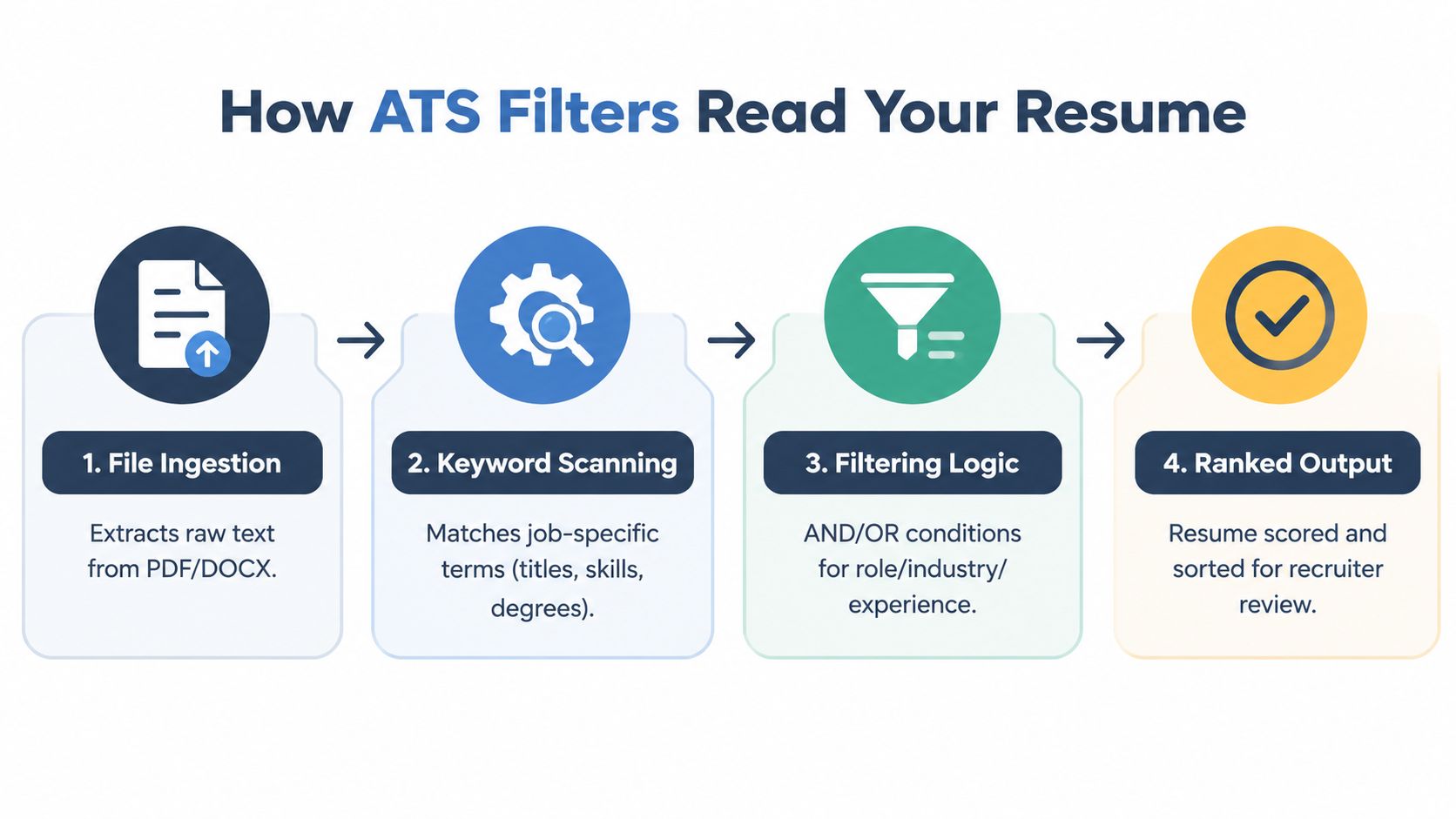
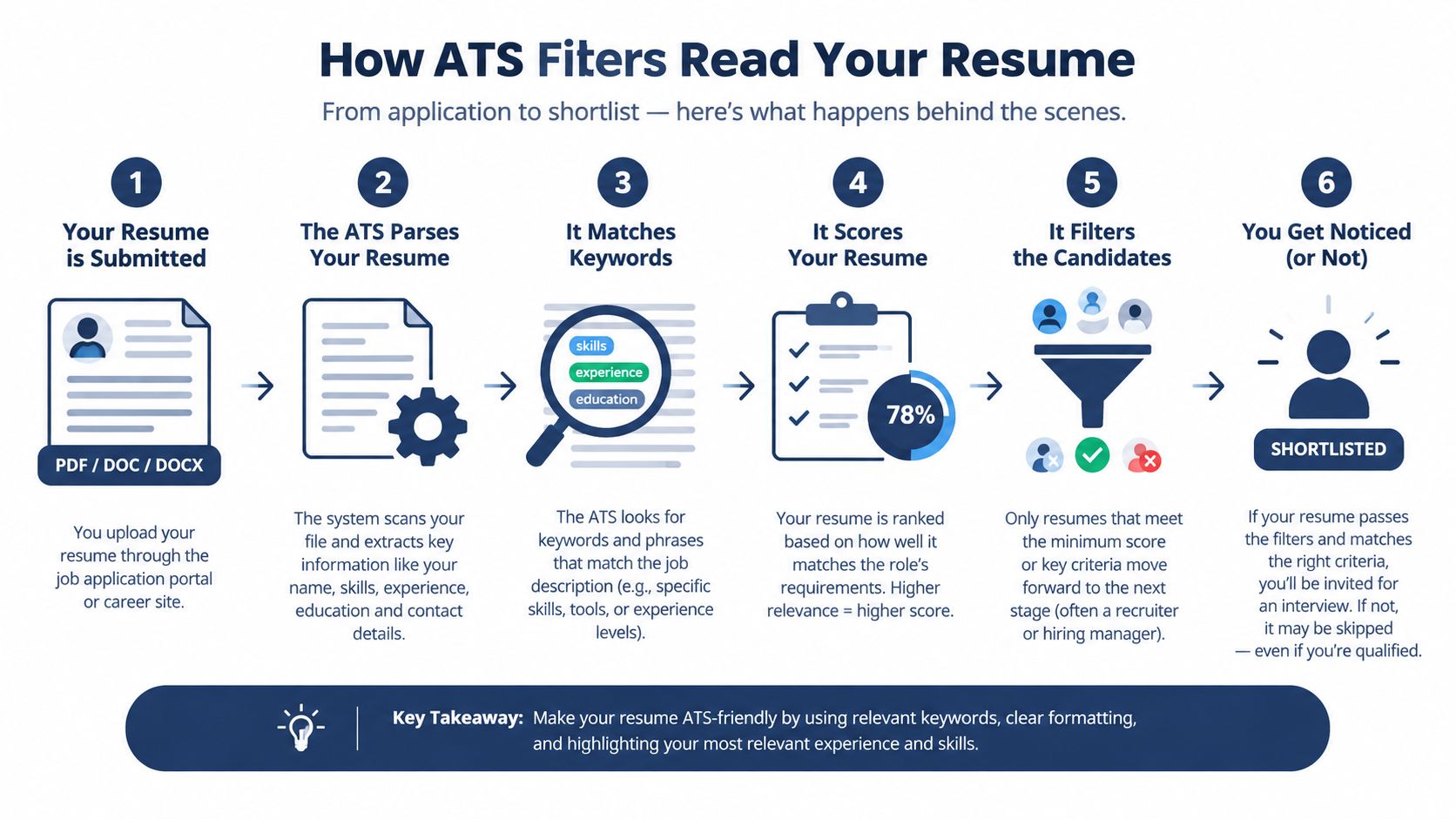
Think of an ATS as a literal filing clerk. It receives your document, extracts text, identifies fields such as job titles and dates, compares your wording with the vacancy, and ranks applications according to configured rules. An industry explanation of the ATS workflow describes stages including file ingestion, text extraction, structured parsing, normalization, contextual matching, and ranking.
That sequence explains why design can become a problem. A two-column layout, text inside graphics, decorative icons, or unusual section labels may look polished to a person while making your employment history difficult for software to interpret. Use conventional headings such as Experience, Education, and Skills, and keep the main content in selectable text.
Formatting rules that protect your evidence
Use a clear chronology, recognizable job titles, readable dates, and standard bullets. Put contact information in the main document body rather than relying on headers or footers that some systems may handle inconsistently.
A plain-text test catches many failures. Copy the résumé from Word or PDF into a basic text editor and read it from top to bottom. ATS formatting guidance from TailorForge recommends checking that names, titles, dates, and bullets appear in the correct order, with no missing or duplicated content.
You can also consult an ATS-friendly résumé guide before exporting. The purpose isn't to make your résumé ugly. It's to ensure that a recruiter and the screening system receive the same coherent version of your experience.
Writing Bullets That Pass the Screen
A résumé bullet should answer three questions quickly: What did you do? What sales-relevant behavior did you use? What changed or became measurable? Generic responsibilities rarely help because they don't show scope, action, or outcome.
Keyword matching also depends on phrasing. Independent ATS guidance says systems may look for literal terms from the job posting, so if the employer uses “appointment setting,” don't rely only on “scheduled meetings.” ResumeAdapter's ATS statistics and guidance explains why matching the employer's wording can matter.
Resume Bullet Transformations
| Generic Bullet | ATS-Optimized Bullet |
|---|---|
| Helped customers in a busy store. | Used needs discovery and objection handling to recommend products, answer questions, and support customer decisions in a high-volume retail environment. |
| Made phone calls to clients. | Conducted outbound calling, documented conversation outcomes, and scheduled follow-ups for prospective and existing customers. |
| Worked with a team to reach goals. | Supported team quota attainment by maintaining accurate customer records, sharing lead information, and following up on open opportunities. |
| Answered questions about services. | Qualified customer needs, explained service options, and addressed objections before directing suitable prospects to the next step. |
| Managed customer information. | Maintained accurate CRM records, updated contact details, and recorded next actions to support pipeline management. |
Don't insert a term because it appears in the posting. Your bullet must remain truthful. If you used a spreadsheet rather than Salesforce, describe the tracking process instead of naming Salesforce. You can mention that you're familiar with CRM concepts only when your experience supports that statement.
A repeatable writing formula
Begin with an action verb such as qualified, researched, contacted, scheduled, resolved, or maintained. Add the relevant sales term, then include the setting and a verifiable result where one exists.
For example, “Contacted members about an event, answered questions, and scheduled attendance appointments” is stronger than “Helped promote events.” It shows proactive outreach, communication, and appointment setting without inventing a sales title or unsupported performance figure.
Your Application Workflow, Step by Step
Suppose you find an entry-level sales posting after working in retail, hospitality, insurance, or another customer-facing role. The job title may be new, but your evidence can still match the employer's needs. Treat the posting like a specification, then translate your experience into its language.
A practical sequence
- Extract the employer's language: Note terms for prospecting, lead qualification, CRM use, follow-up, objections, and targets.
- Separate requirements from preferences: Prioritize terms repeated in the responsibilities and requirements.
- Map real evidence: Link each important term to a task, project, job, volunteer role, or achievement you can explain.
- Rewrite your summary and bullets: Put the strongest role-specific matches in context across your summary, skills, and experience sections.
- Check structure and parsing: Run a plain-text test, confirm dates and titles, and remove design elements that scramble reading order.
- Review before submission: Confirm every claim is accurate and that the résumé reflects this specific role.
A resume checker can reduce manual comparison. GetTheCall can import a LinkedIn profile or résumé, analyze a target listing, align documented experience with job-specific terms, provide a live role match score, and export an ATS-ready PDF. Use its suggestions to find relevant evidence, not to invent skills or experience.
Practical rule: Customization means selecting the clearest proof of your real abilities, not changing your history to resemble someone else's.
Before submitting, read the application twice. An ATS should find clean structure and relevant wording. A recruiter should see a credible candidate who understands the work, can learn the process, and has evidence of following through.
GetTheCall helps turn an existing LinkedIn profile or résumé into a job-specific, ATS-optimized PDF with keyword alignment, bullet suggestions, professional layouts, and a live role match score. Use it to compare your real experience with an entry-level sales posting, fix parsing or wording gaps, and visit GetTheCall when you're ready to submit a clearer application.