ED Nurse Resume: 7 Examples That Get Interviews
Explore 7 ED nurse resume examples with sample bullets, certifications, and ATS keywords to help emergency nurses land more interviews in 2026.
An emergency department job posting catches your eye, but your resume still reads like a general nursing history. It lists patient care, medication administration, and teamwork, yet doesn't show what you did when the waiting room filled, a patient deteriorated, or several teams needed to coordinate at once. That's the gap an ED hiring team needs your application to close.
A strong ED nurse resume makes your clinical scope easy to find. It shows the kind of patients you've cared for, the responsibilities you've held, the credentials you hold, and how your experience fits the department you're applying to. Registered nursing is a large, hospital-centered profession, and the American Association of Colleges of Nursing projects continued RN employment growth through 2034. That context makes clear evidence of relevant experience more useful than a generic list of duties (AACN's nursing workforce fact sheet).
The right format depends on your route into emergency care. Below are seven practical examples for experienced nurses, new graduates, trauma and pediatric specialists, travelers, leaders, and career switchers. Adapt the wording to your actual experience, and leave out any metric or skill you can't verify.
Table of Contents
- 1. Experienced ED RN With a Reverse-Chronological Resume
- 2. New Graduate ED RN With a Skills-Forward Hybrid Resume
- 3. Trauma-Focused ED RN Resume
- 4. Pediatric Emergency RN Resume
- 5. Travel or Contract ED RN Resume
- 6. ED Charge Nurse or Leadership Resume
- 7. Career Switcher to ED Nursing Resume
- 7 ED Nurse Resume Examples Compared Side by Side
- Turn These Examples Into Your Own ED Nurse Resume
1. Experienced ED RN With a Reverse-Chronological Resume
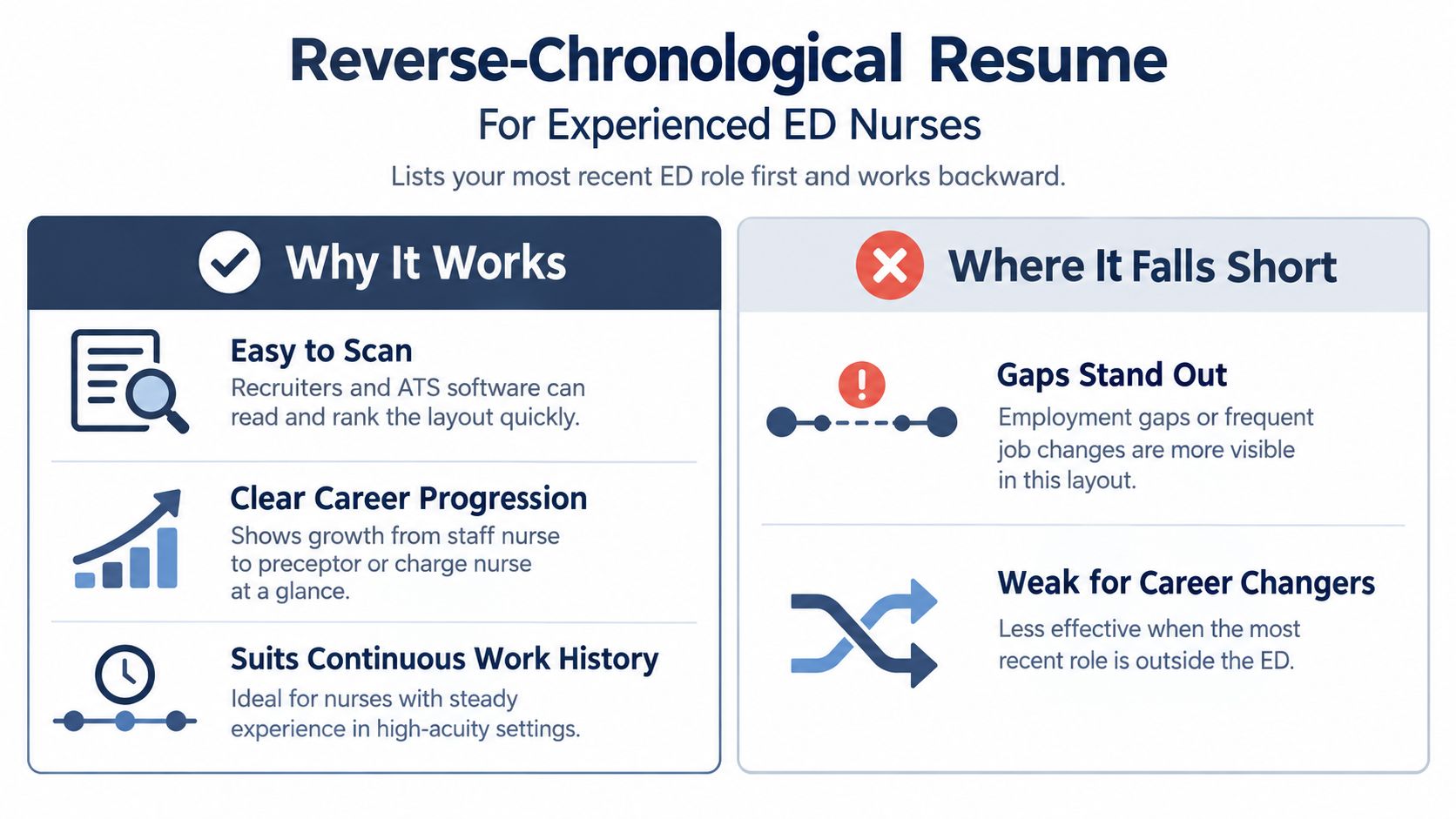
If you've built your career in emergency care, make that history visible right away. Put your current or most recent ED role first, then work backward. A clear timeline lets a hiring manager see your progression, whether that means moving from staff nurse to preceptor, taking on charge responsibilities, or gaining experience with more complex assignments.
Lead with action and context rather than a broad duty statement. For example: “Triaged and managed a high-volume patient assignment in a trauma emergency department, coordinating assessment, stabilization, and escalation with the care team.” Another adaptable bullet is: “Precepted newly hired nurses on ED workflows, documentation standards, and electronic health record navigation.” Add your real patient volume, facility type, acuity, and outcomes where you can verify them. Don't borrow figures from another resume example.
Show clinical scope, not just tenure
Use terms that match the work you've done, such as rapid assessment, ESI triage, resuscitation, sepsis protocols, medication safety, care coordination, and patient flow. If you have experience with a named triage scale, identify it and the setting. The Emergency Nurses Association's triage guidance emphasizes qualified clinicians and reliable five-level scales, including ESI, CTAS, and ATS (ENA triage qualifications and competency guidance).
Practical rule: Pair each important keyword with proof. “ESI triage” is stronger when the bullet also explains your setting, responsibility, or patient population.
A reverse-chronological format is familiar and straightforward to scan, but it won't fix vague writing. Keep the layout simple and check that your headings and experience are easy for screening software to parse. You can compare your draft with a free ATS resume checker before applying.
2. New Graduate ED RN With a Skills-Forward Hybrid Resume
A new graduate may have little or no paid ED experience. That doesn't mean the resume should hide relevant preparation beneath unrelated jobs. Put a brief clinical skills section and your nursing education near the top, followed by supervised rotations, residency experience, and employment. This hybrid structure gives the reader a quick picture of your readiness without implying that a clinical placement was a staff position.
Make rotations specific. Name the care setting, patient populations, and tasks you performed under supervision. For example: “Completed an emergency department clinical placement focused on triage support, focused assessment, patient education, and observing trauma response.” Another option, if accurate, is: “Selected for a nurse residency with a focus on emergency and critical care.” Don't add hours, patient counts, or procedures unless your school or records confirm them.
Make preparation concrete
A skills section can include patient assessment, communication, electronic documentation, infection prevention, and supervised exposure to triage or resuscitation. The right terms depend on the posting and your actual experience. The Emergency Nurses Association of Ontario describes emergency nursing as spanning triage, resuscitation, stabilization, discharge teaching, crisis intervention, and emergency preparedness. Use the areas that match your rotations or training, not the whole list as a claim of independent competence (ENAO emergency nursing core competencies).

Keep your education and license status clear, and list certifications only when earned and current. Use conventional section headings and a readable layout rather than graphics that could obscure important information. These ATS-friendly resume formatting tips can help you check structure before you submit.
3. Trauma-Focused ED RN Resume
A trauma-focused resume should make your trauma experience apparent before a recruiter has to search for it. Place relevant credentials prominently after your name or in a clear credentials section, then use the opening summary and experience bullets to describe your role in trauma response. Include the trauma setting and the types of responsibilities you held, but avoid presenting team exposure as independent leadership if that wasn't your role.
A useful bullet might read: “Supported trauma activations in a designated trauma center, completing focused assessments, preparing for time-critical interventions, and coordinating updates with the interdisciplinary team.” If you hold TNCC or CEN, list the full credential and abbreviation, along with current status when applicable. The Board of Certification for Emergency Nursing position statement discusses research associating CEN certification with professional outcomes, but that association doesn't prove certification alone caused better patient outcomes. Let the credential support your profile, and use experience bullets to demonstrate what you can do (BCEN emergency nursing certification position statement).
Name the work you can defend
Depending on your actual background and the job posting, relevant terms may include primary survey, hemorrhage control, trauma resuscitation, rapid assessment, escalation, and trauma team coordination. A strong bullet connects the keyword to your action and setting: “Prepared equipment and supported team coordination during trauma resuscitations in a high-acuity ED.” If you've contributed to education or a trauma registry, describe that specific work too.

Don't turn this section into a procedure inventory. A hiring manager needs to understand your judgment, teamwork, and scope, not just see a string of trauma terms. Match relevant wording from the posting, then make sure every phrase describes work you've done.
4. Pediatric Emergency RN Resume
Pediatric emergency work calls for more than changing “patient” to “child” in a general ED resume. Show the age groups you've cared for, your role in assessment and stabilization, how you communicate with families, and your experience with pediatric-specific protocols. If you have experience across a range of ages, name that range accurately and distinguish independent practice from supervised training.
An adaptable bullet could be: “Assessed and supported stabilization of pediatric patients in an emergency setting, communicating care plans and discharge guidance to families.” Another might say: “Participated in pediatric simulation and emergency-preparedness activities for ED staff.” Add details about your actual contribution, such as whether you facilitated practice, prepared materials, or completed training.
Put the relevant credentials in view
For a pediatric ED position, PALS may be relevant, as may PEPP, ENPC, or CPEN, depending on the posting and your qualifications. List only credentials you hold, and keep expiration-sensitive certifications current or clearly identify renewal status. Include the full credential name alongside the acronym when useful for clarity and screening.
Hiring teams also need to see the human side of pediatric care. Terms such as family-centered communication, weight-based medication safety, pediatric triage, caregiver education, and age-appropriate assessment can make your experience easier to recognize, provided they accurately describe your practice. Don't claim expertise in a specific age group or procedure because it appeared in a rotation.

A pediatric-focused resume works best when it balances clinical skill with family communication. For example, describe how you explained next steps to caregivers while supporting the clinical team. That shows the reader how you work with both the child and the family, rather than relying on a generic claim that you're compassionate.
5. Travel or Contract ED RN Resume
Travel and contract nurses need to make each assignment easy to understand. Group roles by facility, location, department, and dates, then explain what you were hired to do. A concise entry might say: “Supported emergency department staffing during a contract assignment, adapting to local triage workflows, documentation standards, and EHR procedures.” Name the actual EHR and protocols when you can verify them.
Put active licenses and relevant certifications where an agency recruiter can find them quickly. If you hold a multistate compact license, state that accurately and list any additional state licenses relevant to the role. Nursing credentials should appear consistently across your resume and application. A nursing resume convention places credentials after your name in the sequence of highest degree, licensure, and national certification, when applicable (nurse.org guidance on nursing resume credentials).
Make transitions legible
A string of facility names doesn't explain how you adapted. Include the assignment's setting, patient population, and the work you performed, without suggesting that every ED has the same acuity or workflow. If an assignment involved a surge, staffing coverage, or float-pool work, state that purpose plainly and only when it's accurate.
“A travel resume should make your adaptability visible without making your experience sound interchangeable.”
Relevant screening terms may include travel nurse, emergency department, compact license, triage, Epic, Cerner, Meditech, and rapid onboarding. Use only the systems and capabilities you've used. Tailor each application to its posting, since one agency may prioritize licensure details while a facility may focus on clinical scope, certifications, and EHR familiarity.
6. ED Charge Nurse or Leadership Resume
Charge experience is easy to undersell when it reads like “helped the team run shift.” Write the operational scope plainly: assignments, acuity balance, bed flow, escalation, sick-call coverage, and communication with house supervisors or admitting teams. A ready-to-adapt bullet: “Coordinated ED assignments and break coverage against acuity and skill mix, surfacing staffing gaps early and adjusting flow as arrivals changed.”
Do not bury the charge role.
If you improved a process, name the process and your lane. “Designed” is different from “implemented,” “trained staff,” or “tracked audits.” Team results should be labeled as team results; if door-to-provider or sepsis bundle performance moved during the project, say what records support and what part you owned.
Match leadership evidence to screening terms
Useful ATS terms for this path include charge nurse, staff assignments, patient flow, throughput, bed management, escalation, precepting, staff education, quality improvement, interdisciplinary coordination, and sepsis protocol. Keep active BLS and ACLS easy to find, and list CEN, TNCC, or PALS only when current and relevant to the population served.

Keep bedside judgment visible. One or two direct-care bullets show you still assess, escalate, and close the loop under pressure, which is what makes the leadership evidence credible.
7. Career Switcher to ED Nursing Resume
A PACU nurse applying to a busy ED already knows airway watchfulness, escalation thresholds, and how quickly a stable patient can slide. The resume job is to make that transfer obvious in the first screen. Open with a two-line summary that names your current specialty and the emergency-care abilities you bring: rapid assessment, prioritization, deterioration recognition, medication safety, and calm handoffs under pressure.
Use bullets that translate rather than inflate. A med-surg nurse could adapt: “Recognized subtle deterioration on a high-volume surgical unit and escalated with concise SBAR, prompting rapid evaluation.” An ICU nurse might write: “Managed high-acuity monitoring, vasoactive medications, and family communication during unstable physiology.” If accurate, add bridge experience: “Completed TNCC coursework and shadowed ED triage to learn arrival-to-disposition flow.” Describe shadowing as exposure, and describe CEN work as exam preparation unless you have passed.
Translate without overstating
Keep the value of your original specialty, then explain why it matters at the ED front door. Show the moment you noticed a change, what you did first, who you called, and how you closed the loop. The competency domains noted earlier, adapting practice, critical care, communication, ethics, teaching, and leadership, work best as a checklist for choosing honest examples, not as a claim to every skill at once.
Useful ATS terms may include rapid assessment, deterioration recognition, triage support, resuscitation, SBAR, ACLS, BLS, TNCC, ENPC, and CEN exam preparation. List only credentials you hold or courses you completed. A focused guide to tailoring your resume to a job description can help you mirror the posting's language without stretching your history.
7 ED Nurse Resume Examples Compared Side by Side
| Resume Example | Ideal Use Case | Key Focus | 🔄 Preparation Effort & Resources | ⭐ Expected Outcome & Advantage |
|---|---|---|---|---|
| Experienced ED RN: Reverse-Chronological | Experienced nurses with steady ED work history | Recent roles, career progression, certifications, and measurable clinical scope | 🔄 Low–moderate; requires accurate dates, role details, and performance examples | 📊 Makes experience easy for recruiters and ATS software to scan; clearly shows career growth |
| New Graduate ED RN: Skills-Forward Hybrid | Newly licensed nurses with limited paid ED experience | Clinical rotations, transferable skills, education, and readiness | 🔄 Moderate; requires specific rotation hours, skills, and clinical examples | 📊 Highlights clinical readiness despite limited employment history |
| Trauma-Focused ED RN | Nurses applying to Level I or II trauma centers | Trauma activations, high-acuity care, trauma credentials, and team coordination | 🔄 Moderate–high; needs accurate trauma volumes, credentials, and examples | ⭐ Makes trauma experience and qualifications easy to identify |
| Pediatric Emergency RN | Nurses applying to pediatric or mixed-age emergency departments | Pediatric volume, age ranges, family-centered care, and pediatric certifications | 🔄 Moderate; requires documented pediatric experience and relevant credentials | ⭐ Signals pediatric-specific competence and safety-focused practice |
| Travel or Contract ED RN | Travel nurses and contract applicants | Assignments, locations, durations, licenses, and adaptability | 🔄 Moderate; requires organized assignment history and current licensure details | ⚡ Helps agencies quickly assess placement readiness and flexibility |
| ED Charge Nurse or Leadership | Charge nurses and nurses pursuing ED leadership roles | Staffing, patient flow, quality initiatives, and measurable outcomes | 🔄 High; requires operational data and balanced clinical examples | 📊 Demonstrates leadership impact and value beyond bedside care |
| Career Switcher to ED Nursing | Nurses transitioning from other specialties or fields | Transferable skills, ED preparation, and a clear transition rationale | 🔄 Moderate–high; requires targeted wording and relevant training or shadowing details | 💡 Connects prior experience to ED needs and frames the transition as an asset |
Turn These Examples Into Your Own ED Nurse Resume
The strongest resume format is the one that makes your readiness easiest to verify. Use a reverse-chronological layout when your ED experience is established, bring rotations and clinical preparation forward as a new graduate, and organize travel, pediatric, trauma, leadership, or career-switching experience around the work that matters for that role. Don't force every story into one template.
Across all seven examples, the same habits make a difference. Describe acuity and scope with context, not bare numbers. Put relevant credentials where screeners can see them, and confirm that each is current. Use the job posting's language for skills and responsibilities, but only when it reflects your real practice. Strong bullets tell the reader what you did, in what setting, with whom, and what changed as a result. If you can't verify a metric, leave it out or describe the work qualitatively.
Emergency care also reaches beyond bedside procedures. Triage, stabilization, patient education, crisis response, disaster readiness, coordination, and leadership may all matter, depending on the role. Choose the competencies that fit the posting, then support them with specific examples. “Excellent critical thinker” is easy to write and hard to evaluate. “Recognized deterioration, escalated concerns to the care team, and supported timely intervention” gives the reader something concrete to assess.
Before applying, check that the resume matches the application channel as well as the job. A hospital ATS, government application, agency portal, or international employer may ask for different documentation. Some regulated or government applications can require detailed dates, duties, hours, education, and license information, so a short clinical resume may not contain everything the application needs. Keep a verified master record of your roles and credentials, then create the version that fits each employer's requirements.
A practical next step is to import your current resume or LinkedIn profile into GetTheCall, paste in a target ED job listing, and review the suggested alignment. The tool can help organize verified experience into job-specific resume content and show a live match score as you revise. Use that score as a prompt to inspect missing skills or wording, not as a substitute for clinical accuracy. Your final draft should still sound like your work, because it is.
GetTheCall can use your existing resume or LinkedIn profile to build a job-specific, ATS-oriented resume and compare it with an ED listing. Paste in the role you're targeting, review the suggested keywords against your actual experience, and visit GetTheCall to prepare an application.