Delivery Driver Resume: ATS Guide and Examples
Build an ATS-optimized delivery driver resume that lands interviews. Learn which keywords, metrics, and formats pass automated screens and impress hiring
You've done the hard part. You know how to handle traffic, protect packages, manage a route, and deal with customers at the door. Yet after submitting the same resume to several delivery jobs, you may hear nothing back. The problem often isn't your driving ability. It's that your delivery driver resume has to satisfy an automated system before a recruiter can judge your experience.
A strong application makes two things obvious quickly: you understand the operation, and you can prove your reliability with measurable results. That means replacing phrases like “hard worker” with evidence such as on-time delivery performance, stop volume, vehicle inspections, proof of delivery, and safe route execution.
Table of Contents
- Why Great Drivers Get Filtered Out by ATS
- Extracting the Right Keywords from Job Postings
- Writing Metric-Driven Experience Bullets
- Structuring the Core Resume Sections
- Formatting Rules for Flawless ATS Parsing
- Tailoring Your Application in Minutes
Why Great Drivers Get Filtered Out by ATS
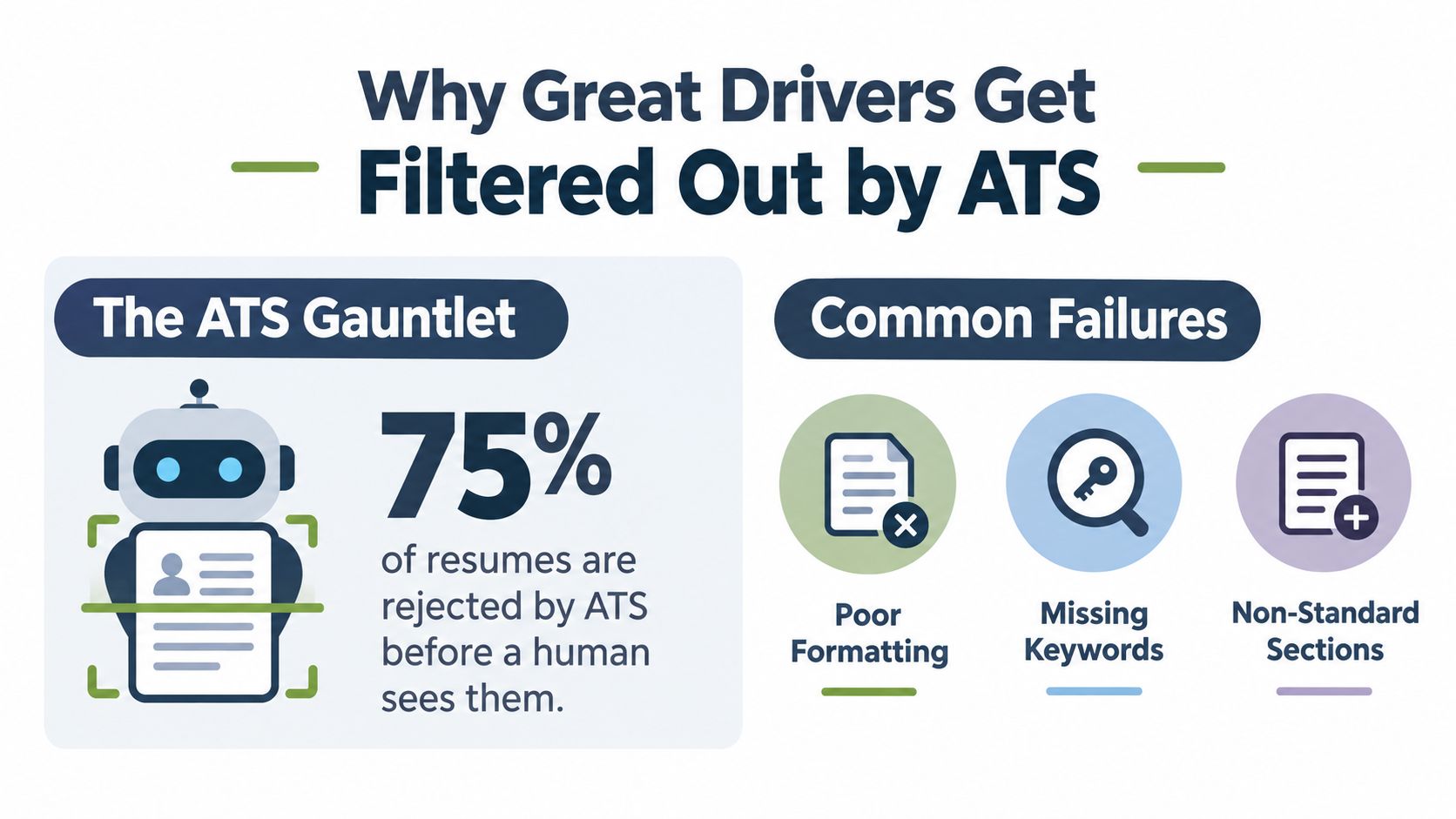
Most drivers write resumes for people, not software. They describe their work in natural language, assuming a hiring manager will recognize that “handled packages and drove routes” means route planning, delivery documentation, customer contact, and safety compliance. An Applicant Tracking System may not make those connections unless the job posting uses the same terms.
The screening problem is widespread. A 2025 Ladders resume eye-tracking and ATS report found that recruiters spend an average of only 7.4 seconds on an initial resume scan, compared with about 6 seconds in 2012. The same source reported that 97.8% of Fortune 500 companies had a detectable ATS on their career sites. Logistics employers commonly use these systems, even when the open role involves local delivery rather than office work.
What the software actually looks for
An ATS usually extracts text from your document, identifies sections, and compares your language with the requirements in the job description. It may look for terms connected to licenses, vehicle classes, route work, safety, delivery technology, and documentation. If your experience says “drove a van to customers,” but the posting asks for GPS navigation, delivery apps, and proof of delivery, the system may not give your resume enough credit.
Formatting can create another barrier. Text boxes, graphics, unusual section names, headers, footers, and multi-column layouts can cause important information to be read out of order or ignored.
Practical rule: Write the first version for the ATS, then make it easy for a recruiter to scan. You need both audiences.
One ATS resume checker can help identify parsing problems and keyword gaps before submission. Still, no tool can replace accurate experience. Never add a license, vehicle type, metric, or certification you don't hold.
Extracting the Right Keywords from Job Postings
A delivery driver resume shouldn't use the same wording for every employer. A parcel carrier, restaurant delivery operation, medical courier, and freight company may all use the title “driver,” but their operational requirements can differ sharply. Your job posting is the most reliable guide to the language that belongs in your application.
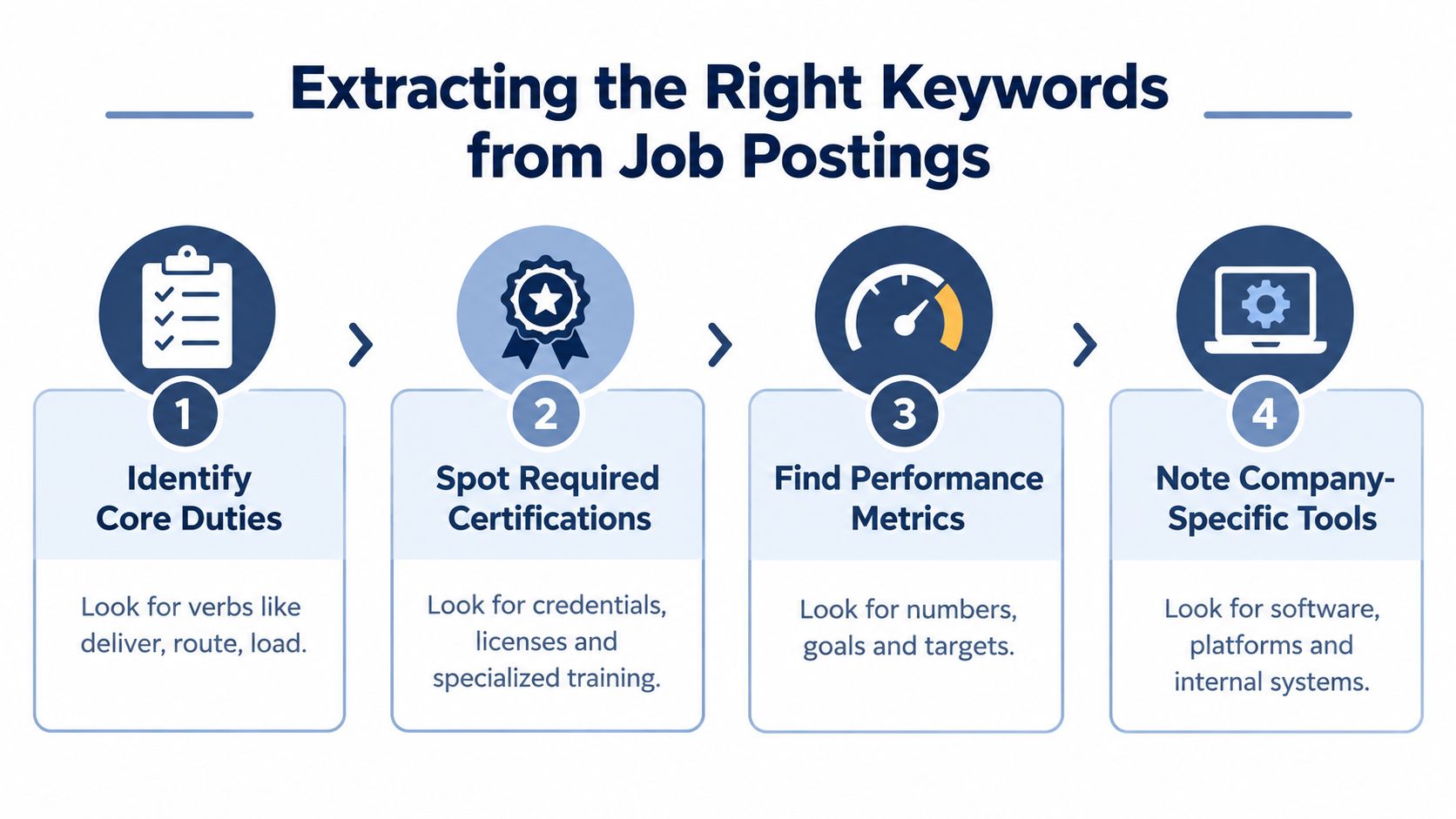
A practical delivery driver ATS keyword guide recommends extracting 5–8 exact phrases from the posting and placing them naturally across your summary, skills, and experience sections. The purpose isn't to repeat terms mechanically. It's to show that your actual background matches the employer's stated workflow.
Start with the duties
Read the posting once for context, then read it again with a highlighter or plain text document. Pull out verbs and operational nouns, such as:
- Route execution: Look for phrases involving route optimization, route planning, delivery windows, GPS navigation, or out-of-route activity.
- Vehicle responsibility: Note vehicle inspection, preventive maintenance, safe vehicle operation, or a specific vehicle class.
- Delivery proof: Capture proof of delivery, electronic signatures, delivery apps, package scanning, and order tracking if they appear.
- Compliance language: Identify DOT compliance, driver qualification requirements, safety procedures, and inspection records.
Use the employer's exact phrase when it accurately describes your experience. If the posting says “vehicle inspection,” don't rely only on “checked the truck.” You can write, “Completed pre-trip vehicle inspection and reported defects before route departure,” provided that reflects what you did.
Separate required terms from useful terms
Required certifications and licenses deserve more prominence than soft descriptors. Put your valid driver's license, CDL class, endorsements, clean driving record, or DOT-related qualifications in a dedicated section when they apply. A recruiter shouldn't have to search through several job bullets to find the credential that determines whether you can legally perform the work.
Then look for company-specific tools. A posting may mention a delivery application, handheld scanner, electronic logging system, GPS platform, or proof-of-delivery process. Include the tool only if you've used it, and describe the task connected to it rather than dropping the brand name into a keyword list.
Distribute keywords instead of stuffing them
Place the most important phrase in the professional summary, repeat relevant terms in a skills list, and demonstrate them in experience bullets. For example, a summary might mention route optimization and DOT compliance, while an experience bullet explains how you completed inspections and used GPS navigation during daily routes.
The language gap matters. One ATS-focused article reports that the average unoptimized resume contains only about 48% of the keywords in its target job description, according to research on ATS resume optimization. The answer isn't adding every possible keyword. It's tailoring the document to the specific route, vehicle, technology, and compliance expectations in front of you.
Writing Metric-Driven Experience Bullets
“Delivered packages safely and on time” sounds responsible, but it tells a hiring manager very little about your workload. A stronger bullet shows the scale of the route, the operating conditions, and the outcome. Delivery employers need evidence that you can handle volume without sacrificing safety, accuracy, or customer service.
The delivery driver resume guide from ResumeGeni identifies the metrics recruiters commonly look for: on-time delivery percentage, daily stop count, package volume, miles driven, and safety outcomes. It also gives examples involving 98%+ on-time delivery, 100% proof-of-delivery capture, and low missing-package claim rates. Use those figures only if they're your real results and you can explain how they were measured.
Use a simple bullet formula
Build each bullet from four parts:
- Lead with the result or scale. Start with the strongest number you can verify.
- Name the operation. Include residential, commercial, medical, food, or another route type.
- Identify the method or responsibility. Mention GPS navigation, vehicle inspection, scanning, route optimization, or customer handoff.
- Show the outcome. Explain what the performance demonstrates, such as reliable delivery windows, accurate documentation, or a strong safety record.
A generic statement such as “Responsible for deliveries” can become:
- Completed [your actual stop count] residential stops per route, using GPS navigation and delivery apps to maintain scheduled delivery windows.
- Maintained [your actual on-time percentage] on-time delivery performance across commercial routes while capturing proof of delivery for every completed order.
- Drove [your actual mileage] miles per shift in a [vehicle class], completing pre-trip vehicle inspections and reporting maintenance concerns before departure.
Keep the bracketed details out of the final resume. They're reminders to insert your own verified figures.
Choose metrics that explain trust
Not every number carries equal value. A high package count may show capacity, but it doesn't prove careful handling. Pair volume with accuracy, safety, or customer outcomes. A bullet about daily stops becomes more persuasive when it also states the on-time result, proof-of-delivery completion, or missing-package record.
Safety evidence can include a clean driving record, incident-free performance, inspection compliance, or documented recognition. Avoid vague claims such as “excellent driver” unless you support them with a concrete record.
The best bullet answers a manager's silent question: “Can this driver handle my route without creating another problem?”
Don't inflate precision
If your employer didn't track stops per hour, don't estimate a precise figure from memory. Use a defensible range only when it reflects how the operation recorded performance, or describe the workload qualitatively. Credibility matters more than a dramatic number that you can't defend during an interview.
Structuring the Core Resume Sections
A delivery driver resume should make licensing, safety, route experience, and customer-facing ability easy to find. Use a reverse-chronological structure for an experienced driver, with the most recent role first and clear dates for each position. That format lets a recruiter see your current level of responsibility without reconstructing your history.
Experienced drivers
Start with contact information, a targeted professional summary, core skills, experience, certifications, and education. Put the credentials that determine eligibility near the top, especially a CDL class, endorsements, license status, or relevant safety qualification. If a clean driving record is important to the role and you can accurately state it, include it in the summary or certifications area.
Your experience section should emphasize route type, vehicle class, delivery volume, customer interaction, inspections, documentation, and measurable performance. A driver moving from local parcel delivery to a larger commercial vehicle role should make the transfer explicit, but shouldn't imply experience with equipment or regulations they haven't handled.
Entry-level applicants
An entry-level candidate should not imitate an experienced driver's resume. Lead with transferable evidence from retail, warehouse, field service, customer service, or other jobs. Order accuracy, time-sensitive work, customer handoffs, handheld technology, physical work, and safe equipment use can all support a delivery application when described accurately.
A useful summary might connect customer service experience with route work without pretending to have driven professionally. The skills section can emphasize GPS familiarity, delivery apps, order management, communication, and safety awareness if those skills are genuine.
What belongs in each section
- Summary: State the role you want, relevant operating experience, and your strongest verified result.
- Skills: Use job-specific terms such as route optimization, DOT compliance, vehicle inspection, proof of delivery, GPS navigation, and delivery apps when they match your background.
- Experience: Show what you handled and how well you handled it. Don't turn every bullet into a task list.
- Certifications: List license class, endorsements, training, and expiration details when relevant and accurate.
- Education: Include your highest completed level and relevant training. Keep unrelated detail brief.
- Additional information: Add languages, availability, or customer-facing experience when the posting makes them relevant.
Leave out hobbies, personal details, and unrelated history unless they strengthen your fit. A short resume with clear evidence usually serves a delivery hiring manager better than a long autobiography.
Formatting Rules for Flawless ATS Parsing
A polished design can hurt your application if the ATS can't read it. Delivery roles don't require a decorative resume. They require a document that extracts cleanly, presents credentials in the expected places, and lets a recruiter identify route experience without fighting the layout.
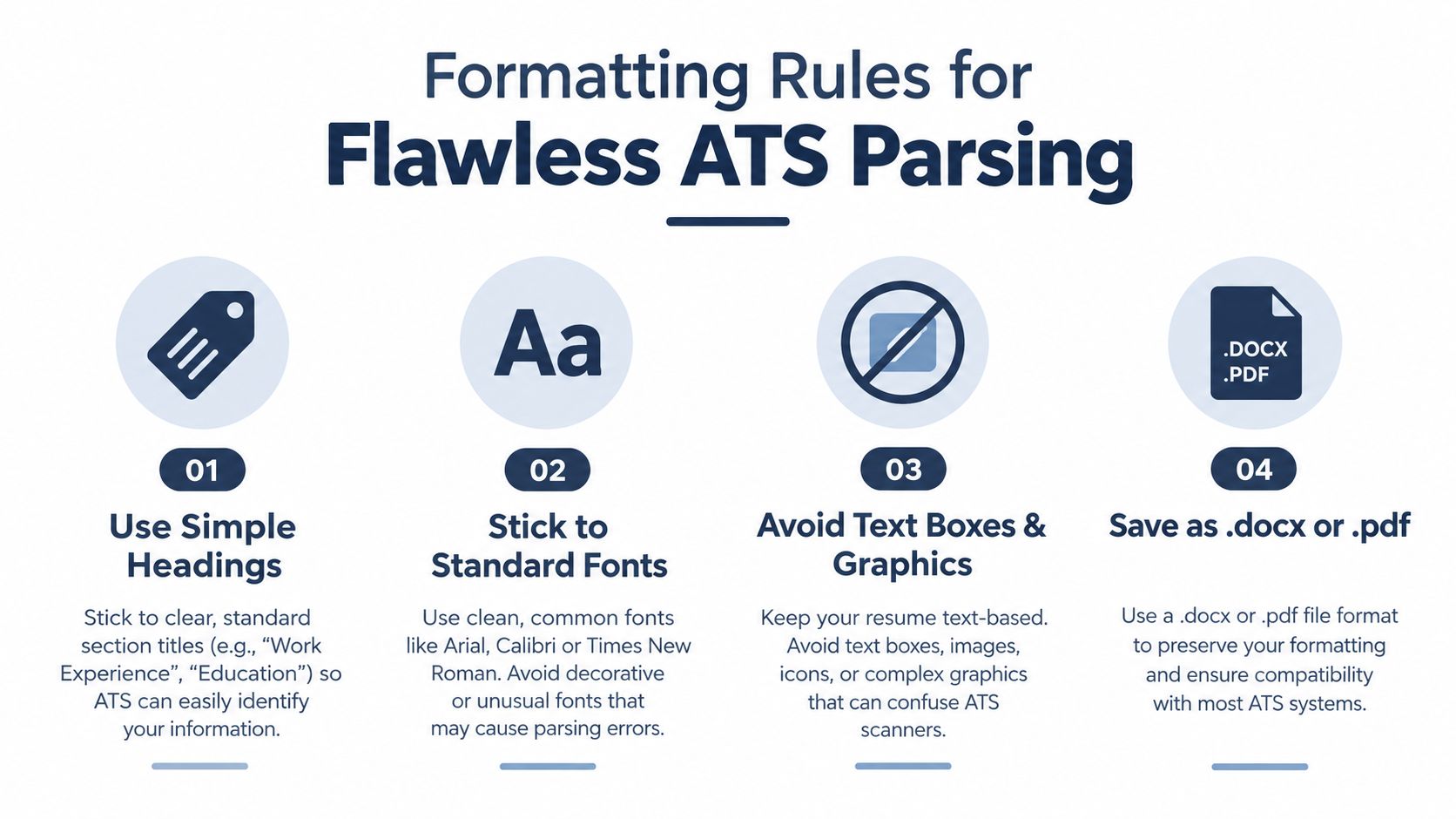
Use a single-column format with familiar headings such as Summary, Skills, Experience, Certifications, and Education. Standard headings give the parser predictable labels and help a human reviewer move through the page. Keep dates, job titles, employer names, and locations in a consistent order.
Make the text predictable
Choose a standard, readable font and maintain consistent styling. Use ordinary bullets, clear spacing, and restrained bold text for job titles or key results. Avoid placing critical information in headers, footers, sidebars, icons, images, or decorative shapes because parsers may skip or misread those areas.
Tables and columns are especially risky. They can appear tidy on screen while the extracted text arrives in the wrong sequence. A license may become separated from its label, or an employment date may be read as part of the wrong job.
Keep design secondary to evidence
Color, logos, profile photos, skill bars, and rating graphics consume space without proving route performance. They can also interfere with text extraction. If you want visual polish, use spacing, hierarchy, and consistent typography rather than graphics.
The same logic applies to file type. Follow the employer's requested format, and when no preference is stated, a clean .docx or text-based PDF is generally safer than a scanned document. Before uploading, open the final file, select the text, and paste it into a plain-text editor. If the order looks scrambled, fix the resume before applying.
A guide to ATS-friendly resume formatting can help you check the structure, but manual review still matters. Confirm that your phone number, email address, license information, dates, and employer names appear as selectable text.
Formatting test: If a recruiter can read the resume from top to bottom in one pass, the ATS usually has a better chance of understanding it too.
Tailoring Your Application in Minutes
You don't need to rebuild your career history for every delivery opening. You do need a reliable way to compare your existing resume with the specific job description, then adjust the summary, skills, and bullets where the match is weak.
Start with one verified master resume. Keep your complete route history, licenses, vehicle experience, safety record, tools, and measurable results in that file. For each application, duplicate the document and tailor only what supports the target role. A residential parcel position may prioritize delivery apps, proof of delivery, and customer contact. A commercial route may place more weight on vehicle inspection, DOT compliance, route planning, and documentation.
Compare the posting with evidence
Use a quick three-column check:
| Job requirement | Evidence you have | Resume location |
|---|---|---|
| Route optimization | Route planning or GPS experience | Summary and experience |
| Vehicle inspection | Pre-trip or post-trip checks | Skills and experience |
| Proof of delivery | Signatures, scans, or delivery app records | Experience |
| License or endorsement | Exact valid credential | Certifications |
Remove anything you can't support. Keyword matching only helps when the wording represents real work, and hiring managers often test resume claims through practical interview questions.
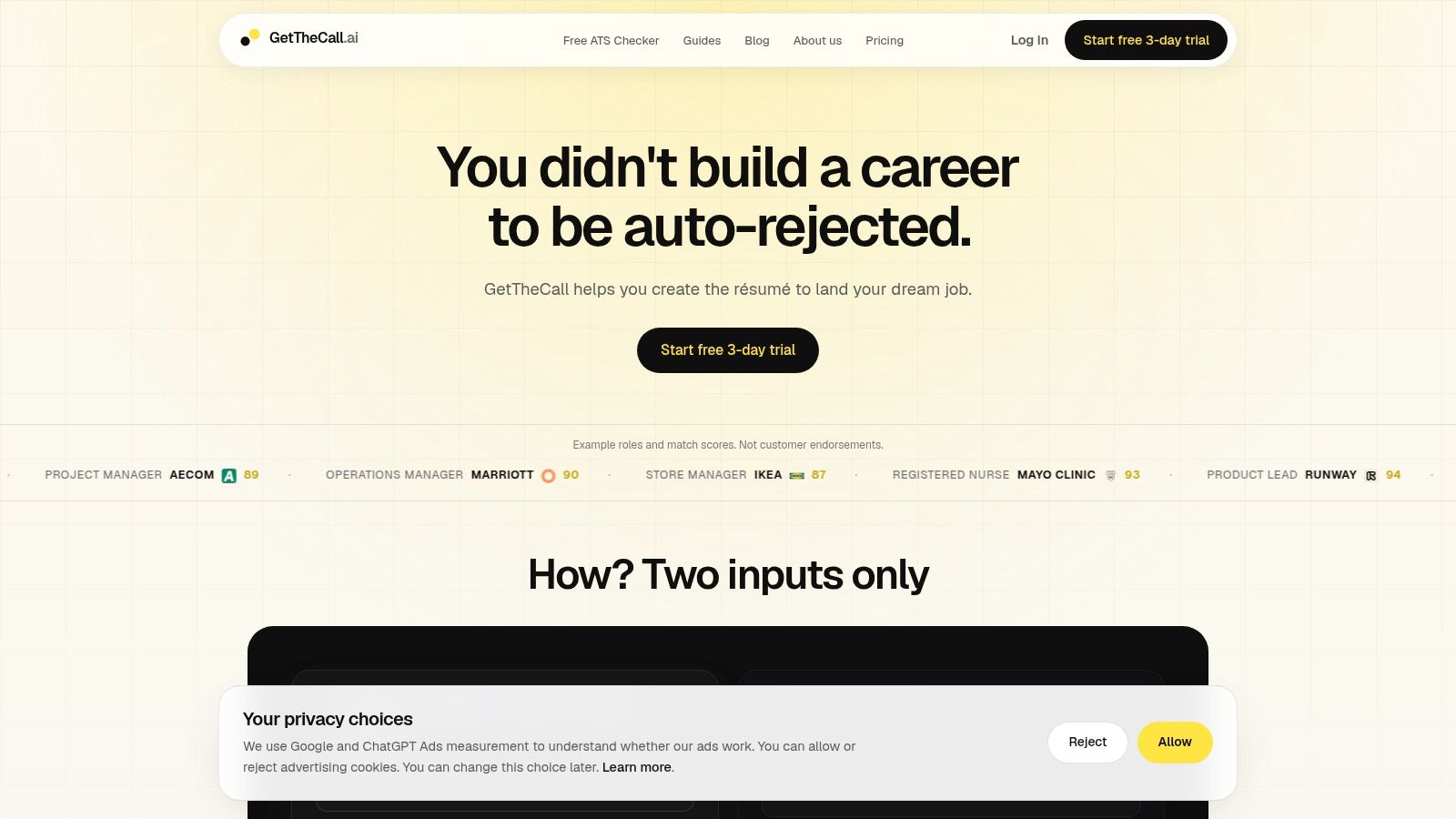
One option is GetTheCall's resume tailoring workflow, which can import an existing resume or LinkedIn profile, parse a target job listing, align the document with relevant requirements, and provide a live role-match score. It can also rewrite bullets based on the information you provide, but you should review every suggestion for accuracy before exporting the final file.
Use the score as a checklist, not as a promise of an interview. A strong match still needs readable formatting, credible metrics, a valid license, and an application that fits the employer's route requirements.
The final review should take less time than writing from scratch. Check that the most relevant keywords appear naturally, your strongest operational metric is easy to see, and the file opens correctly on the device you'll use to submit it.
If your resume currently says only that you're dependable, revise it today. Replace that claim with the route type you handled, the volume you delivered, the safety process you followed, and the result you achieved.
GetTheCall can turn an existing resume or LinkedIn profile into a job-specific, ATS-oriented PDF by analyzing the target listing, aligning real experience with its keywords, and showing a live role-match score. Visit GetTheCall to check your delivery driver resume, correct parsing or keyword gaps, and prepare a customized application before you submit.