Career in French: Translation, Vocabulary, and What It Means
Learn what career in French really means, from carrière to métier and profession. Clear translations, examples, and practical tips for French-speaking careers.
You're halfway through a conversation with a French-speaking recruiter when the question arrives: Quel est votre parcours professionnel ? You know exactly what you want to say, but the English word career disappears. Is it carrière, métier, or profession? And will the same choice work on a French CV?
The answer matters beyond vocabulary. The right word can make your experience sound natural, while the right CV format, language level, and job-specific wording can determine whether a recruiter notices it at all. This guide connects the translation of career in French with practical decisions for working in France, Belgium, Quebec, or the wider francophone market.
Table of Contents
- When You Suddenly Need the French Word for Career
- The Three Core Words You Will Meet First
- How These Words Sound in Real French Sentences
- Career Paths That Open Up With French
- Which French Level Employers Expect
- Why Your Résumé Faces a Machine Before a Human in France
- The French CV Versus the International Résumé
- Your First Practical Steps Toward a French Career
When You Suddenly Need the French Word for Career
You're sitting in a Paris café, balancing a small cup of coffee and a conversation about your next professional move. A francophone contact asks whether you want to build an international career, and you reach for the French word. Carrière comes to mind, but then métier appears, followed by profession. Suddenly, a simple sentence feels like a grammar exam with better pastries.
That hesitation is normal because English often uses career as a broad umbrella. French separates the long-term path from the work you practise and the occupation recorded in formal documents. Choosing the wrong word probably won't end a conversation, but it can make a CV line, interview answer, or networking message sound less precise.
A useful starting point: carrière is usually the safest translation for a career path, but context decides whether métier or profession sounds better.
The next step is to understand the three words together. You'll see how they differ in ordinary conversation, LinkedIn-style descriptions, and administrative language. You'll also connect vocabulary with the practical realities of French employment, including expected CEFR levels and the automated systems that often screen résumés before a recruiter reads them.
That combination is useful whether you're targeting work in France, Belgium, Geneva, Quebec, or another francophone market. French vocabulary isn't decoration on your application. It helps you describe what you've done, what you do now, and where you want your professional road to lead.
The Three Core Words You Will Meet First
Start with carrière, the standard translation of “career.” It refers to the broader professional journey, especially its development over time. You might talk about une carrière internationale, an international career, or l'évolution de carrière, career progression.
Then place métier beside it. Métier often means a trade, craft, or line of work, with an emphasis on the activity itself and the identity attached to it. A person may ask Quel est ton métier ?, meaning “What do you do for a living?” The word can work for an engineer, chef, carpenter, designer, or technician, not only for manual occupations.
Profession is more formal and administrative. It often corresponds to “occupation” or “profession” on paperwork, registration forms, payroll documents, and HR records. A CV might include profession actuelle, current occupation, while a regulated field may be called une profession réglementée.
A simple analogy makes the distinction easier:
- Carrière is the long road you travel.
- Métier is the craft or work you practise along that road.
- Profession is the label an employer or institution records on a document.
| Word | Literal Meaning | Register | Best Used For | Example |
|---|---|---|---|---|
| carrière | Career or professional path | General and professional | Long-term development and progression | Elle construit une carrière internationale. |
| métier | Trade, craft, or line of work | Everyday and professional | The work someone practises or identifies with | Il aime son métier d'ingénieur. |
| profession | Occupation or formal profession | Administrative and formal | Forms, HR records, and regulated work | Profession actuelle : analyste financier. |
All three nouns are feminine: la carrière, la profession, and le métier is the exception because it's masculine. Their plurals are carrières, professions, and métiers. Pronunciation also rewards a little attention. In profession, the final sound is pronounced, and in a phrase such as des professions internationales, liaison may connect the words in fluent speech.
One small trap deserves attention. Carrière can also refer to a quarry, while the historical sense of a track or course helps explain why the word can evoke movement and progression. The French National Centre for Textual and Lexical Resources traces carrière through French carrière and back to Latin carrus, meaning wagon or cart, documenting the shift from a physical route to a path through life in its etymological entry for carrière.
How These Words Sound in Real French Sentences
The difference becomes clearer when the same general topic moves through different settings. In an everyday chat, a friend might say:
- Il parle souvent de sa carrière.
He often talks about his career. - Quel est ton métier ?
What do you do for a living? - Elle a changé de métier après ses études.
She changed careers or professions after her studies.
Here, carrière frames the whole journey, while métier points to the work itself. English uses “career” for both ideas, which is why direct translation can feel slippery.
On LinkedIn or in a professional bio, the vocabulary becomes more specific:
- Après dix ans de carrière dans la finance, elle dirige une équipe internationale.
After ten years in a finance career, she leads an international team. - Le métier d'ingénieur exige une solide formation technique.
The engineering profession requires strong technical training. - Il souhaite développer une carrière internationale dans le secteur de l'énergie.
He wants to build an international career in the energy sector.
Job advertisements also contain recurring combinations. Début de carrière means early career. Évolution de carrière refers to career development. Métier passion describes work presented as a vocation or passion, while profession réglementée identifies an occupation governed by legal or professional rules.
Administrative writing nudges you toward profession:
- Profession actuelle : chargée de communication.
Current occupation: communications officer. - Veuillez déclarer votre profession.
Please state your occupation. - La profession figure sur la fiche de paie.
The occupation appears on the payslip.
The verbs matter too. You faire carrière, make a career or build a career. You exercer un métier, practise or work in a profession. You déclarer une profession, declare an occupation. These pairings sound natural because French speakers have learned them as units, not as isolated dictionary translations.
When you write, ask one question: are you describing the road, the work, or the official label? That answer usually points directly to carrière, métier, or profession.
Career Paths That Open Up With French
French can support far more than a teaching job. It can help you work across international business, diplomacy, translation, tourism, government, and NGOs, as outlined by the University of Lethbridge's career guidance on French. The language becomes especially useful when your technical skill already matches a cross-border need.
A communications specialist might apply for chargé de communication, a medical sales professional for délégué médical, and a compliance specialist for analyste KYC. These titles are worth learning in their original form because recruiters often search and write listings using French terminology rather than an English translation.
| Sector | Example French Title | English Equivalent |
|---|---|---|
| International NGOs | chargé de projet humanitaire | Humanitarian project officer |
| Diplomacy and public affairs | attaché diplomatique | Diplomatic attaché |
| Corporate communications | chargé de communication | Communications officer |
| Healthcare and medical sales | délégué médical | Medical representative |
| Compliance and banking | analyste KYC | KYC analyst |
| Tourism and hospitality | responsable hébergement | Accommodation manager |
| Translation and localisation | traducteur spécialisé | Specialist translator |
| International business | responsable développement international | International business development manager |
Some opportunities are geographically concentrated. International NGOs operate around hubs such as Geneva and Brussels. French-speaking African markets create openings in sales, infrastructure, logistics, and development work. EU-related roles can connect with institutions and networks in Strasbourg and Luxembourg. Luxury hospitality stretches from Paris to Monaco, while aerospace employers in Toulouse combine French with engineering expertise.
French also adds value in healthcare networks serving francophone communities in Quebec and Belgium. In shortage areas such as nursing, IT, engineering, construction, agriculture, and manufacturing, a relevant credential plus workable French can make an application more practical, although language and work-permit requirements still vary by employer and country.
The important distinction is between language as the job and language as an accelerator. A translator sells language expertise directly. An engineer, nurse, analyst, or sales manager uses French to work with clients, colleagues, regulators, and local markets. That second route is often the stronger one for career changers because your professional qualification remains central.
Which French Level Employers Expect
CEFR labels matter when they connect to workplace tasks. For jobs conducted in French, B2 is a practical minimum for working in French. C1 is commonly expected when French is the main working tool in journalism, teaching, law, senior management, healthcare, and similar fields. Technical or low-contact roles may accept B1 to B2, while customer-facing positions generally require at least B2.
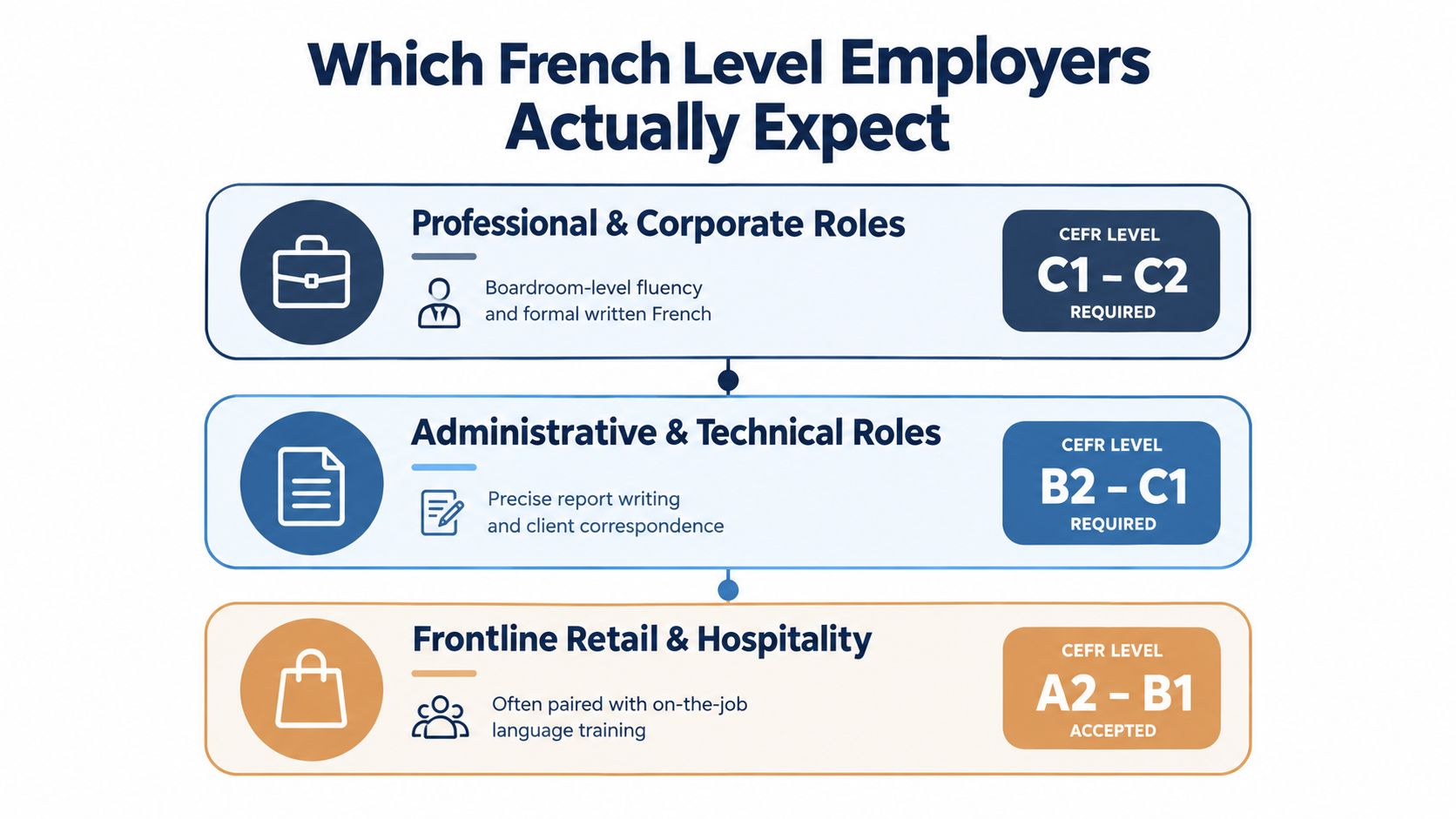
Use this role-based guide as a starting point:
- A2 to B1: Frontline retail, basic hospitality, and roles with substantial workplace support. You should manage greetings, routine requests, schedules, and simple problems.
- B1 to B2: Administrative support, customer service, junior analysis, and technical coordination. You need to understand instructions, write clear messages, and explain your work without translating every sentence mentally.
- B2: Client-facing business development, nursing, teaching French as a second language, and translation-related work. You must follow nuance, respond spontaneously, and handle professional correspondence.
- C1 or above: Legal counsel, medical practice, diplomacy, academic research, and leadership conducted mainly in French. Formal writing, negotiation, and implied meaning form part of the job.
Certificates can support your stated level. Depending on the position, employers may recognize DELF B2, DALF C1, or DFP. A certificate still cannot replace the ability to perform the work.
Test yourself with a realistic workplace scene. Could you explain a complicated project to a French-speaking colleague, write a polite disagreement to a client, and follow a fast meeting without translating each phrase in your head? If you manage only routine exchanges, B1 may be closer. If you can defend a position and write structured professional documents, B2 may be realistic. Detecting indirect criticism and adapting your register points toward C1.
For a concrete example of role-specific wording, compare the language in this LVMH associate manager purchasing job listing template.
Employers assess the difference between saying “I speak French” and showing that “I work effectively in French.”
Why Your Résumé Faces a Machine Before a Human in France
The elegant French CV, with its carefully chosen typography, has a less romantic first destination than a recruiter's desk. At many large employers, an applicant tracking system, or ATS, reads and sorts applications before a human opens the file. A 2025 analysis found a detectable ATS at 97.8% of Fortune 500 companies, while another summary reported that 99.7% of recruiters use keyword filters in ATS workflows, as documented in this ATS screening statistics analysis.
That doesn't mean every French company uses the same process. Large banks such as BNP Paribas and Société Générale, insurers such as AXA, retail groups, and public institutions may rely on systems including Taleo, Workday, or SuccessFactors. Smaller SMEs and family-run businesses are more likely to receive applications in a human inbox, where a manager may read the CV directly.
Match the language of the vacancy
France Travail advises candidates to mirror the exact wording of the job advertisement, including keywords for skills, tools, certifications, and soft skills. That means studying the intitulé du poste, missions, and compétences sections, then using accurate terms naturally rather than scattering a cloud of keywords across the page.
Suppose a listing requests gestion de portefeuille clients, Excel avancé, and anglais professionnel. If your experience supports those requirements, use the same French expressions in the relevant CV bullets. Don't replace them with vague equivalents such as “managed accounts” or “strong software skills” if the application is being evaluated in French.
Keep the file easy to read
Graphic-heavy layouts can confuse parsers. One 2026 ATS report cited a 4% parsing failure rate for DOCX versus 18% for PDF, and reported 93% parsing accuracy for single-column layouts versus 86% for two-column layouts in its tested comparison, detailed in this ATS filtering and keyword screening report.
A custom CV also performs better than a generic one in the cited data. A 2025 dataset covering 139,927 applications reported interview rates of 4.23% for customized résumés and 2.07% for standard résumés, summarized in this resume tailoring and ATS statistics report.
Practical rule: Treat ATS compatibility as the new polite handshake. Before a recruiter evaluates your story, the system must be able to identify it.
For a second-pass check of structure and keyword alignment, use an ATS resume checker. The aim isn't to make your CV robotic. It's to make sure the machine can accurately identify the human experience already inside it.
The French CV Versus the International Résumé
A French CV, short for curriculum vitae, often presents information more compactly and more formally than an Anglo-American résumé. Early-career applicants commonly aim for one page, while experienced candidates may need more space. The key is not a rigid page rule but a readable document that lets a recruiter find identity, education, experience, skills, and languages quickly.
French templates may also place personal information near the top. A professional photo remains common, and some templates retain lines for date of birth or marital status, although candidates should consider the expectations of the specific employer and the privacy implications of sharing such details. These conventions differ from many international résumés, where personal data is often minimized or omitted.
| Element | French CV | International Résumé |
|---|---|---|
| Length | Often concise, with a one-page convention for early-career applicants | Length varies more by experience and market |
| Photo | Optional but still common in many French templates | Often omitted, depending on country and employer |
| Personal details | May include photo, date of birth, or marital status near the top | Usually limited to contact and professional details |
| Opening section | Often starts with identity and target information | Frequently includes a summary or profile |
| Education | Diplomas, institutions, and dates receive visible emphasis | Education placement varies by experience |
| Experience | Chronological detail is common | Chronological or skills-based structures are both used |
| Cover letter | Lettre de motivation is common in many non-tech applications | Requirement varies widely |
| Formatting | Clean, scannable, and increasingly ATS-conscious | Can range from plain text to designed layouts |
The lettre de motivation is more structured than a casual note. Include a clear subject line beginning with Objet, explain why the role and organization fit your direction, and close formally. A hand-signed ending may still appear in traditional applications, especially when the employer requests a printed or formal document.
French CVs also tend to emphasize formation, expérience professionnelle, compétences, langues, and centres d'intérêt. Instead of opening with a long personal objective, candidates often let their role title, qualifications, and experience establish the professional context. Diplomas, internships, institutions, dates, and certifications deserve precise treatment.
The official French public-service explanation of the CV defines it as the document presenting a candidate's career path for selection during hiring. For foreign applicants, that means translating your achievements into a format local readers recognize without erasing the value of international experience.
A practical top-down order is:
- Identity and contact details.
- Target role or professional title.
- Formation, including diplomas and institutions.
- Expérience professionnelle, with dates and responsibilities.
- Skills, tools, certifications, and languages.
- Interests, memberships, or relevant volunteer work.
The best French CV isn't the one with the most decorative design. It's the one that makes your professional path easy to verify and easy to understand.
Your First Practical Steps Toward a French Career
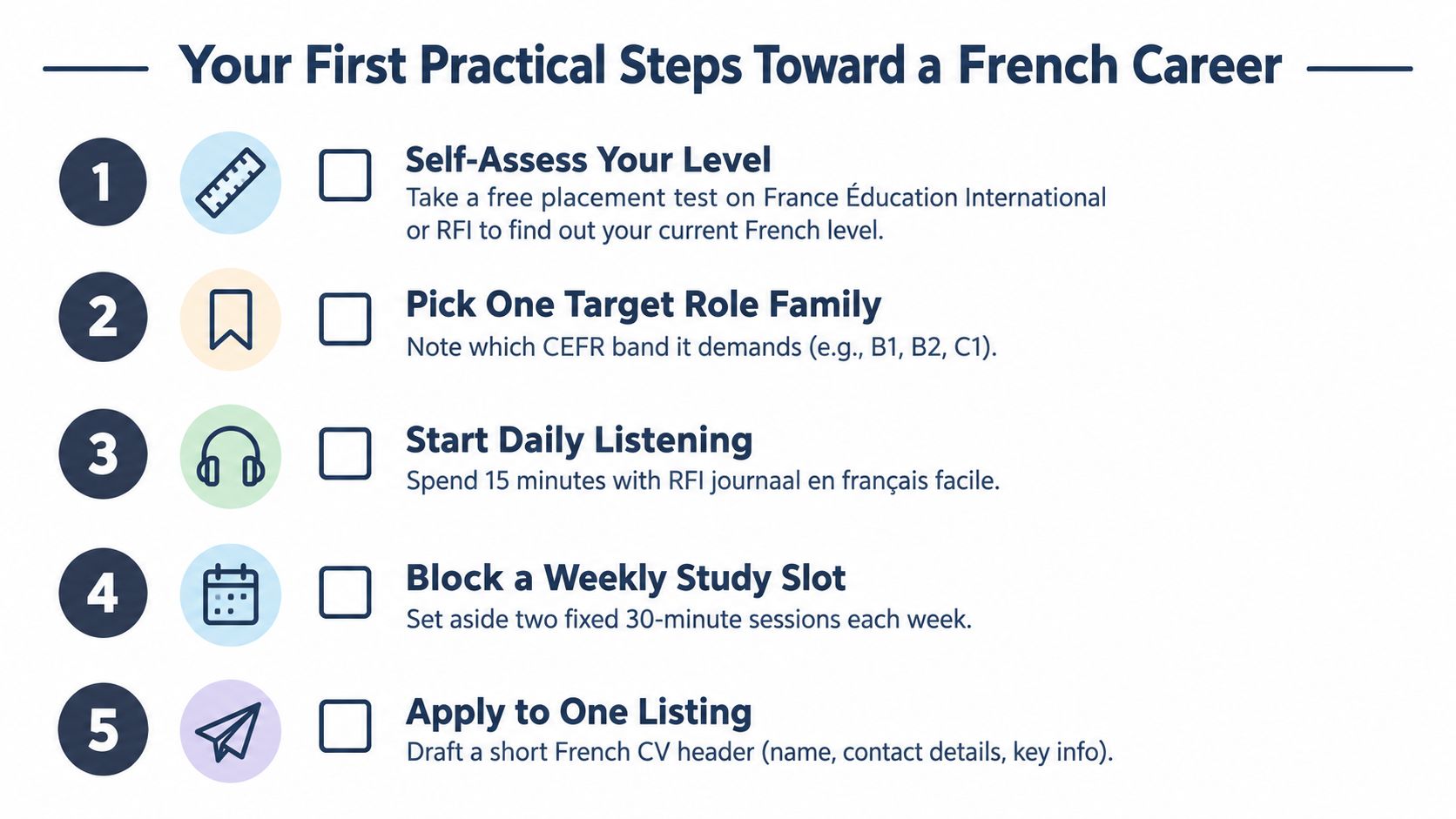
You don't need perfect French to begin preparing. Start by identifying the gap between your current ability and the language demands of one specific role.
- Assess your level. Take a free placement test through France Éducation International or RFI Savoirs and record your approximate CEFR level. Don't choose a target job based only on a vague feeling that your French is “pretty good.”
- Choose one role family. Pick nursing, customer support, engineering, compliance, hospitality, or another defined path. Read several vacancies in French and note whether employers ask for B1, B2, C1, or a certificate.
- Build a recognizable CV. Create an EU-format Europass CV, even if you later apply outside EU portals. French employers generally recognize the structure, and it gives you a useful starting framework for formation, expérience, and langues.
- Use official employment channels. Register with France Travail, formerly Pôle Emploi, for official listings. Check EURES as well if you're considering cross-border mobility.
- Verify your credentials. Contact the ENIC-NARIC centre about translating or evaluating foreign diplomas, so employers can understand your qualifications without having to decode an unfamiliar education system.
- Join your professional network. A sector association or union can introduce you to terminology, local expectations, and people who understand how hiring works in your field.
Finish the day by reading three target-sector job offers in French. Highlight recurring terms such as gestion de projet, relation client, suivi administratif, or connaissance de la réglementation. Then place the words your experience supports into your CV, rather than translating every line word for word.
A guide to tailoring your résumé to a job description can help you turn that vocabulary exercise into role-specific application content. Keep a small glossary for your sector and review it before interviews. The goal isn't to sound like a textbook. It's to show that you understand how employers describe the work.
Your French career can begin before your French is flawless. Choose a role, measure your level accurately, learn the vocabulary recruiters genuinely use, and improve one application at a time.
GetTheCall turns your LinkedIn profile or existing résumé into an ATS-optimized, job-specific PDF, matching your real experience to the language and requirements of each listing. Visit GetTheCall to check your résumé, tailor it for a French-speaking role, and apply with a clearer, more readable application.