ATS Resume Score: What It Means and How to Improve Yours
Understand what an ATS resume score measures, how it's calculated, and practical steps to raise yours before you apply for your next role.
You've customized your résumé, checked the spelling, and sent it to a job that seems like an excellent fit. Then the silence begins. No rejection, no interview invitation, sometimes not even confirmation that a recruiter saw your application.
That silence doesn't automatically mean your experience was weak. Many employers use applicant tracking systems, or ATSs, to collect, organize, search, and filter applications before a person reviews them. The U.S. Department of Labor explains that these systems may scan for keywords, former employers, years of experience, and schools, then use algorithms or artificial intelligence to sort large applicant pools and recommend candidates. The Department of Labor's résumé guidance also warns that qualified applicants can be screened out when their résumés omit terms the system is programmed to find.
That's where the ATS resume score enters the picture. It can help answer a practical question: does this particular résumé clearly communicate relevant experience to this particular job description in a format software can read?
The score isn't a verdict on your career, and it isn't a reliable promise of an interview. It's more useful as a diagnostic lens. It can show where your résumé is difficult to parse, where important requirements are missing, and where your experience is present but not clearly connected to the role. Once you understand those limits, you can improve the document without turning it into a pile of repeated keywords.
Table of Contents
- The Moment Your Application Disappears
- What an ATS Resume Score Actually Measures
- The Signals That Move Your Score Up or Down
- How a Live Match Score Updates as You Edit
- What Different Score Ranges Actually Mean
- When a High Score Can Actually Hurt You
- A Practical Pre-Submit Checklist to Raise Your Score
- Using Your Score as One Signal Among Many
The Moment Your Application Disappears
Maya has worked in customer operations for several years. She has handled escalations, improved support processes, trained new team members, and partnered with product managers to report recurring customer problems. For a customer success manager role, she created a clean résumé with a modern layout and sent it confidently.
The job description asked for customer retention, stakeholder management, CRM experience, onboarding, and account reviews. Maya's résumé described nearly all of that work, but it used different language. It referred to “client relationship coordination” instead of customer success, “system administration” instead of CRM management, and “new client orientation” instead of onboarding. Her job title sat inside a graphic header, and her skills appeared in two narrow columns.
A recruiter reading the document might understand the connection. An ATS might not extract it accurately or might fail to associate those terms with the requirements it was configured to find.
The important distinction: A résumé can be professionally strong and still be machine-invisible for a particular vacancy.
Applicant tracking systems have become a significant part of résumé screening, especially at larger employers. In research on alternative credentials, SHRM reported that 45% of surveyed HR professionals said their organization used automated prescreening to review applicant résumés. Yet only 32% said their automated system recognized alternative credentials, which shows how much results can depend on labeling and structure.
Maya's problem isn't necessarily that she lacks the right background. Her application may have failed to make that background searchable and recognizable. Understanding an ATS resume score helps separate those two possibilities. You can then fix the communication problem while keeping every claim accurate and defensible.
What an ATS Resume Score Actually Measures
Think of an ATS as a library card catalog, not a hiring manager. A librarian can understand that two books are related even if their titles use different wording. A card catalog, however, depends on consistent fields, labels, and searchable terms.
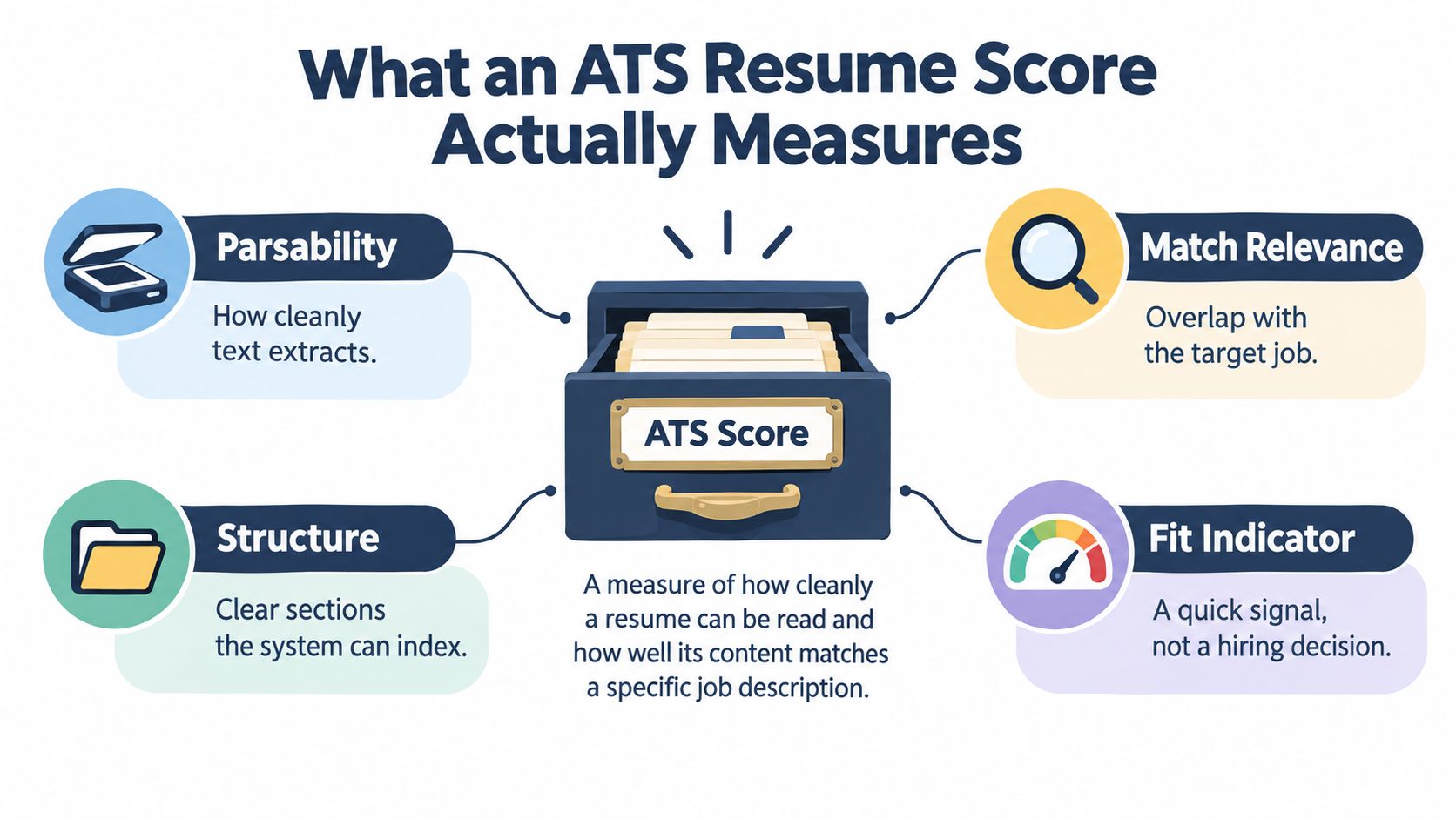
An ATS resume score estimates how cleanly your résumé can be read and how closely its content corresponds to one target job description. It doesn't measure your universal employability. A résumé may receive a different result for another role because the requirements, terminology, seniority, location criteria, and screening rules have changed.
First comes parsing
Parsing is the extraction stage. The system tries to identify your contact information, section headings, education, job titles, employers, employment dates, skills, certifications, and languages.
Dartmouth's career guidance describes parsing as the process of reading and categorizing résumé content before matching keywords against the job posting. Its ATS guidance emphasizes that the system looks for plain text and recognizable formatting patterns rather than interpreting the document as a person would.
If your employer name is embedded in an image, your dates are scattered across a decorative layout, or your employment history sits inside an unsupported structure, the system may extract incomplete information. A keyword can exist visually on the page and still be unavailable to the parser.
Then comes matching
The matching layer compares extracted résumé content with the job's requirements. It may look for skills, responsibilities, qualifications, experience, location, and terminology.
A match is stronger when the target term appears in a credible context. “Stakeholder management” in a work-history bullet is more informative than placing the phrase in a long, unsupported skills list. Strong systems can distinguish exact terms from synonyms and assess whether a skill is connected to relevant evidence.
Finally comes ranking or filtering
The system may apply configured criteria, knockout questions, Boolean searches, or ranking rules. Some workflows remove applications that fail minimum requirements, then use résumé searches to identify candidates who meet important criteria. A published hiring-guideline study describes a process that narrowed the remaining pool to approximately 5–10 candidates before sending résumés to a hiring manager. The study is available through PubMed Central.
That's why an ATS score is best understood as a job-specific compatibility indicator. It tells you whether the document is readable and aligned enough to deserve closer attention. It doesn't tell you whether an employer will choose you.
The Signals That Move Your Score Up or Down
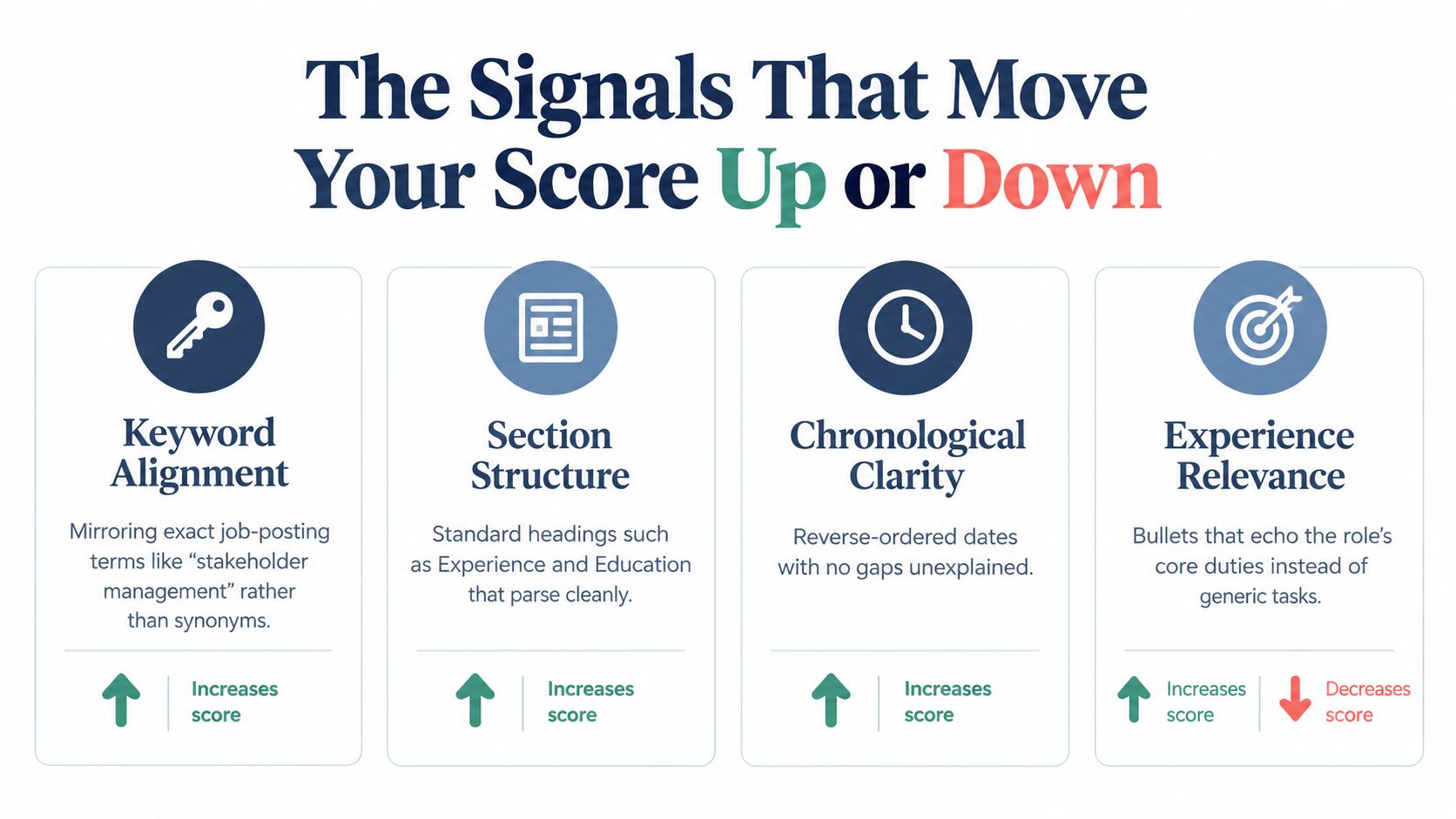
The score usually responds to four connected signals: keyword alignment, section structure, chronological clarity, and experience relevance. Each one answers a different question.
Keyword alignment asks whether your résumé uses the language of the vacancy. If the posting requires “stakeholder management,” using only “cross-functional communication” may communicate a related ability to a person, but it may not satisfy a narrow keyword search. Use the exact phrase when it truthfully describes your work.
Section structure determines whether the system knows what each piece of information represents. Conventional labels such as Experience, Education, Skills, and Certifications give the parser useful signposts. Decorative headings such as “My Story” or “What I Bring” may look appealing but create avoidable ambiguity.
Chronological clarity helps the ATS connect titles, employers, and dates. Use a consistent reverse-chronological order, make month and year formats consistent, and keep each role's dates close to its title and employer.
Experience relevance is the evidence layer. A résumé that lists “CRM” in a skills section may match a term, but a bullet explaining how you used Salesforce to manage renewals gives the system and the recruiter much more to work with.
The same experience can produce different signals
Before:
- Task wording: “Worked with different teams to improve customer processes.”
- Tool wording: “Used systems to track accounts.”
- Role label: A job title placed inside a graphic.
- Structure: Skills presented in a dense visual sidebar.
After:
- Relevant responsibility: “Managed stakeholder communication across support, product, and sales teams to improve customer onboarding.”
- Recognizable tool: “Used Salesforce to track account activity, renewal risk, and customer follow-ups.”
- Clear title: “Customer Operations Specialist” in selectable text.
- Standard structure: Experience, Education, Skills, and Certifications as ordinary headings.
The second version doesn't invent experience. It translates existing work into terms that a target job and an ATS can recognize. For a practical walkthrough of this process, use this guide to tailoring a résumé to a job description.
How a Live Match Score Updates as You Edit
A useful live score should behave like a dashboard, not a mysterious grade. Suppose you're applying for a customer success manager role that emphasizes onboarding, stakeholder management, Salesforce, retention, account reviews, and team leadership.
Your first scan might show a mixed picture:
- Skills: Salesforce is clearly listed, but retention and account reviews appear only indirectly.
- Responsibilities: Your résumé demonstrates onboarding, though the word appears only once.
- Seniority: Your title suggests relevant responsibility, but the bullets don't show ownership.
- Tools: Salesforce is supported by a work-history bullet, while another required platform appears only in the skills list.
- Education: The required degree is easy to locate and parse.
- Format: The document extracts cleanly, so formatting isn't the main problem.

The headline score matters less than the explanation beneath it. “Retention missing” calls for a different edit from “retention present, weak evidence.” The first suggests you should add the term if it accurately describes your work. The second suggests you should rewrite a bullet to show what you did and what changed.
Read the evidence status
Classify each requirement into three groups:
- Present and supported: The term appears in a relevant role, and the bullet demonstrates how you used it.
- Present but weak: The term appears, but the context is vague, old, or disconnected from an accomplishment.
- Missing: The résumé doesn't show the requirement, or it uses wording that doesn't make the connection clear.
A strong editor might change “Supported customer accounts” to “Managed customer onboarding and quarterly account reviews for enterprise clients, coordinating stakeholder updates across support and product.” That edit improves more than keyword coverage. It makes the responsibility legible to a recruiter.
After the edit, the score should update in a direction you can interpret. If adding an accurate bullet about account reviews changes the responsibility breakdown but doesn't change formatting, you've learned that content was the bottleneck. If the system still can't find the employer or dates, you need a parsing fix instead.
The GetTheCall ATS resume checker is one option for reviewing parsing and keyword alignment before submission. Whatever tool you use, treat its score as a comparison against the target posting, not as a universal hiring prediction.
Here's a short demonstration of the kind of edit that makes a breakdown useful:
Don't make five unrelated changes at once if you're trying to learn from the result. Edit the largest evidence gap first, rerun the analysis, and confirm that the wording still sounds like something you could explain in an interview.
What Different Score Ranges Actually Mean
Score ranges are useful only when treated as decision aids. Different systems use different formulas, and some employers don't expose a numeric score at all. A result from a résumé tool is therefore a proxy for alignment, not a universal threshold.
A score around 40% usually suggests a substantial mismatch, poor extraction, or both. Check whether the résumé was written for the right role, whether important sections parse correctly, and whether mandatory requirements are represented.
A result around 70% often means the résumé is workable but incomplete. You may have the right role family and several relevant skills, while missing specific responsibilities, tools, qualifications, or clearer evidence.
A result around 90% can indicate strong alignment, but it shouldn't become a target at any cost. If reaching that number requires repeating terms, adding unsupported skills, or padding the document, the apparent improvement may reduce human credibility.
| Score range | What it usually means | Recommended action |
|---|---|---|
| Below 50% | The résumé may be poorly parsed or aimed at a different role. | Check structure first, then rebuild the content around the vacancy's genuine requirements. |
| 50% to 69% | The document has some alignment but leaves important gaps. | Identify missing requirements and add truthful evidence where you have it. |
| 70% to 89% | The résumé is generally relevant, with wording or evidence gaps remaining. | Make targeted edits, then stop when the document is clear and plausible. |
| 90% and above | The wording appears closely aligned with the job description. | Review every claim for accuracy and human readability before submitting. |
The practical question isn't “How do I reach 100%?” It's “Can the system find my relevant qualifications, and can a recruiter understand the proof quickly?” Employers configure screening differently, so a score that looks strong in one tool can't guarantee the same result in another workflow.
When a High Score Can Actually Hurt You
A high score can hide a weak application when the number rewards lexical overlap more than credible evidence. Repeating “stakeholder management,” “customer success,” and “strategic leadership” across a résumé may increase visible alignment, but it doesn't prove that you performed those activities.
Recruiters notice when a skills list is much stronger than the work history beneath it. They may ask where you used a tool, what decision you made, which teams you influenced, or what outcome followed. If your résumé can't answer those questions, the high score has helped you pass one mechanical check while creating doubt in the human review.
A useful test: If you can't explain a matched requirement with a specific example from your work, don't present it as a proven skill.
This matters even more as employers move toward skills-based hiring. Recent skills-based-hiring research reports that 85% of employers used skills-based hiring in 2025, compared with 81% the previous year. The same research says résumé use fell from 73% to 67%, and only 48% of U.S. employers said résumés were effective for determining candidate capabilities. It also reports that 36% of employers use skills tests before screening résumés.
Those findings don't make ATS preparation irrelevant. They change its role. Your résumé should make your capabilities discoverable, while your portfolio, work sample, assessment, and interview examples should make those capabilities believable.
Watch for three warning signs:
- Unsupported density: The document contains many job-posting terms but few examples of using them.
- Inflated seniority: The summary claims ownership, strategy, or leadership that the experience bullets don't support.
- Human friction: The résumé sounds unnatural because every sentence was rewritten to mirror the vacancy.
The goal is not to make the score as high as possible. It's to make the score reflect a résumé you'd be comfortable defending.
A Practical Pre-Submit Checklist to Raise Your Score
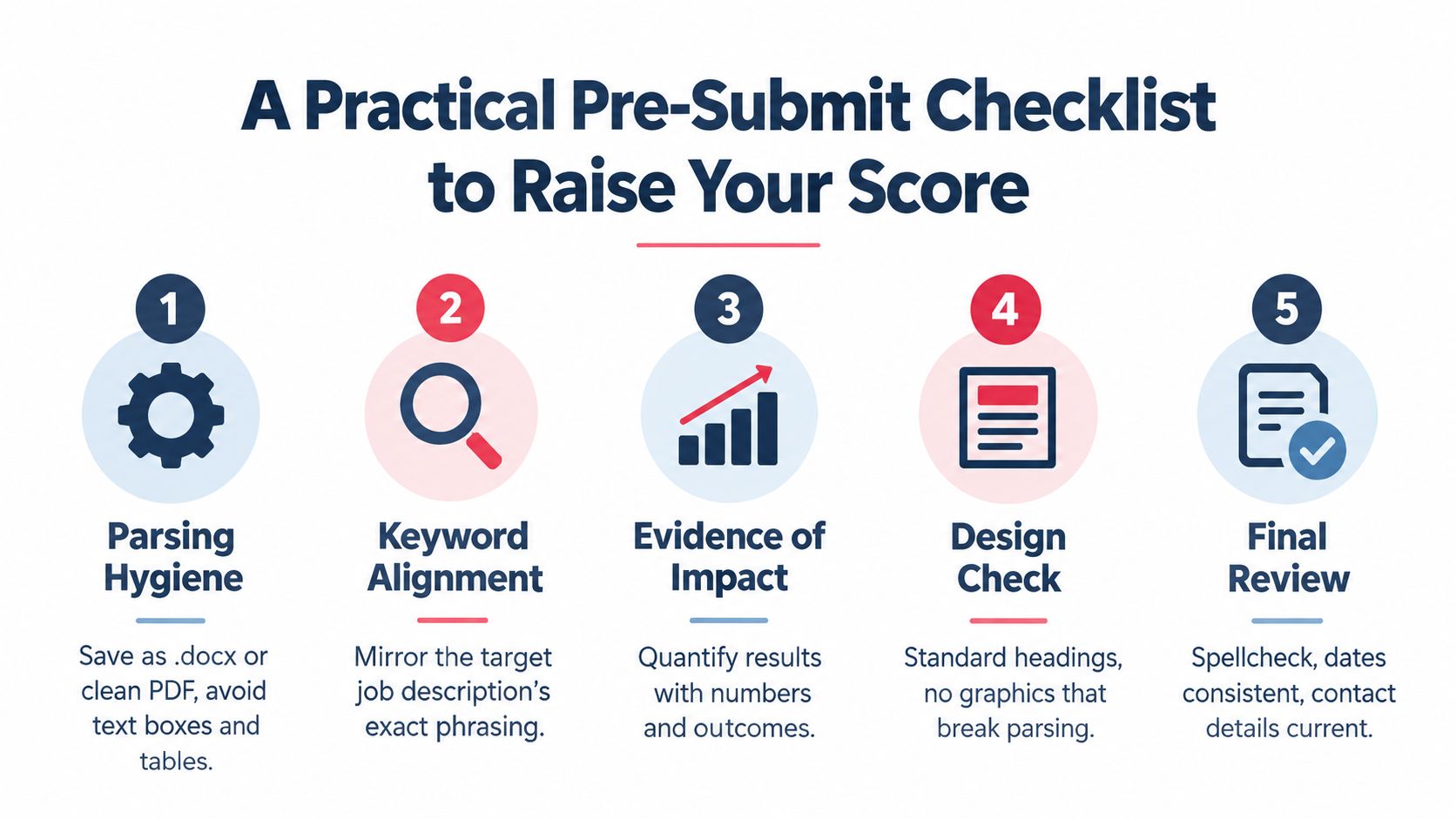
Run this checklist against the exact job description, not a generic version of your résumé. Each step addresses a different failure point.
1. Clean up parsing hygiene
Open the exported file and select the text. If you can't select a job title, employer, date, or section heading normally, the ATS may struggle too. Use a simple structure, conventional headings, selectable text, and a file format the employer accepts.
2. Mirror truthful job language
Find the role's required skills and responsibilities. If you have them, use the same terminology in the relevant experience section. For example, change “coordinated team relationships” to “managed stakeholders” only when that accurately describes your work.
3. Connect skills to evidence
Don't leave important terms isolated in a skills list. Add them to a bullet that explains the setting, action, and result. “Salesforce” is clearer when paired with the accounts, workflows, reports, or customer process you handled.
4. Show impact without exaggerating
Add a concrete outcome to at least one recent bullet when you have a reliable figure. You might describe reduced processing time, completed projects, revenue influenced, customers supported, or error rates improved. If you don't know the number, explain the result qualitatively rather than inventing one.
5. Keep the design readable
Replace decorative section names with standard labels. Avoid putting critical information in graphics, headers, footers, text boxes, or complex tables. A polished résumé can still use restrained visual hierarchy, but the words must remain easy for software to extract.
6. Check chronology
Review every employer, title, location, and date. Use one date style throughout and explain legitimate transitions in a way that doesn't create confusion.
7. Run a human plausibility pass
Read the résumé without looking at the score. Does the summary match your actual level? Do the bullets support the listed skills? Could you discuss each important requirement in an interview?
For more formatting guidance, see this ATS-friendly résumé guide.
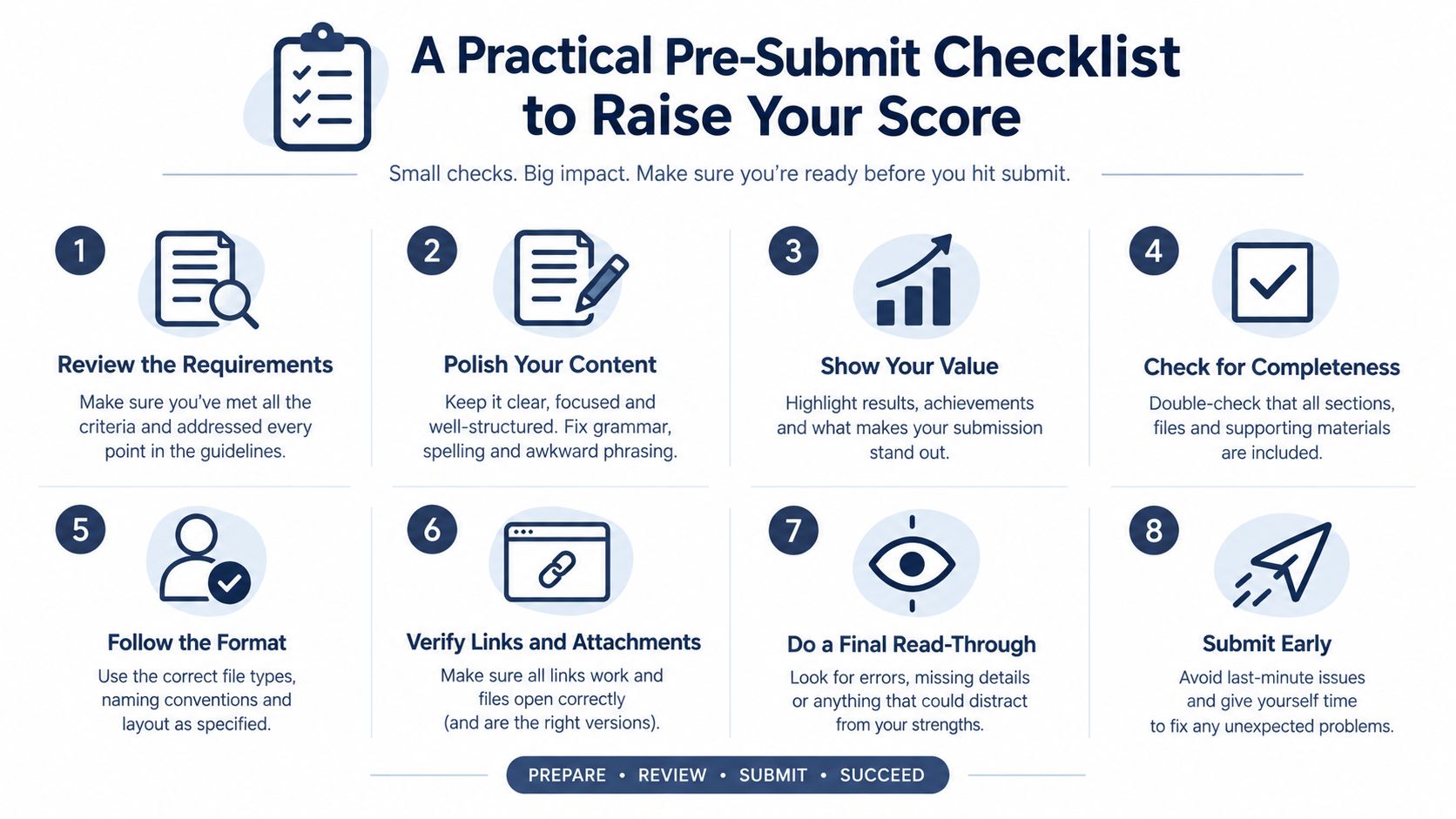
8. Compare the result with the original
Rerun the score after meaningful edits and inspect which categories changed. If only the number moved but the evidence remains unclear, the tool may be rewarding wording without measuring substance. Keep the version that communicates your real qualifications most clearly.
Using Your Score as One Signal Among Many
An ATS resume score is a readiness check, not a career judgment. It can help you find missing terminology, weak evidence, and parsing problems before an employer encounters them. It can't evaluate your full potential, your interview performance, your work sample, or the quality of a recruiter's judgment.
The hiring environment also shows why automation should be treated as an early filter. SHRM reported in 2025 that 43% of surveyed organizations used AI to support HR work, and nearly 90% of organizations using an AI tool said it saved time or increased efficiency. That efficiency helps explain why employers automate parts of screening, but it doesn't turn an ATS score into a hiring decision.
Use the score to become easier to find, then use honest accomplishment statements to become easier to choose. Recheck the document after each meaningful edit, and stop when it is readable, relevant, and defensible.
GetTheCall turns a LinkedIn profile or existing résumé into a job-specific, ATS-oriented PDF, with a live match score that updates as you align verified experience to a target listing. Visit GetTheCall to check your résumé, identify parsing and keyword gaps, and prepare a clearer application for your next role.