Area of Expertise on Your Résumé: How to Show It
Learn how to define your area of expertise for ATS. Turn your core skills into a sharp résumé section that wins interviews with targeted examples.
You've probably had this experience: you match most of a job description, upload a résumé that looks polished, and still receive no response. The problem may not be a lack of ability. It may be that your document presents general qualifications instead of a specific, verifiable area of expertise that both software and recruiters can recognize quickly.
An area of expertise isn't just a list of tools, responsibilities, or personality traits. It's the focused value you bring to a particular kind of problem, supported by evidence from your work. When your résumé makes that value clear, every section works harder, from the summary and skills section to the bullets describing your results.
Table of Contents
- The Power of a Focused Expertise
- Defining Your Area of Expertise
- Why Expertise Matters More Than Ever
- How to Identify and Articulate Your Core Skills
- Examples of Strong Expertise Statements
- Tailoring Your Expertise for ATS and Recruiters
The Power of a Focused Expertise
A résumé can contain impressive experience and still feel directionless. Consider a marketing candidate who writes, “Experienced in social media, email marketing, analytics, content creation, project management, and communications.” Nothing in that list is necessarily weak, but the recruiter still has to determine what the person does best.
Now compare it with: “B2B demand generation specialist focused on turning paid and organic campaigns into qualified pipeline through audience segmentation, lifecycle email, and conversion analysis.” The second version gives the reader a working hypothesis. It identifies a business problem, a professional context, and the capabilities used to solve it.
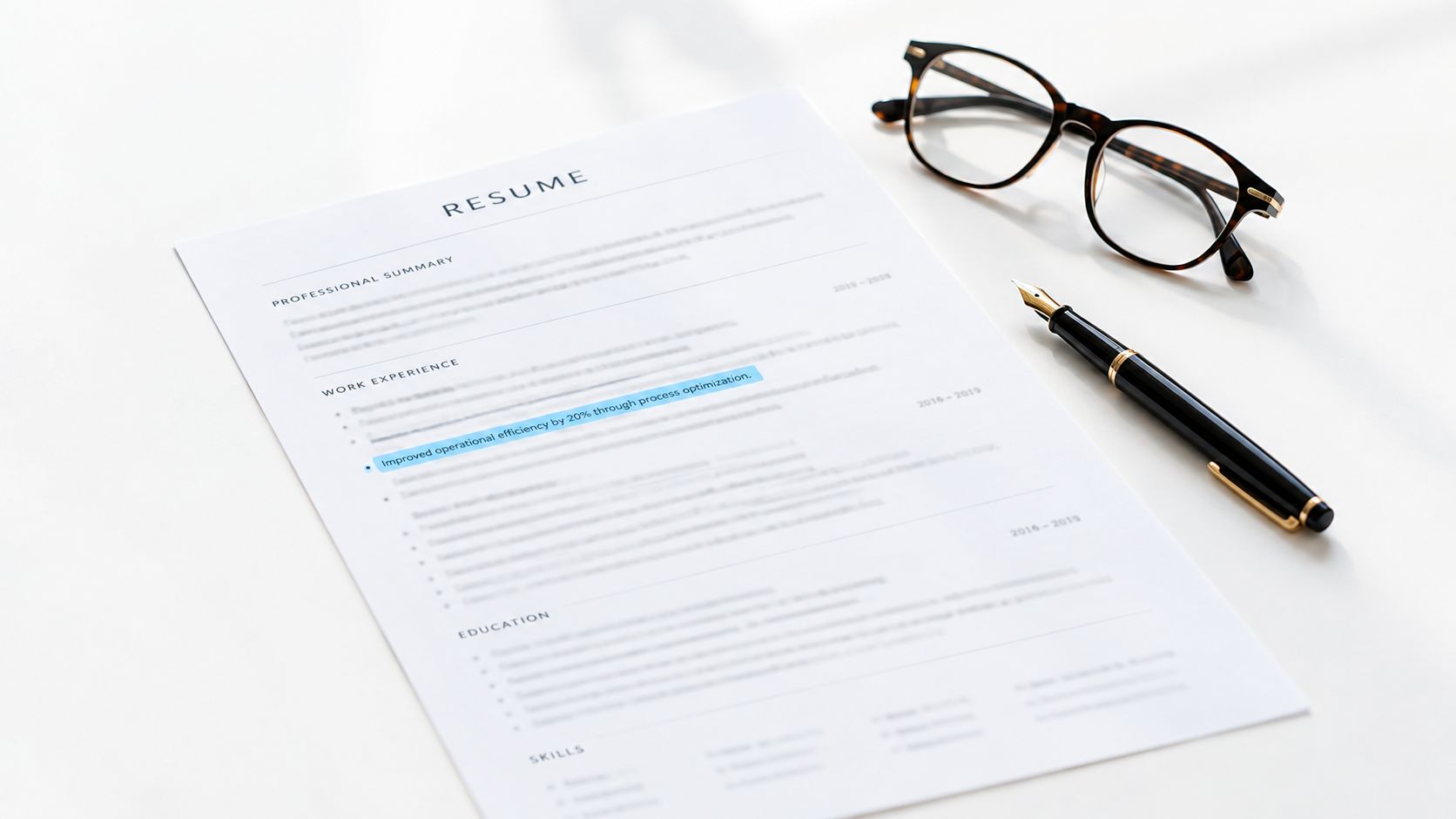
That distinction matters in high-volume hiring. Recruiters often scan for relevance before they study nuance, while an Applicant Tracking System, or ATS, extracts fields such as job titles, dates, skills, employers, education, certifications, and languages. If your strongest capability is buried in a graphic, vague heading, or disconnected list, the system may not associate it with the right role or achievement. Research on résumé parsing describes this as an information-extraction problem, not a visual-design contest.
Practical rule: Lead with the problem you solve, then name the capabilities and evidence that prove you solve it.
A focused expertise statement also changes how you edit the rest of the document. You can remove duties that don't support the target role, move relevant achievements higher, and choose examples that reinforce the same professional identity. The result isn't a résumé that claims you can do everything. It's a targeted argument for why your experience fits this opportunity.
Defining Your Area of Expertise
A skills list is like a toolbox. It tells someone which tools you possess, but it doesn't show whether you know which tool to use, when to use it, or how to produce a reliable result.
An area of expertise is closer to the work of a master craftsperson. It combines domain knowledge, repeated application, judgment, and a recognizable method. A data analyst might list SQL, Python, dashboards, Excel, and A/B testing. Their actual expertise could be “translating fragmented customer data into retention decisions for subscription products.” The tools support the statement, but they aren't the statement itself.
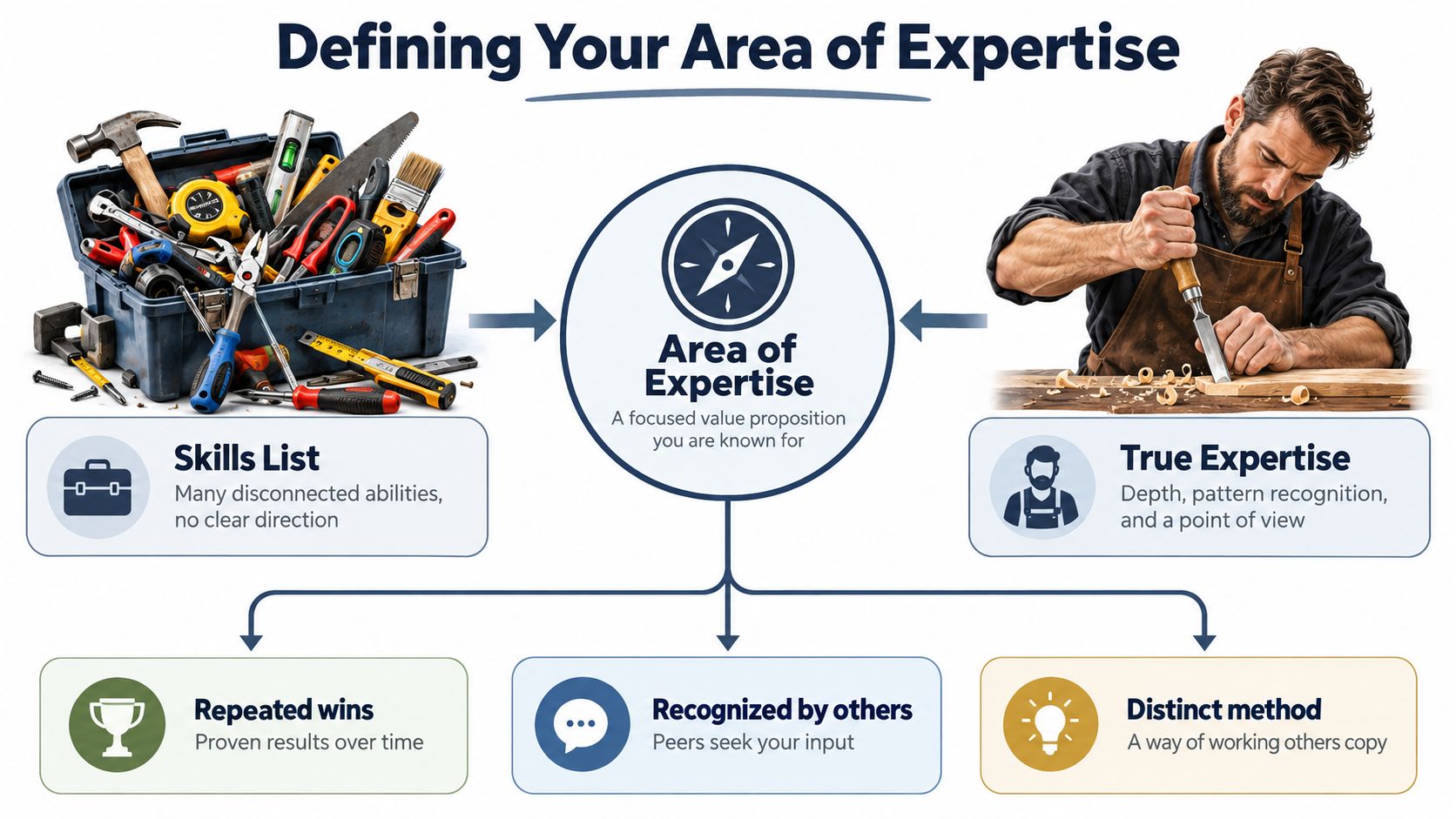
Use three tests to separate a genuine specialty from a collection of keywords:
- Repeated wins: Have you used this capability across projects or roles, with outcomes you can verify?
- Recognition: Do colleagues, managers, clients, or stakeholders seek your judgment in this area?
- Distinct method: Do you approach the problem in a way that produces consistent, explainable results?
The strongest expertise statements combine a who, a problem, and a method. “Operations professional” is too broad. “Operations coordinator who improves handoffs between customer support and fulfillment teams through workflow mapping and performance tracking” gives the reader something concrete to evaluate.
Don't force a niche that your history can't support. A specialist label becomes fragile when the résumé contains no matching projects, tools, outcomes, or decisions. You can be developing an area of expertise, but describe it accurately as a focus or strength until the evidence shows sustained application.
A credible specialty is narrow enough to be memorable and broad enough to describe the work you can actually perform.
This framing also keeps transferable abilities in view. Analytical thinking, communication, prioritization, and adaptability aren't decorative additions to technical expertise. They explain how you apply specialized knowledge when circumstances change.
Why Expertise Matters More Than Ever
The labor market increasingly values people who can combine specialization with adaptability. The World Economic Forum's 2025 Future of Jobs Report draws on responses from more than 1,000 companies across 55 economies and estimates that 39% of workers' current core skills will change by 2030. That projection doesn't make specialization less useful. It changes what a useful specialty looks like.
The report identifies analytical thinking as essential to approximately 70% of surveyed companies. It also ranks resilience, flexibility, and agility at 67%, leadership and social influence at 61%, creative thinking at 57%, motivation and self-awareness at 52%, and technological literacy at 51%. These capabilities help explain why a résumé that names only software or industry knowledge often feels incomplete.
A strong area of expertise therefore has two layers:
- The domain layer, such as financial reporting, clinical operations, enterprise sales, cybersecurity, or paid acquisition.
- The application layer, such as diagnosing patterns, influencing decisions, adapting processes, or communicating complex findings.
The fastest-growing technical skill groups identified in the report include AI and big data, networks and cybersecurity, and technological literacy. Listing “AI” alone won't establish expertise. A better statement explains how you use relevant technology in a real business context, such as automating reporting, improving forecasting, or strengthening access controls, provided your résumé contains evidence for that claim.
This is why job titles are weak substitutes for expertise. Titles vary between employers, while capabilities and outcomes travel more reliably across organizations. Your résumé should make that translation easy for a recruiter who may not know the exact scope of your previous title.
How to Identify and Articulate Your Core Skills
Start with evidence, not adjectives. Words such as strategic, proactive, results-oriented, and collaborative may describe you, but they rarely prove anything without a situation and an outcome.
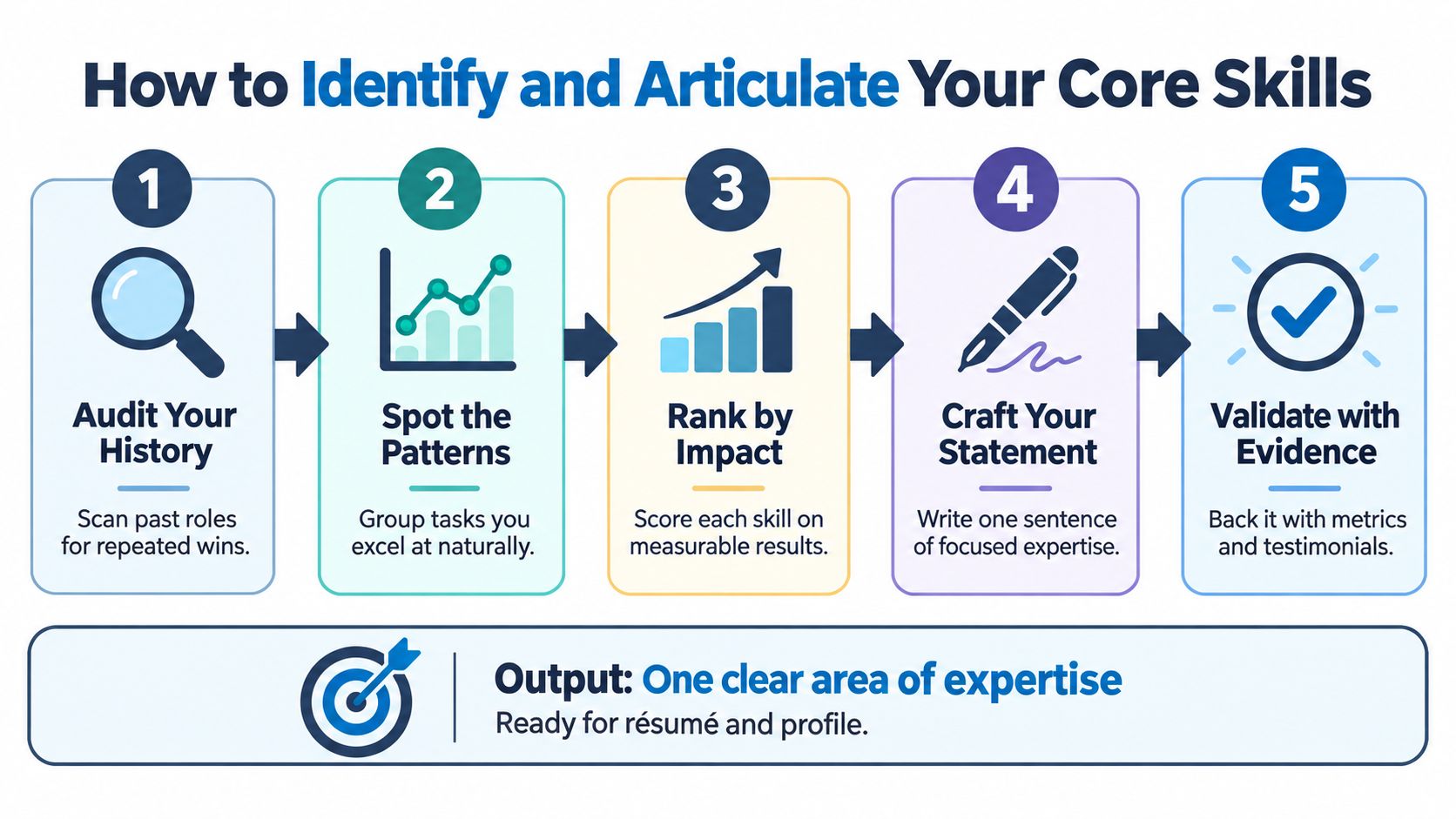
Audit your work history
Review projects, promotions, difficult assignments, and moments when someone trusted you with a complex problem. Write down what changed because of your contribution. Include formal employment, freelance work, internships, volunteer projects, and relevant personal projects when they demonstrate the same capability.
Group recurring problems
Look for patterns across those examples. Perhaps you repeatedly improve onboarding, build reporting systems, resolve escalations, clarify technical information, or convert ambiguous requirements into deliverable plans. The pattern is more valuable than any isolated task.
Rank the evidence
Prioritize capabilities that connect to outcomes, scope, or decision-making. If you can't disclose a figure, describe the result accurately in qualitative terms, such as reducing confusion, improving consistency, shortening handoffs, or enabling a decision.
Write one focused sentence
Use a structure such as: “I help [type of organization or team] achieve [specific outcome] through [relevant capabilities].” Keep the language close to the target role, but don't add a tool, responsibility, or achievement you haven't used or delivered.
Validate every claim
Check each phrase against your employment records, project files, portfolio, performance feedback, or references. A practical guide to tailoring a résumé to a job description can help you compare your evidence with the employer's requirements without turning the résumé into a keyword dump.
Your final statement should act as a filter. If a bullet doesn't support it or the job you're targeting, revise it, move it lower, or remove it.
Examples of Strong Expertise Statements
The difference between generic and focused language becomes clearer in a direct comparison.
| Generic wording | Focused wording |
|---|---|
| “Marketing professional with experience in many digital channels.” | “Content strategist who builds search-led editorial programs for software audiences, from topic research through performance analysis.” |
| “Managed projects and worked with cross-functional teams.” | “Program coordinator who turns complex product launches into sequenced plans across engineering, sales, and customer education.” |
| “Experienced customer service representative.” | “Customer support specialist focused on resolving technical account issues, documenting recurring defects, and improving self-service guidance.” |
| “Finance professional skilled in reporting and analysis.” | “Financial analyst who converts operating data into forecasts, variance explanations, and planning recommendations for department leaders.” |
The focused versions work because they connect a professional identity to a recognizable business problem. They also give ATS software useful language without relying on repetition. If a job description asks for “content strategy,” “technical support,” “program coordination,” or “financial forecasting,” the relevant phrase can appear naturally because it describes the work.
Match the role without copying it
Suppose an employer needs a recruiter who can source technical candidates and improve hiring-manager communication. “Recruiting and communication” is too thin. “Technical recruiter focused on sourcing specialized talent, calibrating intake requirements, and keeping hiring teams aligned through structured candidate updates” is more useful, assuming your history supports those activities.
For a Google-focused application, this résumé guidance for Google roles can help you think about role-specific evidence. The goal isn't to imitate a company's vocabulary mechanically. It's to make the relationship between your past work and the employer's needs obvious.
Avoid statements that claim an identity without proof, such as “industry-leading,” “visionary,” or “expert in everything from strategy to execution.” A recruiter can't test those phrases quickly. Specific scope, methods, and outcomes give them something credible to assess.
Tailoring Your Expertise for ATS and Recruiters
Your area of expertise should remain stable enough to be recognizable, but it shouldn't be identical on every application. A sales résumé for enterprise software should foreground different evidence from one aimed at partnerships, even if both roles draw from the same career history.

Begin by identifying the target role's actual requirements. Separate essential capabilities from preferred tools, recurring responsibilities from employer-specific language, and evidence you possess from evidence you still need to develop. Then adjust the headline, summary, skills order, and achievement bullets so the most relevant proof appears early.
Document readability is part of this process. One reported evaluation found approximate parsing accuracy of 96.7% for plain-text résumés, 90% for standard templates, 80% for graphic résumés, 70% for infographic résumés, and 53.3% for image-converted résumés in its tested materials, as reported in research on AI-powered applicant tracking systems. The figures aren't a universal guarantee, but they illustrate why selectable text, conventional headings, predictable reading order, and restrained design are safer choices.
A polished editor view doesn't prove that the exported PDF will parse correctly. Open the final file, select text, copy the content into a plain-text editor, and check whether headings, bullets, dates, keywords, and role-employer relationships remain intact.
A match score is a diagnostic, not a verdict. It can reveal missing language or formatting problems, but it can't judge your integrity, judgment, or potential on its own.
Over-optimizing creates its own risks. Repeating a keyword unnaturally can make the résumé unpleasant to read, while adding unsupported claims can create problems during interviews or reference checks. A 2025 analysis of approximately 361,000 fictitious résumés found that leading language models produced different evaluations for otherwise identical qualifications when names signaled different gender and racial identities; the models most often disadvantaged Black men relative to comparable White men. The VoxDev discussion of that research also reports that men and women were selected at equal rates in only 37% of tests, with male-associated names favored in 51.9% and female-associated names in 11.1%.
That evidence is another reason to treat automated evaluation cautiously. Use tools to identify gaps, preserve provenance for every rewritten bullet, and review applications through more than one channel when possible. A résumé should help a fair reviewer find your expertise, not ask a flawed system to define it.
Get a final parser check with this ATS-friendly résumé guide, then read the document as a hiring manager would. Can you identify the role you want, the problem you solve, and the evidence behind your claims within a quick scan?
A customized résumé can improve relevance without promising an interview. In a 2026 experiment reported by Kickresume, 204 real applications were divided among four résumé versions, with 51 applications per version. Generic AI-generated résumés produced a 10% response rate, while versions customized to each job posting produced an 18% response rate, an increase of 8 percentage points, or 80% relative to the generic baseline. Because the applications ran in phases rather than as a fully randomized head-to-head trial, treat the result as an indication, not a universal benchmark.
The practical sequence is straightforward: define your expertise, map it to the role, preserve only verified claims, export a readable document, and inspect the final file. That combination gives both the parser and the recruiter a fair chance to understand what you can do.
GetTheCall turns a LinkedIn profile or existing résumé into a job-specific, ATS-optimized PDF using your verified experience. It analyzes the target listing, suggests relevant rewrites, provides a live role match score, and lets you export across professional layouts. Visit GetTheCall to make your area of expertise clearer and tailor your next application with evidence rather than guesswork.