Address on Resume in 2026: What to Include and What to Skip
Address on Resume. Should you put your address on a resume in 2026? Learn what to include, what to leave off, and how to handle location

The popular advice is wrong: a full home address doesn't belong on most modern resumes. Your street, apartment number, and ZIP code were once useful because applications traveled through the postal system. Today, employers usually receive resumes electronically, recruiters scan PDFs, and hiring systems look for a usable location signal rather than a destination for mailed correspondence.
For most applications, put your city and state, province, or region in the contact block. Add your country when it helps clarify where you're authorized to work or where you're applying. Remove the street address, unit number, and ZIP code unless an employer specifically requests them through a secure process.
The right header still needs to communicate four things: how to reach you, where you're based, whether you can work in the relevant location, and how easily systems can search your information. The best address-on-resume choice depends on the role, too. Local, hybrid, fully remote, and cross-border applications don't create the same screening needs.
By the end, you'll know exactly what to type, what to leave out, and when dropping location entirely makes sense.
Table of Contents
- The Old Address Rule No Longer Applies
- What Recruiters and ATS Actually Read From Your Header
- Privacy and Bias Risks of a Full Street Address
- Match Your Location to the Role Type
- Modern Contact Block Format and Quick Checklist
- A Before and After Header You Can Copy Tonight
The Old Address Rule No Longer Applies
For decades, resume advice treated the full mailing address as standard. A candidate might list a street, apartment or unit, city, state, and ZIP code directly beneath their name. That format made sense when applications were physically mailed and recruiters needed a postal destination for follow-up. Once electronic applications became normal, the street line lost most of its practical value, as modern resume guidance on address details explains.
The old format also assumed that every resume would stay with one employer. That assumption doesn't hold in a digital hiring process. You may upload a PDF to a job board, send it through an applicant tracking system, email it to a recruiter, or share it with a hiring manager. A full home address can travel far beyond the person who first receives it.
What your header must accomplish
Your contact block is not a mailing label. It's a quick identity and screening tool. Recruiters need to know whether they can contact you, whether your location fits the role, and whether they should ask about relocation or work authorization. They don't need your front door.
A strong header usually includes:
- Reachable contact: A phone number and professional email address that you monitor.
- Useful location: City and state, province, or region when geography affects eligibility or logistics.
- Work-readiness signal: A short statement about authorization, relocation, or time-zone availability when relevant.
- Searchable text: Plain, recognizable fields that software and people can read without interpretation.
The practical default is simple: city plus state or region, with country added when useful. Recruiters still use location as a screening field, while exact street details add little value. City and region also reflect the shift from postal-era formatting to digital hiring workflows.
Practical rule: Your resume should identify your professional location, not expose your residence.
There are exceptions. A local role may benefit from a clear nearby-city signal. A remote role may need only time-zone or work-authorization information. A cross-border application may require country and authorization details. Those distinctions matter more than blindly following “always include city and state” advice.
What Recruiters and ATS Actually Read From Your Header
The top of your resume has a practical job: make your identity and location easy to extract. An applicant tracking system typically looks for recognizable fields such as your name, phone, email, and location. A recruiter performs a similar scan manually, often moving quickly through the header before deciding whether the rest of the resume deserves attention.
Suppose an employer filters for candidates who can commute under 25 miles from downtown Austin. The useful string is Austin, Texas, not the street name or apartment number. The city helps the recruiter decide whether to investigate commute expectations, relocation, or hybrid availability.
A recruiter searching for a “San Francisco-based product manager” also needs a clear location label. If your header says San Francisco, California, that signal is immediately understandable. If it contains only a street address, the recruiter may need to interpret the line manually, and a poorly parsed header can weaken your match.
For a remote interview, the hiring manager may need to assess time-zone overlap. Denver, Colorado gives a practical geographic clue. A full street address doesn't improve that decision.
Keep the header machine-readable
Use plain text, conventional labels, and a clean single-column structure. An ATS may not consistently interpret decorative formatting or convert a full street address into a searchable city field. The problem isn't that every system fails. The problem is that extra detail creates more opportunities for parsing errors without adding useful screening information.
For practical formatting guidance, review this ATS-friendly resume guide. Keep your location on its own line or in a clearly separated contact row, and avoid placing critical details inside a graphic, icon, image, or elaborate text box.
If location is missing, a recruiter may not know whether you live near the workplace, can meet a regional requirement, or overlap with the team's working hours. For a fully remote role, omission can be reasonable when the employer clearly hires without geographic restrictions. Otherwise, a city and region line prevents unnecessary questions.
The four header fields that consistently deserve priority are:
- Name
- Phone
- City plus region
Add country, authorization, relocation, or time-zone information only when the application calls for it. The goal isn't to provide every identifying detail. It's to provide the smallest useful signal.
Privacy and Bias Risks of a Full Street Address
A full home address turns a resume into a more revealing document than it needs to be. A resume is often shared across job boards, recruiting databases, inboxes, and internal systems. The more personally identifying information it contains, the more exposure you create without improving your candidacy.
Consider a resume uploaded to a public job-board profile. A third party could scrape the document, retain it, or redistribute it. City and region still support location screening while limiting the precision of what strangers can learn. Removing your apartment or unit number is especially important because it provides no meaningful advantage during an initial review.
There's also a bias problem. A hiring panel may make assumptions based on a neighborhood, housing market, or ZIP code. A recruiter might use location as a shortcut for commute difficulty or perceived fit. The concern isn't that every employer behaves this way. It's that a precise address gives decision-makers information they don't need to evaluate your qualifications.
Reduce exposure without hiding your location
Use these practical safeguards:
- Keep only city and region: This preserves a useful geographic signal for most ATS filters.
- Drop the ZIP code: The exact postal code rarely adds value at resume stage.
- Remove apartment details: Unit and floor information belongs in administrative records, not a public career document.
- Review LinkedIn visibility: Check the public contact-info area and remove residential details there, too.
- Use secure forms later: Provide a full address through an employer's internal onboarding or verification process when required.
Some regulated positions or later-stage processes may legitimately require a fuller address. Government clearance procedures, identity checks, and onboarding records are different from a resume. Give that information through the employer's secure form when requested, not automatically on a marketing document sent to strangers.
If you wouldn't tattoo it on your forehead, don't print it in your resume header.
That rule is deliberately blunt. Your resume should show your experience, skills, and professional identity. It shouldn't publish your precise home location when city-level information does the job.
Match Your Location to the Role Type
Location strategy should follow the job, not a universal template. A nearby office role, a flexible hybrid position, and a cross-border remote opening create different questions for the recruiter. Use the least detailed line that answers the question the employer is likely to ask.
| Role type | Recommended location line | Acceptable variation | Avoid |
|---|---|---|---|
| Local | Austin, TX | Austin, Texas | Full street address, apartment, and ZIP |
| Hybrid | Austin, TX, Open to 3-day hybrid in Austin | Austin, TX, open to regular onsite work | Vague “open to anything” language |
| Remote, United States | Denver, CO | Remote, United States, Denver, CO | Omitting location when the posting has geographic limits |
| Cross-border | Toronto, ON, Canada, eligible to work in Canada | Toronto, Canada, available during Eastern Time | Hiding country or authorization when either affects eligibility |
For local roles, city plus state abbreviation or full state name is enough to show that you're nearby. If you live outside the immediate area, don't imply otherwise. State your actual location and address relocation separately in your summary or cover letter.
Hybrid applications need a little more clarity. A line such as Austin, TX, open to 3-day hybrid in Austin addresses the likely commute question without exposing your street. If the role requires regular office attendance, make your availability explicit rather than hoping the recruiter infers it.
For fully remote U.S. postings, city and state is usually the sensible choice. Drop the state only when the company explicitly hires across all U.S. locations and says location is optional. Otherwise, the state helps clarify time zone, payroll jurisdiction, and geographic eligibility.
Remote and cross-border applications
A remote role doesn't automatically mean location is irrelevant. Employers may restrict hiring by country, region, tax structure, or working hours. For international applications, include your country and, when relevant, a plain-language work-authorization statement such as eligible to work in Canada or requires employer sponsorship. Add time-zone availability when it helps the team plan collaboration.
For a deeper application-specific approach, use this guide to tailor your resume to the job description. Your location line should support the target posting, not repeat information the employer doesn't need.
If the job is location-agnostic, you can omit location entirely and use a line such as Remote, available across North American time zones. Don't use “remote” as a substitute for work authorization or availability. It describes a work arrangement, not your legal eligibility or schedule.
Modern Contact Block Format and Quick Checklist
A clean contact block should be compact, readable, and boring in the best possible way. Put your full name first, followed by the details a recruiter needs to reach and screen you. Avoid turning the top of the page into a miniature mailing label.
Use this order:
Your Full Name
+1 512-555-0147
yourname@gmail.com
Austin, TX
For a local role, that may be all you need. For a hybrid application, use:
Your Full Name
+1 512-555-0147
yourname@gmail.com
Austin, TX, open to 3-day hybrid in Austin
For a cross-border application, use:
Your Full Name
+1 416-555-0147
yourname@gmail.com
Toronto, ON, Canada, eligible to work in Canada
For a location-agnostic remote role:
Your Full Name
+1 512-555-0147
yourname@gmail.com
Remote, available across North American time zones
Small upgrades that improve the block
- Use a country code: This prevents confusion when applying internationally or working with distributed recruiting teams.
- Choose a name-matched email: A professional Gmail address using your name is safer than a nickname, gaming handle, or old account.
- Add one relevant profile: Link LinkedIn, GitHub, or a portfolio on its own line using a short, readable URL.
- Check every destination: Your phone should route to you, your email should be monitored, and your profile should reflect your current experience.
- Keep formatting consistent: Match the header font, alignment, and spacing to the rest of the resume.
- Protect the layout: Use a single column and leave enough breathing room so the contact block doesn't look crowded.
A tool such as the free ATS resume checker can help you spot parsing and formatting problems before you submit. It won't decide whether your exact location strategy fits the role. That decision comes from reading the posting and identifying whether geography affects hiring.
Your address on resume choice should take up very little space, but it should be deliberate. A clear city or region line is stronger than an overloaded block that forces the reader to decode your whereabouts.
A Before and After Header You Can Copy Tonight
The dated version below treats a resume like an envelope:
BEFORE, DATED
Jordan Miller
1234 West Elm Street, Apartment 2B
Austin, Texas 78701
+1 512-555-0147
jordanm1988@hotmail.com
AOL handle: jmiller88
That header exposes a residential address, includes an apartment number, uses a personal email that doesn't match the candidate's name cleanly, and adds an outdated social handle. It also spreads essential contact information across six lines, making the top of the resume feel heavier than necessary.
The modern version keeps the useful signals and deletes the rest:
AFTER, MODERN
Jordan Miller
+1 512-555-0147
jordan.miller@gmail.com
Austin, TX, United States
linkedin.com/in/jordanmiller
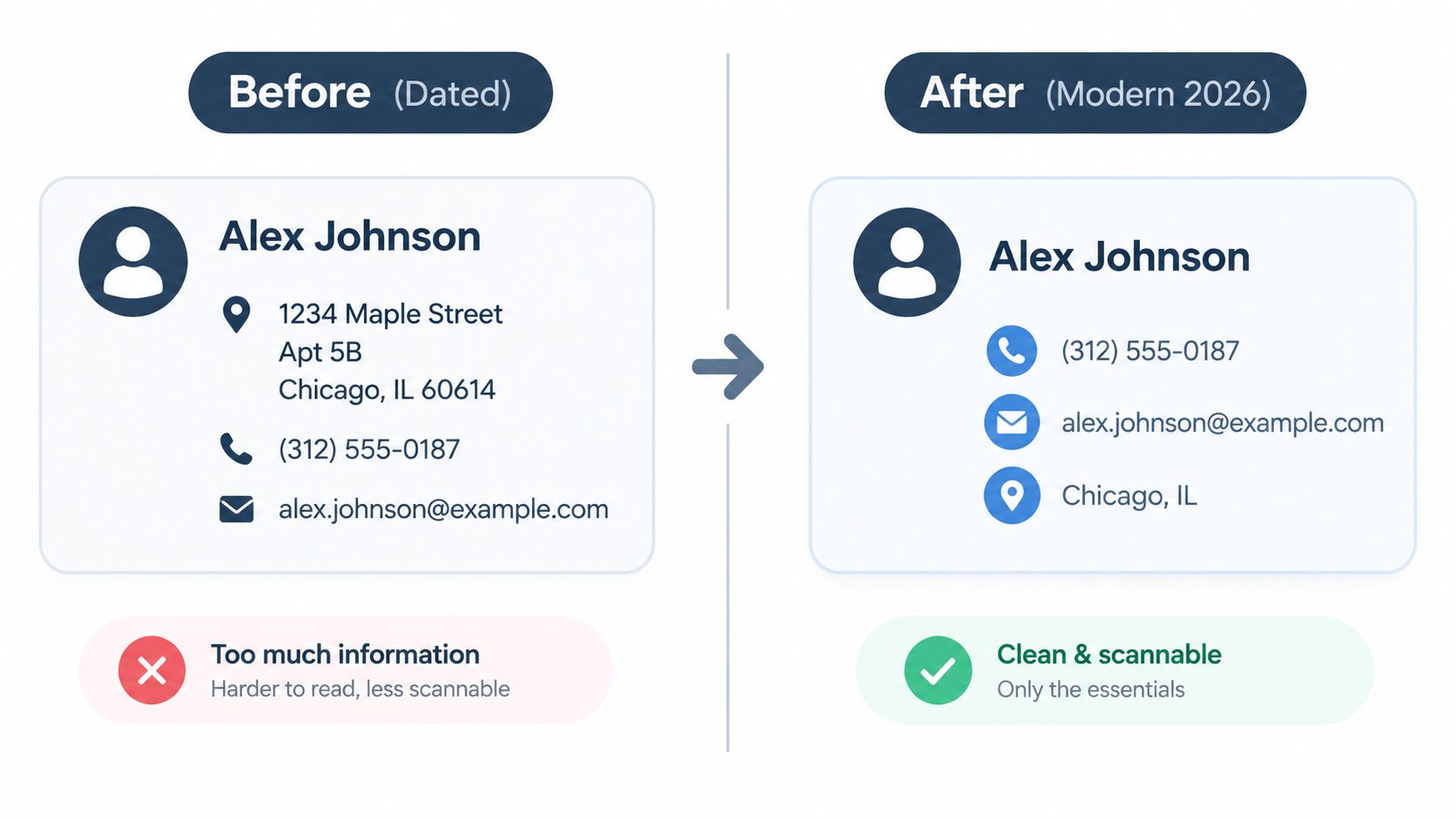
This version gives the recruiter the candidate's name, a reachable phone number, a professional email, a clear location, and one relevant professional profile. It removes the exposed home address, apartment number, ZIP code, and obsolete handle. It also saves four lines, which creates more room for accomplishments and skills elsewhere on the page.
The same principle applies outside the United States. Hiring resources note that city, state, region, or no address at all can be acceptable in many resume formats unless an employer explicitly requests more detail, as discussed in this international resume address guidance.
Use this short video as a visual reminder while you revise your contact block:
Pull up your current resume tonight, cross out the street, apartment, and ZIP code, replace any casual email with a name-matched address, and retest the header before tomorrow's application.
GetTheCall turns a LinkedIn profile or existing resume into an ATS-optimized, job-specific PDF with custom content, professional layouts, and a live role-match score based on the target posting. Visit GetTheCall to clean up your location line and build a focused version for the job you're applying to next.