Accounting Resume Keywords: The Complete 2026 Reference
The accounting resume keywords that actually pass ATS screening — software, compliance, and process terms, plus how to match them to any job listing.

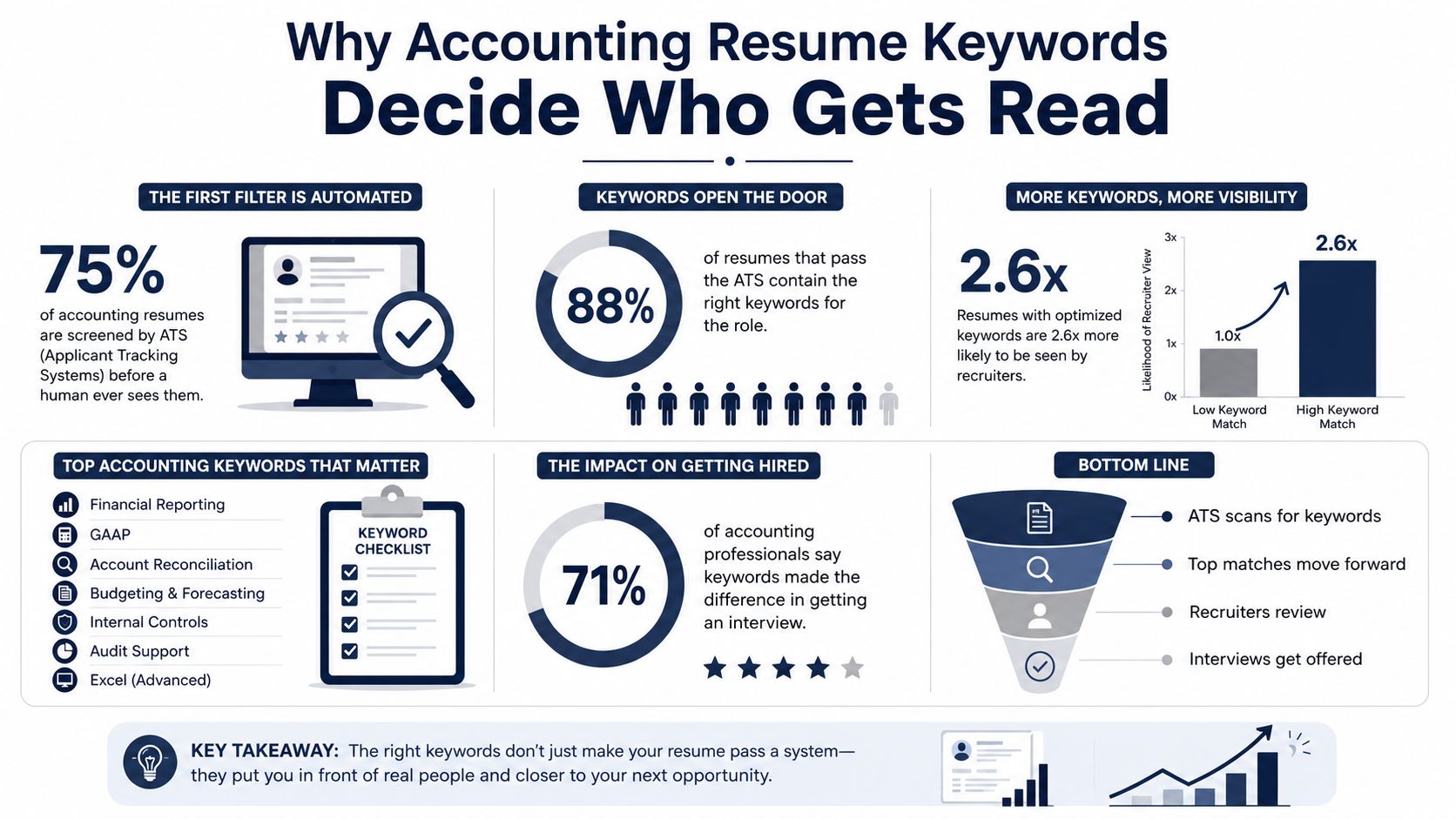
Roughly 75% of resumes are rejected before a human sees them, and 98% of Fortune 500 companies use applicant tracking systems. For accounting roles, exact terms such as GAAP, month-end close, QuickBooks, and SAP are screening signals, not style choices.
That can feel discouraging, but it also gives you a practical advantage. Accounting resumes rely on terminology that employers repeat across job descriptions, from general ledger and bank reconciliation to financial reporting, IFRS, and Excel. When your resume uses the same language as the role, an ATS can identify your relevant experience more easily, and a recruiter can understand your background faster.
The mistake is treating accounting resume keywords as a giant list to paste into a skills section. Strong resumes organize keywords by the work you perform, the systems you've used, the standards you understand, and the accounting specialization you're targeting. They then turn those terms into specific accomplishment bullets that a human can trust.
Table of Contents
- Why Accounting Resume Keywords Decide Who Gets Read
- How ATS Keyword Matching Works for Accountants
- Core Accounting Process Keywords Every Resume Should Show
- Software and Technology Keywords Hiring Systems Search For
- Compliance Standards and Certification Keywords
- Role-Specific Keywords by Accounting Specialization
- Matching Keywords to the Job Listing
- Turning Keywords Into Bullet Points That Survive Human Review
- Quick-Reference Keyword Checklist and Next Steps
Why Accounting Resume Keywords Decide Who Gets Read
A major career-advice source explains that ATS filtering is designed to speed up first-round screening by comparing resume content with employer-provided criteria. An independent ATS statistics roundup reports that 75% of resumes are rejected before a human sees them, while 98% of Fortune 500 companies use applicant tracking systems. Indeed's accounting resume keyword guidance connects that screening reality to the terminology accounting employers commonly expect.
For an accountant, vague language can hide otherwise solid experience. “Managed accounting operations” might sound responsible, but it doesn't tell a screening system whether you handled the general ledger, month-end close, accounts payable, or bank reconciliations. Those exact phrases create a clearer trail between your experience and the job posting.
The foundational vocabulary is remarkably consistent:
- Accounting processes: General ledger, journal entries, month-end close, accounts payable, accounts receivable, and bank reconciliation.
- Reporting language: Financial statements, financial reporting, and variance analysis.
- Standards and controls: GAAP, IFRS, SOX compliance, internal controls, and audit support.
- Technology: Excel, QuickBooks, SAP, Oracle, and NetSuite.
Industry keyword guidance repeatedly groups these terms around close activities, reporting, compliance frameworks, and software names. That makes keyword alignment one of the most measurable parts of an ATS-heavy application process, even though it can't replace sound experience or clear writing.
Practical rule: Use the employer's wording when it accurately describes work you've done. Don't make the recruiter translate “handled books” into “maintained the general ledger.”
Your resume doesn't need every possible accounting term. It needs the right terms, placed where they describe real responsibilities and outcomes.
How ATS Keyword Matching Works for Accountants
An ATS generally converts resume text into searchable information, then compares that information with the skills, duties, tools, and qualifications in a job posting. The system may recognize related language, but exact phrase alignment gives it a much clearer match than broad wording. This ATS keyword matching guide describes why direct terminology matters for accountant resumes.
Consider these two versions:
Vague version
Managed accounting operations and assisted with monthly reporting.
Stronger version
Prepared journal entries, supported the month-end close, maintained the general ledger, and completed bank reconciliations for monthly reporting.
The second bullet gives both the ATS and the recruiter useful information. It names the process, the accounting area, and the work performed. It also creates several legitimate matching points if the posting asks for month-end close, general ledger maintenance, journal entries, or reconciliations.
Treat tailoring as translation
Keyword alignment isn't a trick. It's a translation task. You start with your verified experience, identify what the employer calls that work, and use the employer's exact phrase where it fits naturally.
For example, you might have written “reviewed customer balances and applied incoming payments.” If the target posting uses accounts receivable and cash applications, revise the bullet to name those functions, but only if they accurately describe your work.
A useful sequence is:
- Read the job description for responsibilities, systems, and standards.
- Mark phrases that describe work you've performed.
- Replace vague wording with the exact accounting terminology used in the posting.
- Add the term to an experience bullet, not just a keyword list, whenever possible.
- Remove any keyword you couldn't explain in an interview.
For formatting and parser considerations, compare your document with this ATS-friendly resume guide. Plain text, familiar section headings, and readable bullets help your terminology remain visible to both software and people.
Core Accounting Process Keywords Every Resume Should Show
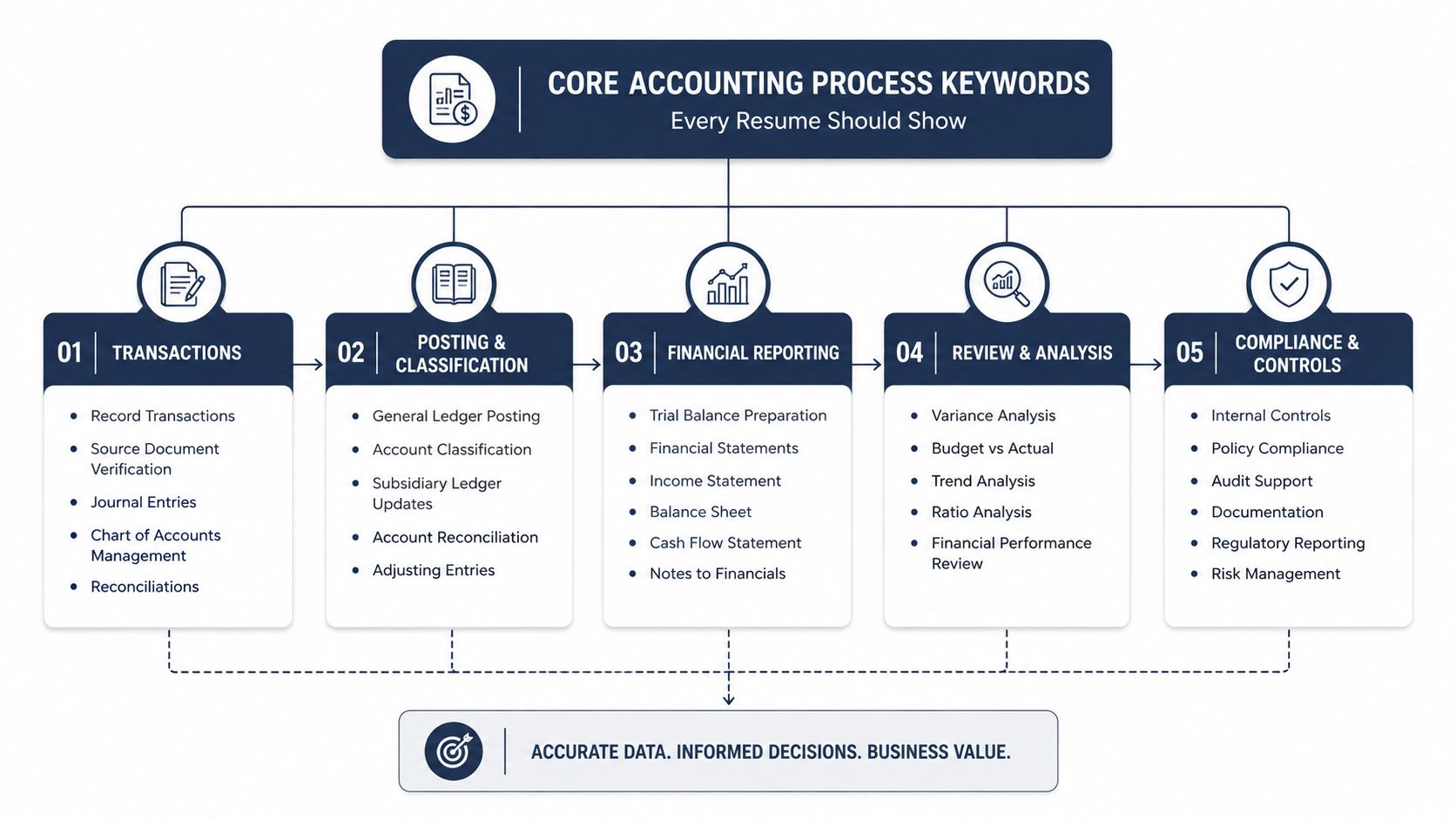
Core process terms describe the work behind staff, senior, general ledger, and corporate accounting roles. Use them as clusters rather than a pasted keyword list. The main groups are month-end close, general ledger, journal entries, reconciliations, accounts payable, accounts receivable, and financial reporting. Your target role determines which group deserves the most space.
Close and ledger work
Month-end close shows that you understand the recurring cycle for finalizing a period's accounting activity. Pair it with the responsibilities you owned, such as journal entries, accruals, account reconciliations, trial balance support, or financial statement preparation.
Prepared recurring journal entries, reviewed accruals, and supported the month-end close by reconciling balance sheet accounts and resolving variances.
General ledger gives more information than “maintained accounting records.” It identifies work with the central record of an organization's financial transactions. If you performed reclassifications, posted entries, reviewed account activity, or supported trial balance preparation, name those tasks.
Maintained the general ledger, posted adjusting entries, and completed account reconciliations before monthly financial reporting.
Journal entries may be recurring, adjusting, accrual, reversing, or manual. Choose the narrowest accurate term. “Prepared journal entries for accruals and prepaid expenses” identifies the accounting activity more clearly than “processed transactions.”
Reconciliations and transaction processing
Account reconciliations and bank reconciliation show accuracy work and exception review. Add the action behind the term, such as investigating differences, documenting support, or escalating unresolved items.
Accounts payable can include invoice processing, vendor records, payment runs, and approval workflows. Accounts receivable can include customer invoicing, cash applications, aging review, collections support, disputes, and adjustments. A bullet that names the task gives both the ATS and the recruiter more useful evidence than either acronym alone.
Use financial statements and financial reporting when you prepared, reviewed, or supported reporting deliverables. Add variance analysis when you compared actual results with expectations and investigated the reasons for differences.
Build a role-specific baseline
Review these process families, then prioritize the cluster that matches the job:
- Close: Month-end close, period-end close, journal entries, accruals, and trial balance support.
- Ledger: General ledger, reclassifications, account reconciliations, and balance sheet accounts.
- Transactions: Accounts payable, accounts receivable, invoice processing, and cash applications.
- Reporting: Financial statements, financial reporting, variance analysis, and reporting packages.
A staff accountant may emphasize close and reconciliations. A revenue accountant may give more space to receivables and reporting. An FP&A candidate should connect reporting terms to analysis, while a controller-track candidate should show ownership, review, and process scope. The terms stay familiar, but your level comes from the responsibility, complexity, and outcome attached to each one.
Software and Technology Keywords Hiring Systems Search For
Software names function as distinct keyword signals. “Accounting software” is a broad category, while QuickBooks, SAP, Oracle, NetSuite, and Xero identify specific platforms. Accountant resume guidance from ATS Pass specifically recommends naming the product used in the job posting when you have genuine experience with it.
Name the system you actually used
If you used SAP, write SAP, not only “ERP.” If your experience was with NetSuite, include NetSuite rather than relying on “cloud accounting platform.” You can still include the broader category, but the product name gives the employer's search a direct match.
Place software terms in three locations:
- Skills section: List the platform and relevant functions, such as SAP reporting or NetSuite reconciliations.
- Summary: Mention the most relevant tool when it supports your target role.
- Experience bullets: Show what you did with the system.
Used QuickBooks to record transactions, support bank reconciliations, and prepare reporting schedules for review.
That bullet is more credible than a software dump because it connects the product to accounting work.
Handle adjacent systems honestly
Experience with one ERP doesn't mean you should claim another. If a posting asks for Oracle and you used SAP, name SAP and describe the transferable work, such as general ledger maintenance, reconciliations, reporting, or close support. You can write “ERP experience with SAP” rather than implying Oracle proficiency.
For Excel, be specific without overstating your level. If you used pivot tables, XLOOKUP, VLOOKUP, SUMIFS, templates, or spreadsheet-based reporting, name the features you can discuss confidently. “Excel” is useful, but “Excel for variance analysis and reporting schedules” explains how you applied it.
The principle is simple: match exact product names only where your experience supports them. A missing keyword may cost a match, but an unsupported system claim can damage trust during an interview.
Compliance Standards and Certification Keywords
Compliance terms show how you protect accuracy, meet reporting requirements, and work within control procedures. Build this cluster around GAAP, IFRS, SOX compliance, internal controls, audit support, and tax preparation, choosing only standards that match the employer and your experience.
Treat each keyword like a label on a workpaper. The label helps an ATS find the term, while the supporting detail lets a recruiter verify it. For example:
Prepared financial reporting schedules in accordance with GAAP, supported account reconciliations, and assembled documentation for external audit review.
Place SOX compliance beside the control work you performed, such as documenting controls, supporting testing, preparing evidence, or helping address remediation items. IFRS is more relevant for international reporting or employers that use that framework. Do not list both standards to fill a skills section. A standard has value when you can explain how it guided a decision, review, or deliverable.
Certifications form a separate standards-level cluster. CPA, ACCA, and CMA are common search terms in accounting recruitment, so include the credential when it reflects your background. Spell out the name on first use when space allows, followed by the acronym, such as Certified Public Accountant (CPA) or Association of Chartered Certified Accountants (ACCA).
Use status language that a recruiter can understand quickly:
- Certified Public Accountant (CPA): List this when you hold the credential.
- CPA candidate or exam progress: State your current status precisely.
- CMA or ACCA: Include the credential or progress only when accurate.
- Tax preparation: Use it when you prepared returns, schedules, workpapers, or related documentation.
Role-specific standards such as ASC 606 for revenue recognition and ASC 842 for lease accounting can distinguish a candidate. Add them only when you can connect the standard to actual work, such as contract reviews, deferred revenue schedules, lease calculations, or related disclosures.
Role-Specific Keywords by Accounting Specialization
A broad accounting resume can pass a basic screen, but specialization keywords help a recruiter understand where you fit. The right choice depends on the role, not on how many terms you can squeeze into a document.
| Target Role | Core Keywords to Prioritize | Differentiators |
|---|---|---|
| Staff accountant | General ledger, journal entries, month-end close, account reconciliations, financial reporting, AP/AR | Bank reconciliation, GAAP, audit support, QuickBooks, Excel, NetSuite |
| Revenue accountant | Financial reporting, reconciliations, journal entries, close activities | ASC 606, revenue recognition, contract accounting, deferred revenue |
| FP&A analyst | Financial analysis, variance analysis, budgeting, forecasting, reporting | Budget-versus-actual analysis, management reporting, financial modeling |
| Controller-track candidate | Month-end close, financial statements, internal controls, audit support | Multi-entity accounting, intercompany reconciliation, SOX compliance, controls ownership |
| Systems-focused accountant | General ledger, reconciliations, reporting, close process | BlackLine, Workiva, SAP FICO, Oracle Financials, NetSuite ARM |
Prioritize the cluster that matches your destination
A staff accountant usually needs a strong close-and-reconciliation foundation. A revenue accountant should make ASC 606 and revenue recognition visible when they reflect actual work. An FP&A analyst needs forward-looking language such as budgeting, forecasting, and variance analysis, rather than relying only on historical ledger terms.
Controller-track candidates should show broader ownership. Multi-entity accounting, intercompany reconciliation, internal controls, audit support, and reporting leadership communicate a wider operating scope. System-level terms such as BlackLine, Workiva, SAP FICO, Oracle Financials, and NetSuite ARM can distinguish candidates when those systems appear in the posting and the candidate has used them.
Limited resume space makes prioritization necessary. Start with required terms that describe your actual experience, then add preferred differentiators that are both relevant and defensible. You don't need every system listed in a job advertisement.
For a company-specific application, compare your wording with this Deloitte resume guidance, then keep the final version grounded in your own work history.
Matching Keywords to the Job Listing
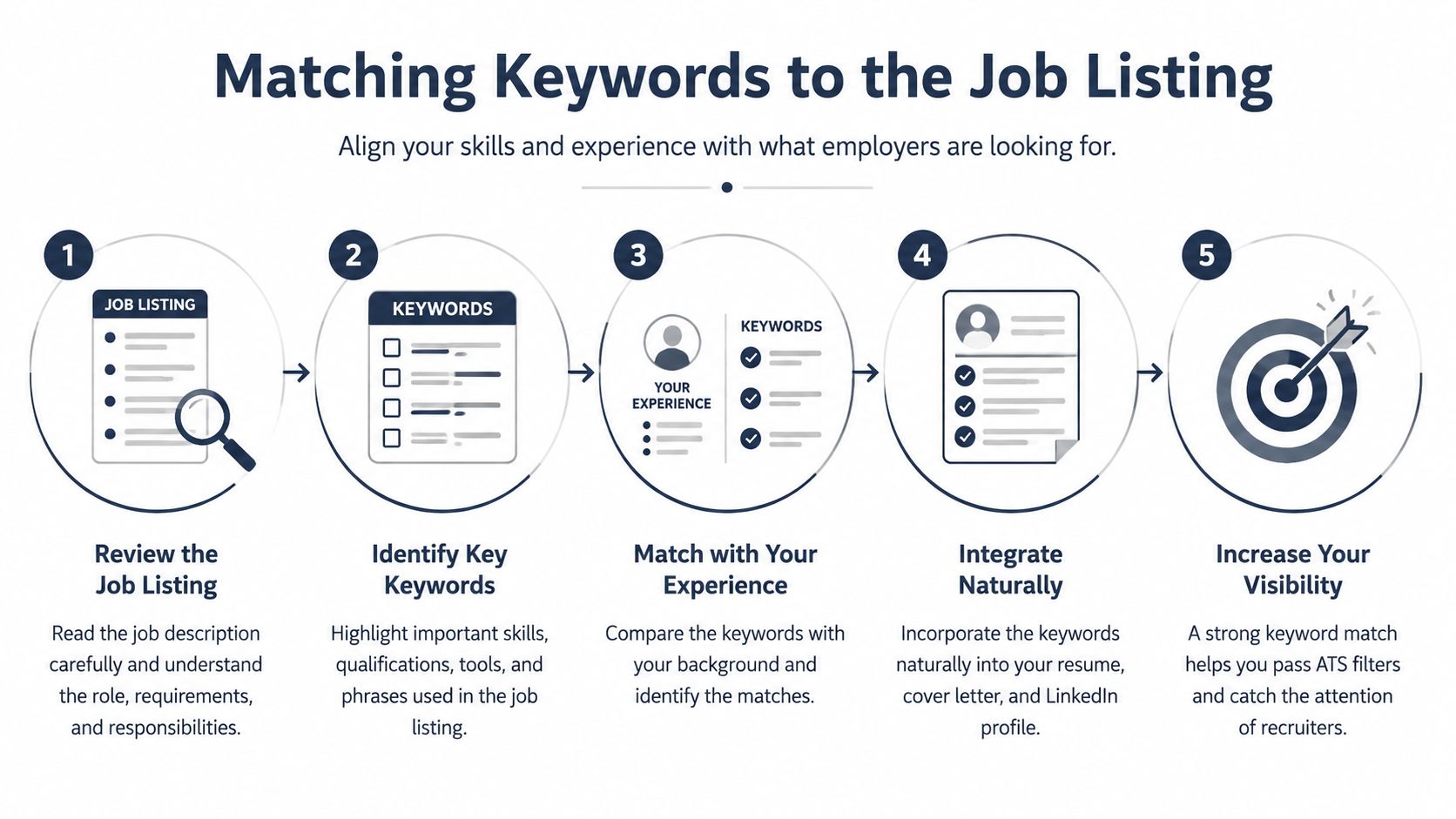
Tailoring works best as a repeatable mapping exercise rather than an attempt to rewrite your entire resume for every application. Start with the target posting and divide its language into four groups: responsibilities, tools, standards, and qualifications.
Use a four-pass reading method
First pass, identify the role. Note whether the posting is centered on close, revenue, FP&A, AP/AR, audit, or controllership. The job title alone doesn't tell you enough, so read the responsibilities.
Second pass, mark repeated language. Highlight phrases such as month-end close, general ledger, financial reporting, variance analysis, SAP, or internal controls when they appear in the description. Repetition indicates what the employer expects to see clearly.
Third pass, separate required from preferred. Required qualifications deserve priority if they match your background. Preferred terms can strengthen the resume, but they shouldn't displace core evidence or lead you to claim experience you don't have.
Fourth pass, map every selected phrase to proof. Create a simple working table:
| Job listing phrase | Your verified evidence | Resume location |
|---|---|---|
| Month-end close | Prepared entries and reconciled accounts | Experience bullet |
| SAP | Used SAP for reporting and ledger review | Skills and experience |
| Internal controls | Prepared control documentation | Experience bullet |
| Forecasting | Supported planning reports | Summary or experience |
Career switchers, recent graduates, and return-to-work candidates can use the same method. A budgeting project, finance internship, bookkeeping assignment, operational reconciliation, or reporting responsibility may support accounting language, but the wording must remain honest. Don't turn exposure into ownership or familiarity into expertise.
A practical tailoring workflow is also covered in this guide to tailoring a resume to a job description. It reinforces the central rule: borrow the employer's terminology, but connect every selected phrase to experience you can explain.
Turning Keywords Into Bullet Points That Survive Human Review
A keyword by itself proves very little. A strong bullet shows the accounting process, the scope of the work, and the result. When available, use credible measures such as DSO, budget variance, audit findings, material weakness, or cost reduction. Only include a metric you can verify and explain.
Start with the weak version:
Responsible for reconciliations.
Make the process visible:
Completed account reconciliations and investigated differences during the month-end close.
Then add scale or outcome if you have reliable information:
Completed account reconciliations for assigned balance sheet accounts during the month-end close, documented outstanding items, and supported timely resolution of variances.
The final version is still useful without an invented number. If you know the actual number of accounts, reporting cycle, audit findings, DSO movement, or budget variance, add it accurately.
A simple bullet formula
Use this structure:
Action + exact keyword + scope or method + verified outcome
Examples:
- Prepared journal entries for accruals and reclassifications, supporting the month-end close and improving the completeness of reporting documentation.
- Performed bank reconciliations and investigated unmatched transactions, escalating exceptions for resolution.
- Built variance analysis in Excel to explain actual results against budget and support management reporting.
- Supported SOX compliance by maintaining control documentation and organizing evidence for review.
- Managed accounts receivable activity, including cash applications, aging review, and customer account follow-up.
These examples avoid unsupported metrics while still showing what the work involved. If you have a real outcome, make it specific. For example, a bullet can mention an actual DSO result, a documented budget variance, a confirmed reduction in audit findings, or a verified cost reduction.
Avoid keyword stuffing
Keyword stuffing is counterproductive. A skills section filled with GAAP, IFRS, SAP, Oracle, NetSuite, BlackLine, ASC 606, and SOX doesn't establish proficiency, especially if the experience section never shows how you used those terms.
Use the strongest keywords more than once only when the repetition is natural. Put a term in the summary or skills section, then place the most important ones in bullets that demonstrate actual work. Human reviewers want a coherent accounting story, not a vocabulary test.
Career switchers can frame transferable work carefully. “Reviewed financial data and reconciled records in Excel” is stronger and safer than claiming ownership of a full close cycle when that never happened. Accuracy builds credibility.
Quick-Reference Keyword Checklist and Next Steps
Before submitting an accounting resume, run a focused review. The process should confirm that your document matches the target role without turning into a generic keyword inventory.
The resume check
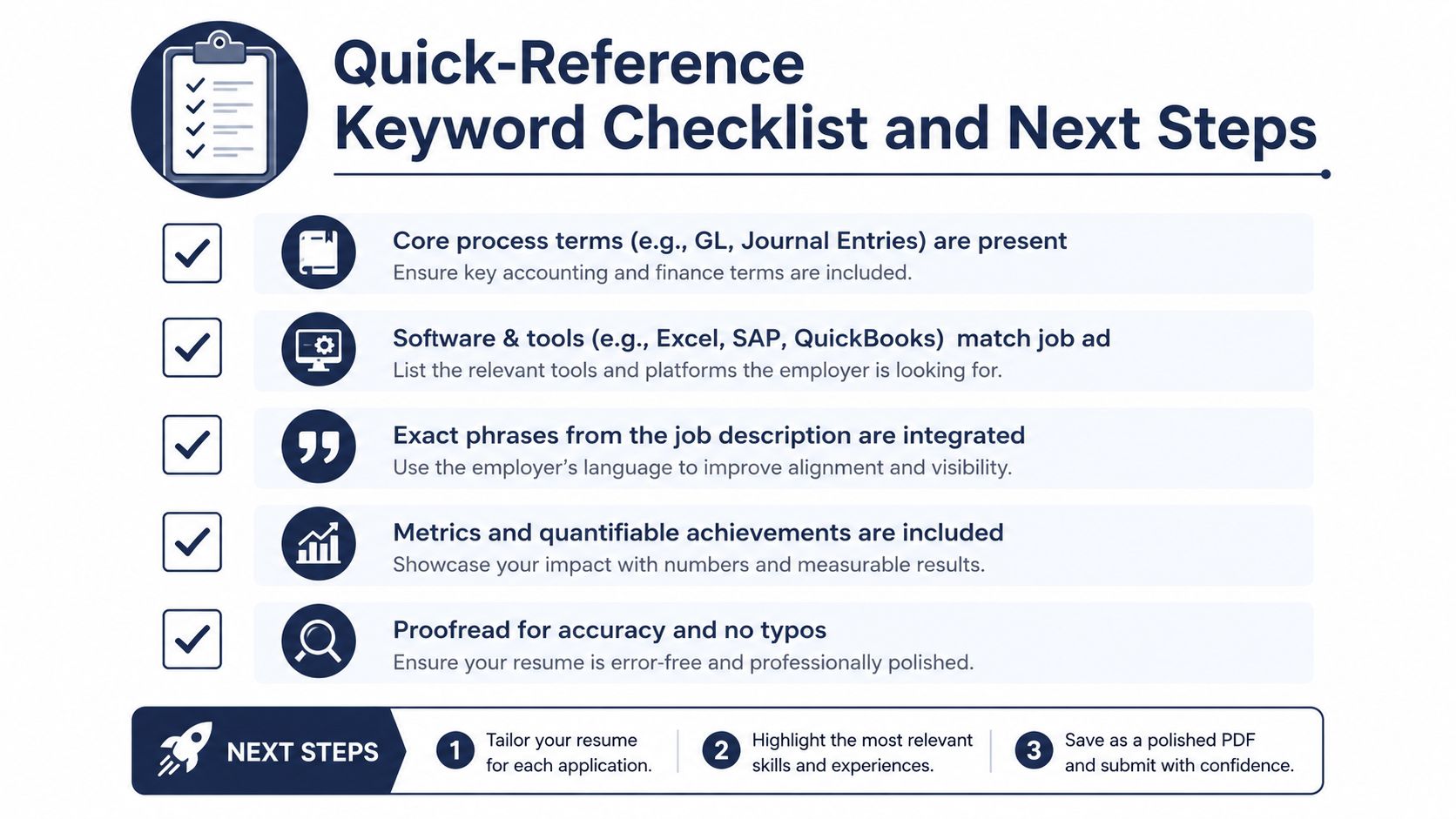
- Core processes: Confirm that relevant terms such as general ledger, journal entries, month-end close, reconciliations, financial statements, AP, and AR appear where your experience supports them.
- Exact software: Name the actual products you've used, such as Excel, QuickBooks, SAP, Oracle, NetSuite, or Xero.
- Standards and controls: Include GAAP, IFRS, SOX compliance, internal controls, audit support, or tax preparation only when relevant.
- Role differentiators: Select terms for your destination, such as ASC 606 for revenue accounting, budgeting and forecasting for FP&A, or multi-entity accounting for controller-track work.
- Evidence in bullets: Make sure priority keywords appear in accomplishment bullets, not only in a skills block.
- Verified metrics: Add real measures involving DSO, budget variance, audit findings, material weakness, or cost reduction when you can substantiate them.
- Plain-text readability: Keep headings familiar, formatting clean, and important phrases easy for an ATS and recruiter to find.
- Final accuracy: Remove unsupported systems, standards, credentials, and claims before applying.
The most useful routine is to repeat this check for each target posting. A static resume may contain good accounting language, but a resume customized for the role gives priority to the terms that matter for that specific posting.
GetTheCall can import a LinkedIn profile or existing resume, parse a job listing's skills and keywords, and provide a live match score while you edit. If you want to check your accounting resume against a real posting before applying, visit GetTheCall and use the job-specific tailoring workflow to align your verified experience with the employer's language.